
Can I Joke with Attendings on Rounds? A Practical Yes-or-No Guide
What actually happens if you crack a joke on rounds and it does not land—do you just look awkward, or can it quietly kill your eval?
Let me give you the blunt answer first, then the nuance.
You can joke with attendings on rounds. But not with all of them. And not in every setting. And not with any kind of joke you want.
Think of joking on rounds like giving IV contrast: it can really improve the picture, but used on the wrong patient, at the wrong time, you cause damage.
This is your practical yes-or-no guide.
The Core Rule: Who Sets the Tone?
Your humor threshold is not about how funny you are. It’s about how the attending runs the team.
There’s a simple hierarchy of who sets the tone on rounds:
- Attending
- Senior resident
- Then you
If the attending is all business and the senior is also all business, you do not get to be the fun one. That’s how people get tagged as “unprofessional,” “doesn’t read the room,” or “not serious enough.”
Step 1: Read the Attending in 24 Hours
In the first day, you should be in observation mode. You’re not auditioning for a Netflix special.
Watch for:
- Do they ever smile or laugh?
- Do they make any jokes themselves (even dry ones)?
- How do they respond when others joke—lean in or shut it down?
- What’s their reaction when the team is a bit loose vs. serious?
If after one full round you’ve seen zero humor and very tight body language, your answer for now is: No, do not joke. At least not on rounds.
If they joke a bit, smirk, or add a funny aside and people laugh and they don’t look annoyed, your answer is: Yes, but stay mild and clean.
The Yes-or-No Matrix: Quick Reference
Here’s a brutally practical summary.
| Situation | Joke? (Yes/No) |
|---|---|
| New attending, first day, serious | No |
| Attending makes small jokes first | Yes (light) |
| Family in room, bad news pending | No |
| Stable patient, light conversation | Maybe (soft) |
| ICU code, rapid response, crisis | No |
| Post-rounds, in workroom, relaxed | Yes (safer) |
Use this as default. If you’re going to violate it, you’d better have a pretty clear read on the people in the room.
What Kind of Humor Is Actually Safe?
Here’s where people screw this up. They think “no dark humor” is enough. It’s not. There are a bunch of categories that are basically radioactive for students and junior residents.
Things to avoid (as in, 100%):
- Anything about patients, their conditions, or their choices
- Anything sexual, romantic, or even “lightly flirty”
- Anything about race, gender, religion, politics, weight, or appearance
- Jokes at the expense of nurses, consultants, or other specialties
- Self-deprecating jokes that imply incompetence (“Guess we’re both hoping I don’t kill anyone today!”)
If you want a yes/no litmus test: if this joke could be even slightly misquoted in an eval comment and sound bad, skip it.
Safer humor zones:
- Light self-deprecation about benign things: “My handwriting is a war crime.”
- Process humor: “His med list is longer than my to-do list.”
- Shared struggle humor about training: “I remember when I thought I’d understand all of heme/onc in one week.”
- Harmless wordplay or observational humor unrelated to patients
Notice a pattern: safe humor is:
- Short
- Gentle
- Not punching down
- Not about patients directly
Timing: When Humor Helps vs. Hurts
Same joke. Different setting. Totally different consequences.
Bad Times to Joke (Answer: No)
- On the first presentation of a new, sick patient
- Right after someone delivers bad news
- During family meetings, palliative discussions, or end-of-life rounds
- During codes, rapid responses, or tense handoffs
- When the attending is visibly irritated, behind schedule, or chewing someone out
- During pimping when someone else is clearly struggling or embarrassed
In those settings, you’re not “lightening the mood.” You’re telling everyone you don’t understand gravity.
Better Times to Joke (Answer: Possibly Yes)
- Walking between rooms during long rounds
- At the very end of rounds when the attending has clearly relaxed
- In the workroom after patients are seen and there’s a lull
- At the end of the day sign-out (if the culture allows it)
Even there, start small. Two sentences, max. If it lands, you’ll see it. If it doesn’t, don’t repeat it.
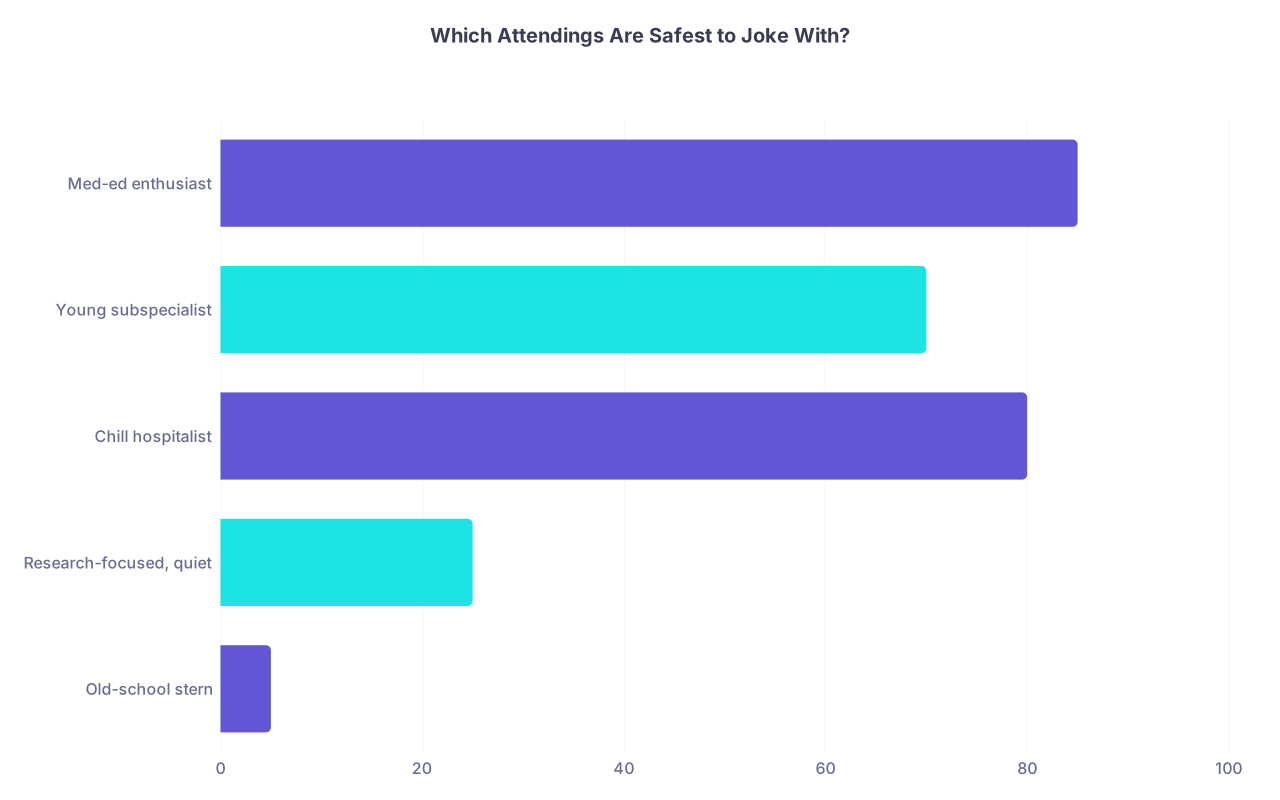
Attending Archetypes: Match Your Approach
You’ll meet some patterns over and over. Here’s how I’d handle each.
| Category | Value |
|---|---|
| Old-school stern | 5 |
| Research-focused, quiet | 25 |
| Chill hospitalist | 80 |
| Young subspecialist | 70 |
| Med-ed enthusiast | 85 |
The numbers here are “approximate % chance humor is welcome if it’s mild and well-timed.”
The Old-School Stern Attending
Classic line: “We’re here to work, not socialize.”
Answer: No jokes on rounds. Maybe the tiniest smile in the workroom if they start it, but generally: respect their style. Your humor won’t help your eval, and it might hurt.
The Research-Focused, Quiet Attending
Reserved. Loves data. Minimal small talk.
Answer: Mostly no. But you can occasionally offer nerdy, content-related dry comments. Example: “I thought I’d understood JAK inhibitors until I tried to explain them to a patient.” That’s about as far as I’d go.
The Chill Hospitalist / Med-Ed Attending
They introduce themselves by first name. Ask about your interests. Occasionally roast themselves.
Answer: Yes, with guardrails. These are the ones you can build rapport with using light, observational humor and training-struggle jokes. You still stay away from anything patient-related.
The Young Subspecialist Who Jokes a Lot
They’re witty, they reference memes, they laugh with the team.
Answer: Yes, but do not try to match their level. Let them be the funnier one. Drop occasional, low-key comments. The temptation to be “on” is what gets people in trouble here.
How to Test the Waters Without Wrecking Your Eval
There’s a simple three-step ramp-up.
1. Start with Smiles and Micro-Reactions
In the beginning, show you get humor before you make humor.
If they say something lightly funny, you can respond with:
- A quick smile or quiet laugh
- A short validating remark: “That’s so true.”
- A tiny follow-up that isn’t really a joke, just acknowledgment: “Story of my intern year.”
If they seem to enjoy that, you’re safe to move one level up.
2. Make Yourself the Target (But Not Your Competence)
Self-deprecation is safer than punching at others—if it doesn’t undermine their faith in you.
Good:
- “My brain buffer overflowed at slide 12 of that path report.”
- “I thought I understood sodium once. That was a good five minutes.”
Bad:
- “I have no idea what I’m doing.”
- “I’m probably missing half the patients’ problems.”
You don’t want your evaluator thinking, “Yeah… I actually kind of believe that.”
3. Watch for Feedback in Real Time
You need to be brutally honest with yourself here.
Signs your joke landed:
- Attending smiles or laughs
- They keep eye contact and maybe build on it
- The senior resident looks relaxed, not guarded
Signs your joke did not land:
- Tight half-smile, immediate pivot back to business
- No reaction at all, awkward silence
- Senior/residents look mildly horrified, glance at attending
If it doesn’t land: do not apologize profusely, do not justify it, do not repeat it. Just move on and quietly dial it way down from that point on.
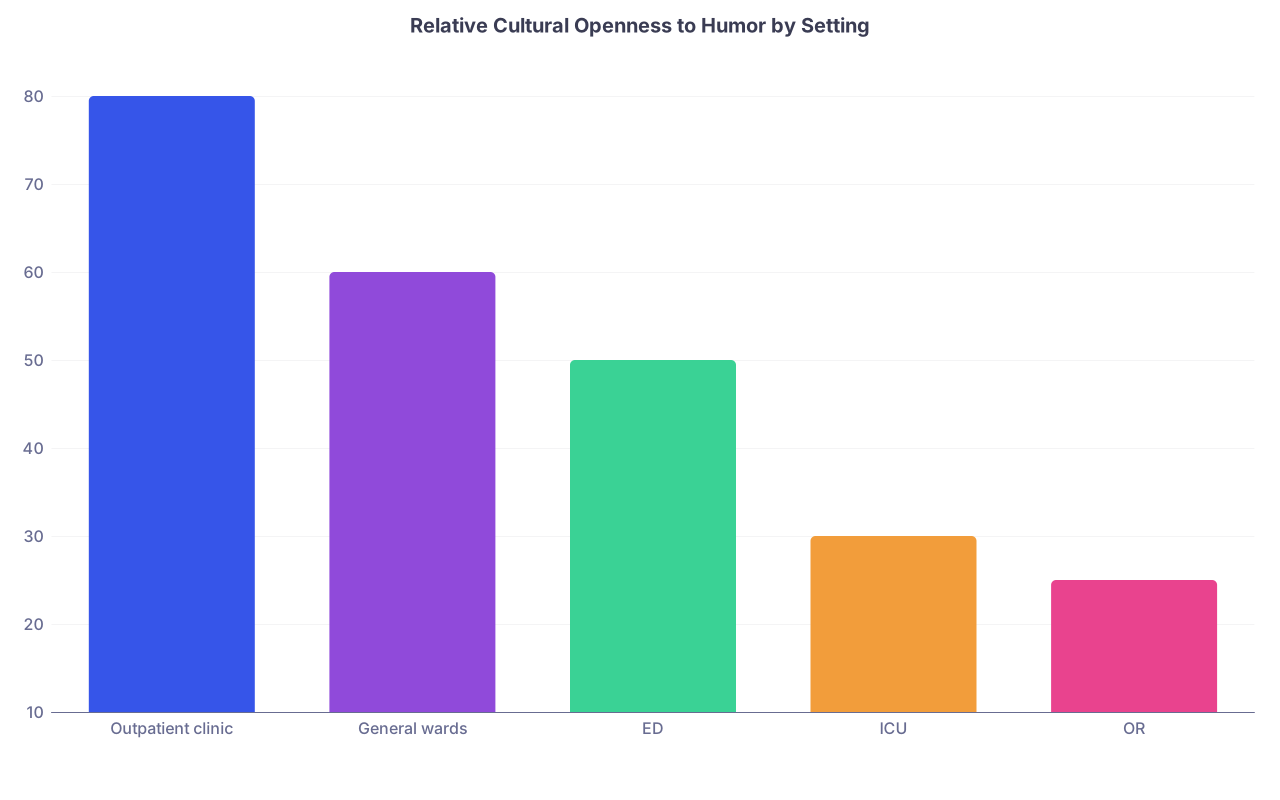
Specialty and Setting: Does It Matter?
Yes. Massively.
| Category | Value |
|---|---|
| Outpatient clinic | 80 |
| General wards | 60 |
| ED | 50 |
| ICU | 30 |
| OR | 25 |
Higher number = more likely casual humor is accepted when used appropriately.
General trend:
- Outpatient clinic / continuity clinic → usually more conversational, more space for light humor.
- Wards / hospitalist teams → mixed, heavily attending-dependent.
- ED → gallows humor exists, but as a student, you should never be the source of it.
- ICU / OR → more task-focused, more hierarchy, less margin for joking.
As a learner, assume your “humor budget” gets smaller as acuity and hierarchy go up.
What If the Attending Jokes About Patients?
It happens. You’ll see dark humor, sarcasm, and some things that make you quietly uncomfortable.
Two rules:
- You don’t have to match their style to be liked.
- You definitely shouldn’t “one-up” them or push it further.
If an attending makes a slightly edgy joke about a case, the safest response is a small, non-committal smile, then pivot back to the medicine.
If it crosses your line ethically, you’re not obligated to laugh. Neutral face, no performance, then move on. Your job is not to be the attending’s comedian-in-training.
How Humor Can Actually Help You (When Done Right)
Used correctly, your sense of humor can make you:
- More memorable (in a good way)
- Easier to work with during long rotations
- A perceived “good fit” for team-based specialties
I’ve seen evals say:
“Great sense of humor, kept the team positive during long days while staying professional.”
Notice the second half of that sentence. That part matters more than the first.
Humor that:
- Eases tension after a stressful moment
- Humanizes you without undercutting your competence
- Builds team cohesion without mocking anyone
…is a net positive. There just isn’t a lot of room for error early in training, so you move slowly.
If You’re Naturally Funny (or Naturally Not)
If you’re naturally quiet and not a “jokey” person: you’re fine. You won’t be penalized for not being funny. Most “unprofessional” comments come from people trying to be funny and misreading the room.
If you’re the funny friend, class clown, improv person: you’re the one at highest risk. Because your baseline feels normal to you, but it’s probably too high for the power dynamics of medicine. On rotations, your goal is to run at 30–40% of your usual joke output.
You’re not suppressing your personality. You’re adapting it to the setting.
The Bottom Line Answer
Can you joke with attendings on rounds?
Yes, if:
- They’ve clearly shown they joke first
- The moment is low-stakes and not patient-facing in a serious way
- Your humor is clean, light, and not about patients or competence
No, if:
- You’re unsure of their style
- The situation is emotionally heavy, critical, or tense
- You’re reaching for a joke to fill silence or impress someone
When in doubt, err on the side of being slightly too serious early on. You can always open up later. You can’t un-say the joke that made the room go quiet.
FAQ: Joking With Attendings on Rounds
1. Is it okay to joke with attendings in front of patients?
Usually no. In front of patients, you’re on stage as professionals. Light, supportive warmth is fine—like smiling or a very gentle, non-medical comment (“He’s been putting up with all our questions like a champ”). Anything that risks being misinterpreted by the patient or family as dismissive, casual, or mocking is off-limits. Save humor for outside the room unless you’re mirroring the attending’s very clear, very gentle tone.
2. Can I use dark humor with attendings if they do it first?
You shouldn’t. Even if they do. You don’t have their reputation, power, or history at that institution. Dark humor lands very differently from a department chair than from a third-year student with a thin eval file. Nod, don’t escalate, and pivot back to medicine. Protect your professional record and your own boundaries.
3. What if my attending seems offended by a joke I made?
Do not make a second joke trying to fix the first one. Briefly acknowledge if it was clearly inappropriate (“Sorry—that was poorly timed”), then switch back to clinical content and keep it strictly professional the rest of the rotation. Over-apologizing or bringing it up multiple times just cements the memory. The best repair is steady, serious, high-quality work afterward.
4. Is it unprofessional if I never joke or laugh at all?
No. You will not fail a rotation for being earnest. Plenty of excellent residents and attendings are low-key, calm, and not outwardly funny. As long as you are kind, engaged, and not visibly annoyed by others’ appropriate humor, your lack of joking won’t count against you. You’re evaluated on reliability, knowledge, and teamwork, not stand-up skills.
5. How do I handle a resident who constantly makes edgy jokes and expects me to join in?
You can respond with neutral or very light reactions: a small smile, a non-committal “yeah,” then change the subject or ask a clinical question. You do not need to match their tone. If they push you to contribute, you can deflect with something like, “I’m not very good at jokes on the spot—I’ll stick to writing notes.” That signals a boundary without accusing them of anything.
6. Can humor ever actually hurt my grade or evaluation?
Yes. Comments like “unprofessional at times,” “too casual,” or “did not always read the room” often come from poorly timed or inappropriate humor. Even a single badly placed joke, especially in a family meeting, serious conversation, or in front of nursing staff, can stick in someone’s memory. That doesn’t mean you must be humorless, but it does mean joking is not risk-free. Treat it like any other high-yield, high-risk intervention: you use it deliberately, not reflexively.
Open the notes app on your phone and write one line: “My default on new rotations is 0 jokes for 24 hours.” Treat that as your baseline starting tomorrow, and let the attending’s style earn each level of humor you add after that.