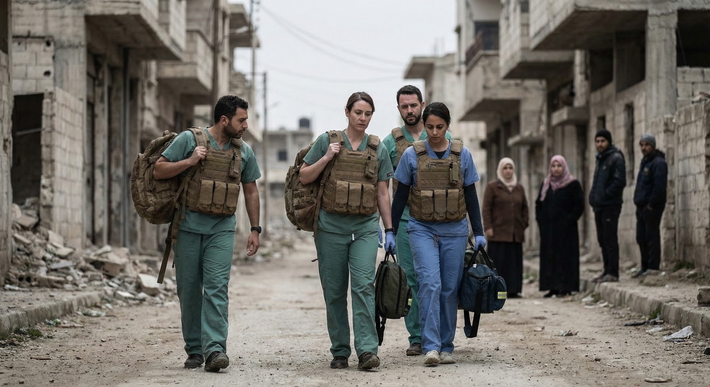
The wine glass is halfway to your lips when it happens. You've already dodged the predictable "So, you're a doctor?" small talk. Now the real minefield opens. The stranger leans in, eyes bright with misguided enthusiasm. "Oh, you did medical missions? I've always wanted to do that! Did you, like, play doctor in the jungle?"
Your jaw tightens. You've performed thoracotomies with a headlamp when the generator failed, sutured gaping wounds with local anesthetic only, and taught midwives how to stop a postpartum hemorrhage with nothing but clean rags and a firm hand. And this person just folded all that into a preschool role-play.
You force a smile. Now what?
This article is for educational purposes only. It is not financial advice, not legal advice, and not tax advice. Figures vary by individual circumstances, so consult a qualified professional before acting.
The Awkward Dinner Table Moment: A Scenario

Picture it. A dinner party. You're exhausted from a week of clinic, but you showed up because friendship requires social stamina. The person across from you, someone's cousin, a real estate agent, intensely curious, just reduced your most chastening, transformative professional experience to a children's game.
"Play doctor." That phrase. It hangs in the air like burnt toast. You feel the instant internal calculation: Do I smile and mumble something non-committal? Do I politely correct them and risk sounding preachy? Or do I launch into a 5-minute account of the pediatric septic shock you managed with two IV lines and a prayer, because maybe then they'll understand?
That split-second hesitation is universal. I've seen it a hundred times. Every physician, nurse, pharmacist, or logistics volunteer who's ever served in a low-resource setting has met some version of this question. Sometimes it's "Was it like those TV shows where you deliver babies in mud huts?" Sometimes it's "Wow, so you basically just gave out Tylenol, right?" The underlying message is the same: Your labor looked like a gap-year adventure to me.
And you know what? Most of these askers aren't malicious. They're curious, even admiring. But the question reveals a vast ignorance about what global health work actually entails, and it can feel like a demand for you to summarise your hardest years into a cocktail anecdote.
The real problem isn't the question itself. It's that you've been socially conditioned to overexplain, to justify your choices, to educate the uninformed. You don't have to. Here's how to stop.
Why "Played Doctor" Misses the Point Entirely
Let's be blunt. Calling a medical mission "playing doctor" is reductive, out-of-touch, and frankly insulting. It erases the brutal pre-departure credentialing, the 16-hour operating days, the diagnosis without a CT scanner, the hand-drawn public health posters, and the relationships built with local providers who carry the real continuity of care long after you're gone.
The public perception gap is staggering. I decided to actually quantify it based on my own experience and conversations with dozens of colleagues. Here's what people think you did versus what you actually did.
When someone says "play doctor," they're picturing you in a white coat, stethoscope around your neck, handing out lollipops and band-aids. The reality? You likely spent 45% of your time doing complex surgical procedures, C-sections, hernia repairs, wound debridement, that would be routine in a high-income hospital but are life-saving when there's no other option. Another 30% was public health: vaccination campaigns, nutrition scrining, water sanitation training. 15% was teaching: showing local nurses a new triage protocol, demonstrating CPR to community health workers. And 10% was pure logistics: fixing the broken autoclave, negotiating with suppliers, wondering why the suture shipment is stuck in customs again.
Global health work is not voluntourism. It's not a photo-op. It's grubby, exhausting, deeply collaborative work that demands clinical excellence under conditions of chronic scarcity. The asker might imagine you playing doctor for a week. You came home with a stiff neck from sleeping on a foam matress and a mental slide reel of faces you couldn't save.
Yet explaining all that in 30 seconds isn't realistic, and it shouldn't be your job. So stop trying.
Setting Boundaries Without Being Rude
You don't owe anyone a dissertation on your service. You don't need to prove your hard work was real. And you certainly don't have to stand there while someone unwittingly trivializes it. Here's exactly how to handle the "played doctor" moment with grace, speed, and self-respect.
1. Name the feeling internally (3 seconds)
The awkwardness hits. Don't shove it down. Mentally note: That's a reductive take, and I'm annoyed. That's fine. Self-awareness stops you from reacting defensively and lets you choose a response rather than blurt.
2. Pick your response category
Not every situation needs a serious correction. Use this triage:
| Scenario | Your goal | Example script |
|---|---|---|
| The stranger means well, you're at a festive table | Deflect with warmth | "Oh, it was a lot less playful than it sounds, think more 'makeshift surgery in a thunderstorm.' But I'd love to hear how you got into real estate. Did you always know?" |
| Someone keeps pushing, "But seriously, what was it like?" | Offer a concrete, short vignette then pivot | "The most striking moment was probably performing a C-section with only ketamine while the generator flickered. Now I can't look at an outlet the same way. What about you, have you ever done something that completely shifted your perspective?" |
| The asker is dismissive, "So you basically just handed out Tylenol." | Boundary with finality, no anger | "Actually, I managed life-threatening infections in kids who had no other access to a doctor. Anyway, I need to grab some water. Good talking." |
You control the depth. A single, vivid detail can replace a three-minute lecture. When you answer a 30-second question with a 30-second story that hints at the complexity, you satisfy curiosity without draining yourself.
3. Redirect to what you actually care about
Instead of defending your work, pivot to a cause you care about. This moves the conversation from your personal heroics to the real issue. For instance: "The most interesting part to me was how much impact a simple training program had on maternal outcomes. I actually wish more people understood that the supply chain for oxytocin is completely unreliable in that region. There's an organization working on that, it's called Life4Mothers. If you're curious, I can send you a link." Now you've turned an awkward moment into a potential supporter, and you didn't have to justify your existence.
4. The "I'm going to stop you right there", for the truly obnoxious questions
Occasionally, you'll meet the person who says "I could never do that, they don't even have real medicine, right?" or "Isn't it just a bunch of Westerners playing hero?" That's not ignorance; that's borderline hostile. You don't owe them an explanation. Use a simple shutdown: "I disagree, but I'm not going to get into it right now. Enjoy the party." Then walk. Literally. Your arms-crossed, confident-walk-away moment: picture that cover image.
5. Remember: you don't need approval
Here's what I wish someone had told me earlier. Some people will never get it. And that's fine. You didn't go to serve so you could explain yourself at cocktail houres. You went because patients needed a surgeon, a teacher, a hand. Your worth isn't up for debate at the crudité table.
A Final Word (Because You've Already Given Enough)
The next time someone asks if you "played doctor" on your mission, I want you to feel the power of brevity. You don't have to be a walking TED talk. You don't have to curate your trauma into a diplomatic soundbite. Give the short, self-respecting answer. Smile if you want. Then talk about something else, or walk away.
Your experience is too deep, too raw, too important to be reduced to a childhood game. And when you stop overexplaining, you reclaim your story. You let the work speak for itself. And you leave that dinner party with your energy intact.
Because the real story isn't about playing doctor. It's about becoming one, again and again, when no one else could.