

You’re standing outside a crowded clinic in a hot, unfamiliar town. It’s day 6 of a “10-day medical mission.” You slept 3 hours, skipped lunch again, and you’re on your fourth “just one more” patient after the official clinic hours ended two hours ago.
Your head is pounding. You barely remember the last blood pressure you wrote down. A local nurse asks you a question and you realize you do not know the patient’s name, even though you’ve just prescribed them medications you’ll never see monitored.
Everyone keeps saying, “We just have to push through,” and you nod—because you don’t want to be the only one who says no.
This is what overcommitting yourself on a medical mission looks like. And it’s how burnout on the ground starts.
Let’s walk through the big mistakes that drive people into this trap—and how to avoid becoming another well-meaning, exhausted liability instead of a sustainable help.
Mistake #1: Confusing Sacrifice With Effectiveness
The first big error: thinking the “harder” and more miserable you are, the more good you must be doing.
That’s not noble. That’s lazy thinking.
I’ve watched students brag about “We saw 200 patients today with just three providers” like it’s a badge of honor. What that actually means:
- No continuity
- Limited documentation
- Rushed exams
- Questionable safety
And yes—burnout brewing under the surface.
You are not a martyr; you’re part of a health team. When you overextend yourself, you don’t just hurt you. You undermine:
- Patient safety
- Team reliability
- Local trust in visiting clinicians
The dangerous pattern looks like this:
- Day 1–2: Adrenaline high. You say yes to everything.
- Day 3–4: Sleep cuts. Meals skipped. “I’ll catch up later.”
- Day 5–7: Emotional numbness, shortcuts, irritability. Dangerous clinical shortcuts creep in.
- Day 8–10: You’re counting hours. You’re not fully present. Mistakes start to feel… normal.
You will never out-suffer bad planning, poor supervision, or unrealistic goals. Over-sacrificing yourself doesn’t fix structural problems; it just hides them—temporarily.
Mistake #2: Saying “Yes” To Work You Shouldn’t Be Doing
Let me be blunt: a mission trip is the worst place to fake competence.
I’ve seen this too often:
- A preclinical student “helping” suture because “there’s no time to wait.”
- A new grad “managing” complex chronic disease with limited follow-up options.
- A resident doing procedures they’ve barely seen before—because the team is shorthanded and “the patient needs something.”
The subtle overcommitment here isn’t time. It’s scope.
You overcommit when you:
- Take on tasks beyond your training because you feel guilty saying no
- Don’t ask for supervision because you’re afraid of slowing things down
- Let flattery (“you’re so capable for a student”) override your ethical boundaries
Remember: being physically present in a low-resource clinic doesn’t magically give you new qualifications.
A simple rule:
- If you wouldn’t do it unsupervised at home––you should not be doing it unsupervised abroad.
- If your license, school, or training program wouldn’t back you doing it at home, they won’t back it when something goes wrong overseas.
This is ethics 101, not optional.
Mistake #3: Underestimating How Fast Burnout Hits in Mission Settings
People assume burnout is a slow, residency-style erosion. Not always. On medical missions, it can be rapid-onset.
Look at the environment you’re dropping yourself into:
- Heat, jet lag, and dehydration
- Cultural stress and language barriers
- Unfamiliar diseases and presentations
- Emotional overload (poverty, preventable deaths, suffering you can’t “fix”)
- Pressure to “make the most” of your short time
Now combine that with a classic mission mentality:
- “We’re only here 7 days, we can rest at home.”
- “This might be their only chance to see a doctor.”
- “Everyone else is pushing through. I should too.”
You get a perfect setup for acute burnout:
- Emotional exhaustion by day 3–4
- Detachment toward patients by day 5
- Questionable decision-making and apathy by day 6–7
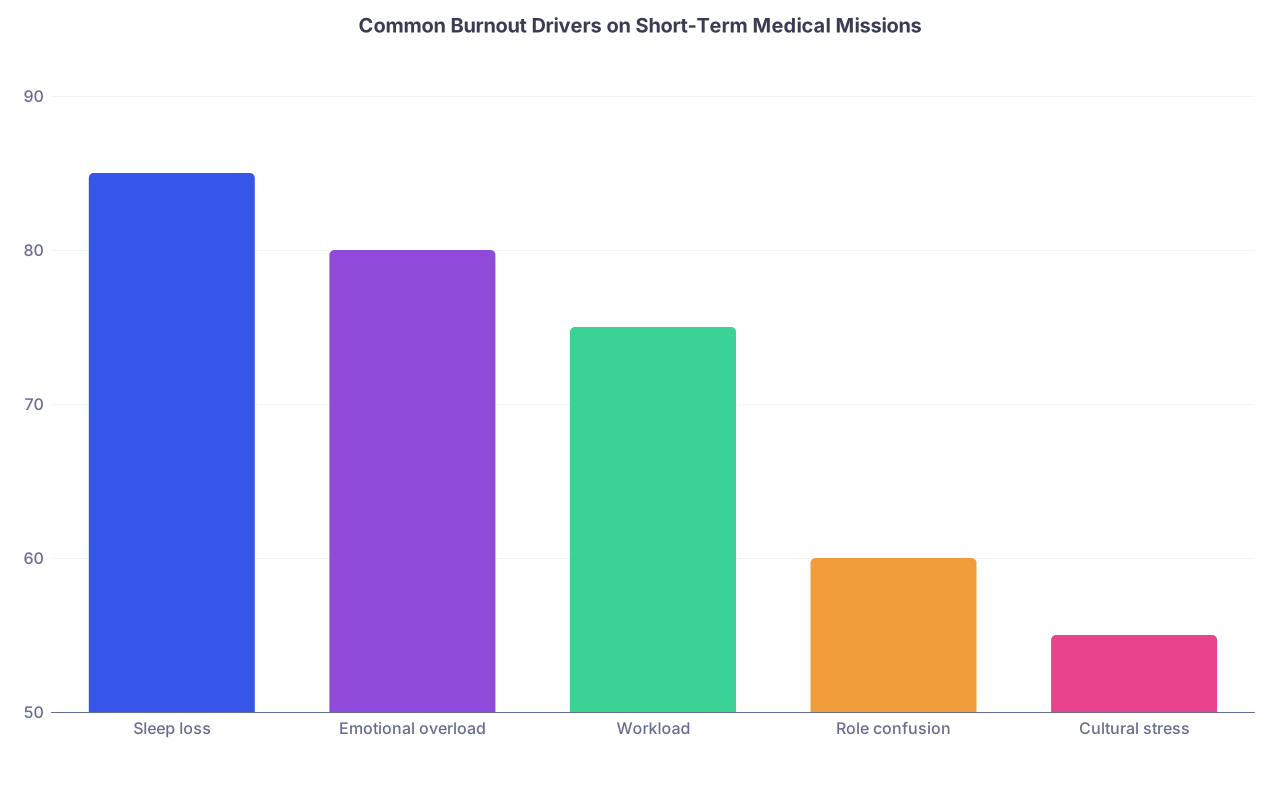
| Category | Value |
|---|---|
| Sleep loss | 85 |
| Emotional overload | 80 |
| Workload | 75 |
| Role confusion | 60 |
| Cultural stress | 55 |
You’re not weak if this hits you. You’re human.
The mistake is pretending you’re a machine—and then letting that fantasy put patients and teams at risk.
Mistake #4: Treating Self-Care as Selfish While You’re There
I hear this line constantly from students on missions:
“I didn’t come all this way to rest.”
That’s ego talking, not ethics.
If you believe:
- You should always volunteer for the extra clinic hours
- You’re a bad person for taking an afternoon off
- Eating and hydrating during clinic feels “luxurious”
you’re walking straight into burnout and bad medicine.
Self-care in a mission setting is not:
- Bubble baths
- Journaling under a palm tree for two hours every afternoon
Self-care there is brutally basic:
- Sleep: 6+ hours, non-negotiable
- Water: actually drinking, not just carrying a bottle as a prop
- Food: stop skipping meals “to help more patients”
- Body: sitting when you can, stretching, not standing 12 hours because you feel guilty
Let me spell out the ethical linkage:
- Sleep-deprived clinician → slower cognitive processing → diagnostic errors
- Dehydrated clinician → impaired attention → missed red flags
- Emotionally flooded clinician → poor empathy, short temper → damaged trust
Burnout is a patient safety issue. Protecting yourself protects them.
Mistake #5: Joining the Wrong Kind of Medical Mission
Some trips are designed to burn you out. And to be clear: many are poorly structured, ethically questionable, and practically unsafe.
- No clear daily schedule (“we’ll figure it out when we get there”)
- Vague lines of responsibility (“everyone helps however they can”)
- No defined supervision structure for students or early trainees
- Zero mention of rest days or downtime
- Big focus on numbers (“we saw 1,000 patients last year!”) instead of continuity and outcomes
| Aspect | Red Flag Version | Safer Version |
|---|---|---|
| Schedule | “We work until people stop coming” | Defined clinic hours + defined breaks |
| Supervision | “You’ll get lots of hands-on experience” | Named supervisors with clear roles |
| Scope of practice | Not discussed | Explicit boundaries by training level |
| Rest / days off | “We go hard the whole time” | Built-in recovery time |
| Follow-up care | “We do what we can while we’re there” | Identified local partners & follow-up plan |
If the pre-trip orientation sounds like a pep rally, not a plan, you’re walking into trouble.
Pick missions that:
- Have local partners leading the agenda
- Define your role clearly
- Limit clinic hours
- Address sustainability and follow-up
- Encourage—not shame—rest and boundaries
Because if the system is built on overwork, your burnout won’t be an accident. It will be part of the business model.
Mistake #6: Overpromising What You Can Give
Overcommitting doesn’t just happen with hours and tasks. It happens with expectations.
Common overpromises:
- “We’ll come back every year” when you’re not the one controlling funding or scheduling
- “We’ll send you these medications” when you have no reliable pipeline
- “We’ll follow up on your lab results” when you leave in 3 days and have no structured handoff
- Personally: “I’ll stay in touch and help you” to every patient who breaks your heart
You do this because the suffering is uncomfortable and you want to ease it—for them and for you. But those promises become a psychological debt you carry home.
Result:
- Guilt when you cannot follow through
- Emotional exhaustion from ongoing emails, WhatsApps, requests
- That “I abandoned them” feeling that sticks for months or years
Ethically, you cannot guarantee what you don’t control.
Better approach:
- Promise only what the system you’re part of can reliably do
- Direct patients toward local structures, not your personal inbox
- Use language like:
- “Our team is partnered with this clinic…”
- “The local doctor will be following up on…”
- “On this trip, we’re able to provide X and Y. We’re not able to provide Z.”
You’re not there to be a one-person savior. That savior role is a straight shot to burnout and bad boundaries.
Mistake #7: Ignoring Your Warning Signs Until Something Breaks
People rarely burn out overnight. The signs show up. They get ignored. Then something cracks.
On the ground, the early burnout flags are subtle:
- You stop introducing yourself properly to patients
- Documentation gets thinner, sloppier, or “I’ll finish it tonight” (you won’t)
- You get irrationally irritated at minor delays, translation issues, or cultural differences
- You feel emotionally numb hearing serious stories
- Tasks you’d normally double-check, you just accept and move on
By the time you’re:
- Snapping at teammates
- Avoiding tougher patients
- Hoping for fewer people to show up to clinic
you’re not “just tired.” You’re compromised.
You need a plan before you get there for how you’ll respond to warning signs:
- Who do you tell if you’re too exhausted to be safe?
- Is there a designated clinical lead who can pull you from tasks without drama?
- How will you track your own status—sleep, mood, decision fatigue?
If the answer is “I’ll just push through,” that’s not resilience. That’s denial.
Mistake #8: Believing Your Burnout Is a Fair Price to Pay
This one’s ugly but common:
“I burned out, but it was worth it for them.”
No. That is bad math.
Why?
Burned-out providers make more mistakes
You’re trading your clarity and attention for a vague sense of sacrifice. Patients lose.You’re less likely to return
If you associate global health with exhaustion and emotional trauma, you’ll avoid it in the future. The community loses.You perpetuate a harmful culture
When you brag about how hard you pushed, you normalize dangerous standards for the next group.You drain local resources
A struggling local team having to manage or buffer your burnout—emotionally, logistically—pays a cost too.

| Step | Description |
|---|---|
| Step 1 | Unrealistic workload |
| Step 2 | Overcommitment |
| Step 3 | Physical and emotional exhaustion |
| Step 4 | Impaired judgment and empathy |
| Step 5 | Lower quality care and errors |
| Step 6 | Shame and guilt |
| Step 7 | Withdrawal or avoidance of future missions |
| Step 8 | Fewer experienced volunteers |
A sustainable global health career—or even sustainable occasional missions—requires you to protect your capacity, not burn it as a one-time offering.
How to Commit Without Burning Out: Practical Guardrails
Let’s flip this. Here’s how you avoid these mistakes without becoming the “lazy” one who “isn’t committed enough.”
1. Set Hard Limits Before You Go
Decide in advance:
- Maximum hours per day you’ll work clinically
- Non-negotiable sleep minimum (e.g., 6 hours)
- What you will not do clinically (procedures, types of patients, etc.)
Then communicate them early:
- To trip leaders
- To your roommate / close teammates
If you wait until you’re exhausted to set limits, you won't.
2. Treat Breaks as a Clinical Duty
Build mental scripts you can actually say out loud:
- “I need 10 minutes to hydrate and reset so I can be safe.”
- “I’m at my safe limit for new patients today; can I assist in a non-clinical way instead?”
- “I’m too tired to safely do this procedure—I’d like supervision or for someone else to take it.”
Say it like you’d say, “The BP is 90/60.” Calm. Factual. Non-apologetic.
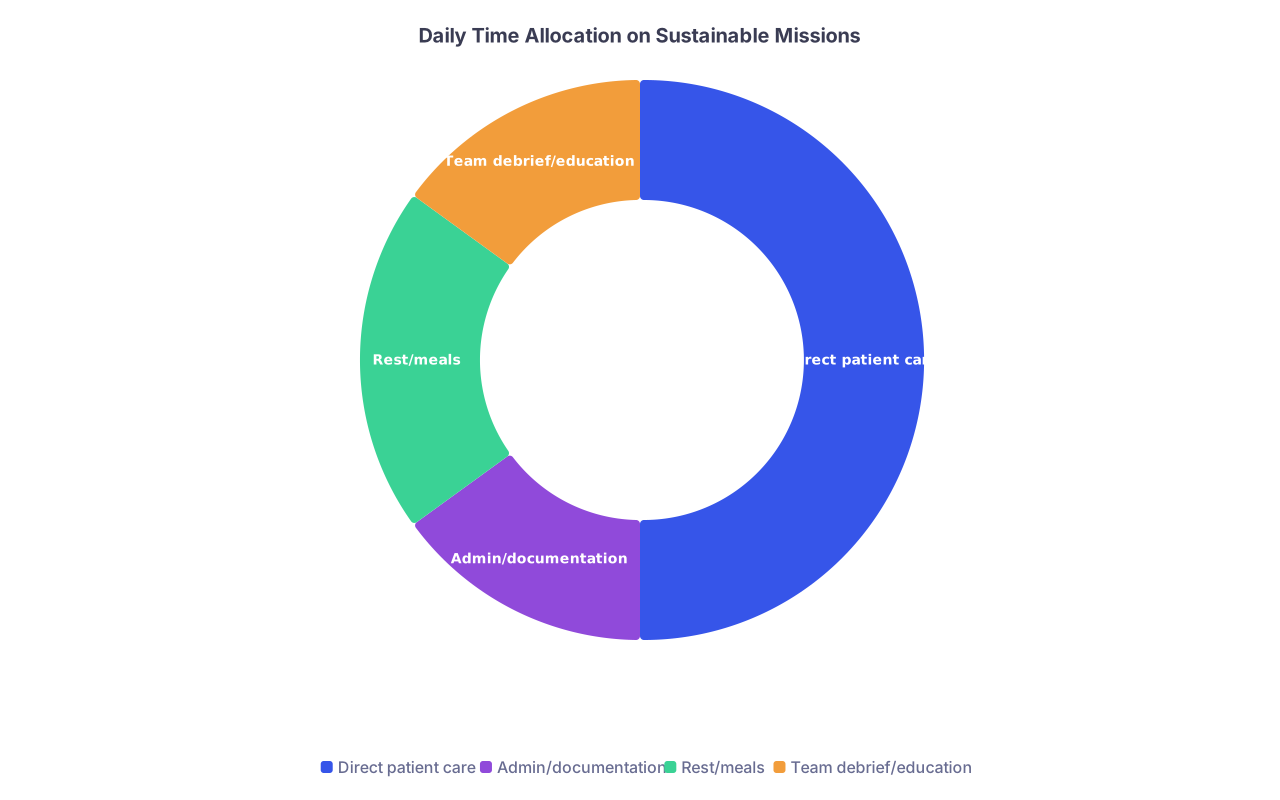
| Category | Value |
|---|---|
| Direct patient care | 50 |
| Admin/documentation | 15 |
| Rest/meals | 20 |
| Team debrief/education | 15 |
If your program acts like these statements are weakness, that’s not a program that respects ethics or safety.
3. Learn to Use the Word “No” Without Guilt
You need ways to say no that don’t invite argument. Examples:
- “That’s beyond my training level; I’m not comfortable doing that unsupervised.”
- “I’m not able to safely take on another patient right now.”
- “I can help with logistics, but I cannot see more patients today safely.”
Notice the language: “not able,” “beyond my training,” “safely.” You’re anchoring your no in ethics, not preference.
4. Anchor Yourself to the Local System, Not Your Ego
Before you go:
- Learn who the local partners are
- Ask explicitly: “What is my role in your system?”
- Ask what typically overwhelms past groups—and what helped
On the ground:
- Default to: “What will happen to this patient once we leave?” before you act
- Think: “If I weren’t here, what would the local system do?” and don’t create unsustainable one-off plans
- Remember: you’re temporary. The local team is not.
FAQs
1. How do I know if I’m just “tired” vs truly burned out on a mission?
Tired is: you’re exhausted, but you still care and your judgment feels intact with rest. Burnout is: you stop caring, you feel detached or resentful toward patients, you start hoping people don’t show up, and you cut corners you’d never accept at home. If you’re emotionally numb and your internal “this isn’t okay” alarm has gone quiet, you’re past normal fatigue.
2. What should I do if my mission leaders discourage breaks or boundaries?
That’s a structural problem, not your personal failing. Start by calmly framing your needs as safety issues: “For me to practice safely, I need X.” If they still push back, scale down your clinical role yourself—help with non-clinical tasks, documentation, teaching. And afterward, don’t go back with that organization. Share honest feedback with your school or sponsoring institution.
3. Is it unethical to limit how much I do when the need is obviously huge?
No. It’s unethical to provide care when you’re too impaired to do it safely. Need will always exceed what you can provide in a week-long or month-long mission. Your job is not to erase need; it’s to provide the highest-quality, safest care you can within your limits, in partnership with the local system. Protecting your function protects patients.
4. How can I prepare myself emotionally to reduce burnout risk before going?
Do a pre-trip reality check: read honest accounts (not just marketing brochures), talk to people who’ve gone with that exact group, clarify your role and limits in writing if possible. Build a simple self-monitoring plan: how you’ll track sleep, mood, and warning signs, and who you’ll tell if you’re slipping. And decide now that you will choose patient safety and your own integrity over impressing anyone with how “hardcore” you are.
Key points to walk away with:
- Overcommitting yourself on medical missions is not heroic; it’s a predictable path to burnout and unsafe care.
- Protecting your limits—time, scope, and emotional bandwidth—is an ethical obligation, not a selfish choice.
- The right mission structures, clear roles, and the ability to say “no” are what keep you useful to patients, to the team, and to yourself—on this trip and the next ones.


