

The romantic idea of “learning surgery” on a mission trip is not just exaggerated. It’s dangerous, unethical, and in many cases flat-out illegal.
Let me be direct: if you are a medical student, premed, or early trainee flying abroad because you think you’ll “get to do more hands-on surgery than at home,” you’re already on the wrong side of medical ethics. The patients in other countries are not your practice material. They are not an educational resource to compensate for your lack of opportunities at home.
And no, “but they would not get care otherwise” does not magically make everything okay. That’s the most overused and least supported justification in this entire space.
You want medical missions for personal growth, service, and ethics? Good. Let’s dismantle the biggest myths first.
The Core Myth: “They’re Desperate, So Anything We Do Is Better Than Nothing”
I hear it constantly on campuses and in pre-departure “info sessions” (the bad ones):
“They don’t have surgeons, so if I can help close, that’s still better than nothing.”
Or: “The local team asked me to operate — they wanted my help.”
This logic falls apart the second you hold it to the same standard you’d use at home.
Low- and middle-income countries (LMICs) are understaffed, under-resourced, and often overwhelmed. That is true. They’re not lawless, ethics-free zones. They still have:
- Professional standards of care
- Consent laws
- Scope-of-practice rules
- Local training pathways and hierarchies
None of that evaporates just because a foreign student shows up with shiny scrubs and a GoPro.
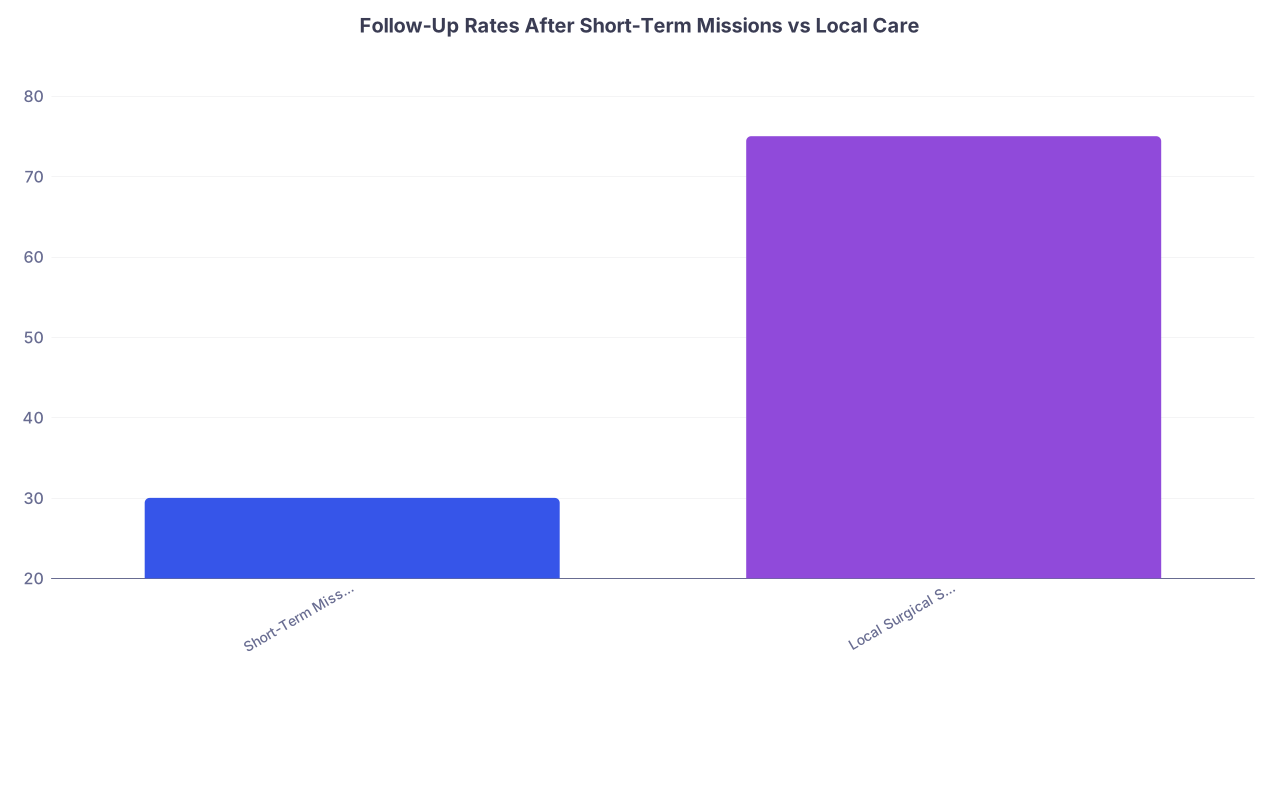
And the “better than nothing” argument? The data do not support this comforting story. When people have tried to follow outcomes from short-term surgical trips, they find exactly what you’d expect:
– Follow-up is often poor or nonexistent.
– Complication rates are often unknown.
– Systems for documenting and auditing foreign teams are weak.
Meaning: a lot of the “we saved so many lives” narrative is built on vibes, not outcome data.
| Category | Value |
|---|---|
| Short-Term Missions | 30 |
| Local Surgical Services | 75 |
That chart is representative of what several reviews show: mission patients are much more likely to be lost to follow-up than those treated in established local systems. So when you say “it went fine,” you usually mean “they were alive when I left.”
Which is not the same thing.
What Students Think They’ll Do vs What They Should Do
Let’s cut through the fantasy. There’s a particular script people imagine:
- At home: “I’m just retracting and suturing skin.”
- Abroad: “They’ll finally let me do the real surgery.”
If someone is genuinely willing to hand over operative responsibility to an unqualified trainee who won’t be around for complications, that’s not an “opportunity.” That’s a red flag.
Here’s the ethical line, and it’s not fuzzy.
| Activity | Student Expectation | Ethically Acceptable? |
|---|---|---|
| Independently performing surgery | Common fantasy | No |
| ‘First assist’ beyond training level | Often expected | Usually no |
| Basic suturing within competence | Desired | Maybe, tightly supervised |
| Holding retractors/observing | Viewed as 'too little' | Yes, appropriate |
| Taking primary responsibility for decisions | Sometimes happens | Absolutely not |
The correct ethical standard is boring and strict:
If you are not allowed to do it on a similar patient at your home institution, you do not suddenly gain that privilege because the patient is poor, foreign, or lacks alternatives.
That’s not just an opinion. It’s codified in:
- World Medical Association (WMA) guidelines on medical student electives
- AAMC and ACGME position statements
- Numerous peer-reviewed analyses of short-term experiences in global health (STEGH)
Yet students keep crossing that line. Often with encouragement from poorly regulated organizations.
What the Evidence Actually Shows About “Hands-On” Missions
There’s a huge gap between marketing and reality.
A lot of “global health” or “medical mission” programs aimed at students are more tourism than medicine. They use phrases like:
- “Procedural exposure”
- “Hands-on clinical experience”
- “Unique opportunities you can’t get at home”
Translation: “We’re going to put you in situations that would get your supervisors sued if they did this in your country.”
When researchers have looked at these programs, recurring problems show up:
Scope creep
Students write in reflective essays and surveys about “closing incisions” or “doing C-sections” despite having no such role at home. The justification is always the same: “the local doctor asked me” or “they really needed help.”Power imbalance
Local clinicians may feel pressure to let foreign visitors “get experience” because the visitors are attached to donors, NGOs, or future funding. The “invitation” is not always free of coercion.Lack of transparency with patients
Patients are rarely told: “The person doing part of your operation has never done this before and is here for three weeks.” Consent forms, when they exist, are usually generic and do not reflect the true training level of foreign participants.No continuity of care
Complications from surgery often declare themselves days to weeks later. Exactly when the mission teams and students have flown home. Locals are left holding the bag.
So what you have is a structurally unsafe setup:
- Inexperienced operator
- Little accountability
- Weak follow-up
- Patients with limited recourse
But sure, post the scrub selfie.
What You Actually Should Not Be Doing Abroad (Even If Asked)
Let’s be concrete. The gray zone is smaller than people pretend. If you’re a med student (or worse, premed), there is a long list of things you should not be doing abroad, even if a local physician says yes.
You should not:
Perform any surgical procedure independently. Not C-sections, not appendectomies, not hernia repairs, not circumcisions. Nothing where you’re the person “doing the operation.”
Act as the primary operator on any step that, if done badly, could meaningfully harm the patient. That includes deep suturing of fascia on laparotomy wounds, vascular ligation, bowel anastomosis, or inserting central lines.
Make triage or operative decisions solo. No deciding who goes to the OR, who “doesn’t need surgery,” or which limb gets amputated.
Administer anesthesia or sedation beyond what you are certified and legally permitted to do at home. Level of supervision doesn’t magically upgrade your qualifications.
Work without proper documentation and oversight from the host institution. If there’s no official role, no credentialing process, no log of what you’re allowed to do, that’s not flexibility — that’s negligence.
I’ve seen students try to defend this with, “But I did similar stuff in the sim lab,” or “I practiced suturing on pigs’ feet.” That’s like saying you drove go-karts, so you’re ready for the highway with passengers. Patients are not mannequins and volunteer trips are not simulation centers.
If you need an easy rule:
Would your home med school’s legal department sign off on you doing this activity in your own country, on a similar patient, with the same supervision?
If the answer is no, you’re out of bounds.
“But The Local Surgeon Let Me” – Why That Excuse Fails
This is the most common dodge: “The local surgeon literally handed me the scalpel and said, ‘You do it.’ So it must have been okay.”
Not necessarily. Several dynamics are usually in play:
Power and money
The visiting team often controls supplies, equipment, or future partnerships. Local clinicians don’t want to offend them. Saying yes to the student is sometimes seen as the price of ongoing support.Different culture around hierarchy
In some contexts, questioning a foreign doctor (or their students) is seen as rude or insubordinate. So juniors and nurses stay quiet, even when uncomfortable.Misunderstanding of your training level
You say “I’m a medical student” and they hear “basically a junior doctor.” Or they assume your training system is identical to theirs.Practice drift from chronic understaffing
Local providers who are already used to working beyond their own ideal scope may not perceive letting you do too much as a big step. That’s not an endorsement. It’s a symptom of a strained system.
Ethically, responsibility still sits with you and your sending institution. The WMA guidance is very clear: trainees must not take on tasks beyond their level of competence, regardless of setting.
“Someone let me” is not a defense in any other area of medicine. It does not suddenly become valid because you crossed a border.
What Ethical, Valuable Surgical Exposure Abroad Actually Looks Like
Here’s the part people don’t like, because it’s not sexy.
Ethical surgical involvement for students abroad looks a lot like ethical involvement at home:
You observe. A lot. You’re in the OR, you’re scrubbed, you’re seeing how things are done in that system.
You assist in minor, clearly supervised ways: basic retraction, suctioning, skin closure if you’re already cleared for that at home.
You ask questions about decision-making, logistics, cultural norms, system constraints — not “Can I do this next one?”
You follow patients on the wards, pre-op and post-op, to understand continuity and complications.
You contribute to projects that outlast you: capacity-building, protocols, teaching, quality improvement. Not one-off heroics.
To be blunt: if the main reason you want to go abroad is to get your hands deeper into someone’s abdomen than your home program allows, you’re not going for global health. You’re going for global self-interest.
And yes, done right, these “boring” roles are incredibly educational. Watching how a district hospital handles a ruptured ectopic pregnancy with limited blood products will teach you more about medicine, systems, and ethics than hijacking the case to pad your procedure count.
The Mission-Trip Industry Isn’t Neutral Here
Students don’t develop these fantasies in a vacuum. There’s an entire ecosystem that profits off them.
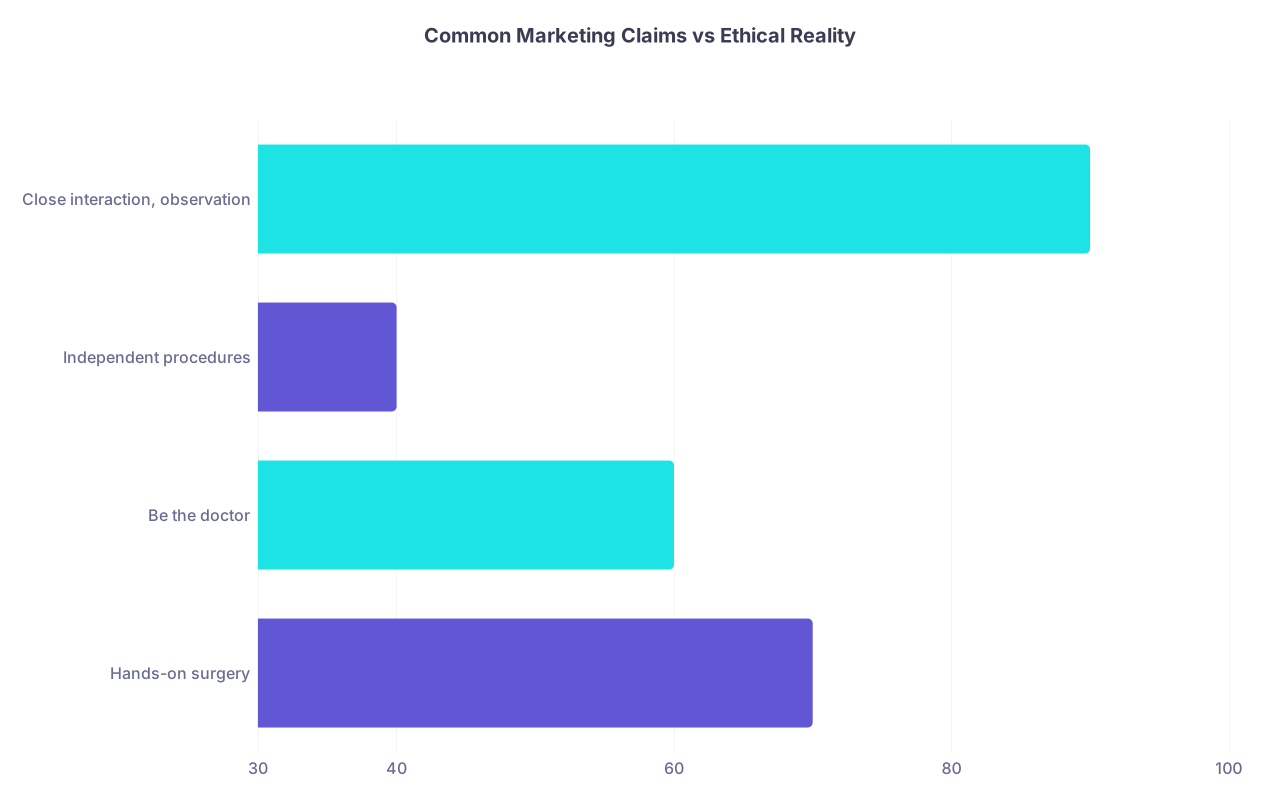
Look at the marketing of some for-profit volunteer companies and even some “NGOs” geared toward undergrads and early med students:
- “Perform hands-on procedures under supervision”
- “Experience being a doctor in a low-resource setting”
- “Stand at the operating table, not in the back of the room”
They sell the exact thing that is ethically indefensible: scope-of-practice inflation on vulnerable patients with no real choice.
| Category | Value |
|---|---|
| Hands-on surgery | 70 |
| Be the doctor | 60 |
| Independent procedures | 40 |
| Close interaction, observation | 90 |
That chart captures the pattern: the most frequently advertised “experiences” are often the least ethical.
Responsibility here isn’t just individual. Medical schools, residency programs, and licensing bodies are waking up and asking harder questions:
- Did you work under appropriate supervision?
- Were you doing what you’re credentialed to do at home?
- Was there formal approval from the host institution?
The old “I helped deliver babies in Country X when I was a premed!” story, which used to impress interviewers, now increasingly raises eyebrows.
What Actually Builds You as a Better, More Ethical Physician
Here’s the twist: avoiding unethical hands-on surgery abroad will not stunt your growth. It’ll do the opposite.
You become a better, more grounded clinician when you:
Learn to tolerate not being the hero
That feeling of “I could do more” but choosing not to cross ethical lines — that’s moral maturity, not cowardice.Take the time to understand systems instead of just touching scalpels
How do referral patterns work? What’s the blood bank situation? Who gets turned away from surgery and why? Those answers matter more than whether you tied a knot.Focus on capacity, not your CV
Helping train local nurses on safe surgical checklists or helping build a simple complication registry will have more lasting impact than any operation you touched.Practice the discipline of saying no
There will be times someone offers you a chance to do more than you should. Learning to decline — clearly, respectfully — is a real professional skill.
If you want surgical volume, pursue proper training in environments that can handle your learning curve without using anonymous patients in faraway countries as disposable safety nets.
A Harder Standard, Not a Lower One
Medical missions and global health work can change you for the better. They can also turn you into the kind of clinician who tells slightly edited stories for the rest of your career, because the full truth would sound bad.
You choose which path you’re on.
So, the bottom line:
- Being abroad does not expand your ethical or legal scope of practice. If you can’t do it at home, you shouldn’t be doing it there.
- “They would not get care otherwise” is a comforting myth, not a blanket justification. It does not erase the duty to avoid harm and respect autonomy.
- The most ethical, high-value roles for students in surgical missions are observational, supportive, and capacity-building — not “hands-on surgery.” If that disappoints you, that’s exactly the reflection you need to have.


