

The idea that a two‑week mission trip proves you’re compassionate is fiction. Worse, it is comfortable fiction that lets people feel virtuous without asking if they actually helped anyone.
Let’s pull this apart with data instead of Instagram captions.
The Myth: “I Did a Mission Trip, Therefore I’m Compassionate”
The hidden belief goes like this:
Go to a low‑income country → take photos with kids → maybe help in a clinic → boom, evidence of compassion and “global health commitment.”
Admissions committees and residency PDs see this mythology play out every cycle. Personal statements filled with lines like:
- “This mission trip changed my life.”
- “I realized how privileged I am.”
- “I want to give back to underserved communities.”
I’ve read those essays. They sound compassionate. They are not proof of compassion.
They are proof of:
- Access to money and time.
- Access to organizations that run short‑term “missions.”
- A baseline awareness that other people suffer.
That’s the bar? You saw suffering and didn’t turn away? Bare minimum of humanity, not evidence of deep moral character.
And the research agrees: short‑term medical missions (STMMs) are far better at changing how participants feel about themselves than they are at improving health outcomes for the people they claim to serve.
What Actually Happens on Short‑Term Medical Missions
Let’s step away from your personal narrative and look at what’s been published.
- Reviews of STMMs consistently find limited or no long‑term health impact on host communities.
- Many projects are not integrated into local health systems.
- Supervision, continuity of care, and follow‑up are often weak to nonexistent.
- Learners frequently work beyond their training level.
In other words: they’re great at producing reflection essays. Not so great at sustainable health benefits.
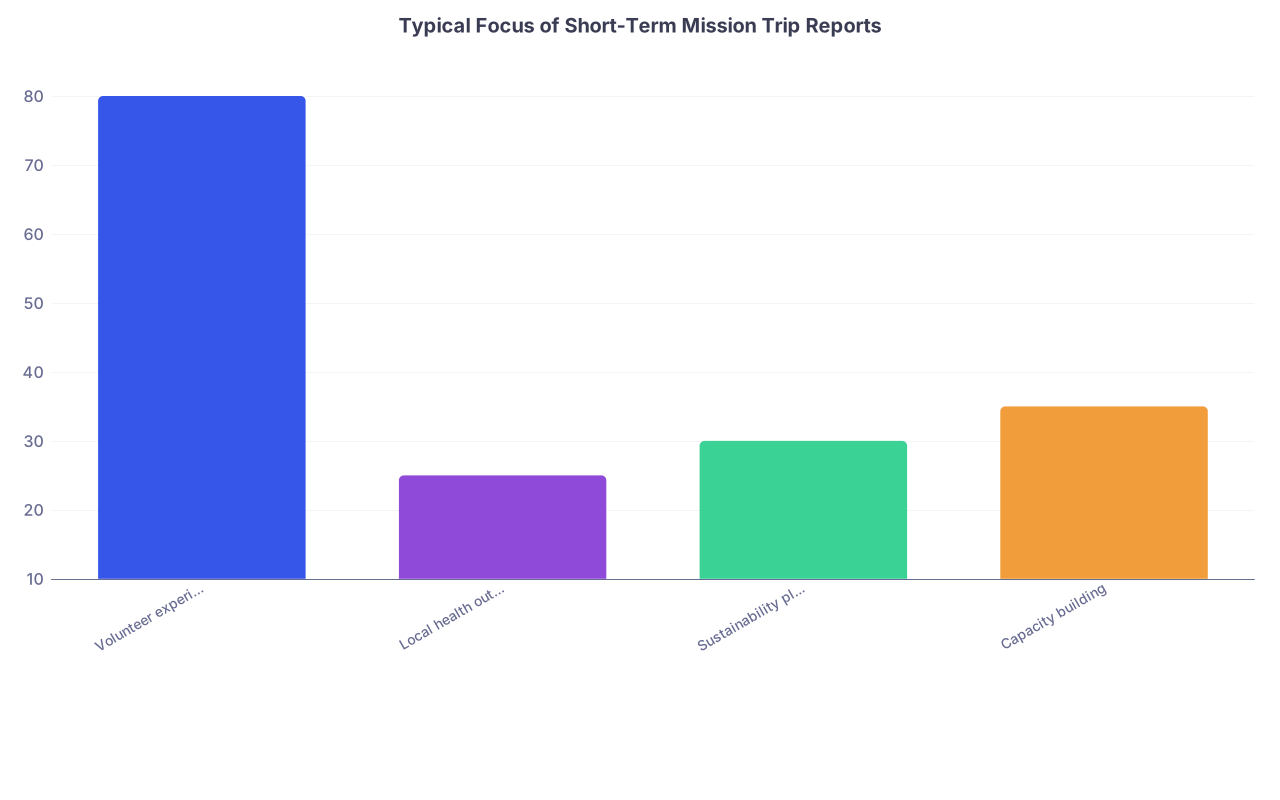
| Category | Value |
|---|---|
| Volunteer experience | 80 |
| Local health outcomes | 25 |
| Sustainability plans | 30 |
| Capacity building | 35 |
You’ll notice something ugly if you actually read evaluations of these trips instead of their glossy brochures:
- Most “impact” metrics are about the volunteer: cultural exposure, empathy, career intentions.
- Few measure hard outcomes: mortality, morbidity, continuity, system capacity.
- Fewer include rigorous community input on whether the trip was wanted, useful, or damaging.
That disconnection matters when you’re trying to claim moral credit for being “compassionate.”
A truly compassionate project centers what the community needs and wants. Most short trips center what the volunteer wants: experience, stories, photographs, and a sense of meaning.
Evidence Check: Do Mission Trips Predict Compassionate Careers?
This is the part people do not like to hear.
There is no solid evidence that:
- Students who do short‑term missions are more ethical clinicians.
- They provide more compassionate care long term.
- They choose more underserved or primary care careers at a meaningful, population level.
Do some individuals get genuinely shaped by these experiences? Yes. People exist, anecdotes exist, and some of them are beautiful.
But when you look at cohorts and trends, the signal is thin and noisy. What’s stronger?
- Longitudinal commitment to underserved work at home.
- Repeated involvement with the same community or clinic.
- Training in structural competency, ethics, and health systems.
- Mentorship by clinicians who actually do global or underserved work as their career, not as tourism.
Mission trips are not an independent variable that magically generates compassion. At best, they’re one data point in a larger trajectory. At worst, they’re moral tourism.
The Savior Complex Problem (You’re Not Immune)
You might think, “That’s not me, I went in humble.”
Good. Humility helps. It doesn’t erase structural dynamics.
Short‑term trips are structurally primed for the savior narrative:
- You fly from a high‑income country to a low‑income one.
- You’re positioned, implicitly or explicitly, as “bringing help.”
- Locals are the recipients; you are the actor.
- The story, photos, and reflection pieces are all told through your eyes.
That’s textbook savior framing, no matter how earnest you felt.
Ethics scholars and global health educators have been banging on this drum for years:
- Power and benefit skew toward the visitors.
- The work often undercuts local providers (patients line up for “the foreigners” or free meds).
- Language barriers, lack of follow‑up, and unfamiliarity with local disease patterns increase the risk of harm.
Compassion isn’t “feeling bad” in a village for a week. Compassion is taking on the unglamorous responsibility of not making things worse and building systems that still work after you leave.
Most mission trips are not built for that. They’re built to be time‑boxed and emotionally intense—perfect for personal transformation, terrible for longitudinal responsibility.
Skill Mismatch and Ethical Drift
Let’s talk about scope of practice, because this is where the myth really cracks.
If you’ve ever heard or thought any of these:
- “I got to do things there I’d never be allowed to do in the U.S.”
- “They really needed help so I did what I could.”
- “There were no doctors, so we had to step up.”
That’s not evidence of compassion. That’s evidence of an ethical problem.
A first‑year medical student has no business performing procedures unsupervised anywhere on earth. The fact that the patients are poor, brown, non‑English‑speaking, or “grateful” does not lower the ethical bar. It raises it.
There are documented cases of:
- Students doing ultrasounds, minor surgeries, suturing, or deliveries solo on trips.
- Misdiagnosis or incorrect treatments given because visiting trainees didn’t know the local epidemiology or guidelines.
- Volunteers handing out expired medications or inappropriate antibiotics.
None of this is compassionate care. It is carelessness dressed up as charity.
Compassion would look like:
“I will not do here what I’d be unqualified to do at home, even if it disappoints me or makes my trip feel ‘less meaningful’.”
Ask yourself bluntly: did anyone on your trip ever say, “No, we’re not doing that—that’s beyond our training and unsafe”? If no one ever drew that line, what you saw wasn’t compassion. It was rationalized overreach.
What Really Signals Compassion to People Evaluating You
Admissions committees and PDs are not stupid. They’ve seen the “mission‑trip‑as‑virtue” performance for years. Many of them have grown openly skeptical.
What actually moves the needle for serious evaluators is not your flight history. It’s patterns like these:
- Long‑term, local engagement with underserved populations (free clinics, harm reduction, immigrant health, rural outreach).
- Ongoing involvement with the same community or organization over years.
- Roles that evolve from “I showed up” to “I took responsibility and improved something concrete.”
- Evidence that you understand systems and structures, not just narratives of personal growth.
| Example Activity | Why It’s Weak/Strong |
|---|---|
| One 10-day overseas mission trip with photo-heavy essay | Weak – episodic, self-focused, no continuity |
| 3 years volunteering weekly at a local free clinic | Strong – consistent proximity and responsibility |
| Annual mission trip, no language skills, no follow-up | Weak – repeated tourism, minimal accountability |
| Building a sustainable referral or follow-up process for an underserved clinic | Strong – systems thinking, long-term impact |
| “Realizing my privilege” essay after one trip | Weak – insight, but still you-centered |
Notice something: the strong signals don’t require a passport.
If your only serious experience with “the underserved” exists thousands of miles away but you’ve never set foot in the free clinic 20 minutes from campus, don’t try to sell that as evidence of deep compassion. It reads as tourism and resume curation, not moral formation.
The Reflective Trap: “It Changed Me” Is Not Enough
One of the most overused phrases in mission trip essays: “This experience changed me.”
Here’s the uncomfortable follow‑up no one writes: “And here is exactly how my daily behavior changed for the long term.”
If your “life-changing” trip:
- Didn’t change how you allocate your time when no one is watching,
- Didn’t affect what you read, who you learn from, how you vote, or what you fight for,
- Didn’t pull you into sustained work with marginalized groups where you live,
then it wasn’t evidence of compassion. It was a moving experience. Those are different things.
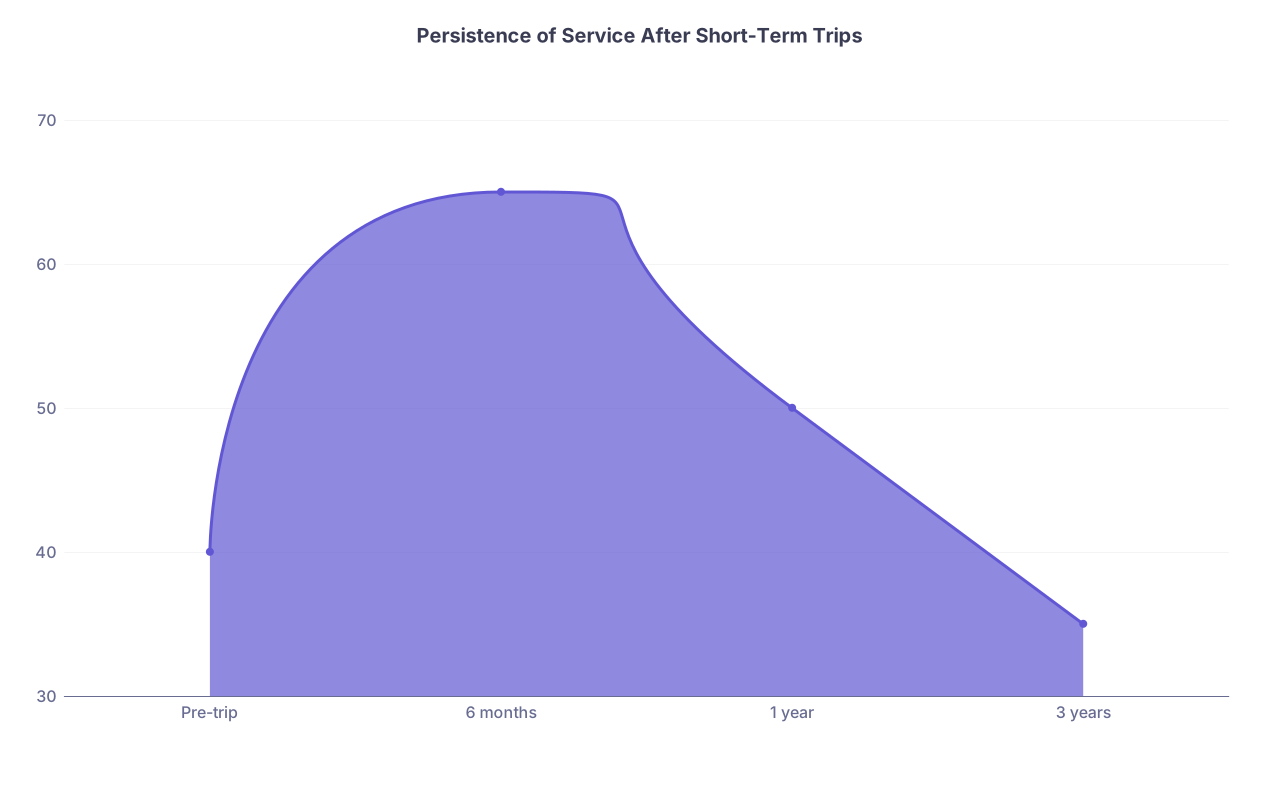
| Category | Value |
|---|---|
| Pre-trip | 40 |
| 6 months | 65 |
| 1 year | 50 |
| 3 years | 35 |
Patterns from follow‑up surveys are predictable: spike in interest right after the trip, gradual decay back to baseline. Emotional high, moral regression to the mean.
Compassion is boringly persistent. It doesn’t leave when the photos stop getting likes.
If You Still Go: How Not to Lie to Yourself
I’m not arguing that all overseas or short‑term work is inherently bad. There are programs that are ethical, locally driven, and educationally sound. They exist. They’re just rarer than their marketing suggests.
If you’re going, here’s how to keep your story honest:
Drop the savior script.
You’re not “bringing healthcare” to people. At best, you’re a guest assisting local systems that existed before you and will exist after you.Stay ruthlessly within your scope.
If you wouldn’t do it unsupervised at home, you don’t do it unsupervised abroad. Period.Ask what the host wants measured.
Ask local partners what they see as successful outcomes. Hint: it’s usually not “student reflection journals.”Look for continuity.
Is there year‑round presence? Clear handoffs? Local clinician leadership? Or is it just waves of short‑term visitors?Reflect on power and benefit.
Who gains skills, career capital, and social credit? Who takes the risk? Who has veto power? If you can’t answer those questions, your “compassion” is under-informed.

| Step | Description |
|---|---|
| Step 1 | Offered mission trip |
| Step 2 | Reconsider participation |
| Step 3 | Proceed with humility |
| Step 4 | Local leadership in charge |
| Step 5 | Your role matches training |
| Step 6 | Continuity and follow up |
Notice that nowhere in that flowchart is “Will this look good on my application?” Because that’s your question, not the community’s.
How to Actually Build and Show Compassion
If you want your life—not just your CV—to reflect compassion, do the unsexy work.
A few examples that count more than one glamorous stamp in your passport:
- Show up weekly at a local homeless outreach or syringe service program, for years.
- Learn Spanish (or another relevant language) well enough to speak directly with patients without an interpreter.
- Work in a domestic violence shelter, prison reentry program, or refugee resettlement clinic and accept that you’re not the hero in that story.
- Study health policy and advocate for boring but powerful changes: insurance coverage, transportation vouchers, language access, housing policy.
These are the things that admissions and faculty notice over time. Because they’re hard to fake and they don’t give you quick narrative payoff.
If you also do a mission trip, fine. Write about it honestly:
- Name the limits.
- Admit what you could and couldn’t do.
- Describe what you learned about systems, not just about yourself.
- Connect it to sustained, local action afterward.
That sounds a lot more like integrity than, “I saw poor people and now I know I’m meant to be a doctor.”
Bottom Line: Compassion Isn’t a Souvenir
Mission trips do not prove you are compassionate. They prove you had the means and desire to go on a mission trip.
Sometimes they’re part of a deeper, long-term trajectory of service and ethical responsibility. Often they’re not.
If you’re serious about being a compassionate clinician, stop trying to outsource your moral development to a week abroad. Start doing the quiet, continuous work where you are, in systems you’ll still be accountable to next year.
Years from now, you won’t remember which village gave you the most dramatic photo. You’ll remember which patients, communities, and colleagues you kept showing up for long after the trip ended.


