
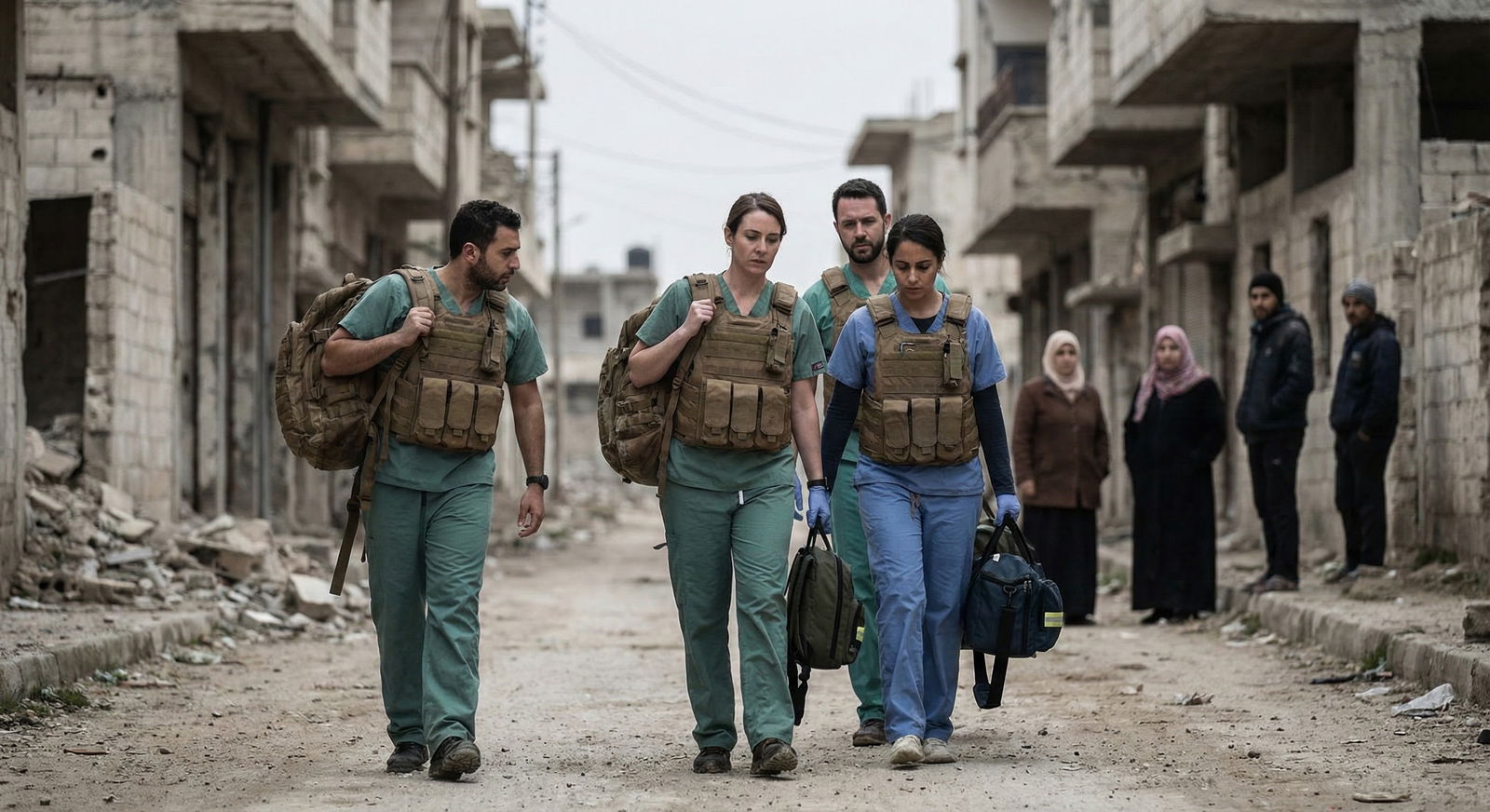
You are in a cramped church basement that has been converted into a “clinic.” Outside, you hear distant intermittent gunfire. A local nurse is trying to translate for you, but the patient’s dialect is different enough that both of you are guessing. The NGO that brought you here promised “high-impact short-term surgical support in an underserved conflict-affected area.” It is day three and you are realizing: the ventilator is unreliable, there is no blood bank, the “consent form” is a single sheet translated last-minute, and the local doctor quietly mentions that if anything goes wrong, the family might blame the foreigners.
This is the reality of many short-term medical missions in conflict zones. Not the Instagram version. The ethically complicated, clinically constrained, politically entangled version.
Let me break this down specifically.
1. What “Short-Term Mission” Means in a Conflict Zone – and What It Really Is
Short-term in a stable low-resource setting is one thing: two weeks in rural Guatemala, a month in a refugee camp near Cox’s Bazar, a 10-day orthopedic camp in sub-Saharan Africa. Hard, but relatively predictable.
Short-term in an active or recent conflict setting is different. The work sits at the intersection of:
- Disaster medicine
- Humanitarian law and politics
- Cross-cultural clinical care with minimal continuity
And it is usually compressed into absurd timeframes: 7–21 days of “deployment” with huge pressure to “do as much as possible.”
Typical patterns you see:
- Teams fly in to support a local hospital overwhelmed by trauma casualties.
- A surgical specialty NGO fields “trauma teams” rotating every 2–3 weeks.
- Faith-based groups run mobile clinics in internally displaced person (IDP) camps.
- Academic groups partner (in theory) with local hospitals for “training” plus clinical service.
The clinical reality: you are dropped into half-built or half-destroyed systems, with fragmented records, shifting lines of authority, and insecure supply chains. You are often working with:
- No reliable imaging beyond plain X-ray and an occasional ultrasound.
- Uncertain sterilization standards.
- Severely limited lab capacity (basic CBC, maybe creatinine, maybe not).
- Intermittent power and oxygen shortages.
The ethical reality: every clinical decision is now also a justice, responsibility, and harm-reduction decision. You cannot separate them.
You are not “just doing medicine.” You are practicing medicine as a temporary foreign actor in a politically loaded, socially traumatized setting. That changes everything.
2. Core Ethical Tensions: What You Feel on Day 2 at 3 a.m.
You will hear a lot of lofty language about “serving the least of these” and “standing in solidarity.” Fine. But what you live are smaller, sharper tensions at the bedside.
2.1 Autonomy vs. Reality of Consent
Consent in conflict zones is rarely textbook.
Take a trauma laparotomy scenario:
- 22-year-old, penetrating abdominal trauma, unstable.
- You have one blood unit left, no second ventilator, and an OR with limited lighting.
- Family is not present; there is no legal surrogate system functioning.
- Language barrier is heavy; translation is approximate and rushed.
Is consent “informed”? Not in the way you were trained.
Worse, add power dynamics:
- You are the foreign “expert.”
- The patient has probably never had major surgery.
- Saying “no” in many cultures is almost impossible, especially to honored guests or perceived authority figures.
Ethically honest approach:
You stop pretending this is classic informed consent. You aim for maximally honest, context-appropriate consent, acknowledging:
- The limits of what you can explain.
- The limits of how freely the patient can decide.
- Your own constraints if they say no (e.g., there is no higher-level facility).
You say, with a translator you trust: “You are very sick. Without an operation, you will probably die. With an operation here, there is still a serious chance of death or complications. We do not have all the equipment we would usually have. I recommend the operation, but this is your decision.”
Not perfect. But far better than “We need to operate now, sign here.”
2.2 Beneficence vs. Non-maleficence… on a Clock
Conflict-zone medicine amplifies the harm-benefit balance.
You see:
- Kids with shrapnel wounds you can debride now, but not fully reconstruct.
- Patients needing ICU-level support that your “ICU” cannot really provide.
- Oncology patients needing months of chemo you cannot guarantee.
Example that comes up constantly:
Do you start a treatment that requires long-term follow-up when you know your presence is temporary and the system is shaky?
- Starting insulin on a diabetic in a bomb-damaged town with uncertain medication supply.
- Initiating high-dose steroids when follow-up labs are unlikely.
- Doing complex fracture fixation with hardware when there is no plan for removal and infection management.
The ethical line I use: Do not start anything you cannot reasonably hand off to a realistic system.
Not a perfect system. A realistic one.
Ask yourself:
- Is there a local provider who can continue this care?
- Are medications or supplies locally available at a sustainable cost?
- Is there any referral pathway if things go wrong?
If the answer is “no” across the board, your obligation shifts. Stabilize. Palliate. Avoid introducing new long-term risks that will outlast your departure.
2.3 Justice vs. Visibility Bias
Here is a quiet but pervasive ethical distortion: foreigners tend to treat visible, dramatic cases more than silent, chronic suffering.
Why?
- Acute trauma is “easier” to justify and photograph.
- Chronic disease is cognitively and logistically harder in a two-week mission.
- Donors like dramatic before-and-after stories.
But justice in a conflict setting demands you actively resist the “spectacle of suffering” problem.
It may be more ethical to spend the day:
- Running a hypertension and diabetes station in a camp.
- Training local staff on infection prevention in a maternity ward.
- Setting up a basic triage algorithm with the nurses.
Than to do one highly photogenic but questionably sustainable cleft or burn reconstruction for media.
If your mission’s output metrics are “number of surgeries” or “patients seen per day” without any weighting for long-term benefit and local capacity, that is a red flag.
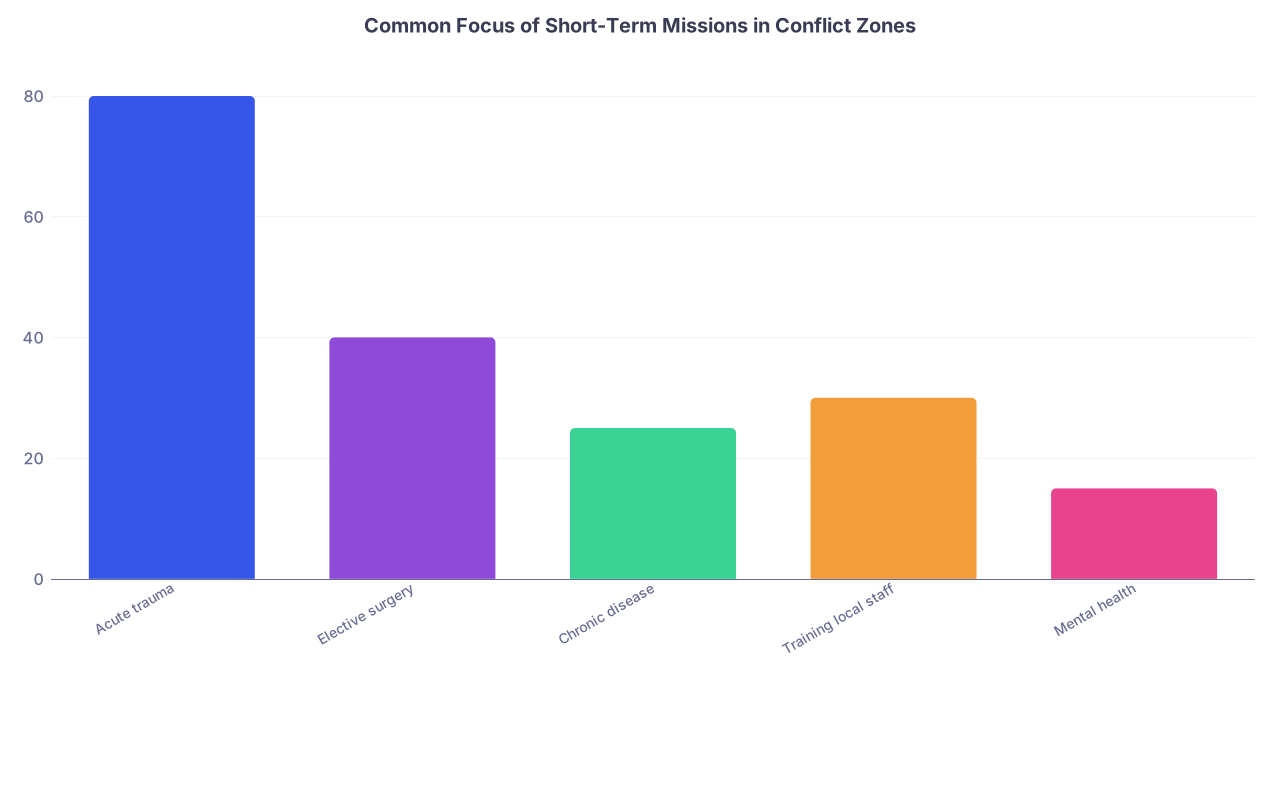
| Category | Value |
|---|---|
| Acute trauma | 80 |
| Elective surgery | 40 |
| Chronic disease | 25 |
| Training local staff | 30 |
| Mental health | 15 |
3. Clinical Complexities You Do Not Appreciate Until You Are There
You are still a clinician, so let me get concrete about the medicine.
3.1 Trauma and Surgical Care – Under-Resourced, Over-Expected
Short-term teams are often brought as “trauma experts.” Reality: you are improvising.
Common patterns:
- Patients arrive late – hours after injury, already septic or in shock.
- No CT. Sometimes no ultrasound. Diagnoses rely on clinical exam plus X-ray.
- Limited anesthesia drugs; sometimes only ketamine and a failing oxygen concentrator.
- Only one or two functioning ORs; power outages mid-case.
Specific clinical-ethical dilemmas:
Complex vs. Damage Control Surgery
You know the orthopedically ideal operation. You also know you will be gone in 5 days and the follow-up is uncertain.Often the ethical move: damage control surgery (external fixation, washout, delayed closure) even if you could do more technically. You prioritize:
- Short operative time
- Minimal blood loss
- Lower requirement for high-level postop care
- Simpler follow-up for local surgeons
Resource-based triage
You cannot ventilate everyone. You cannot transfuse everyone.You are suddenly doing mass-casualty style triage in slow motion.
You start asking:
- Does this person have a reasonable chance of survival with the resources available here?
- Will using the remaining O-negative units on this case cost three other lives in the next 24 hours?
Harsh, but real. This is not a tertiary-care ICU with endless blood products. You are operating inside a scarcity framework whether you admit it or not.
3.2 Infectious Disease and Public Health Blind Spots
Conflict breaks public health. You might be so focused on trauma that you miss where the real mortality is.
In camps and war-damaged towns, the big killers are often:
- Diarrheal disease from contaminated water
- Respiratory infections from overcrowding
- Measles where vaccination coverage collapsed
- TB in poorly ventilated shelters
- Malaria or dengue where vector control broke down
Your ethical question: how do you use your short-term presence to act on system-level risks, not just one-off patients?
That might mean:
- Working with WASH (water, sanitation, hygiene) teams to link clinical findings to interventions.
- Tracking patterns (e.g., many kids with severe diarrhea from one tap) and reporting to coordination clusters.
- Pushing your team to allocate some time to vaccination or surveillance instead of pure curative work.
Even if you are a surgeon, ignoring the infectious and public health layer in a conflict setting is ethically lazy.
3.3 Mental Health and Moral Injury (Theirs and Yours)
Conflict zones are soaked in trauma. Not just physical.
Patients:
- Survivors of torture, sexual violence, displacement.
- Children witnessing killings and bombings.
- Health workers losing colleagues and family.
You, as a visitor:
- Are seeing repeated exposure to severe suffering you cannot fix.
- Are making life-and-death choices with incomplete tools.
- Might leave behind patients you suspect will die after you go.
That is a recipe for moral distress and moral injury.
Clinical and ethical complexity:
- You must not “open up” deep trauma histories psychologically if there is zero follow-up care.
- Brief psychological first aid is appropriate; complex trauma therapy is not.
- You should advocate for integrating local mental health resources or training, not doing amateur therapy in your off hours.
Your own mental health:
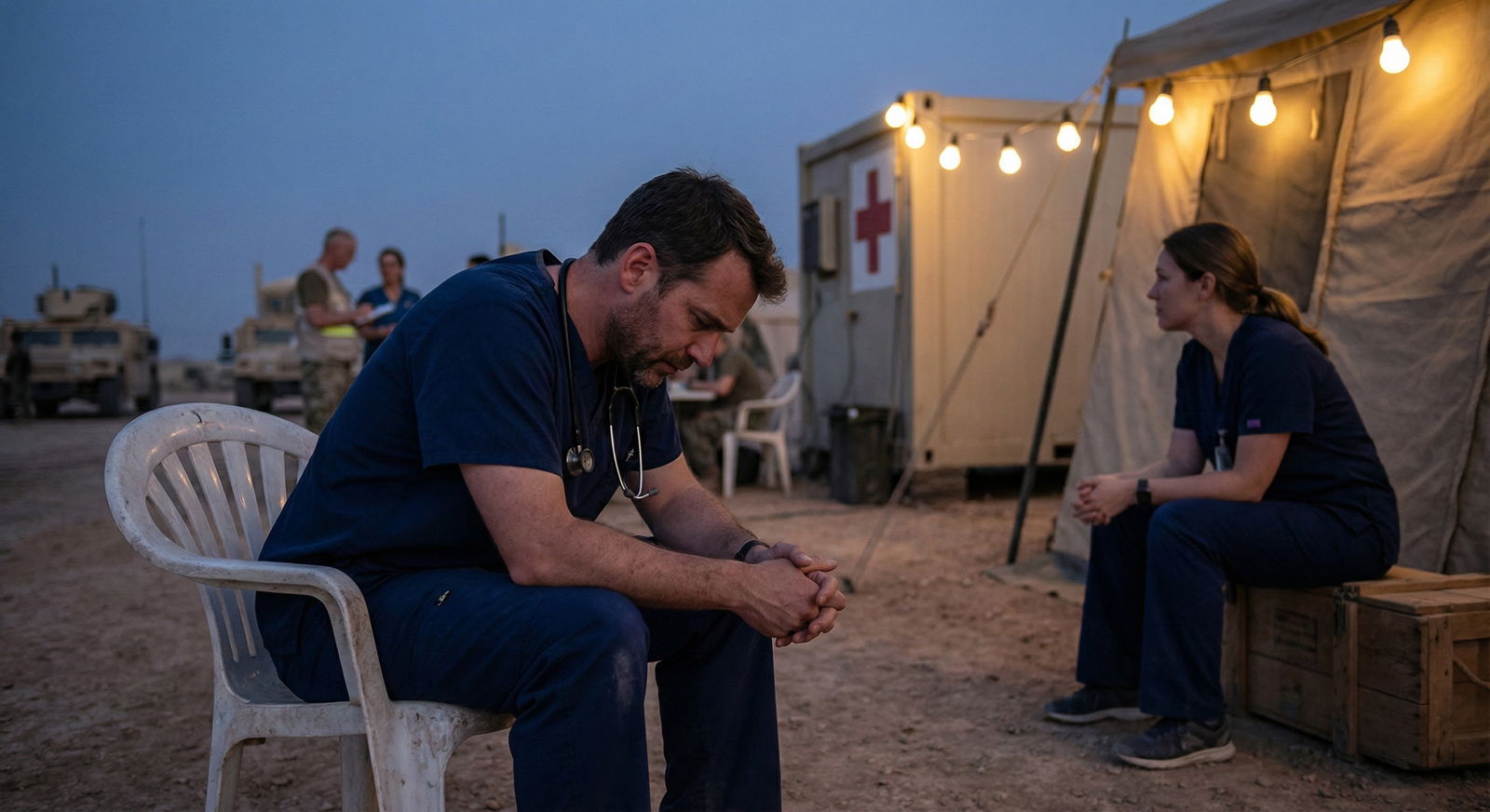
If you walk out thinking, “That was intense, but I am fine,” and you have no emotional residue, you were probably dissociated. Healthy clinicians in these environments feel something. The ethical responsibility is to:
- Debrief with peers and supervisors.
- Reflect on decisions you made that haunt you – and learn from them.
- Recognize when you are being drawn to conflict work because of adrenaline or savior narratives, not service.
4. Power, Politics, and Being Used – Because You Will Be
There is a fantasy that medical work is “neutral.” In conflict zones, that is mostly false.
4.1 You Are a Political Actor Whether You Like It or Not
Health care is a strategic asset in war. It can be:
- A tool for gaining civilian support.
- A bargaining chip between warring parties.
- A propaganda asset (“foreign doctors support our side”).
- A target to terrorize populations.
If your mission is invited by one group, you are automatically seen as aligned, even if your charter says “neutral.”
You need to ask, before you go:
- Who requested our presence? Government, opposition, local NGO, religious group?
- Who controls access to this area?
- Are we being escorted by armed actors? If yes, who are they, and how does that look to the other side?
- Are any photos or stories from our mission being used to legitimize a particular faction?
Ethical red lines I have seen crossed:
- Clinics run in military compounds where civilians must pass armed checkpoints, effectively tying care to loyalty.
- Teams posing in photos with armed fighters in branded vests.
- “Thank you” banners with political slogans behind foreign teams.
If your presence increases risk for local staff once you leave, you have done harm, even if your incision lines look pristine.
4.2 Local Staff: Partners, Not Assistants
The worst behavior I have seen from short-term teams in conflict zones is this: acting like visiting “experts” with local staff as “helpers.”
Reality check:
- Local nurses, midwives, and doctors have been carrying the system before you came and will carry it after you leave.
- They understand the conflict dynamics, the communities, and the unspoken rules of survival.
- They often have skill sets far beyond what the broken infrastructure allows them to show.
Ethically decent practice:
- Ask local clinicians how they usually handle cases before you impose your algorithm.
- Don’t perform procedures you would not let them do, unless you are also explicitly training them and leaving equipment appropriately.
- Give them decision-making power in triage and patient selection.
If you are “the one doing all the cool cases” while they prep, retract, and fill forms, you are running a colonial theater, not an ethical mission.
4.3 Exit Strategy and Dependency
Short-term missions in conflict often become not-so-short-term habits. Teams rotate every few weeks for years, but the structure of care remains “visiting experts + dependent local hospital.”
Ask hard questions:
- After 12 rotations, is the local team doing more independently than at rotation 1?
- Has the mission changed the local system’s ability to respond without foreign staff?
- Are you draining local staff time and attention away from their own priorities?
If the answer is “no, no, and yes,” then your mission is functionally a parallel system. That is ethically very shaky.
4.4 Data, Stories, and Exploitation
Conflict sells. Suffering sells. Many organizations and individuals weaponize that.
Do not:
- Post patient photos on social media from the field, even “de-identified,” without explicit, fully voluntary consent that you know is informed.
- Use children’s faces, women with bandages, or collapsed buildings as backdrop for your pious reflection posts.
- Retell trauma stories in fundraising pitches that patients never agreed to share publicly.
The ethical rule is simple: if you would be uncomfortable seeing your own family member’s worst moment used that way, do not do it to someone else.
5. Faith-Based or Values-Driven Missions: Added Ethical Layers
Many short-term conflict missions are faith-based. That brings extra layers.
Let me be blunt: if you are there to proselytize more than to provide clinically competent care, stay home.
Key concerns:
- Coercion: Anytime care access is implicitly linked to religious participation (prayers before treatment, required religious materials, proselytizing while patient is captive in your exam room), you are violating autonomy.
- Power imbalance: In a war zone, the foreign doctor with scarce resources already holds overwhelming power. Adding a spiritual “agenda” on top is ethically combustible.
- Local religious dynamics: You might not see it, but your activities can inflame local tensions, especially if religion is part of the conflict narrative.
Ethically tolerable model:
- You work under clear humanitarian principles: impartiality, neutrality, independence.
- Your personal faith or values motivate you, but they are not conditions for care.
- Spiritual support, if offered, is always optional, clearly separated from clinical decisions, and preferably led by local trusted actors, not foreigners.
If your sending organization resists those boundaries, that tells you what you need to know.
6. How to Decide if You Should Go – And When You Absolutely Should Not
Not everyone should do short-term work in conflict zones. That is not a moral failure. That is realism.
6.1 You Probably Should Not Go If…
- You are early in training with limited independent practice skills and no structured supervision in the field.
- The organization cannot clearly state who is responsible for malpractice, adverse events, and security decisions.
- There is no pre-deployment training on security, ethics, cultural context, and mental health.
- They cannot name specific local partners and how decisions are shared with them.
- Their metrics of success are purely “numbers seen” and social media engagement.
6.2 You May Be a Good Fit If…
- You have a clearly needed skill set (e.g., trauma surgery, anesthesia, critical care, emergency medicine, OB in low-resource settings, infectious disease, public health).
- You have prior low-resource or humanitarian experience and have already made your beginner mistakes in safer environments.
- You have long-term commitment to this region or population, not just a “one-time experience.”
- Your sending organization has a documented security framework, ethical guidelines, and genuine local partnerships.
| Aspect | Red Flag Example | Green Flag Example |
|---|---|---|
| Training | “You’ll learn as you go” | Formal pre-deployment training provided |
| Local partnership | “We go where doors open” | Named local institutions and co-planning |
| Scope of practice | “Do whatever you feel comfortable with” | Clear role definition and supervision |
| Follow-up care | “We’re just the trauma team” | Documented handover and referral pathways |
| Metrics of success | “We saw 2,000 patients in 5 days” | Focus on outcomes and capacity building |
6.3 Personal Ethical Checklist Before Saying Yes
Ask yourself, and be honest:
- Am I drawn to this for adrenaline, “hero” narratives, or because it looks impressive on a CV?
- Do I understand the political and historical basics of the conflict, and have I read from multiple perspectives?
- Can I commit to multiple trips or longer-term involvement, or am I just “dropping in”?
- Do I trust this organization’s ethics enough that I would let them treat my family member in that context?
- Am I prepared to say “no” on the ground if I find out the situation is unethical, even if that disappoints the team?
If you cannot answer those with some rigor, you are not ready. That is fine. Get experience in more stable low-resource settings first.

| Step | Description |
|---|---|
| Step 1 | Considering short term conflict mission |
| Step 2 | Do not go |
| Step 3 | Proceed with caution and reflection |
| Step 4 | Clear local partnership? |
| Step 5 | Adequate training and support? |
| Step 6 | Needed skills and safe scope? |
| Step 7 | Follow up for patients ensured? |
7. Growing as a Clinician and Ethicist Through This Work
If you do go, and if it is done well, short-term missions in conflict zones can sharpen you profoundly.
You learn to:
- Make decisions with incomplete data and high stakes.
- See power structures in health care more clearly.
- Question your own training’s blind spots around resource assumptions.
- Integrate ethics into every clinical move, not as a separate “consult.”
But only if you do the hard reflective work.
Practical ways to use these experiences for genuine personal and ethical development:
- Keep a field journal focused not just on “what I saw” but “what decisions I made and why.”
- After returning, write out 3–5 cases that troubled you and analyze them against accepted humanitarian ethics frameworks (e.g., MSF, ICRC guidelines).
- Seek out supervision or mentoring from people who have long-term humanitarian experience, not just one-off trips.
- Treat your first mission as school, not as proof of your virtue.
If you find yourself telling the same dramatic story at every dinner for months and framing yourself as the hero, you have missed the point.
Key Takeaways
Short-term missions in conflict zones are not just “medicine in harder conditions”; they are ethically loaded, clinically constrained, politically entangled work where every decision carries long shadows after you leave.
The most ethical care in these settings is often less flashy: damage control instead of heroic surgery, public health and training instead of pure numbers, honest limited consent instead of performative forms, and real partnership instead of foreign dominance.
You should only go with a clear-eyed understanding of your motivations, limits, and responsibilities—and with an organization that treats ethics, local ownership, and follow-up as non-negotiable, not afterthoughts.


