

It’s late. You’re sitting with your laptop open to your personal statement draft, cursor blinking over a paragraph that starts with: “During my mission trip to [country]…”
And you’re panicking.
You’re replaying images: you in scrubs you probably didn’t need, holding a kid for a photo, shadowing a local doctor you barely understood, passing out vitamins, maybe even taking a blood pressure or two. And now you’re asking yourself:
Is this going to look like medical tourism?
Is an adcom going to read this and think, “Ah yes, the Savior Complex Starter Pack”?
Did I actually help anyone? Or did I just… consume poverty for experience points?
Let’s go through this properly. No sugarcoating.
What Adcoms Actually Worry About With Mission Trips
Here’s the uncomfortable truth: admissions committees have seen a lot of cringe “global health” stories.
They’ve read the essay where someone goes to Guatemala for 7 days and suddenly discovers “people are poor but so happy.” They’ve seen applicants proudly describe doing things abroad they’d never be allowed to do in the U.S. They know the buzzwords: “heartbreaking,” “grateful,” “changed my life,” “taught me gratitude.”
That’s why you’re anxious: because somewhere in your gut you know they’re not wrong to be suspicious.
There are three big red flags that make a mission trip look like medical tourism:
- It centers you instead of the community.
- It glamorizes doing “medical” stuff you weren’t trained to do.
- It treats poverty as a backdrop for your personal growth arc.
If your trip, your program, or your essay leans heavily into any of these, yeah—adcoms might side-eye it.
But that doesn’t automatically mean your application is doomed. It just means you need to be brutally honest about what you did and how you talk about it.
Quick Reality Check: Was Your Trip Actually Ethical?
Let me be blunt: some trips are garbage from an ethics standpoint. Some are… fine but shallow. A smaller number are genuinely well-structured global health or community partnerships.
If your chest tightens reading that, good. That’s your ethical radar working.
Use this as a gut-check:
| Question | Red Flag If... |
|---|---|
| Were you doing hands-on clinical tasks? | You had no training/licensure and were “treating” people |
| Was there local leadership? | Trip led entirely by foreigners, locals just “helping out” |
| Was there continuity of care? | Team drops in once a year, no follow-up system |
| Did you pay a company to go? | For-profit company, slick marketing, “do procedures” promised |
| Did anyone talk about ethics? | No pre-trip training on culture, harm, or scope of practice |
If you’re ticking a lot of the red-flag boxes, then yeah, the structure itself was problematic.
But here’s the key:
You can’t go back and un-take the trip.
You can control how you handle it now.
If you recognize it might’ve been ethically messy, that actually gives you something powerful to write about: your discomfort, what you learned, and what you changed in your behavior afterward.
The worst thing you can do is double down and pretend it was a flawless, heroic experience.
How Mission Trips Turn Into “Medical Tourism” On Paper
Even if your trip itself was as ethical as a short-term trip can be, you can still talk about it in a way that makes it look awful.
Red flag patterns in applications:
The “I discovered poverty” essay
You spend most of your space describing how shocked you were to see “such poor conditions,” how they “had so little but were so grateful,” and how you now “appreciate everything more.”Translation to adcoms: You turned other people’s suffering into a life lesson about your Target runs and Starbucks.
The “I practiced medicine” narrative
You write about “treating patients,” “diagnosing,” or “providing care,” when in reality you were unlicensed and either:- shadowing
- doing vitals/basic tasks under supervision
- helping with logistics
This screams: “I don’t understand scope of practice and I’m fine doing things abroad I’d never do here.”
The “I was the hero” tone
You frame yourself as the key character who brought help, insight, or “hope” to the community, rather than seeing yourself as an observer, learner, or very small part of a bigger local effort.The “no follow-through” story
You talk like it transformed your worldview, but then… nothing. No long-term involvement with underserved populations. No local volunteering. No global health coursework. Just a single trip and a bunch of adjectives.
That’s when adcoms roll their eyes and file it under “mission tourism.”
Can You Still Use The Trip In Your Application?
Short answer: yes, usually. But you have to be surgical about it.
If you’re scared your trip reads like medical tourism, your instincts are probably right, and that’s actually helpful. People who are oblivious write the worst essays. You at least see the problem.
Here’s the approach I’d use:
1. Decide if it belongs in your primary personal statement
If your mission trip is:
- your only clinical exposure → big problem. It’ll look like you chased “sexy” international stuff instead of actually working in your own community.
- your main “why medicine” story → also a problem. Looks shallow and ungrounded.
Use it in your primary personal statement only if:
- you also have solid U.S.-based clinical experiences and can show continuity of service.
- the mission trip fits into a broader pattern (e.g., long-term work with a local immigrant community, public health interest, global health research, etc.).
- the focus is on what you learned ethically, not how inspiring the poverty was.
For most people? I’d keep the trip in the activities section and maybe a secondary, not front-and-center in the primary essay.
2. Be painfully honest about what you actually did
If you were basically an untrained volunteer helping with logistics and observation, say that.
Bad:
“I provided care to underserved patients in rural clinics.”
Better:
“I assisted the clinic staff by organizing supplies, helping with patient flow, and observing patient encounters under physician supervision.”
You’re terrified that underselling your role will make it sound unimpressive. Reality: admissions committees are way more impressed by ethical humility than fake heroics.
3. Shift the focus from “I helped” to “I realized I wasn’t the hero”
Some of the strongest mission trip reflections I’ve seen look like this:
- Acknowledgment that you arrived expecting to “help” and realized pretty quickly you were mostly learning.
- Recognition of how skilled the local providers were and how little you actually contributed clinically.
- Concrete examples of where you felt uncomfortable—like being asked to do something outside your competency—and how that shaped your understanding of ethics.
That’s how you make it clear you’re not using the trip as poverty tourism content.
What Ethical Growth Actually Looks Like On An Application
If you’re going to keep this mission trip on your app (and you probably will), you need to show it changed your behavior, not just your emotions.
This is the part schools care about.
Here’s what that looks like in real life:
- You came back and shifted your volunteering toward sustainable, local work: free clinics, mobile outreach in your city, long-term relationships with marginalized communities.
- You read about global health ethics, Missionary medicine, Paul Farmer, or critiques of voluntourism—and it actually made you uncomfortable enough to rethink things.
- You started asking harder questions about systems: Why do these communities lack care? Why do short-term teams keep going there? Who actually benefits—locally and financially?
If all you did was come back and feel “grateful for what you have,” that’s not growth. That’s tourist guilt.
How To Write About A Mission Trip Without Sounding Like A Savior
You’re probably obsessing over specific sentences. Good. Let’s fix them.
Here’s a simple filter for anything you write about your trip:
Ask:
“Does this sentence:
- Center me as the hero?
- Romanticize poverty or suffering?
- Exaggerate my clinical role?
- Ignore the expertise of local professionals?”
If yes, delete or rewrite.
Concrete writing tips:
Name your discomfort. Don’t hide it. “I was uncomfortable being asked to take on tasks I wasn’t trained for, and it forced me to confront how easy it is to cross ethical lines when you’re far from home.”
Credit local providers. “I expected to ‘bring help’ but spent most of the week watching local nurses manage complex conditions with limited resources and deep knowledge of their community.”
Admit your limits. “I realized I was far more useful organizing the pharmacy shelves and intake lists than trying to pretend I had any real clinical skills.”
Connect to what you did after. “That discomfort pushed me to focus my next two years on working consistently at a local free clinic, where I could learn how to support existing systems rather than create brief, unsustainable ones.”
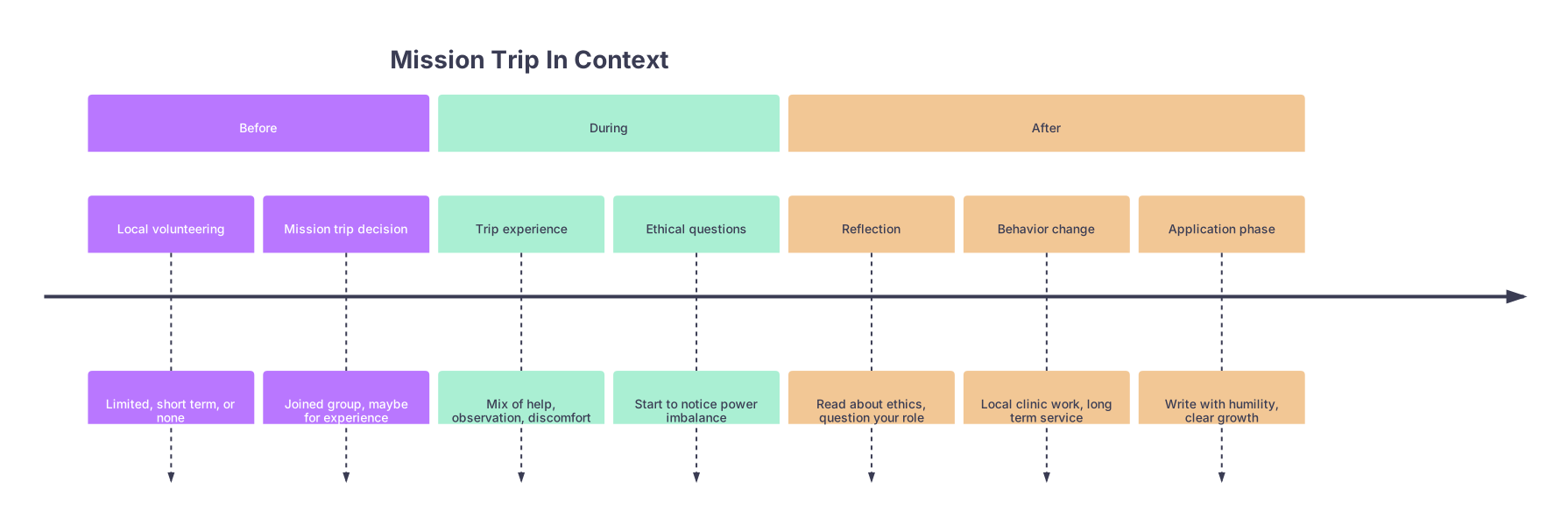
Timeline: How This Trip Fits Into Your Bigger Story
You’re scared this one line on your app will tank everything. It won’t—if everything around it makes sense.
Use this to zoom out:
| Period | Event |
|---|---|
| Before - Local volunteering | Limited, short term, or none |
| Before - Mission trip decision | Joined group, maybe for experience |
| During - Trip experience | Mix of help, observation, discomfort |
| During - Ethical questions | Start to notice power imbalance |
| After - Reflection | Read about ethics, question your role |
| After - Behavior change | Local clinic work, long term service |
| After - Application phase | Write with humility, clear growth |
If your story stops in the “During” phase and never moves into reflection + behavior change, that’s where you get burned.
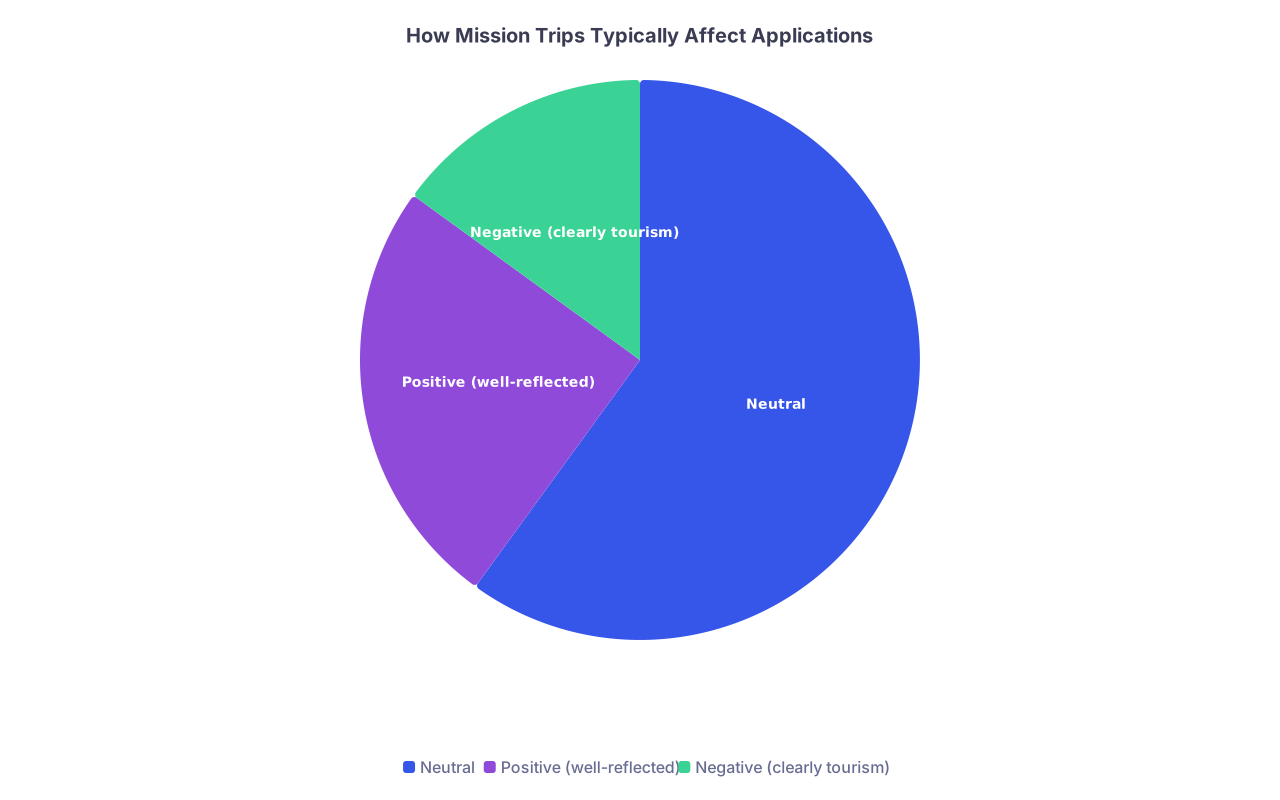
Quick Reality: How Often Do Mission Trips Actually Hurt You?
I’ve seen:
- People with ethically questionable trips still get in because they wrote humbly and had strong, grounded experiences elsewhere.
- People with “fancy” international trips get quietly side-eyed because everything else in their app was shallow.
- People who barely mentioned their mission trip, focused on local work, and were seen as thoughtful and grounded.
So how much are adcoms really punishing mission trips?
| Category | Value |
|---|---|
| Neutral | 60 |
| Positive (well-reflected) | 25 |
| Negative (clearly tourism) | 15 |
Most of the time? They’re neutral. They neither save you nor kill you. They just add context.
What matters is:
- Are you honest?
- Are you humble?
- Did this experience push you toward better behavior afterward?
If yes, you’re fine.
If You’re Still Worried Your Trip Was Really Bad
Let’s say you’re thinking, “No, seriously, mine was awful. I drew blood. I started IVs. I literally did things beyond my training.”
You have two options:
Minimize or omit it.
List it as a volunteer experience with a very conservative description. Don’t brag. Don’t detail ethically questionable procedures. Don’t anchor your personal statement on it. You’re not lying; you’re just not showcasing your worst judgment moment as your best story.Own the mistake and show real growth.
Harder, riskier, but if done right, very powerful. This means you explicitly acknowledge that what you did was ethically wrong, that you understand why, and that it’s fundamentally changed how you think about global health and power dynamics.
If you can’t talk about it without sounding defensive or minimizing it (“well, there was no one else, they needed us”), then don’t make it a centerpiece.
And seriously—do not ever admit to doing something blatantly illegal or dangerous in a proud tone. That’s the fastest way to the shred pile.
What You Can Do Now To Balance Things Out
You can’t un-take the flight. But you can absolutely reshape how this fits into your story.
Practical moves:
- Commit to at least one long-term, local clinical or service role (free clinic, mobile outreach, refugee center, etc.).
- Read real global health ethics work so your reflections aren’t surface-level.
- Talk to someone cynical and honest (like a global health faculty member) about your experience and ask them to tear apart your draft.
- In secondaries that ask about service or global health, be the applicant who already knows the critiques and is clearly not naïve.
You want the reader to think:
“This person went on one of those typical mission trips, realized the problems, and then matured. Good. They’re teachable.”
Not:
“This person went abroad to cosplay as a doctor and still doesn’t see the problem.”
FAQ (Exactly 4 Questions)
1. Should I leave my mission trip off my application completely?
Usually no. You did spend time, money, and effort, and you probably learned something. Just don’t oversell it. Keep the description accurate, modest, and short if you’re worried. Omit only if it was extremely unethical and you can’t frame it without sounding defensive or clueless.
2. Can I still write about my mission trip in my personal statement?
You can, but I wouldn’t make it your central, defining story unless it led directly to substantial, long-term work afterward. If the trip is a standalone, feel-good experience from years ago, use something more grounded and sustained (like ongoing clinical work) as your anchor.
3. What if I honestly thought I was helping and only later realized it was questionable?
That’s normal. Almost everyone who grows ethically can look back and cringe at a younger version of themselves. What matters is what you did after the realization. If you can articulate that growth clearly—without making excuses—you’re in better shape than the person who never questions anything.
4. How do I know if my actual wording sounds like medical tourism?
Give your description or essay to someone who does global health or ethics and ask them bluntly: “Does this sound savior-y or cringe?” If you don’t have that person, check your writing for: overuse of “gratitude,” “so poor but happy,” “changed my life,” any exaggeration of your role, and any sentence where you sound like the main hero. If you find those, you’re drifting into medical tourism territory—rewrite with more humility and specificity.
Bottom line:
Your mission trip, by itself, probably won’t sink you.
How you talk about it—and what you did after it—matters a lot more.
Aim for honesty, humility, and clear ethical growth, and you’ll be on the right side of this.


