

The worst thing you can do after a medical mission is rush back to “normal life” and pretend it was just a cool trip. The post‑mission month is where you either mature into an ethical global health practitioner—or lock in bad habits and shallow stories.
You’ve got about 4 weeks where memories are vivid, emotions are raw, and data is still salvageable. Use that window correctly, and you’ll walk away with genuine reflection, solid ethics, and maybe even a publishable piece of scholarship. Waste it, and you’ll be left with Instagram posts and fuzzy anecdotes.
Here’s your week‑by‑week, then day‑by‑day guide through the first month back.
Week 1: Landing, Decompression, Immediate Debrief
Days 1–2: Re‑entry and emotional triage
At this point you should not be writing a paper. You should be decompressing and doing a basic emotional and ethical “systems check.”
Day 1 checklist (or first full day home):
- Sleep. Real sleep, not airplane “sleep.”
- Eat something familiar and basic.
- Tell 1–2 close people you’re back safe. Not your entire social media feed yet.
- Jot a 10–15 minute “dump” in a notebook or doc:
- 5 most vivid patients.
- 3 moments you felt proud.
- 3 moments you felt uncomfortable or uneasy.
- Anything you can’t stop thinking about.
Do not edit. Do not make it sound good. Just capture raw material before your brain sanitizes it.
Day 2: Initial personal debrief
You’re still too close to it all to be “analytic,” but you can start sorting.
Spend 60–90 minutes with three buckets:
Facts
- Where you were (exact location, facility names).
- Who you worked with (local partners, NGOs, ministries).
- What you actually did (outpatient clinics, surgery assist, teaching, data collection).
Feelings
- Guilt, anger, admiration, helplessness, exhilaration.
- Circle the 1–2 strongest emotions. Those are likely to become the spine of your reflection or ethics piece.
-
- Any moments you suspect were ethically questionable:
- Being pressured to perform beyond your training.
- Short‑term “surgical blitzes” with no follow‑up.
- Photography or social media that felt exploitative.
- Meds or equipment left without a plan.
- Any moments you suspect were ethically questionable:
Write 2–3 sentences for each red flag. You are not assigning blame yet. You’re preserving evidence.
Days 3–4: Team and mentor debriefs
At this point you should talk before you publish.
Day 3: Team debrief (if applicable)
If your mission was with a group, push for (or organize) a structured debrief within 72 hours of everyone being back.
Core questions for a 60–90 minute session:
- What surprised us—clinically, culturally, logistically?
- When did we feel we added genuine value?
- When did we feel we might have caused harm or confusion?
- What did local partners say (explicitly or between the lines)?
- What should we absolutely change next time?
Document this. With consent, record audio or assign a note‑taker. This debrief becomes gold when you write later.
Day 4: One‑on‑one mentor check‑in
You need one person who:
- Knows global health or ethics (think: ID attending with global work, bioethics faculty, seasoned NGO medical lead).
- Isn’t dazzled by “voluntourism” stories.
In a 30–45 minute call or meeting:
- Walk them through 1–2 patient cases that are sticking with you.
- Flag the red‑flag moments you noted on Day 2.
- Ask bluntly:
- “What here sounds ethically problematic?”
- “What would you want me to read or think about based on this?”
Their reactions will shape what kind of scholarship your experience is suited for:
- Reflective essay.
- Ethical analysis/case.
- Quality improvement report.
- Program evaluation.
- Education/teaching initiative.
Days 5–7: Organizing data, protecting privacy, and setting your month goals
By the end of week 1 you should know what raw materials you have and what boundaries you must not cross.
Day 5: Data and documentation audit
Sit down with your laptop and any paper notes. Your job is to sort and secure.
Create three folders:
Raw clinical/log data (restricted)
- Patient logs, de‑identified where possible.
- Aggregate stats (e.g., “124 outpatients, 45 prenatal visits, 12 minor procedures”).
- Any pre/post teaching scores, if you did education.
Personal reflection
- Journal entries, emails to yourself, voice memos.
- Photos for your memory, not for public posting.
Shareable material
- Photos with explicit consent (written, if possible).
- Clinic stats already de‑identified.
- Teaching slide decks, protocols.
If you accidentally brought back any identifiable patient info that shouldn’t leave the host site, lock it down and talk to your supervising organization about secure deletion or return. Do not shrug this off.
Day 6: Quick ethical risk scan
This is where you prevent future headaches.
Use this simple triage:
| Area | Low Risk Example | High Risk Example |
|---|---|---|
| Photos | Landscapes, team only | Close-ups of identifiable patients |
| Procedures | Within your usual scope | Independently doing unfamiliar procedures |
| Data | De-identified counts | Names, dates of birth, full charts |
| Social Media | General reflections | “Case reports” with specifics |
Anything in the “high risk” column requires:
- Supervisor/mentor input.
- Possibly IRB consultation if you’re thinking publication.
- More anonymization than you think you need.
Day 7: Set your 3–4 week goals
You have limited bandwidth. Pick one primary scholarly output and maybe one secondary.
Options, depending on your role and context:
- Reflective essay (for a med school mag, residency newsletter, or journal like Academic Medicine’s “On the Teaching”).
- Ethics case commentary (e.g., for AMA Journal of Ethics or institutional ethics rounds).
- Brief report or QI piece (e.g., process improvement in triage, med supply logistics).
- Education product (curriculum, pre‑departure training module, simulation case based on a real scenario).
By the end of week 1, write one sentence:
“By 4 weeks post‑mission, I will have a solid draft of ________ ready for feedback.”
That sentence is your north star.
Week 2: Structured Reflection and Project Design
You’ve decompressed. Now you turn experience into something coherent.
Days 8–10: Deep reflection with structure
At this point you should force your brain to think beyond “it was eye‑opening.” Use frameworks.
Pick one day and spend 60–90 minutes using a reflection model; I like Gibbs’ cycle (adapted, simplified):
- Description – What actually happened?
- Pick 1–2 key scenes. Write them narratively in 300–500 words each.
- Feelings – What were you thinking and feeling at the time?
- Don’t sanitize. “I was scared I’d hurt someone.” “I felt weirdly proud.”
- Evaluation – What was good and bad about the situation?
- Good: e.g., strong local nurse leadership.
- Bad: lack of follow‑up after surgical camp.
- Analysis – Why did it play out that way?
- Bring in systems thinking: workforce shortages, supply chains, colonial legacies.
- Conclusion – What else could you/your team have done?
- Action plan – How will you act differently next time?
Do this properly for one strong case and you essentially have the backbone of a reflective essay or ethics case.
Days 11–12: Identify the scholarly angle
Now you transform all that raw content into a question worth writing about.
Common angles I’ve seen actually lead to publications:
- Scope of practice creep
- Question: “How should trainees respond when asked to practice beyond their training in low‑resource settings?”
- Short‑term missions vs continuity of care
- Question: “Are short‑term surgical campaigns ethically defensible without established follow‑up systems?”
- Power dynamics and consent
- Question: “What does informed consent look like when language and cultural gaps are huge?”
- Education and capacity building
- Question: “How can visiting teams shift from ‘doing for’ to ‘teaching with’ in one‑month rotations?”
Spend one evening distilling your angle into:
- One core question (1–2 sentences).
- Three supporting points or cases that illustrate it.
At this point you should also sketch your target venue:
- If it’s mostly narrative + emotion → reflective essay, maybe local institutional publication.
- If it’s analytic, citing ethical frameworks → ethics journal or departmental M&M/ethics rounds.
- If you have pre/post data or process changes → QI journal or global health education outlet.
Day 13–14: Basic project plan and IRB reality check
Here’s where people usually get it wrong. They go to IRB too late or not at all.
If you’re only doing:
- Personal reflection.
- Non‑systematic description of your own experience.
- No systematic data analysis of human subjects.
You likely don’t need IRB. But if you:
- Intend to analyze patient‑level data (even de‑identified) systematically.
- Collected surveys from local staff or patients with publication in mind (or even just “maybe someday”).
You must at least ask your institution’s IRB whether your project is:
- Not human subjects research.
- Exempt.
- Needs expedited/full review.
Use these days to:
- Draft a 1‑page project brief:
- Background (2–3 sentences).
- Question.
- Methods (even if simple).
- Data sources.
- Ethical concerns and how you’ll handle them.
- Send it to:
- A faculty mentor.
- The global health office (if your school has one).
- IRB office (if needed) asking, “How should I proceed?”
While this is in motion, you can still work on non‑data‑heavy parts (reflection, literature review, outlines).
Week 3: Writing, Analyzing, and Building Something Real
Week 3 is production week. This is where you actually create.
Day 15–17: Literature quick scan and outline
By now you should stop pretending your case is “totally unique.” It’s not. That’s actually good news—you can plug into existing conversations.
Spend 2–3 hours with PubMed/Google Scholar:
Search phrases like:
- “Short term medical missions ethics”
- “Global surgery trainee scope of practice”
- “Voluntourism critical analysis”
- “Task shifting ethics low income countries”
As you skim:
- Save 6–10 key articles in a reference manager (Zotero, Mendeley, or even a simple doc with links).
- Note 3–4 quotes or findings that resonate with your experience.
Now outline your piece. For a reflective/ethics article, a simple structure works:
- Hook – A brief, vivid scene (the patient or moment that won’t leave you).
- Context – Where you were, who you are, what the mission was.
- Ethical tension or question – The core of your piece.
- Analysis – What existing literature says, how your case fits or conflicts with it.
- Reflection – How this changed your practice or thinking.
- Implications – For trainees, programs, or policy.
For a more data/QI piece, your IMRAD‑ish skeleton:
- Introduction
- Methods (even if descriptive)
- Results (basic counts, patterns)
- Discussion (implications, limitations)
- Conclusion
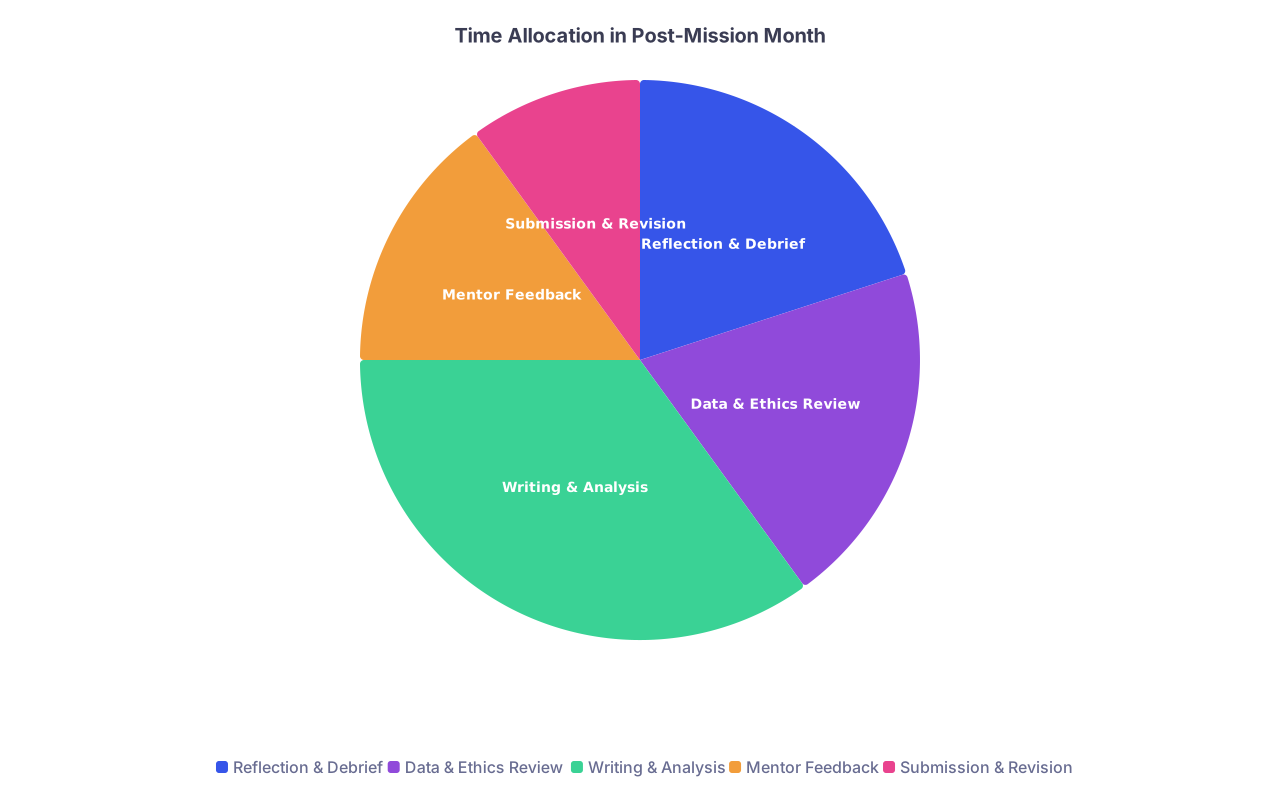
| Category | Value |
|---|---|
| Reflection & Debrief | 20 |
| Data & Ethics Review | 20 |
| Writing & Analysis | 35 |
| Mentor Feedback | 15 |
| Submission & Revision | 10 |
Days 18–20: First draft sprint
At this point you should stop perfecting your outline and write a bad first draft.
Block 2–3 sessions of 60–90 minutes.
Session 1:
- Write the hook + description of your key case(s).
- Do not cite anything yet. Just tell the story clearly and concretely.
Session 2:
- Draft the analysis section.
- Bring in 3–5 references you flagged.
- Explicitly name frameworks if you use them (e.g., Beauchamp & Childress’ four principles, justice, reciprocity, etc.).
Session 3:
- Draft reflection and implications.
- Be specific:
- “Next time, I’d insist on X before agreeing to Y.”
- “Programs should require Z for all trainees.”
By the end of Day 20 you should have a complete but ugly draft.
Days 21: Local partner reality check (if possible)
If you have a respectful, ongoing relationship with local collaborators, this is the day you loop them in.
Send a brief email:
- Thanking them again.
- Summarizing your planned piece in 3–4 sentences.
- Asking:
- “Does this feel like a fair representation?”
- “Is there anything you’d want included or excluded?”
If they’re too busy or unreachable, you still write—but you assume they’ll one day read it. That assumption should shape your tone.
Week 4: Revision, Feedback, and Submission Strategy
This week turns a draft into scholarship.
Days 22–24: First revision and “ethics scrub”
At this point you should do a line‑by‑line ethics scrub before anyone else sees it.
Print your draft or use track changes. For each paragraph, ask:
- Am I sensationalizing poverty or suffering?
- Do I describe patients with dignity and agency, not as props?
- Could a colleague reasonably identify a specific patient from what I’ve written?
- Do I accidentally center myself as “savior” rather than part of a system?
Concrete steps:
- Change names, ages, and non‑essential details to protect identity.
- Remove any “poverty porn” language (“desperate,” “in the middle of nowhere,” “primitive”).
- Replace vague virtue signaling (“It changed my life”) with concrete behavioral change.
Days 25–26: Mentor and peer feedback
Now your piece is clean enough to show other humans.
Pick:
- One content mentor (global health/ethics).
- One form mentor (good writer/editor).
- One peer (resident, student) who gets the culture.
Send:
- The draft.
- A 1–2 sentence statement of your goal and target venue.
- 3 specific questions, for example:
- “Where does this feel self‑centered?”
- “Is the ethical tension clear?”
- “What would you cut?”
Give them 5–7 days, but while you wait you don’t just sit idle.
Parallel task: identify 2–3 possible outlets.
| Type | Example Venue | Typical Length |
|---|---|---|
| Reflective | Academic Medicine, in-house | 800–1500 words |
| Ethics Case | AMA Journal of Ethics | 1500–2500 words |
| QI/Brief Report | Global Health journals | 1500–3000 words |
Check:
- Word limits.
- Reference style.
- Any specific global health/ethics guidelines.
Day 27–28: Final revision and technical prep
At this point you should incorporate feedback ruthlessly.
- Cut flabby intros and repeated points.
- Clarify your central question or thesis early.
- Make sure at least one paragraph explicitly connects your anecdote to broader systems or literature.
Then:
- Format references.
- Check word count.
- Write a 150–250 word abstract or cover email summarizing:
- Context.
- Question.
- Main insight.
This is also the time to assemble any simple tables or figures if you’re doing a more data‑based piece.
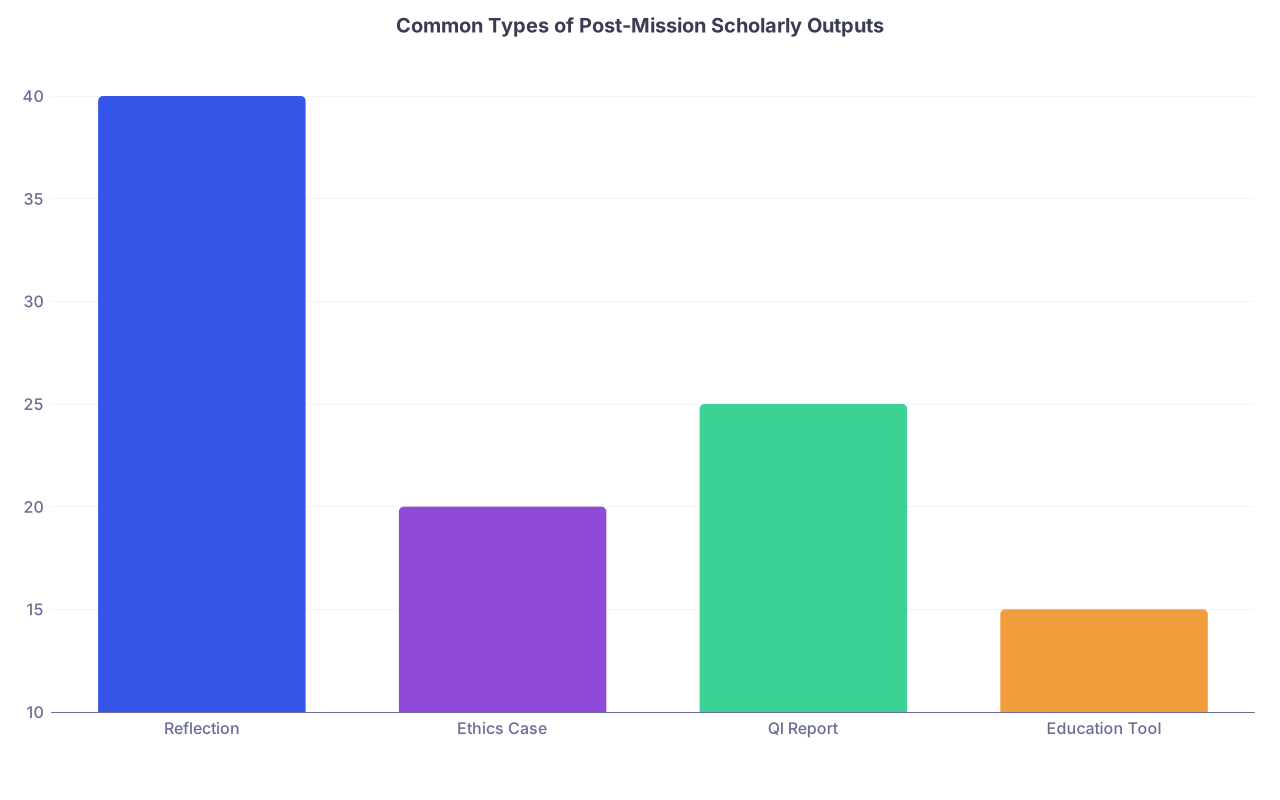
| Category | Value |
|---|---|
| Reflection | 40 |
| Ethics Case | 20 |
| QI Report | 25 |
| Education Tool | 15 |
Day 29–30: Submission and long‑term integration
The last two days of your post‑mission month are about closing the loop and setting the next one.
Day 29: Submit and document
- Submit to your chosen venue (or two, if one is internal, one external).
- Save:
- Final draft.
- Cover letter/email.
- Notes on where you submitted and when.
Also log your experience more broadly:
- In your CV: “Short‑term clinical experience, [country], [dates], focus on [X].”
- In a running doc of “cases and reflections” for future residency/fellowship essays.
Day 30: Personal ethics and practice plan
Now zoom out.
Take 45–60 minutes with one document titled:
“Global Health Practice Commitments”
Bullet out:
- What you will not do again (e.g., “I will not agree to independent procedures outside my usual scope without adequate supervision and follow‑up.”).
- What you will insist on next time (e.g., “Pre‑departure ethics briefing; understanding local follow‑up systems; clearer role definitions.”).
- How you’ll prepare differently before the next mission (courses, language learning, reading).
This is how you prove—to yourself more than anyone—that the mission wasn’t just a story factory. It changed how you practice.
Integrating scholarship into your long game
One last piece: don’t let this be a one‑off.
Over the next 6–12 months, you can:
- Present your experience at:
- Department grand rounds.
- Medical school global health days.
- Residency noon conference.
- Collaborate with your global health office to:
- Build pre‑departure training with real cases from your trip.
- Develop checklists for ethics review before and after missions.
Here’s a simple visual of how the month you just walked through fits into an ongoing cycle:
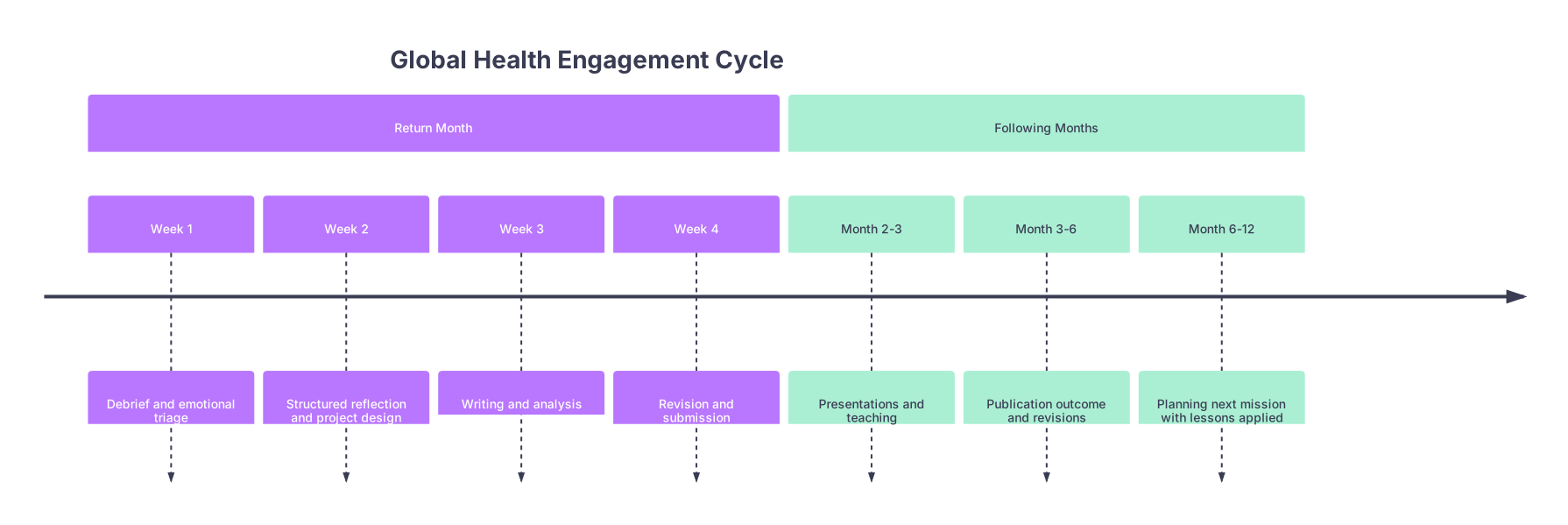
| Period | Event |
|---|---|
| Return Month - Week 1 | Debrief and emotional triage |
| Return Month - Week 2 | Structured reflection and project design |
| Return Month - Week 3 | Writing and analysis |
| Return Month - Week 4 | Revision and submission |
| Following Months - Month 2-3 | Presentations and teaching |
| Following Months - Month 3-6 | Publication outcome and revisions |
| Following Months - Month 6-12 | Planning next mission with lessons applied |
And underneath all that, remember: scholarship is not just papers. It’s any disciplined, shareable reflection that others can learn from—especially when it calls out uncomfortable truths about how we do global health.
Key takeaways:
- The first month back is not optional downtime; it’s the critical window to debrief honestly, confront ethical tensions, and capture fragile details before they fade.
- Scholarship starts with structure: a clear question, a specific angle, and disciplined reflection—not with a blank Word document and vague guilt.
- If you end this month with one solid draft, one ethics commitment document, and one concrete change to your future practice, you’ve actually honored the people and systems you just visited.


