
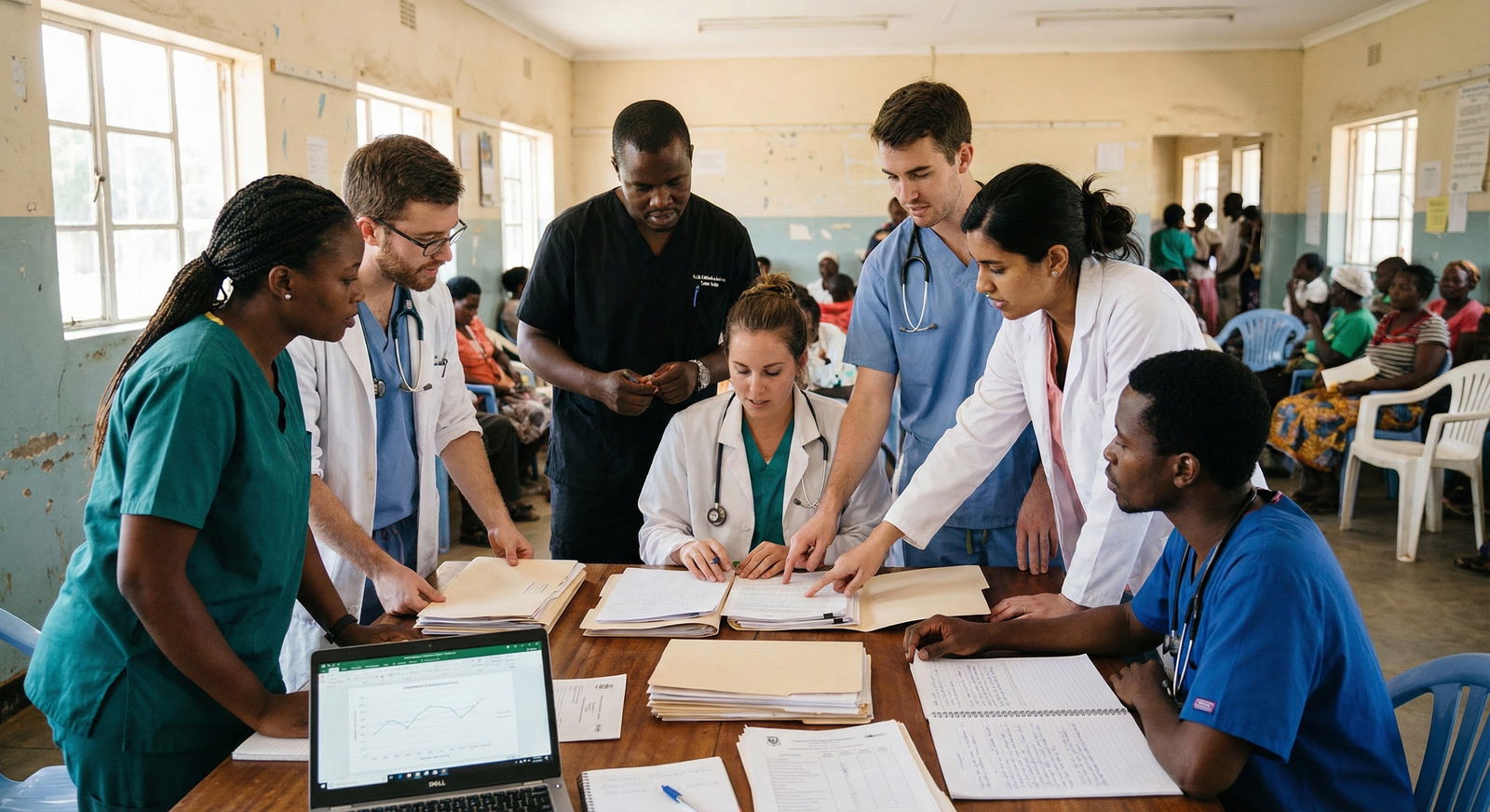
Rushing into medical missions as a trainee is one of the fastest ways to cause harm with good intentions.
If you want to serve abroad (or in underserved domestic settings) and protect your license, your patients, and your sanity, timing is everything. The question is not “Should I go?” It is “When, and under what conditions, is it safe and ethical for me to go?”
I am going to walk you straight through that timeline. From M3 to PGY‑3. Where missions actually fit. When they are a terrible idea. And what should already be in place each time you say yes to a trip.
Big Picture Timeline: Where Missions Actually Fit
At this point, you need a mental map of the whole training arc. Here is the blunt overview.
| Stage | Mission Type That Fits Best | Key Requirement |
|---|---|---|
| Late MS2–MS3 | Observership / research-focused | Strong supervision |
| MS4 | For-credit global/underserved elective | University-affiliated |
| PGY-1 (Intern year) | Usually avoid short-term missions | Program director approval |
| PGY-2 | Structured elective with oversight | Skills aligned with needs |
| PGY-3 | Longer, integrated rotation or prep for long-term work | Clear scope and backup |
You will notice what is missing: “Solo spring break surgical hero trip as an M1.” That is because it is reckless.
Now let us go step by step.
Pre‑Clinical to Early Clinical (M1–Early M3): Prepare, Do Not Practice
At this point you should focus on building foundations, not flying out to “run clinics.”
M1–M2: Learn, Do Not Treat
You are dangerous with a stethoscope and enthusiasm but no clinical judgment. Use these years to prepare, not perform.
What is appropriate here:
Classroom and independent preparation
- Global health ethics courses.
- Reading on colonialism and “voluntourism” (Paul Farmer, Madhukar Pai, Partners In Health case studies).
- Basic language learning (medical Spanish, French, Swahili, whatever is relevant).
Local, domestic underserved work
- Free clinics where you are clearly a pre-clinical student:
- Taking histories under direct supervision.
- Scribing.
- Patient education with scripts your attending has approved.
- Free clinics where you are clearly a pre-clinical student:
Maybe: future-oriented trip planning
- Helping faculty design systems, protocols, or research for an established partner site you may visit later as an MS4 or resident.
What you should not do yet:
- Fly abroad to “help” in any hands-on clinical role.
- Prescribe, perform procedures, or “be the doctor” for anyone.
At this point, your mission work should be about education, humility, and context, not clinical impact. You do not have the skills to make safe independent decisions, and pretending otherwise is how disasters start.
Late M2–M3: First Clinical Skills, Still Limited Missions
Now you are barely starting to be clinically useful. Barely. That changes what is safe, but not as much as you think.
At this point you should:
Prioritize your core clinical training. Shelf exams and Step 2 matter more than another stamp in your passport. Weak clinical fundamentals = unsafe on missions later.
If you “go,” go in strongly supervised, clearly defined roles:
- University-sponsored trips with clear objectives.
- Longstanding institutional partnerships (5+ years, recurring).
- A local in-country medical leadership structure.
Your safe mission roles now:
- History taking, physical exams, and case presentations.
- Scribing and documentation.
- Community education alongside local staff.
- Research/data collection under IRB and local ethics approval.
What you still must avoid:
- Operating as the primary decision-maker.
- Doing procedures you are not fully competent in at home.
- Trips where the presence of trainees is the point of the trip rather than a side benefit to a system that already works without you.
If you cannot do it unsupervised in your home hospital without making your attending sweat, you should not be doing it on a mission trip.
MS4 Year: The First Real Window for Responsible Missions
Now we are finally at the first real inflection point. MS4 is usually your best chance during medical school to do a meaningful clinical mission safely.
At this point you should be:
- Locking in one or two formal global health or underserved electives.
- Making sure they are:
- For credit.
- University-approved.
- Covered by your malpractice and student insurance.
- Supervised by faculty who know the site personally.
Timeline Through MS4
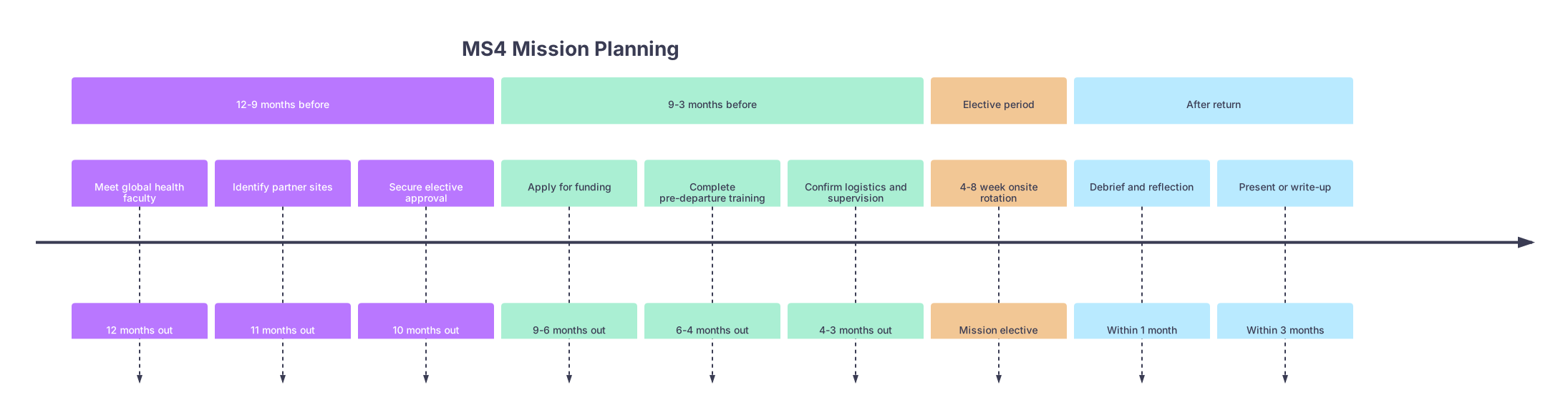
| Period | Event |
|---|---|
| 12-9 months before - Meet global health faculty | 12 months out |
| 12-9 months before - Identify partner sites | 11 months out |
| 12-9 months before - Secure elective approval | 10 months out |
| 9-3 months before - Apply for funding | 9-6 months out |
| 9-3 months before - Complete pre-departure training | 6-4 months out |
| 9-3 months before - Confirm logistics and supervision | 4-3 months out |
| Elective period - 4-8 week onsite rotation | Mission elective |
| After return - Debrief and reflection | Within 1 month |
| After return - Present or write-up | Within 3 months |
Week-by-week for a 4‑week MS4 mission elective:
Week 1
- Observe more than you touch.
- Learn the local system, referral patterns, formulary.
- Understand what happens after your team leaves.
Week 2
- Take on typical MS4 responsibilities:
- See patients.
- Present plans to local and supervising physicians.
- Document under supervision.
- Audit yourself: Are you practicing within your usual scope at home?
- Take on typical MS4 responsibilities:
Weeks 3–4
- Take on slightly more autonomy but only to the level a trusted MS4 would have in your home teaching hospital.
- Begin small quality improvement or teaching tasks that local staff actually asked for.
Red flags that mean you should walk away from a site:
- “You can be the surgeon/doctor because they are short-staffed.”
- No local partner who will be there when you leave.
- No plan for continuity of care.
MS4 is the right time, but many sites are the wrong place. Choose carefully.
PGY‑1: Intern Year — Minimum Missions, Maximum Training
This is where many people make bad decisions.
You finally have the MD, you are exhausted, and a two‑week trip to “make a difference” sounds noble. It is usually a mistake.
At this point you should:
Protect your core residency training. Intern year is about survival and competence. Every elective you get is gold. You cannot afford to waste it on a poorly structured mission where you are ineffective and sleep-deprived.
If you do any mission work, it should be:
- Brief and non-clinical or minimally clinical.
- Within a well-established residency track (e.g., global health pathway) with:
- Clear objectives.
- Assigned mentors.
- Realistic scope.
Most interns are still calibrating basic skills:
- Triage.
- When to escalate.
- Orders and monitoring.
- Recognizing when a patient is about to crash.
Add language barriers, no labs, and spotty follow-up, and your risk of making a serious error multiplies.
I have watched interns try to “manage DKA” in a clinic with no insulin pump, no lab, no ICU backup. Scary does not begin to cover it.
Rule for PGY‑1:
- If you are not yet comfortable managing these problems at home with backup, you have no business managing more complicated, less-resourced versions abroad.
PGY‑2: The Real Sweet Spot for Careful, Structured Missions
Now you have some clinical seasoning. You have seen enough bad outcomes to know what you do not know. This is when mission work, if structured correctly, can be both impactful and safe.
At this point you should:
Work only through your residency program or a well-vetted NGO.
- Program director knows where you are.
- Rotation is in your schedule, not “vacation with a stethoscope.”
- Malpractice and licensure coverage are confirmed in writing.
Choose missions that match your skill level and specialty.
- Internal medicine PGY‑2:
- Chronic disease management clinic.
- HIV/TB programs.
- Hospitalist-style ward work under local consultants.
- EM PGY‑2:
- ED triage, stabilization, teaching basic emergency skills.
- Surgery PGY‑2:
- Assisting in cases you also perform or assist with at home.
- Not leading major cases solo.
- Internal medicine PGY‑2:
Focus on partnership, not volume.
- You are not there to “see as many patients as possible.”
- You are there to:
- Support local clinicians.
- Strengthen systems.
- Teach small, durable skills if invited.
Sample 4‑Week PGY‑2 Mission Elective Structure
Week 0 (Pre‑departure, 2–3 months earlier):
- Finalize goals with mentor:
- 2–3 clinical learning goals.
- 1 systems/education goal.
- Complete:
- Travel clinic visit.
- Pre-departure ethics and safety training.
- Confirm:
- Housing.
- In-country contact.
- Emergency evacuation plan.
Weeks 1–2 on site:
- Shadow local clinicians for the first several days.
- Gradually step into:
- Running a small subset of follow-up visits.
- Teaching students or interns at the bedside (if asked).
- Helping with protocols (e.g., sepsis bundles, diabetes flowsheets) that local partners requested.
Weeks 3–4:
- Take on near-full PGY‑2 level responsibilities:
- Call for help early and often.
- Keep a low threshold for saying “I do not know.”
- Begin handoff planning:
- Ensure continuity for patients you followed.
- Leave behind documentation that local clinicians actually want.
Post-return (Weeks 5–8):
- Debrief with your PD and global health faculty.
- Reflect: Did you stay in scope? Where did you almost cross the line?
- Share lessons with your peers, ideally with a case presentation focused on systems, not your heroics.
PGY‑3: Integration, Leadership, and Long-Term Thinking
By PGY‑3, if you have maintained your training priorities, you may finally be clinically solid enough to take on more leadership in mission settings.
Key phrase: more leadership. Not full control. Not martyrdom.
At this point you should:
- Make your mission decision based on your career trajectory:
- Planning a global health or underserved career?
- Use PGY‑3 to test a site for possible long-term work.
- Planning standard practice at home?
- Choose carefully: one, maybe two short-term, high-quality experiences.
- Planning a global health or underserved career?
Realistic Roles for a PGY‑3
Senior resident in an integrated global health track:
- Co-leading teaching sessions for local trainees.
- Helping design or refine protocols requested by local partners.
- Supporting quality improvement with real data and follow-through.
Returning to the same site:
- You already know the system.
- You have relationships and understand what not to try.
- Your second or third trip is usually more effective than your first.
Year‑Long Timeline for a PGY‑3 Mission Rotation
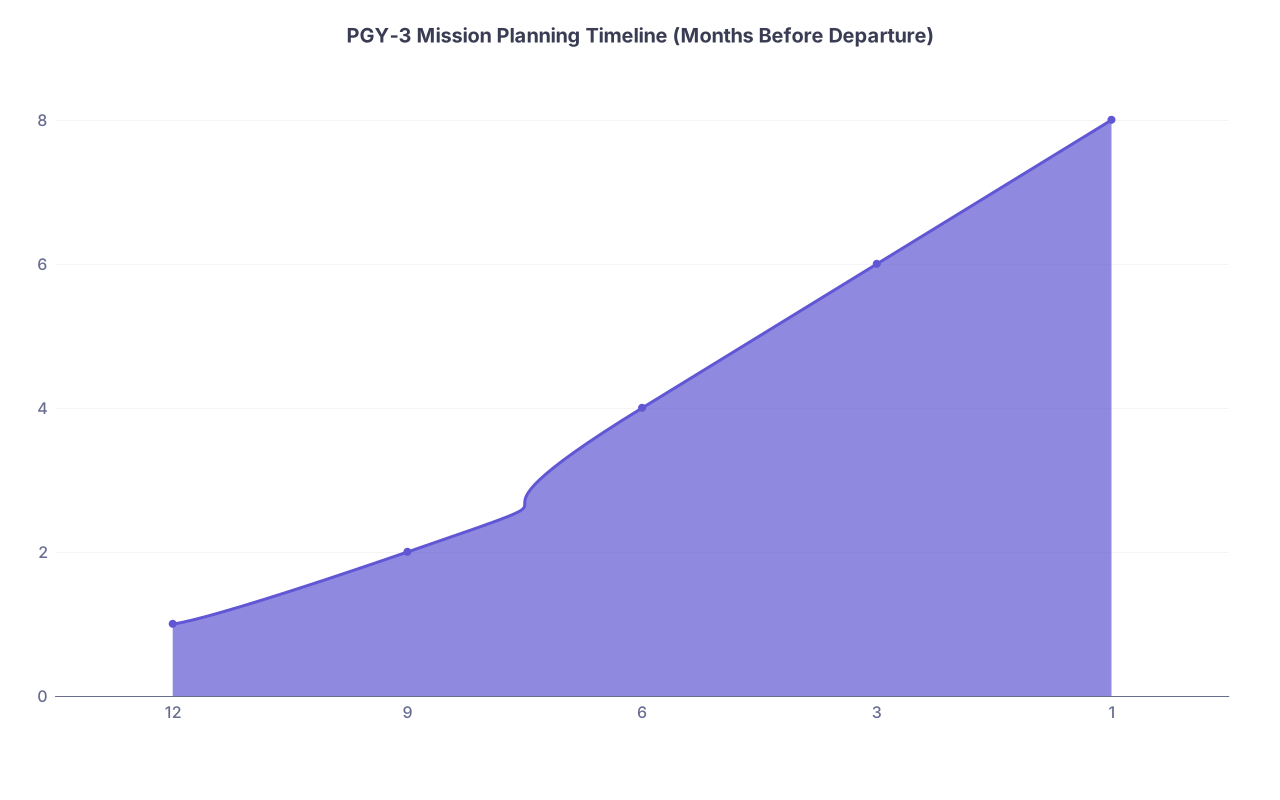
| Category | Value |
|---|---|
| 12 | 1 |
| 9 | 2 |
| 6 | 4 |
| 3 | 6 |
| 1 | 8 |
Interpretation (how many major planning tasks are active):
12 months out
- Decide: mission vs no mission this year.
- Discuss with PD and global health faculty.
9–6 months out
- Secure rotation approval and schedule block.
- Confirm funding, housing, and licensure coverage.
- Begin targeted language study if needed.
6–3 months out
- Clarify expectations with local site:
- Clinical scope.
- Teaching commitments.
- Research or QI roles.
- Clarify expectations with local site:
3–1 month out
- Lock in travel and safety plans.
- Update vaccines, prophylaxis.
- Assign clear point-of-contact at home for emergencies.
On site (typically 4–8 weeks)
- Function at or slightly below your usual senior resident scope, never above.
- Be the most cautious person in the room, not the most aggressive.
Post-return
- Help build continuity:
- Protocol documents that local clinicians revise and own.
- Handover notes for the next team.
- Translate experience into sustainable involvement if appropriate.
- Help build continuity:
Ethical Guardrails at Every Stage
Across M3 to PGY‑3, your timing decisions are really ethical decisions in disguise. Every year, ask yourself:
- Am I practicing within or below my home scope of training?
- Is this trip serving local needs, or my CV and ego?
- Has the local community meaningfully approved and shaped this project?
- What happens to my patients when I get on my flight home?
If you cannot answer those cleanly, the timing is wrong. I do not care whether you are an MS4 or PGY‑3.
Quick Comparison: When Missions Are Safest
| Level | Safety Window | Why |
|---|---|---|
| MS1–2 | Prep only | No clinical competence yet |
| MS3 | Limited | Still too green for major decisions |
| MS4 | Good | Supervised electives, some skill |
| PGY‑1 | Poor | Overloaded, still calibrating |
| PGY‑2 | Best | Enough skill, still supervised |
| PGY‑3 | Good | For integration, leadership |
If you want one blunt rule:
Aim for structured, supervised missions as an MS4 and PGY‑2/3. Avoid early, unsupervised, or “pop-up” trips at all costs.
FAQ (Exactly 4 Questions)
1. Is it ever acceptable to go on a mission trip before MS4?
Yes, but only in non-clinical or tightly supervised, observation-heavy roles. Before MS4, you should not be making independent clinical decisions or performing procedures in mission settings. Your contributions should be educational, logistical, or research-focused, ideally in longstanding partnerships where your presence is not critical to service delivery.
2. Can I use vacation time during residency for an independent mission trip?
You can, but usually you should not. Independent trips during vacation often lack proper supervision, malpractice coverage, or integration with your training goals. If you go, it must be with a vetted, reputable organization that understands your training level, and your program director should be fully informed. “Shadowing as the only physician” on your week off is a disaster waiting to happen.
3. Do short-term missions actually help, or are they mostly harmful?
Short-term missions are often harmful when they are one-off, poorly coordinated, and trainee-centered. They can be helpful when they are:
- Part of long-term partnerships.
- Led by local priorities.
- Focused on capacity building rather than numbers seen. Your timing in training does not fix a fundamentally bad model, so choose programs that have been invited, evaluated, and sustained by local partners.
4. How can I tell if a specific mission opportunity is ethically sound for my level?
Ask concrete questions: Who is in charge on the ground? How long has this partnership existed? What exactly will I be allowed to do, and is that within my usual scope at home? What happens to my patients after I leave? Is there malpractice coverage, and do I hold appropriate licensure for that country? If the answers are vague, defensive, or centered on “exposure” and “experience” rather than local care and continuity, walk away.
Key points:
- The safest, most ethical windows for medical missions during training are structured MS4 electives and PGY‑2/3 rotations woven into real partnerships.
- At every phase, your scope abroad should be equal to or less than your scope at home, with stronger—not weaker—supervision.


