

Most students think mission trips are about “helping the poor.” Attendings know they’re actually about watching who you become when no one is grading you.
Let me tell you how you’re really being evaluated on medical mission trips—because no one is going to say this to your face during pre-departure orientation. But your attendings are talking about it on the bus, at dinner, and on the debrief call once you’re back home.
And yes, those quiet impressions do end up in letters of recommendation, selection committee meetings, and the mental “never again” list attendings keep about certain students.
The First Filter: Why You’re There (And What You Talk About)
The vetting starts long before you’re holding a stethoscope in a village.
On every mission trip I’ve been on or helped organize, there’s an unofficial pre-trip conversation among faculty: “Who’s going? Who pushed to get on the roster? And why?”
We’re not usually reading your soul. We’re listening to what you reveal without realizing it.
If you say things like:
- “I’m really hoping to get some procedures in.”
- “I didn’t get to do much in my last rotation, hoping to finally put in some lines.”
- “This will look great on my residency application.”
You’ve already red-flagged yourself. Not automatic doom. But we’re now in “watch this one carefully” mode.
The students who immediately earn quiet respect say things more like:
- “I’m interested in how to provide ethical care with limited resources.”
- “I want to understand how local clinicians actually feel about visiting teams.”
- “I’m worried about scope of practice—what should I not do over there?”
Same trip, same packing list, completely different starting reputation.
And here’s the part you don’t see: before you ever step on the plane, attendings will sometimes call each other:
“Hey, you’ve worked with her, right? How does she handle feedback?”
“He’s solid clinically, but he likes to show off. Might be an issue.”
By the time you’re posting your first “so grateful for this experience” airport selfie, some attendings already have a working hypothesis about you. The trip is where they test it.
The First 48 Hours: How You Handle Discomfort
Mission trips strip away your usual support system—your language, your routines, your hospital infrastructure. That’s exactly why attendings like them as a testing ground.
They watch how you respond when you’re tired, hungry, jet-lagged, and slightly confused.
Here’s what they’re silently scoring.
1. Your Relationship With Inconvenience
Nobody cares how you act at 10 a.m. after coffee and breakfast. They care how you act when:
- The bus is late.
- The clinic start time keeps sliding.
- The housing has cold water only.
- The bugs are relentless and the Wi-Fi doesn’t work.
The students who quietly get labeled as “immature” are the ones who:
- Constantly compare everything to home: “Our hospital would never…”
- Complain about food, beds, temperatures to patients, not just privately.
- Turn minor annoyances into group complaints and poison the mood.
I once watched an attending at a Central American site mentally cross off a student after hearing them say (loudly), “This would be fine as a vacation, but working like this is ridiculous.” That line came up directly—verbatim—when we discussed whether to write them a letter later.
The ones who quietly gain credit are the people who roll with it, make jokes, adjust, and re-focus on the work without performance.
2. How You Approach the Local Team on Day One
You’re not just being seen by your attendings. The local nurse, translator, clinic director—they all report back on you. Informally, but very clearly.
On day one, attendings pay attention to simple things:
- Do you introduce yourself to the local staff first, or just trail your attending like a duckling?
- Do you ask the translator’s name—or treat them like a tool?
- Do you say “thank you” in the local language, or act as if English is an entitlement?
I watched a senior attending in Kenya pull me aside once and say, “That student? She asked the nurse how this clinic runs when we’re not here. She’s thinking right.” That one question told him she wasn’t just another short-term voluntourist.
Your early small talk is being weighed. Not for smoothness. For respect.
At the Bedside: What You Do When No One’s Looking Closely
This is where the ethical vetting gets serious, and where most students overestimate how much they’re getting away with.
Your attending cannot stand over your shoulder every second. But there are patterns, and faculty notice them quickly.
3. Scope of Practice: Do You Chase Experiences or Protect Patients?
Here’s the dirty secret: on many mission trips, you could get away with doing more than you’re trained for. Local patients are grateful. Systems are looser. There’s no EMR audit trail.
Every ethical attending knows this. So they watch how you behave when the guardrails look weak.
Common scenarios:
- You’ve never done a real IV start, but supplies are limited and the line “has to go in.”
- Someone mentions you might get to “assist on a minor procedure” and your eyes light up.
- The local clinician casually offers, “Student can do it?” and looks to see if you step forward.
The student who quietly worries good attendings is the one who jumps at every chance for a “first” without first asking:
- “What’s my role here?”
- “Is this appropriate for my level?”
- “Can I observe first, then see if it’s reasonable for me to try under supervision?”
I’ve heard attendings say things like, “She’s just a little too eager to do things to poor people she wouldn’t do back home.” That is a devastating line. It means you’ve failed the fundamental ethics test of global health.
Good students:
- Ask before doing.
- Are quick to defer when something feels out of depth.
- Do not exploit the looser environment to rack up procedures.
We remember the ones who voluntarily say, “I’m not comfortable doing that here; can I watch instead?” That’s a trust signal.
4. Consent and Language: Do You Treat Patients as Props?
Here’s something most students underestimate: how often faculty stand in the doorway or just close enough to hear you try to “explain” a procedure through a translator.
They’re not just evaluating your Spanish/French/Swahili. They’re listening for whether the patient is treated as a full person or as a passive body.
Red flags:
- Talking about the patient to the translator instead of to the patient.
- Glossing over risks because “we’re trying to help them.”
- Using dumber or more coercive language than you would at home (“This will fix you,” “We need to do this now or you’ll get very sick”).
One attending I know in Haiti said flatly, “If I hear a student give less honest consent there than they would in Boston, I never write them a strong letter. Ever.”
Good students still mess up phrases and stumble, but they:
- Look the patient in the eye.
- Try to learn key words (pain, OK, stop, thank you).
- Ask the translator to repeat crucial points back.
- Do not rush consent just to keep the line moving.
You are being vetted on whether your ethical floor travels with you—or whether it magically lowers in a low-income country.
The Non-Clinical Vetting: How You Move in the Group
Your attendings are not just gauging your clinical instincts. They’re watching how you exist in community. Global health work lives and dies on that.
5. The “Off Hours” Test: Evenings and Weekends
Most students behave decently in front of patients. Where the truth leaks out is back at the guesthouse, at dinner, on the van ride home.
That’s when attendings mentally sort you into one of three piles:
The Energy Drain
Constant complaining. Gossip about other students. Eye-rolling about local systems. Turning every inconvenience into a story about their own suffering.
Those students might still be clinically strong, but they don’t get invited back. Programs are built on reliability, not drama.The Performative Do-Gooder
Always “on brand.” Never puts the phone down. Posts every patient encounter. Says cringey things like “These people are so happy with so little.”
Attendings see through that. I’ve literally watched a faculty member scroll through a student’s Instagram mid-trip and say, “She’s making this trip about herself.”The Quiet Steady One
Helps clean up without being asked. Talks to the local staff at dinner, not just other Americans. Takes in hard cases and asks thoughtful questions later, not in the moment for performance.
These are the students whose names come up later when someone says, “We need one good resident for this global health elective.”
Your evenings matter. Not for puritan reasons. Because they reveal your underlying attitude toward the work and the people.
6. How You Handle Being Wrong or Out of Your Depth
Every trip has a moment where you say something naive or culturally clueless. That’s expected. What’s evaluated is your reaction to being corrected.
If a local physician says, “No, that’s not how we treat hypertension here,” do you:
- Argue gently but arrogantly about “guidelines back home”?
- Shut down and sulk?
- Or ask, “Can you walk me through your reasoning and your constraints?”
I sat in on a debrief once where a local doc said about a student, “He listened. He did not come to fix us.” That line turned an average clinical student into someone I’d trust on any global project.
Your ability to absorb correction from non-American authority figures is a major hidden test.
Ethics Under Scarcity: What Choices You Make With Limited Resources
A real mission or global health trip is not a cosplay clinic. There are finite resources, conflicting needs, and long-term implications.
That’s where attendings really separate the “nice traveler” from the future ethically solid physician.
7. Triage and “Who Gets What” Decisions
You will see the same patterns of illness over and over: uncontrolled diabetes, untreated hypertension, chronic pain, advanced disease that should have been caught years ago.
The resources:
- Limited medications.
- Limited time.
- Limited follow-up ability.
Attendings watch how you reason through that. Not to see if you pick the “correct” person every time, but to see if you’re even aware of the ethical weight.
Bad signs:
- Treating the clinic like a giveaway table: eager to prescribe or dispense just for the emotional payoff of “helping.”
- Getting angry at local staff for saying “no” when they know the system better.
- Pushing for a dramatic intervention on one patient at the cost of many small, sustainable ones.
Good signs:
- Asking early, “What happens after we leave for this patient?”
- Prioritizing medications that can actually be continued, not just started.
- Involving local clinicians in decisions instead of making them unilaterally.
Your internal compass about fairness is being mapped, even if no one spells that out to you.
8. Short-Term Benefit vs Long-Term Harm
The most uncomfortable ethical vetting happens quietly. In discussions you’re not always part of.
After clinic, faculty and local partners talk: “Should we even be doing X?” “Does this help the system or just feel good today?”
They’re also talking about how you think about those questions.
Students who stand out aren’t the ones who “save a leg” or “diagnose the rare tropical disease.” They’re the ones who say things like:
- “Are we undermining local providers by doing this?”
- “How is this clinic funded when we’re not here?”
- “Are we creating dependency with this model?”
When you bring those questions up—not as an attack, but as curiosity—you signal that you understand global health ethics isn’t solved by smiling hard enough. That’s rare. And it gets remembered.
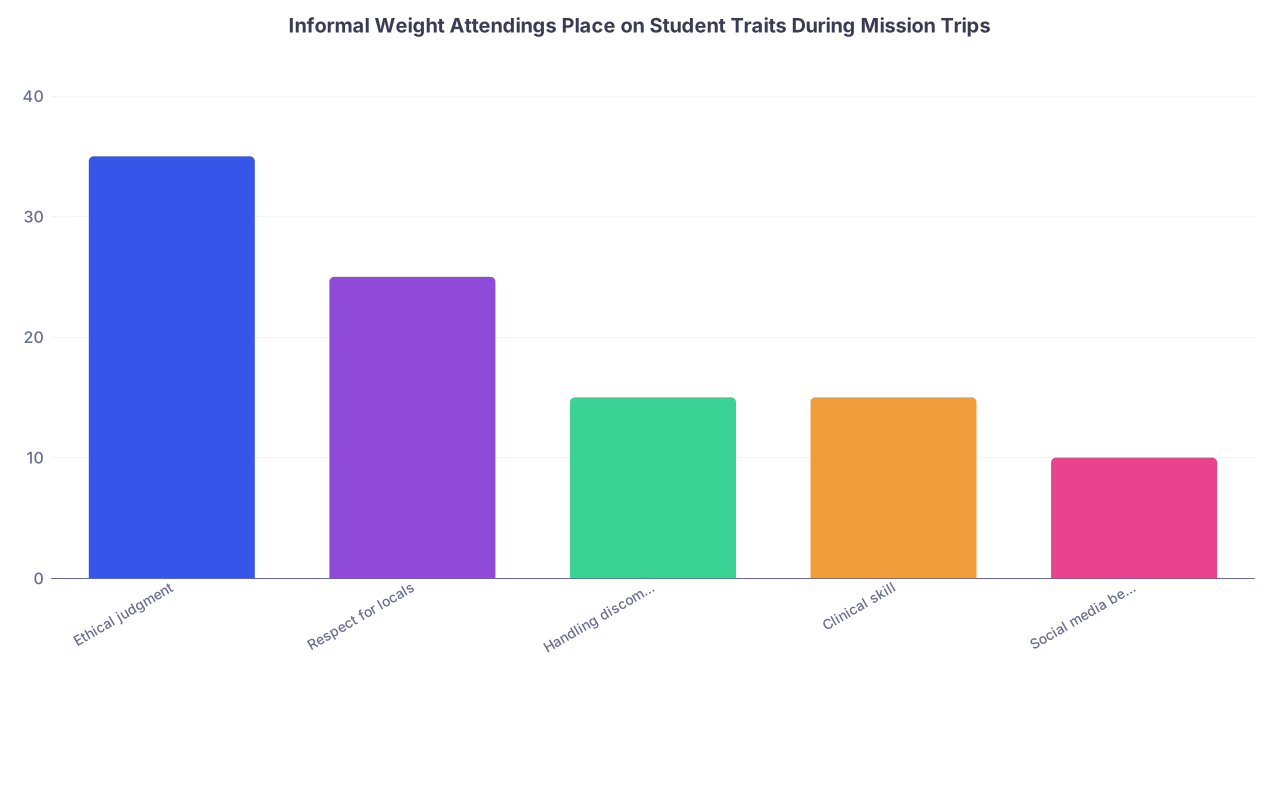
| Category | Value |
|---|---|
| Ethical judgment | 35 |
| Respect for locals | 25 |
| Handling discomfort | 15 |
| Clinical skill | 15 |
| Social media behavior | 10 |
The Back-Home Consequences: What Gets Said When You’re Not in the Room
Here’s where the “quiet vetting” becomes very loud, just not to your face.
After most serious mission trips, there’s some kind of faculty debrief. Sometimes formal, sometimes at an airport gate with bad coffee.
The questions sound like:
- “Would you take them again?”
- “Would you trust them with more autonomy next time?”
- “Would you support their application for global health track / chief / fellowship?”
Your behavior during the trip is the main data they’re using. And there’s almost always one or two students everyone talks about.
Common categories:
Automatic Re-invite / Future Leader Material
Comments:
“She was unflappable and respectful.”
“He put patients before his ego consistently.”
“I’d take her anywhere.”Fine Clinically, Ethically Questionable
Comments:
“He’s sharp, but I don’t like how he treated consent there.”
“She’s good, but she did things there she’d never try here. That bothers me.”Never Again
Comments:
“Too much drama.”
“Too self-centered; used the trip for content.”
“I wouldn’t put my name behind him.”
When you later ask for a letter of recommendation, that mental file comes up. Faculty don’t always spell out, “This is because of how you behaved on that trip.” But it is.
I’ve watched a strong-on-paper student get a very lukewarm global health fellowship letter because the writer had seen how they acted on a mission trip: clinically fine, ethically slippery.
And yes, program directors and selection committees do give more weight to letters that mention behavior in challenging global settings. Because that’s where the floor shows.
How to Pass the Quiet Vetting Without Performing
You shouldn’t turn yourself into an actor for a mission trip. That’s how you end up as the artificial “perfect” student no one quite trusts.
Instead, anchor on a few principles that attending physicians repeatedly reward:
Your ethics travel with you.
Do not lower your bar for consent, scope of practice, or respect because you’re in a poorer country. If anything, raise it.Curiosity over control.
Ask how and why local systems work the way they do before you “fix” anything. Good attendings notice when a student listens more than they lecture.Responsibility over experience.
You are not there to collect procedures or trauma stories. When you choose patient safety over your own CV, that gets noticed. Always.Humility without self-hatred.
You’ll be ignorant about some things. Own it, ask, learn. The students who admit what they don’t know—without theatrically self-flagellating—are the ones faculty trust.Consistency between on-camera and off-camera you.
If your compassion spikes only when someone’s taking pictures, you are failing the vetting. Faculty see the gap.
You don’t have to be perfect. You do have to be honest, willing to be shaped, and unwilling to exploit vulnerable people for your own narrative.

| Step | Description |
|---|---|
| Step 1 | Pre-trip impressions |
| Step 2 | First 48 hours |
| Step 3 | Clinical behavior |
| Step 4 | Group dynamics |
| Step 5 | Ethical decisions under scarcity |
| Step 6 | Faculty debrief |
| Step 7 | Future opportunities and letters |
| Area | Rewarded Behavior | Red-Flag Behavior |
|---|---|---|
| Scope of practice | Defers unsafe tasks, asks for supervision | Chases procedures beyond training |
| Local relationships | Respects and learns from local staff | Talks down or ignores local clinicians |
| Consent & language | Honest, slow, patient-centered communication | Glosses risks, treats patients as props |
| Group conduct | Steady, low-drama, supportive | Complains, gossips, centers self |
| Ethics under scarcity | Asks about follow-up and long-term impact | Treats clinic as short-term giveaway |


