The most common mission follow‑up mistake is pretending telemedicine is “just a video call.” It is not. It is a clinical system that will either extend your mission’s impact—or quietly undermine it.
You want to integrate telemedicine into ongoing mission follow‑up care. Good. That is exactly what most teams should be doing. But if you do it sloppily, you create confusion, abandonment, and sometimes real harm.
Let me walk you through how to do this properly—clinically, logistically, and ethically.
1. Start With One Ruthless Question: What Problem Is Telemedicine Actually Solving?
Most mission teams jump straight to “Which platform should we use?” Wrong starting point.
You need a brutal, specific answer to this first:
“What gaps in our current follow‑up care can telemedicine realistically fix for this community?”
Not in theory. In this place, with these people, and our actual capacity.
Common legitimate gaps telemedicine can solve:
- Post‑op wound checks and medication adjustments
- Chronic disease follow‑up (diabetes, hypertension, epilepsy)
- Complication screening (e.g., post-cataract surgery, hernia repair)
- Specialist input for local clinicians (tele-consults, not direct-to-patient)
- Short-term post-mission continuity (bridging to local long-term care)
And here is what telemedicine usually cannot fix in low‑resource mission settings:
- Complete lack of any local clinician or pharmacy
- No reliable way to get labs, imaging, or emergency care
- Zero digital literacy among patients and clinicians
- Unstable political or security environment that disrupts connectivity constantly
Before anything else, do a 1-page reality check with local partners.
| Factor | Minimum Acceptable Level |
|---|---|
| Connectivity | Stable 3G or better ≥ 70% time |
| Local clinical partner | At least 1 reliable clinician |
| Patient access point | Clinic, church, or NGO outpost |
| Data privacy practices | Basic private space available |
| Follow-up duration | ≥ 3–6 months post-mission |
If you cannot honestly check most of those boxes, you should not build a patient-facing telemedicine program yet. Focus first on clinician-to-clinician tele-consults—that is lighter, safer, and often more impactful early on.
2. Define a Narrow, Ethical Scope of Practice
Unclear scope is where telemedicine in missions goes off the rails. You try to do everything, you end up doing nothing well.
Decide exactly who you will follow and for how long
Create written criteria. No exceptions “because we felt bad for this one patient.”
Examples of clear scope:
- “We will provide tele-follow-up for:
- All post-op patients we operated on during this mission, for 90 days.
- Complex chronic disease patients we initiated new regimens for (insulin, antiepileptics), for 6 months.
- Only when they can attend calls at the partner clinic with a local nurse present.”
That clarity matters ethically. Why?
Because if you do not set boundaries, patients and even local teams will assume you are now the remote doctor for everything. You are not. And you cannot safely be.
Define what you will NOT do via telemedicine
Write this down explicitly and share it with local partners:
- No management of new, undifferentiated acute emergencies
- No prescription of controlled substances remotely
- No imaging/lab ordering that cannot be fulfilled locally
- No follow-up for patients you have never seen in person (unless part of a clear local-clinician–led workflow)
This is not about being rigid. It is about protecting patients and local systems from dependency on a team that flies in and out.
3. Build a Simple, Local‑First Telemedicine Workflow
The tech is secondary. Workflow is everything.
You want a process where the local team stays central and the mission team is in a supporting role, not the other way around.
Map the workflow step by step
Use a basic process map before you pick a platform.

| Step | Description |
|---|---|
| Step 1 | End of Mission Visit |
| Step 2 | Identify Eligible Patients |
| Step 3 | Obtain Informed Consent |
| Step 4 | Register Patient on Tele List |
| Step 5 | Schedule First Tele Visit |
| Step 6 | Tele Visit at Local Clinic |
| Step 7 | Document Plan and Tasks |
| Step 8 | Local Follow Up Actions |
| Step 9 | Next Tele Visit or Discharge |
Now, fill those steps with real actions.
Concrete workflow: what actually happens
During the mission (not after)
- Identify tele-eligible patients at discharge.
- Explain:
- How long follow-up will last
- That you are not available 24/7
- That emergencies still go to the local clinic/hospital
- Get informed consent (oral or written, but documented) for:
- Tele-consultation
- Electronic storage of health information (even if just secure email)
- Register patient with:
- Full name, DOB, local ID if used
- Local contact number or community health worker contact
- Primary diagnosis / surgery / chronic issue
- Preferred language
Create a follow‑up schedule on the spot
- Example: Post-op hernia:
- Tele-visit at 1 week, 4 weeks, 12 weeks
- Example: New insulin start:
- Tele-visit at 1 week, 2 weeks, 4 weeks, then monthly x 3
- Example: Post-op hernia:
Anchor telemedicine in a local physical place
- Patients do not call your US number directly.
- They come to:
- A partner clinic
- A church health post
- A community center with a health worker present
- That site:
- Has the device (tablet / laptop / smartphone)
- Has minimal privacy
- Has someone who can help translate and examine the patient if needed
Local clinician as gatekeeper, not bystander
- Tele-visit structure:
- Local clinician shares brief update.
- Visiting clinician asks clarifying questions.
- Local clinician examines the patient with guidance as needed.
- Agree on plan together.
- The note is owned by the local clinician, with your recommendations added.
- Tele-visit structure:
Telemedicine for missions that bypasses the local clinician is almost always ethically fragile and unsustainable.
4. Choose Technology That Fits the Reality, Not Your Preferences
Most mission teams pick platforms like they pick hotel Wi‑Fi. Quick and thoughtless.
Do not do that.
Step 1: Match platform to actual constraints
Ask the local partner these three things:
- What devices do you already have that can run video calls?
- How stable is internet in the clinic, honestly? Drops per hour?
- What messaging apps are people already using locally (WhatsApp, Telegram, SMS, etc.)?
Then pick the simplest tool that satisfies:
- Encryption or at least no public broadcasting
- Ability to share images (wounds, rashes, scans)
- Low bandwidth mode / audio-only option
- Minimal friction to join a call (no complex account setup for patients)
In low‑resource settings, a well-structured WhatsApp Business account with strict protocols is often more ethical than a “perfect” HIPAA-compliant platform that no one can access reliably.
For US-based teams subject to HIPAA working with foreign clinics, the legal picture is complicated. Practically:
- Use a secure, healthcare‑oriented platform if possible (e.g., Doximity, Zoom for Healthcare, doxy.me with BAA).
- For clinician‑to‑clinician consults, secure email + attached images can be acceptable when both sides understand and accept the risks.
5. Lock Down Documentation and Communication Standards
If it is not documented, it did not happen. Telemedicine does not get a pass.
Create a very short telemedicine note template
One you and the local clinicians can actually use under time pressure.
Example fields:
- Patient ID / Name:
- Date / Time / Duration:
- Participants present:
- Reason for visit:
- Subjective (including new symptoms since last visit):
- Objective (vitals if available, wound description, etc.):
- Assessment:
- Plan:
- Med changes:
- Lab / imaging (only if available):
- Red-flag warning instructions given:
- Responsibility:
- Tasks for local clinician:
- Tasks for mission clinician:
- Next follow-up date:
- Was patient informed of limits of tele-care today?: Yes/No
Share this as a one‑page PDF and as a WhatsApp-formatted text block. No one is logging into a fancy EMR from a rural clinic if the connection is dropping every 5 minutes.
Decide where the “source of truth” record lives
Pick ONE of these and commit:
- The local EMR (ideal if it exists) with scanned or text notes from tele-visits.
- A shared, encrypted folder system with clearly separated patient folders (used by both teams).
- A simple but secure clinic-based paper chart with tele-notes printed or transcribed.
Your US-based EMR can hold parallel notes if you need them for your own compliance, but ethically the local system should own the primary record of what happened to their patients.
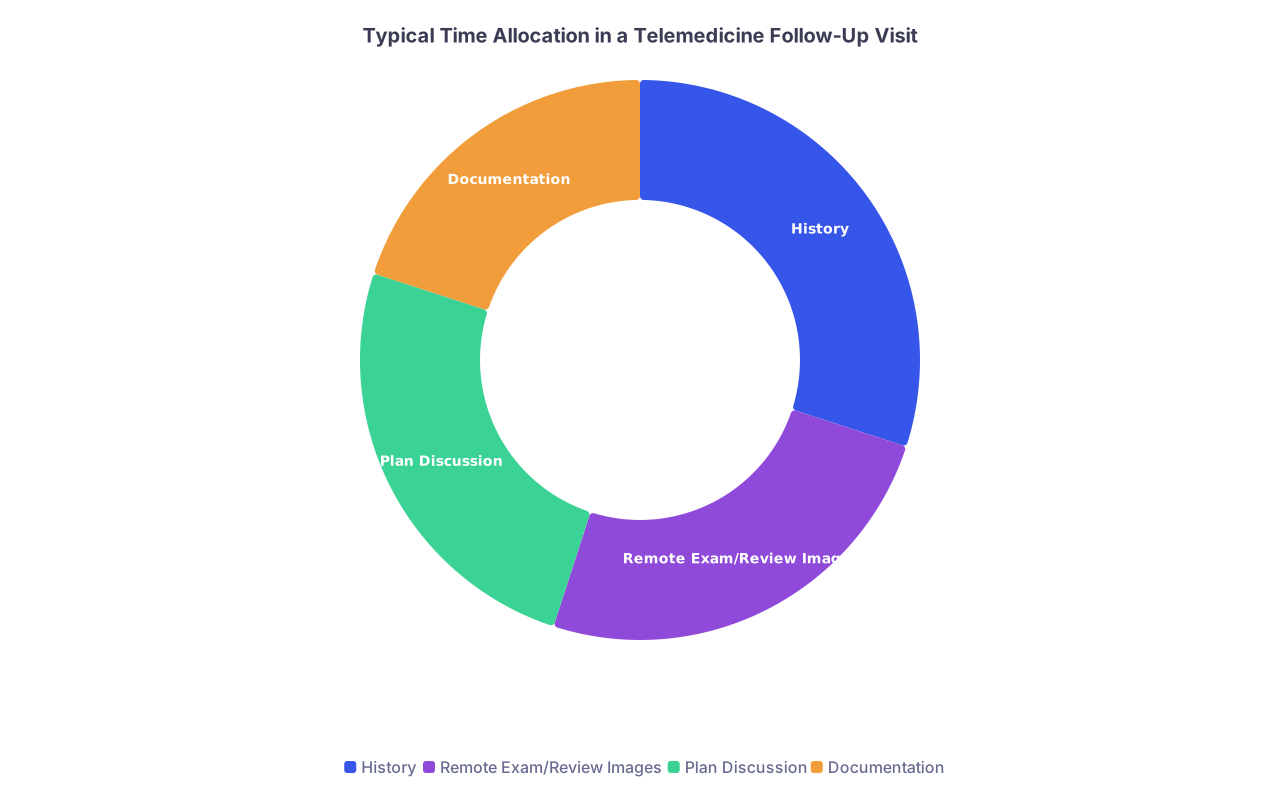
| Category | Value |
|---|---|
| History | 30 |
| Remote Exam/Review Images | 25 |
| Plan Discussion | 25 |
| Documentation | 20 |
6. Create Clear Escalation, Handoff, and “We’re Done” Rules
Mission teams are notoriously bad at endings. People drift. Emails slow down. Patients feel dropped.
You fix that ahead of time.
Escalation protocols (when things go wrong)
Write a one-page “If X then Y” sheet for the local team. Examples:
Red-flag symptoms for post-op patients:
- Fever, severe pain, purulent discharge, rapidly expanding redness
- Action:
- Local clinician examines same day
- If serious → refer to nearest hospital per existing referral pathway
- Notify mission team by predefined channel (email / WhatsApp) but do not delay local care waiting for remote input
Medication side effects:
- Suspected severe allergic reaction, suicidal ideation on psych meds, hypoglycemia on insulin
- Action: Use existing local emergency pathways first; telemedicine is secondary, not primary emergency care.
Telemedicine is for support and optimization, not remote emergency rooms.
Time‑bound follow‑up
An ethical telemedicine plan has a built‑in end date.
Examples:
- “We will follow you for 3 months after surgery. After that point, your care will be fully with Dr. X at this clinic.”
- “We will co-manage your blood pressure with your local clinic for 6 months while they stabilize your medications. After that, they will review your meds directly with you each visit.”
Communicate this:
- Verbally to the patient in their language.
- On a simple handout.
- In the discharge note.
And then actually close the loop:
- At final tele-visit, summarize:
- What has been done
- Who is now responsible for ongoing care
- When to come back to local clinic if new problems arise
7. Guardrails for Ethics: Power, Consent, and Dependency
You are operating with a power imbalance. Foreign specialists. Tech. Money. Patients know it. Local clinicians know it.
You have to consciously push the other way.
Practical consent that is more than a signature
Consent for telemedicine in missions needs three layers:
Clinical limits
- “Sometimes the camera will miss things we would see in person.”
- “We may ask you to return to the clinic for an in-person exam even after a video call.”
Access limits
- “We are not always online. In an emergency, you must go to [local hospital/clinic] first.”
Data limits
- “We will store your information in [place]. Only medical staff involved in your care will see it. It will not be used for advertising or social media.”
If the patient cannot read, the documentation must reflect verbal consent witnessed by a local staff member.
Avoid creating a shadow parallel system
Warning signs you are drifting into unethical dependency:
- Patients skipping local clinic visits because they can “just wait for the video doctor.”
- Local clinicians deferring every moderately complex decision to the remote mission team.
- Your team routinely overriding local treatment norms without mutual discussion.
Solutions:
- Always send patients back to the local clinician for prescription issuance and physical exams.
- During tele-visits, address the local clinician by name and ask their opinion first.
- If you disagree with local practice, discuss it as colleagues, not as external saviors.
8. Train Your Own Team and the Local Team—Before You See a Single Patient Online
Most telemedicine failure is not technical. It is behavioral.
Minimum training for your mission clinicians
Short, mandatory pre‑mission session (60–90 minutes):
- Cross-border telemedicine legal basics:
- You are often not licensed in that country.
- Your role is usually consultant to the local clinician, not official treating physician.
- Remote clinical skills:
- How to guide a local clinician through an exam (“Press here, ask if it hurts here, check for this sign…”).
- How to ask more specific, directed questions because you cannot lay hands on the patient.
- Documentation discipline:
- Use the shared template every single time.
- Avoid speculation or comments you would not put in a real chart.
Minimum training for local clinicians and staff
This is where many teams get lazy. Do not.
At the start of the mission or by remote training beforehand:
- Walk through:
- The follow-up criteria
- How to schedule and initiate a tele-visit
- How to troubleshoot basic connection issues
- Provide:
- Written “cheat sheets” in their language
- A list of example cases where telemedicine is helpful vs not
- Practice:
- 1–2 mock tele-visits with role-play before seeing real patients
9. Measure Outcomes and Adjust Like a Serious Clinical Program
If you are not measuring anything, you are guessing. Guesses are not good enough for clinical care.
Start with a tiny dashboard
Three to five metrics. That is it. For example:
- Number of tele-follow-up visits completed per month
- Completion rate of scheduled tele visits (%)
- 30‑day readmission or complication rate among post-op tele patients
- Patient satisfaction (simple 3-question survey, verbal)
- Local clinician satisfaction and perceived usefulness
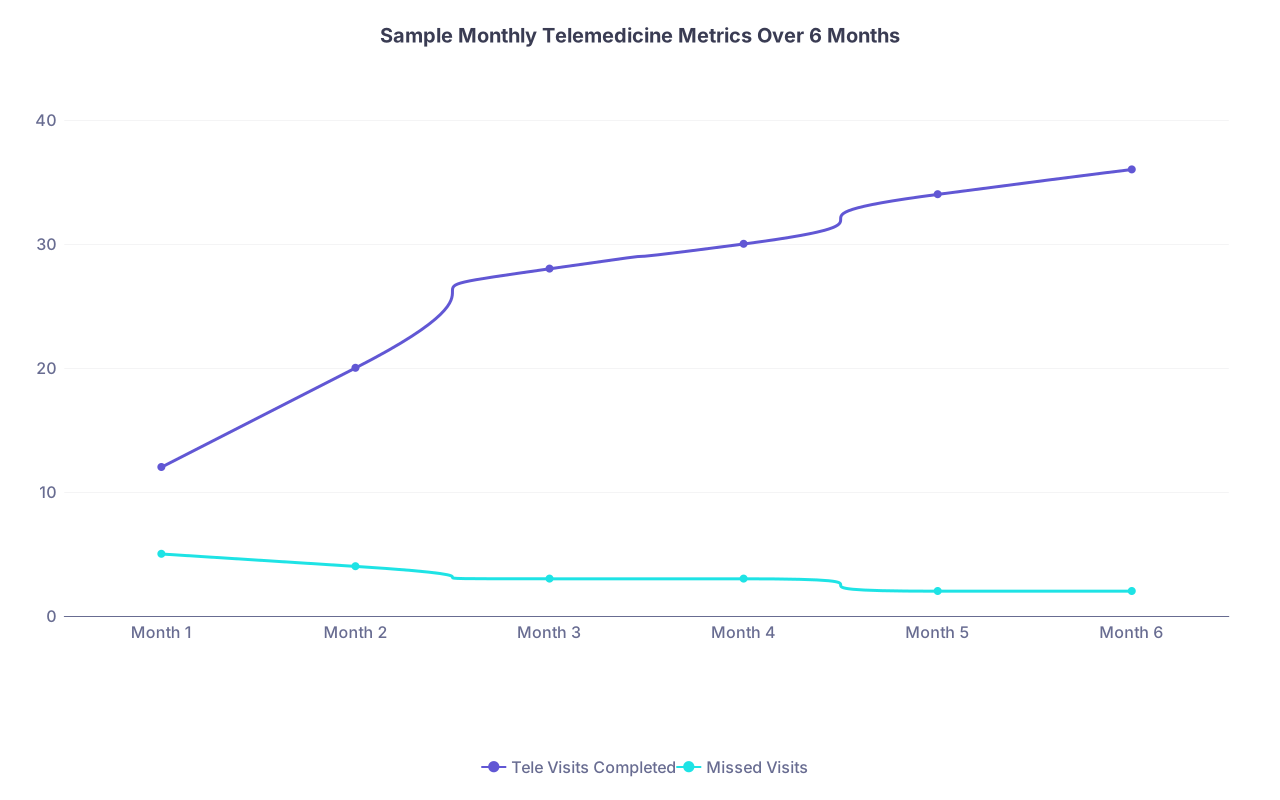
| Category | Tele Visits Completed | Missed Visits |
|---|---|---|
| Month 1 | 12 | 5 |
| Month 2 | 20 | 4 |
| Month 3 | 28 | 3 |
| Month 4 | 30 | 3 |
| Month 5 | 34 | 2 |
| Month 6 | 36 | 2 |
Debrief systematically
Every 3–6 months:
Review:
- Are we actually improving continuity of care?
- Are local clinicians more confident, or more dependent?
- Are there worrying cases where telemedicine clearly delayed needed in-person care?
Decide:
- What to stop doing (types of cases that consistently do poorly)
- What to strengthen (e.g., earlier escalation for certain symptoms)
- Whether the follow-up window is too short or too long
You are not building a toy. You are building clinical infrastructure. Treat it that way.
10. Example: A Clean, Realistic Telemedicine Integration Plan
Let me pull this together with a concrete scenario.
Mission field: Rural Central America, partner clinic with one physician and two nurses. Stable 3G. WhatsApp ubiquitous. Your team does general surgery and internal medicine once per year.
Your telemedicine model
Scope:
- Post-op general surgery patients (hernias, cholecystectomies, etc.) for 90 days.
- Complex hypertension and diabetes cases with med adjustments for 6 months.
Flow:
- During the mission, the local physician and your team identify 40 eligible patients.
- You consent them, register them, and set tele-visit dates before they leave the clinic.
- All tele-visits happen at the partner clinic, with the local physician physically present.
- You use secure Zoom for Healthcare between your home institution and the clinic laptop. WhatsApp is backup for audio if the video fails.
- Tele-notes are written by your team in a structured template and then pasted into an email to a clinic account; local staff print and file in physical charts and write a short summary in Spanish.
Escalation:
- Any red-flag symptoms trigger same-day local in-person visit and, if needed, transfer to the regional hospital. The mission tele-team is looped in when possible but never as a prerequisite for urgent care.
Endpoints:
- Surgery patients are discharged from tele-follow-up at 3 months with a summary note to the local physician.
- Chronic disease patients are either:
- Handed off fully to local care at 6 months, or
- Discussed for extended shared care if local clinician explicitly requests and capacity exists.
Ethics and evaluation:
- Patient and clinician surveys at 6 months.
- Review of any complications where telemedicine may have played a role—good or bad.
- Annual renegotiation with the local clinic to adjust the scope based on what is actually helping.
Is this perfect? No. Is it safe, realistic, and ethically defensible? Yes. And compared to no tele-follow-up at all, it is a major step forward.
11. Common Pitfalls You Should Avoid Immediately
To save you some pain, here are the mistakes I see repeatedly:
Direct WhatsApp-to-patient with no local clinician involved.
Tempting. Fast. Almost always erodes local systems and creates dependency.No clear stop date.
Two years later, you are still getting random messages from patients you saw once—no structure, no boundaries.Overpromising during the mission.
Mission doctors say, “We will always be here for you by video.” Then they are not. That is worse than doing nothing.Shadow EMR in your home country that no one local can see.
Legally comfortable for you. Clinically useless for them.Using US legal standards as an excuse to do nothing.
Yes, cross-border telemedicine is messy legally. But carefully structured clinician-to-clinician consults with clear roles are often permissible and highly beneficial.
12. Quick Implementation Checklist
If you want something you can actually act on this month, use this:
- Define telemedicine scope (who, what, how long).
- Confirm local feasibility (devices, connectivity, staff).
- Choose one simple, secure-enough platform.
- Build patient inclusion criteria and get consent wording approved with local partner.
- Create a one-page workflow and a one-page escalation protocol.
- Create a shared telemedicine note template.
- Train:
- Your mission clinicians
- Local clinicians and 1–2 staff “super users”
- Pilot with:
- 10–20 patients max for the first 3–6 months.
- Review outcomes and ethics:
- At least twice in the first year.
- Adjust and either scale up slowly or pull back if it is not helping.