

You are standing in a crowded church-turned-clinic on the last day of a one-week mission. You just saw a 52-year-old woman with new-onset diabetes and blood pressures in the 180s. You gave meds, did some brief counseling, wrote everything down on a paper chart…and tomorrow you fly home.
You know exactly what is bothering you on the drive back to the guesthouse: “What happens to her now?”
That feeling? That is your conscience trying to do quality improvement. Let’s build you a system so you never have to wonder “what happens now?” without having a concrete answer.
Step 1: Decide What You Are Actually Responsible For
Before you build any follow-up or handover system, you need a clear ethical stance. Otherwise you will design a feel-good process that does nothing.
Here is the line I draw, and I think it is the only defensible one:
If you start care, you own reasonable follow-up and safe handover.
Not infinite follow-up. Not “forever responsibility.” Reasonable follow-up and safe handover, defined clearly.
Concretely, that usually means:
You are responsible for:
- Communicating a clear plan to the patient and local system
- Ensuring time-sensitive items (results, referrals, med changes) will be acted on
- Not initiating therapies you know cannot be monitored at all
- Documenting in a way that local clinicians can actually use
You are not responsible for:
- Guaranteeing outcomes
- Building an entire health system from scratch during a 10‑day trip
- Personally calling every patient for years
You need this clarity because it drives design decisions:
- Will you use paper only, or a simple spreadsheet, or a shared EMR?
- Do you need a local nurse champion, or a full “continuity clinic” structure?
- Do you limit the complexity of new diagnoses you make?
Make this explicit with your team before the trip, not during the final debrief when everyone is tired and emotional.
Step 2: Map the Life Cycle of a Mission Patient
You cannot fix follow-up if you do not understand the full path of the patient’s contact with your project.
Use a simple flow like this.

| Step | Description |
|---|---|
| Step 1 | Team planning |
| Step 2 | Define guardrails and tiers |
| Step 3 | Create templates and logs |
| Step 4 | Clinical care during mission |
| Step 5 | Identify follow-up patients |
| Step 6 | Fill handover sheets and log |
| Step 7 | End-of-mission handover meeting |
| Step 8 | Local follow-up actions |
| Step 9 | Post-mission check-in |
| Step 10 | Adjust system for next mission |
Your job is to make sure points F, G, H, I exist in reality, not just on the whiteboard.
So walk through these questions with your host partner:
- Where are patients currently recorded? A ledger? Excel? WhatsApp? Nothing?
- Who, on the local side, “owns” chronic patients now, if anyone?
- What are realistic follow-up options:
- Local clinic visit?
- Community health worker home visits?
- Phone / SMS / WhatsApp check-in?
- Next mission team, six months later? (Often a terrible plan by itself.)
You are going to plug your system into their reality, not the system you wish they had.
Step 3: Build a Simple, Ruthless Patient Tracking System
This is the backbone. If you cannot generate a list of “patients we still owe something to,” you do not have a system. You have vibes.
You want two things:
- A master log of all patients seen
- A focused follow-up list of patients with open tasks
Keep it brutally simple.
3.1 Core data you must capture
At minimum, your follow-up list needs:
- Patient identifier
- Contact details / locator info
- Diagnosis category
- What needs to be done
- By when
- Who is responsible
Turn this into a structure the team can actually use:
| Field | Purpose |
|---|---|
| Patient ID / Name | Unique identification |
| Age / Sex | Basic clinical context |
| Contact / Locator | How to find them again |
| Key Diagnosis | Main problem needing follow-up |
| Action Needed | Specific next step |
| Due Date | When it should happen |
| Assigned To | Local person or clinic |
I have seen groups try to build EMR-level forms on day one and then abandon them by day three. Do not do that. A clipboard with this table printed in bulk is infinitely better than a half-built app nobody maintains.
3.2 One-page “handover summary” per patient
For any patient who needs follow-up (not every single URI), create a one-page handover sheet. Paper is fine. The rule: a local clinician should be able to understand the case in under 30 seconds.
Essential sections:
- Patient details (ID, age, sex, contact)
- Problem list (3–5 bullet points, max)
- Medications started/changed (with doses in local units, not just mg if that confuses staff)
- What we did during mission (tests, key findings)
- Precise follow-up plan:
- What needs to happen
- When
- Where
- By whom
- Red-flag instructions for the patient (in their language)
Make this a template and print a stack. Teach every clinician on the team to fill it out for:
- New chronic diagnoses (diabetes, HTN, seizure disorder, HIV)
- Any new high-risk med (anticoagulants, insulin, TB regimen)
- Any abnormal test pending further evaluation (suspicious mass, positive screen)
- Any serious acute condition that is not fully resolved but stable enough to go home
Step 4: Define Follow-Up Categories and Timeframes
Not all follow-up is created equal. You need triage categories, or your local partner will drown in a sea of “maybe follow up in 3–6 months” noise.
Split your follow-ups into three tiers:
Tier 1: Critical / High-Risk (non-negotiable follow-up)
Examples:
- New insulin start
- Newly recognized advanced heart failure
- Suspected malignancy
- Positive TB screen or new TB treatment start
- Untreated BP > 180/110 with end-organ risks
Plan:
- Follow-up within 3–7 days, or at most 2 weeks
- Confirm during the visit how follow-up will happen:
- Specific appointment date at local clinic
- Community health worker visit booked
- Phone call scheduled (with who, at what time)
Tier 2: Moderate Risk / Chronic Disease Adjustment
Examples:
- New diagnosis of hypertension managed with oral meds
- New diabetes on orals only
- Asthma that needed step-up therapy
- Epilepsy with medication titration
Plan:
- Follow-up within 4–8 weeks
- Clear instructions for:
- Where to refill meds
- What to monitor (BP log, blood sugars, seizure frequency)
- When to escalate back to a clinician
Tier 3: Routine / Opportunistic Follow-Up
Examples:
- Stable chronic patients whose meds you refilled
- Mild depression with counseling and resource referral
- Non-urgent surgical referrals
Plan:
- Follow-up “when next attending clinic is convenient”
- Educate patient to seek care if symptom X or Y occurs
- Hand over to system, but do not clog the high-risk list
Put this on paper and on the wall in the clinician area so everyone is sorting into the same buckets.
Step 5: Choose and Empower Local Owners
If nobody local owns follow-up, you have nothing. The worst pattern I see is “we’ll email them a list later.”
No. Name names.
You need at least two local roles:
Clinical Owner
Usually:- The medical director of the local clinic/hospital, or
- A senior nurse or clinical officer
Responsibilities:
- Receives the follow-up list
- Reviews and prioritizes high-risk cases
- Allocates them to providers / community health workers
- Flags cases they cannot handle (for referral planning)
Data / Coordination Owner
May be:- A clinic receptionist
- A records clerk
- A community health worker with literacy and reliability
Responsibilities:
- Maintains the follow-up log
- Checks off completed tasks
- Tracks no-shows
- Communicates with your team after the mission (if agreed)
You need to sit down, in person, with these people and:
- Show them the log and handover sheets
- Walk through 3–5 example cases
- Ask them to explain back the system in their own words
- Adjust for their reality (e.g., if they say “we never call patients, nobody answers phones,” then stop building a call-based plan)
This conversation is not optional. It is the system.
Step 6: Design Reliable Communication Channels
A good follow-up system dies on the hill of “I sent you an email, did you not get it?”
You need to standardize how communication happens between:
- Mission team → local partner
- Local partner → patients
- Local partner → next mission team (if recurrent trips)
6.1 For mission team → local partner
Pick one primary and one backup channel. Examples:
- Primary: Shared Google Sheet (if reliable internet)
- Backup: Printed and signed follow-up list physically handed over
or
- Primary: Encrypted WhatsApp group with PDF and photos of the lists
- Backup: USB stick + printed documents left at clinic
Just do not design a system that depends on:
- Your personal laptop
- A single volunteer’s private email
- A “smart” EMR nobody else knows how to log into
6.2 For local partner → patients
Clarify their existing practice:
- Do they ever call patients? Or only community visits?
- Do they send SMS reminders?
- Is there a market-day clinic pattern they can leverage?
Then make the follow-up plan match that pattern. Not your fantasy of what follow-up should look like.
Example options:
- Appointment card with:
- Date, time, place
- Purpose (“BP check,” “sugar test,” “wound review”)
- SMS template they can send to all Tier 1 patients
- A list of Tier 1 patients given to community health workers for home visits
Step 7: Create a Handover Ritual at the End of Every Mission
The last day is usually chaos: packing meds, rushing to the airport, last-minute goodbyes.
You need to carve out protected time for handover. Treat it like a formal sign-out in an ICU. Because ethically, that is what it is.
Minimum agenda (60–90 minutes):
- Review the follow-up list case-by-case with the local clinical owner
- Highlight Tier 1 first
- Confirm plan for each:
- Where they will be seen
- By whom
- Rough date / timeframe
- Hand over physical documents
- Patient handover sheets (organized by risk tier or alphabetically)
- Master follow-up log
- Confirm how and when you will check in
- One check-in at 1–3 months
- One person on each side designated as contact
- Document the meeting
- Simple one-page summary:
- Number of patients requiring follow-up by tier
- Agreed next steps
- Barriers flagged (e.g., “we cannot manage insulin dose titration safely here”)
- Simple one-page summary:
Do not skip this. I do not care how late your flight is. If you cannot do this, you did not design the mission schedule properly.
Step 8: Put Guardrails on What Care You Start
A lot of follow-up problems are created upstream. If you start interventions that the local system cannot sustain or monitor, you are generating harm and future guilt.
You need a treatment eligibility filter based on local capacity. Decide it with the host partner before clinic opens.
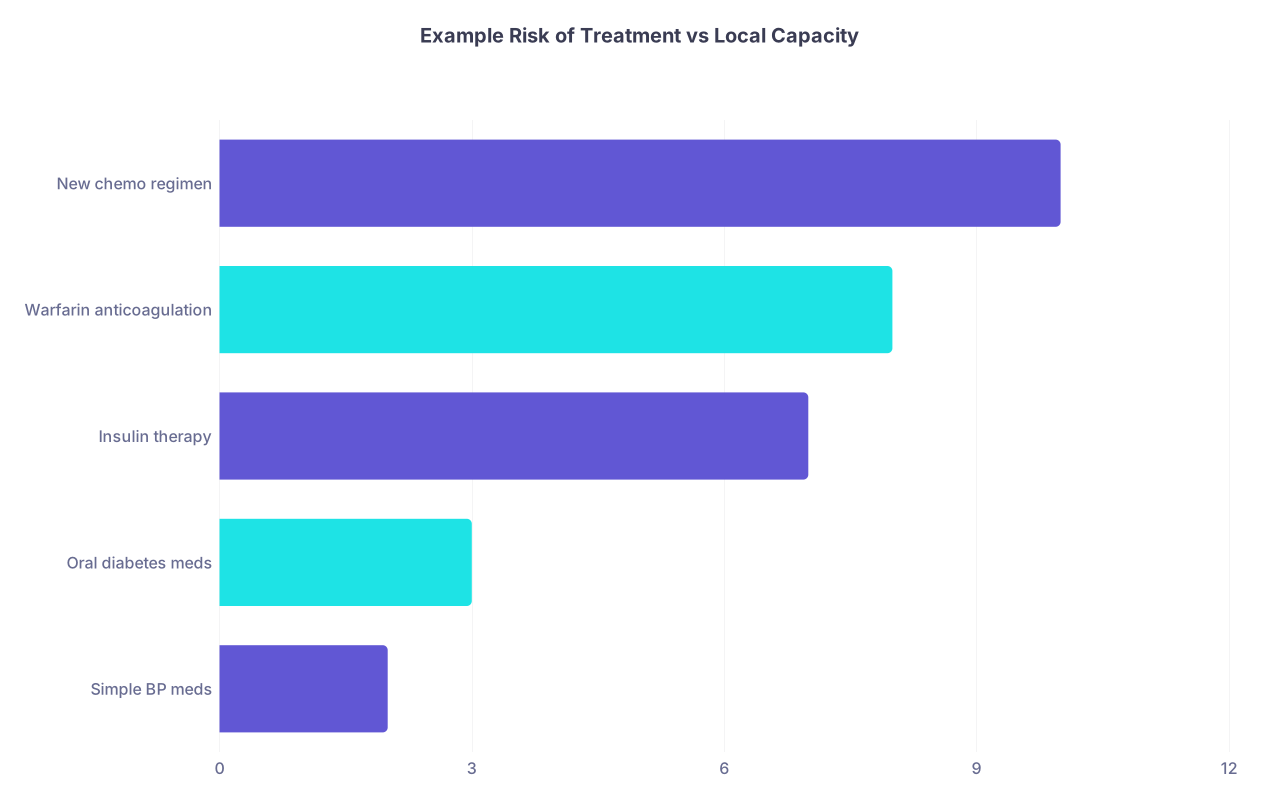
| Category | Value |
|---|---|
| Simple BP meds | 2 |
| Oral diabetes meds | 3 |
| Insulin therapy | 7 |
| Warfarin anticoagulation | 8 |
| New chemo regimen | 10 |
Think in terms of:
- Monitoring needs (labs, INR, glucose)
- Side effect risks
- Requirements for emergency management (hypoglycemia, bleeding)
- Availability of follow-up meds locally
Rules of thumb that have saved more than one mission:
- Do not start warfarin if INR testing is nonexistent and no clinician understands dosing.
- Do not start insulin without:
- Reliable access to insulin
- Patient or family education on dosing and hypoglycemia
- Some mechanism for dose adjustment
- For conditions like new HIV, TB, or cancer:
- Prioritize linkage to an existing program rather than playing “mini-oncologist” for a week
Put your “we do not start this here” list on paper. Share it with every clinician on the team.
Step 9: Build a Micro Quality Loop After the Mission
A system without feedback decays. You need a small, realistic loop where you learn what actually happened.
No 50-page report. Just a simple check-in.
Within 1–3 months after the mission, you or a designated team member should:
- Contact the local data / coordination owner
- Ask for:
- Number of Tier 1 patients who:
- Were seen
- Were not reached
- Major problems encountered (patients could not afford meds, clinic closed, etc.)
- Number of Tier 1 patients who:
- Update your follow-up log with:
- Completed
- Lost to follow-up
- Deceased (if known)
Use this to adjust:
- Your follow-up categories (were too many in Tier 1?)
- Your treatment choices (did you start therapies they could not sustain?)
- Your handover clarity (were local staff confused about plans?)
Over 2–3 missions, you can refine this into something shockingly robust, if you are willing to listen to the uncomfortable parts.
Step 10: Address the Ethical Tension Head-On
If you are doing this right, you will run into hard cases.
Example: You diagnose advanced cervical cancer in a setting where there is no oncologist within 300 km and the patient cannot afford travel.
Here is the ethical sequence I recommend:
Be honest with patient and family
In language they understand:- What you know
- What you do not know
- What treatment options exist (if any) and where
Engage the local clinician in the conversation
They will still be here when you leave. They know:- Referral possibilities
- Cultural norms around bad news
- Realistic palliative options
Set a follow-up goal that fits reality
Maybe:- Referral visit arranged
- Palliative care and symptom control only
- Family meeting with local pastor / community elder
Document your reasoning
On the handover form:- Why certain treatments were not started
- What was offered
- Patient preferences (if stated)
You cannot fix structural injustice on a 10‑day trip. You can refuse to add ethical sloppiness to it by pretending “we will follow up” when you know you will not.
Practical Tools You Can Implement This Week
Here is a compact toolkit you can build now and bring to your next mission.

- Master follow-up log template (1–2 pages)
- As in the table above
- One-page handover sheet template
- Patient details
- Problem list
- Meds
- Investigations
- Follow-up plan
- Patient instructions
- Risk tier cheat sheet
- Examples of Tier 1 / 2 / 3 with timeframes
- End-of-mission handover checklist
- Review list with local clinician
- Hand over documents
- Confirm communication channels
- Schedule 1–3 month check-in
- Treatment guardrail list
- “We will not start” meds and interventions in this context
- Agreed with host partners
Laminate the critical pages. Put them in the clinician area. Make them part of the orientation talk on day one.
Example: Putting It All Together for a Single Patient
Let us run your 52-year-old woman with new diabetes and severe hypertension through this system.
During the visit
- Diagnose DM2 and HTN
- Start oral hypoglycemic (available locally) and two BP meds they routinely stock
- Provide brief diet and medication education in her language through interpreter
Risk tiering
- New DM and severe HTN → Tier 1 (critical) for first follow-up
Handover sheet
- Fill out one-page summary:
- Diagnosis: DM2, HTN
- Meds and doses using local names
- Baseline BP and glucose values
- Red flags for patient: severe headache, chest pain, confusion, very low sugar symptoms
- Plan: follow-up BP and glucose check at local clinic in 7 days
- Fill out one-page summary:
Clinic linkage
- While patient is still present, receptionist gives:
- Specific appointment date and time at local clinic
- Paper appointment card
- While patient is still present, receptionist gives:
Follow-up log entry
- Add her to master follow-up log:
- Name/ID, contact, diagnosis, action (“clinic visit in 7 days”), due date, assigned to “Nurse Samuel – hypertension/diabetes clinic”
- Add her to master follow-up log:
End-of-mission handover
- Review her case with local clinical owner:
- Confirm she is on local formulary meds
- Confirm nurse Samuel runs that clinic and will be working next week
- Review her case with local clinical owner:
Post-mission check-in (1–3 months)
- Ask local data owner:
- Did she attend?
- Any major issues?
- Ask local data owner:
If she never shows, that is still information. On your next mission, you might:
- Add home visits for Tier 1 patients
- Adjust how you explain the seriousness of the condition
- Work with local staff on retention strategies
The point: you had a system. You did not just hope.
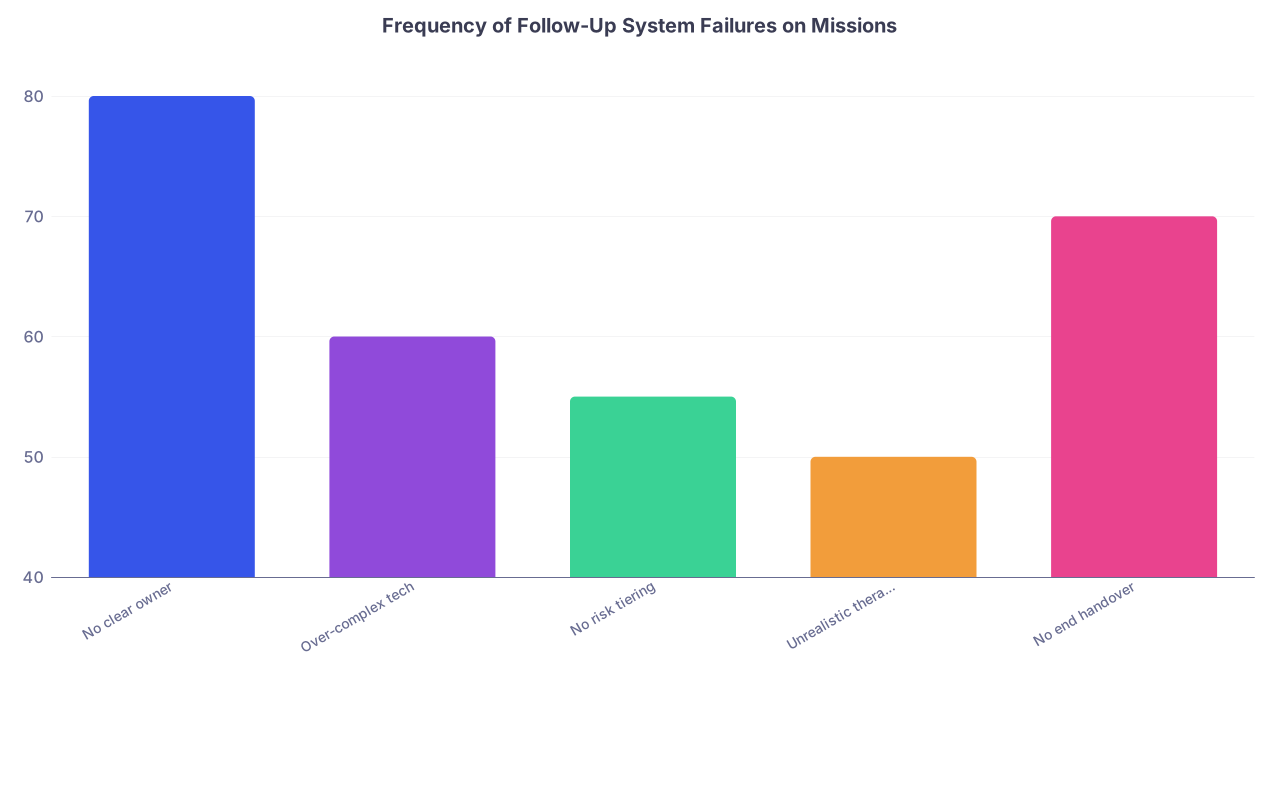
Common Pitfalls and How to Avoid Them
| Category | Value |
|---|---|
| No clear owner | 80 |
| Over-complex tech | 60 |
| No risk tiering | 55 |
| Unrealistic therapies | 50 |
| No end handover | 70 |
Some failures I see repeatedly:
No single person is responsible
Fix: Name the local clinical and data owners. In writing.Overly complex digital solutions
Fix: Start with paper. If the local partner begs you for an app and has used one before, reconsider. Otherwise, paper.Everything is “follow-up if possible”
Fix: Use tiers. Protect Tier 1 with obsession. Let Tier 3 be opportunistic.Starting high-risk regimens in low-capacity settings
Fix: Agree up front what you will not start. Stick to it even when you are tempted.No protected time for handover
Fix: Schedule the handover meeting in the mission agenda from day one. Non-negotiable.
Visual: High-Level Handover Workflow
| Step | Description |
|---|---|
| Step 1 | Team planning |
| Step 2 | Define guardrails and tiers |
| Step 3 | Create templates and logs |
| Step 4 | Clinical care during mission |
| Step 5 | Identify follow-up patients |
| Step 6 | Fill handover sheets and log |
| Step 7 | End-of-mission handover meeting |
| Step 8 | Local follow-up actions |
| Step 9 | Post-mission check-in |
| Step 10 | Adjust system for next mission |
FAQ (Exactly 3 Questions)
1. What if there is truly no local clinic or provider to hand over to?
Then you either:
- Limit what you do to:
- Acute, self-limited care
- Health education
- Support of existing community structures (CHWs, churches, NGOs)
- Or you commit to building that follow-up capacity with the host (not in a week, but as a multi-year partnership).
Providing complex, ongoing treatments with zero local handover option is unethical. If a setting has no follow-up capacity at all, your mission should focus on capacity-building, not chronic disease management.
2. How do we handle language barriers in follow-up instructions?
Design your materials with the local partner:
- Use bilingual forms: English (or your team language) + local language
- Use pictograms for key instructions (med timing, danger signs)
- Train interpreters to deliver a standard script for:
- Follow-up explanation
- Red flags
- Where to go if things get worse
Always test the instructions with a local staff member first: “If you only had this paper, would you know what to do?”
3. How much follow-up is “enough” to be ethical?
You aim for reasonable continuity, not perfection. For high-risk patients, I expect at least:
- A documented follow-up plan agreed with local staff
- A realistic timeframe
- A local clinician who knows they own the next step
If you consistently cannot meet that bar for most high-risk patients, your mission model is broken. You either fix the system (partnership, capacity, schedule) or you stop offering services that require follow-up.
Open your last mission’s records right now—digital or paper. Can you produce a list of patients for whom your team still owed something at the time you left? If the answer is no, your first step today is to build the follow-up log template described above and commit to using it on your next trip.


