
Is Any Volunteering Better Than None? The Truth About Medical Missions
“Any volunteering is better than none” is one of the most dangerous half-truths in premed and med school culture.
When it comes to short-term medical missions, it is often flat-out wrong.
There is a big difference between serving and sightseeing in scrubs. Between ethical longitudinal partnerships and a group photo with kids you cannot name. You already suspect this; I am just going to say the quiet part out loud and walk through the evidence.
The Feel-Good Trap: Who Actually Benefits?
Most students tell me some version of the same story.
“I went to [Haiti/Honduras/Uganda/Peru] for 8 days with a team from my school. We saw hundreds of patients a day. It was life-changing.”
Life-changing for whom?
The data on short-term medical missions (STMMs) is ugly once you look past the Instagram filters. A BMJ Global Health review in 2018 went through the literature on STMMs and found three recurring problems: minimal long-term benefit, poor integration with local systems, and almost no outcomes tracking. Translation: lots of photos, very little proof of meaningful, sustainable impact.
Here is the uncomfortable pattern I have seen repeatedly:
- Students perform tasks abroad they would never be allowed to do at home
- Clinics pop up for a week, hand out meds with no continuity, then disappear
- Local health workers get sidelined while visitors do “heroic” work
- Nobody knows what happened to those patients a month later
But everyone gets a great story for their personal statement.
This is not volunteering. It is self-focused experience acquisition packaged as altruism.
To make this concrete, look at how common short-term trips are in applications:
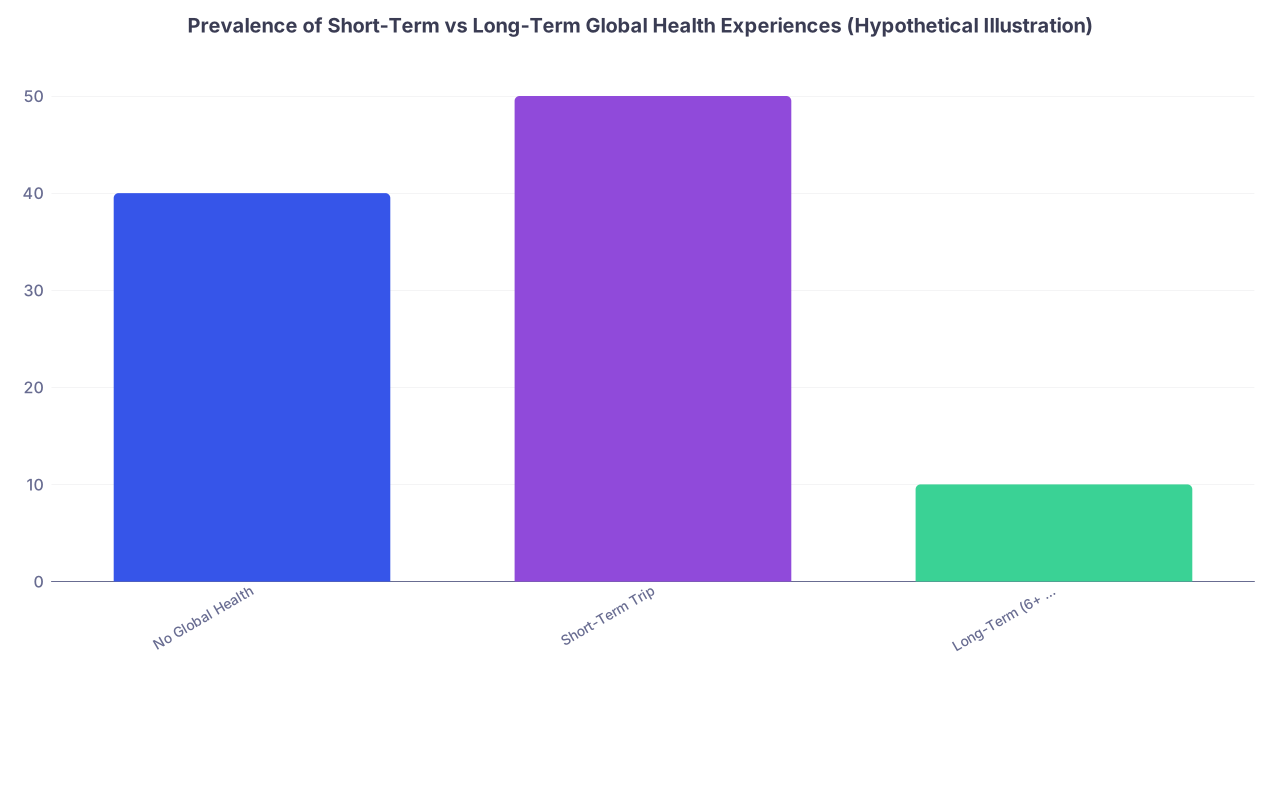
| Category | Value |
|---|---|
| No Global Health | 40 |
| Short-Term Trip | 50 |
| Long-Term (6+ months) | 10 |
Most applicants who do “global health” are doing short, episodic trips. The least effective and most ethically fraught format dominates the landscape.
So no, not “any” volunteering is better than none. Some “volunteering” is actually negative value—ethically, educationally, and for patient care.
The Myth of “At Least I’m Helping”
I hear this justification constantly: “The system there is so bad that even what we do is better than nothing.”
It feels persuasive. It’s also lazy.
The “better than nothing” argument collapses when you ask a few basic questions:
- Better than what specific alternative?
- Measured how?
- According to whom—the visiting team, or the local community?
Look at what actually happens clinically.
Common scenario: A team shows up, runs a pop-up clinic in a school or church. They hand out antihypertensives, antibiotics, maybe start someone on insulin with a glucometer and a couple strips. Then they leave. No EMR, no continuous supply chain, no formal handoff to a local clinic that can reliably follow up. Maybe a handwritten note if they are “organized.”
I have seen trip organizers brag about “seeing 800 patients in 4 days.” That is speed dating, not primary care.
From a systems perspective, this kind of care can be worse than nothing:
- You diagnose new chronic diseases with no plan for continuity
- You disrupt local clinics by pulling patients to the free foreign clinic
- You normalize foreign dependency instead of strengthening local capacity
The Lancet Commission on global surgery has hammered on this point: sustainable capacity-building beats episodic care every time. But capacity-building is slow, unsexy, and not easily sold as a one-week “mission experience.”
Better than nothing? Sometimes it is actually harm plus photo ops.
Power, Privilege, and the “Practice on the Poor” Problem
Let’s be blunt.
If you would not be allowed to do it on a patient in your home country, you have no business doing it on a patient abroad just because they are poor.
Yet I still hear students say, out loud, “I’m excited to go on this trip because I’ll get to do procedures/see cases/ prescribe meds I can’t do here.”
They usually realize, mid-sentence, that this sounds bad. Because it is bad.
An ethical test I use is simple: swap locations.
Would it be acceptable for a group of second-year medical students from a low-income country to fly to your city, set up a pop-up clinic in a church basement, and start treating uninsured Americans with minimal supervision, hand out meds for chronic diseases, then disappear?
If the answer is no, then it is not OK in the reverse direction either. Poverty is not an IRB waiver.
Ethics groups have flagged this repeatedly. The American College of Physicians, the AMA, and multiple global health consortia all emphasize that learners must remain within the scope and supervision that would be required at home. Yet watch how often that collapses once passports get stamped and everyone is “in the field.”
When you strip it down, the “practice on the poor” model is not volunteering. It is exploitation rationalized as service.
What Actually Helps: Unsexy, Local, Longitudinal
Here is the part students do not like to hear: the volunteering that actually makes you a better physician and helps communities the most is usually local, long-term, and somewhat boring on the surface.
Working a weekly shift at a free clinic in your city for 2 years will teach you more about health systems, inequity, and real continuity of care than any 8-day trip to Guatemala.
Spending a year doing structured, mentored global health work with a partner institution—where you are a small part of a multi-year collaboration—has more ethical weight than five “medical mission” vacations.
To make the contrast clear, look at this:
| Aspect | Short-Term Mission Trip | Long-Term Partnership Program |
|---|---|---|
| Duration | 1–2 weeks | Years, with repeated engagement |
| Continuity of care | Minimal to none | Integrated with local system |
| Student supervision | Variable, often loose | Structured, defined roles |
| Focus | High patient volume | Capacity building + service |
| Evaluation of outcomes | Rare, mostly anecdotal | Built-in monitoring and evaluation |
Pick the right-hand column if you care about patients, not just experience points.
And yes, this absolutely “counts” for your application. Increasingly, admissions committees are tired of the cliché “I went on a trip and realized how privileged I am” essay. They are more impressed by sustained, local service with real responsibility and reflection.
The Evidence vs The Narrative
A lot of the global health mission world runs on vibes, not data. Stories, not outcomes.
But when you do find data, the myth that “all volunteering is good” falls apart.
Studies of STMMs consistently show:
- Poor documentation
- Little to no systematic follow-up
- Costs that would often be better spent funding local staff or infrastructure
- A lack of needs assessment done by the local community
One frequently cited analysis estimated that the per-person cost of sending US-based volunteers on short-term trips can be enough to fund several local health workers’ salaries for a year. Ask yourself which option has more impact: 10 Americans flying in for a week, or one nurse from that country fully supported for 12 months.
Here is a simplified illustration of where trip budgets actually go:
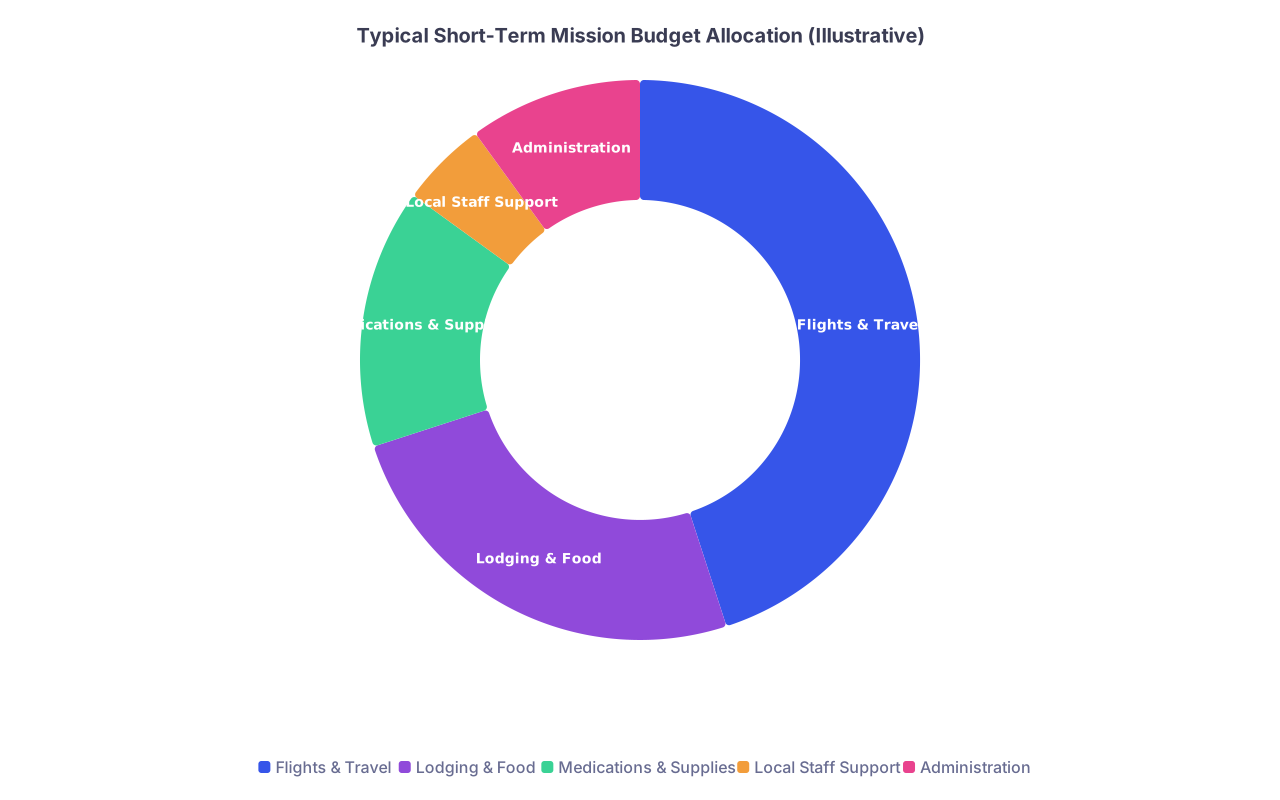
| Category | Value |
|---|---|
| Flights & Travel | 45 |
| Lodging & Food | 25 |
| Medications & Supplies | 15 |
| Local Staff Support | 5 |
| Administration | 10 |
Almost half of the “mission” budget can evaporate into airfare. That is not charity; that is tourism with side effects.
You will rarely see this breakdown on program brochures, because it undermines the feel-good narrative. But if you ask hard questions—about budget, outcomes, local leadership, and long-term goals—the picture is usually clear within five minutes.
When a Short-Term Trip Can Be Ethical
Now, I am not saying every short-term presence is inherently unethical. That would be as lazy as saying they are all good.
There are better and worse versions.
Shorter stints can be defensible when:
- They are part of a multi-year, locally led partnership
- Roles are clearly defined, and students do not exceed their training
- Care is coordinated with existing local services with real handoffs
- There is a concrete plan for continuity, data collection, and feedback
- Local professionals are in charge, and visitors are support, not heroes
The key is who holds power and whose priorities drive the work.
If the trip exists because a US or European school “needed something global” for their brochure, that is a red flag. If it exists because a local clinic or health ministry explicitly requested support, co-designed it, and controls how it evolves, that is a different story.
This is where structured global health programs—like long-standing university partnerships—tend to outperform ad-hoc church trips or student-led expeditions.

| Step | Description |
|---|---|
| Step 1 | Student Interest in Global Health |
| Step 2 | Join Longitudinal Community Clinic |
| Step 3 | Do Not Create New Trip for Yourself |
| Step 4 | Apply to Structured Program |
| Step 5 | Ask Hard Questions or Decline |
| Step 6 | Participate and Reflect |
| Step 7 | Local or Global Option |
| Step 8 | Existing Partnership? |
| Step 9 | Clear Roles and Supervision? |
Notice what is missing: “Find the cheapest mission trip that gives me the most hands-on experience.” That metric is how you end up in ethically compromised situations.
How Admissions Committees Actually See This
Here is what most premeds and med students do not realize: seasoned reviewers can smell the performative mission trip essay a mile away.
Lines like:
- “We brought healthcare to a village that had never seen a doctor before.”
- “I realized how grateful I am for what I have.”
- “They had so little, yet were so happy.”
These do not make you look compassionate. They make you look naïve and self-centered.
I have sat with faculty who literally groan when they hit the “single, transformative week in a foreign country” narrative. They are not impressed.
What they do notice:
- Nuanced reflection about power, privilege, and harm
- Clear understanding of your scope and limits during any trip
- Evidence that you listened to and learned from local professionals
- Longitudinal commitment—especially at home, not just abroad
Applications with no overseas missions but strong, consistent local service often beat applications full of photos from abroad but shallow substance. The “I volunteered at my city’s needle exchange every Friday for two years” essay carries more ethical and professional weight than “I flew to Kenya once.”
If you want a dirty little secret: a growing number of program directors and faculty view some mission trips as a mild negative if they smell like voluntourism. They will not say this on websites, but I have heard it in debrief rooms.
A Better Framework: Not “More Hours,” but “Less Harm, More Honesty”
You do not need to be perfect. But you do need to stop thinking in terms of “any volunteering is better than none.”
A better framework is brutally simple:
- First, do not harm
- Second, do not lie to yourself about who an experience is really for
- Third, when in doubt, prioritize local, long-term, and low-glamour
If you are already committed to a trip, you can still salvage something useful:
Ask what will happen to the patients you see the week after you leave.
Ask who designed the project—and who can change it.
Ask how local staff are paid, credited, and listened to.
Ask what data is collected and how it shapes future work.
Then pay attention to the answers, not the brochure.
To see the trade-offs clearly, it helps to compare typical student paths:
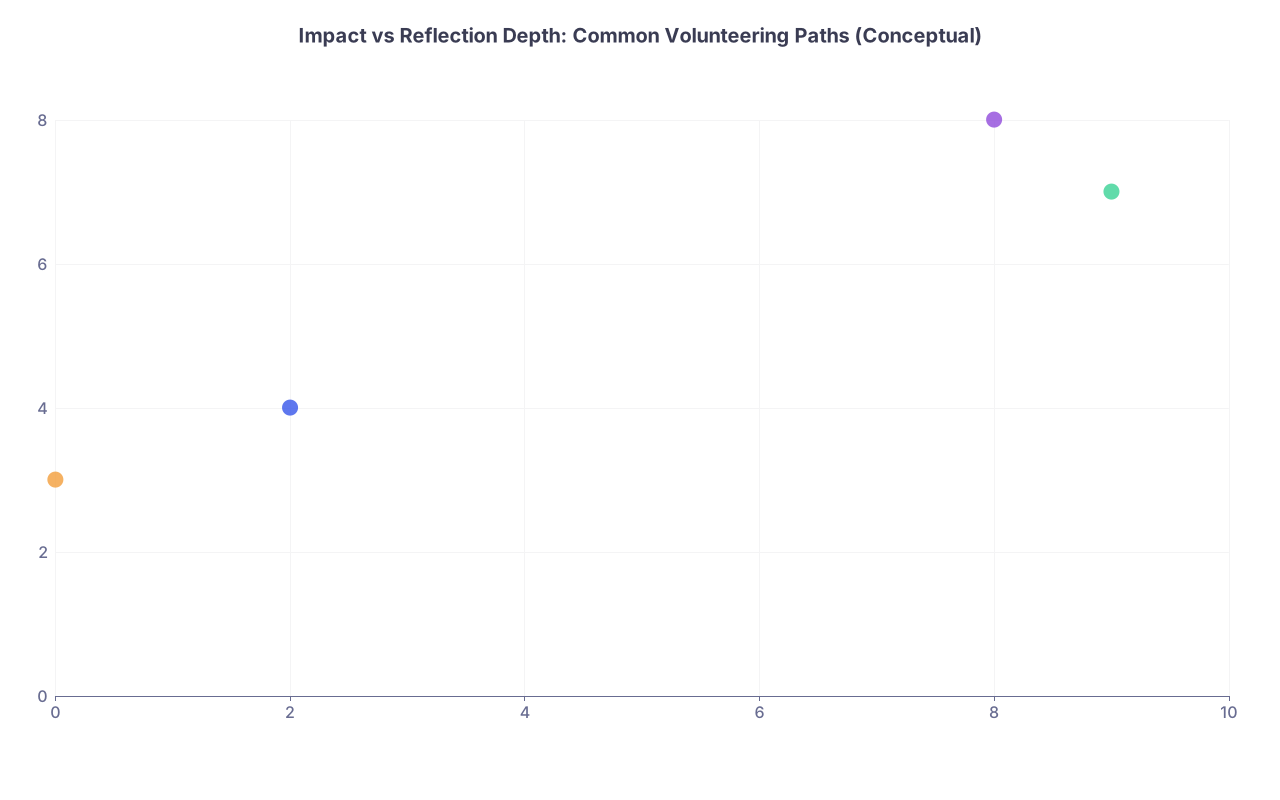
| Category | Value |
|---|---|
| Short-Term Mission | 2,4 |
| Local Longitudinal Clinic | 8,8 |
| Long-Term Global Partnership | 9,7 |
| No Volunteering | 0,3 |
On this conceptual map, the x-axis is potential impact, the y-axis is typical depth of reflection. Notice how “short-term mission” sits low compared to long-term, integrated work.
The point is not to shame you out of global health. The point is to push you toward forms of engagement that treat patients as people, not as case studies.
Years from now, you will not be proud of how far you flew or how many patients you “saw” in a week; you will be proud of whether you can look back on your so-called service without wincing.


