Last month I sat in a conference room while a global health committee reviewed applications for a short-term mission to East Africa. Two files came up back-to-back: one student with stellar scores and impressive procedures, another with average grades and almost no hands-on skills. The committee accepted the second applicant instantly and argued for ten minutes about whether to take the first.
If that surprises you, you do not yet understand how these decisions are actually made.
Let me walk you through what global health committees really look for when they choose mission volunteers—because it’s not what most pre-meds, residents, or early attendings think it is.
The First Filter: Are You a Risk or a Safe Bet?
Almost every committee I’ve sat on starts from the same unspoken question:
“Will this person make our work harder or easier?”
Not “Are they brilliant?”
Not “Will they save lives?”
Just: risk vs. safe.
And the risks they care about are not the ones you obsess over (GPA, test scores, how many procedures you’ve done). They’re thinking about liability, reputation, and local partnerships.
Here’s what quietly puts you in the “risk” pile:
- You sound like a savior. Phrases like “I want to help the less fortunate,” “bring advanced care,” “teach them modern medicine,” or “give back to those who have nothing” are red flags. Committees have learned the hard way that savior narratives correlate with entitlement, boundary violations, and disrespect of local clinicians.
- You oversell your skills. When an MS2 calls themselves “highly proficient” with procedures, or a PGY1 says they “independently manage critically ill patients,” we see liability. No one on the ground wants to explain to the local hospital director why a visiting student attempted a C-section.
- You romanticize hardship. Statements about loving “adventure,” “getting outside my comfort zone,” or “embracing primitive conditions” sound cute to you, but to people who’ve actually practiced in low-resource settings, they scream naïveté and poor judgment.
The “safe bet” applicants sound different:
They talk about listening before acting. They name supervision limits. They explicitly state they understand they may do more observing and supporting than hands-on care. They reference systems, teams, and local protocols, not “my experience” or “my impact.”
That’s the first secret: committees are risk managers disguised as idealists.
Competence: Not What You Think It Is
Most applicants think competence = procedural skills + medical knowledge.
Global health committees define it differently:
“Can this person function safely and respectfully in a chaotic, unfamiliar system with limited resources and unclear backup?”
So they read your file and listen to your interview for very specific signals.
What “competence” actually looks like to them
You know your lane, and you stay in it
The strongest applicants say things like:- “As a second-year student, my clinical skills are basic; my goal is to learn, support data collection, and help with education where appropriate.”
- “As an EM resident, I’m used to high-acuity care, but I recognize that here I’ll need to understand local practice patterns before assuming I know the best approach.”
When you show you understand scope of practice, committees breathe easier. They’ve seen the opposite: the eager student who wants to “practice” suturing on real patients, the intern who tries to override local guidelines because “this isn’t how we do it in the States.” Those people do not get invited back.
You know how to function with uncertainty
They’re listening for whether you’ve worked in low-structure environments: free clinics, understaffed wards, disaster drills, chaotic EDs. And more importantly, how you talk about them.The strong candidates say, “I learned to ask for help early when I felt over my head,” or, “I realized how dangerous it is to improvise outside my training.”
Weak candidates brag about “taking initiative” in ways that sound like improvising outside supervision.
You have emotional regulation under stress
Committees know you’re going to see death, suffering, avoidable harm, and systems that offend your sense of “how medicine should be.” The question is: will you melt down, moralize, or adapt?The applicants who get picked often have some story of conflict or distress—on a tough rotation, with a difficult preceptor, during a family health crisis—and they can describe how they processed it, learned, and stayed functional.
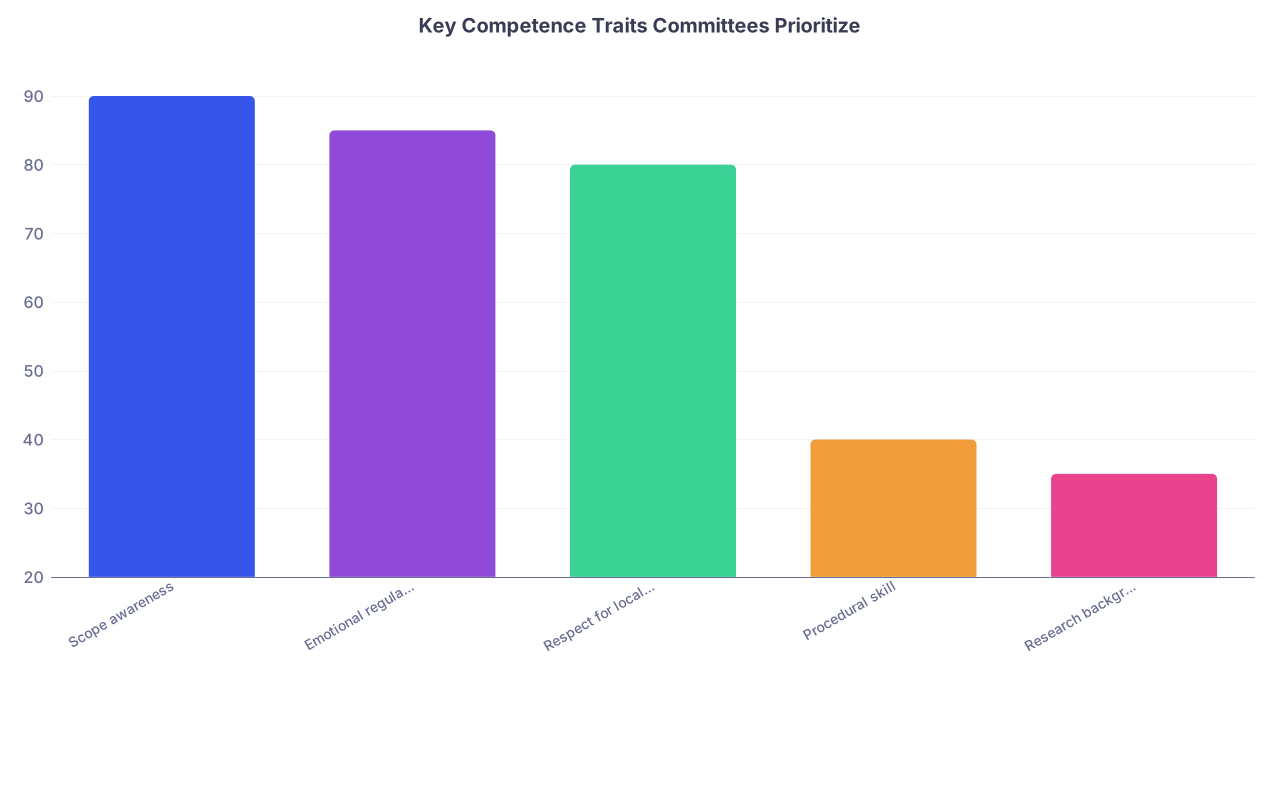
| Category | Value |
|---|---|
| Scope awareness | 90 |
| Emotional regulation | 85 |
| Respect for local systems | 80 |
| Procedural skill | 40 |
| Research background | 35 |
Notice what’s at the bottom of that list. Committees are not primarily looking for your skill at central lines. They are screening for whether you will destabilize a fragile ecosystem.
Ethics: The Stuff They Judge But Don’t Put in Writing
Now we get to the uncomfortable part.
Global health selection is an ethics screening disguised as an application process. Programs rarely say this outright, but inside the room, the questions are blunt:
- “Will this person use local patients as practice material?”
- “Will they undermine local clinicians?”
- “Will they exploit this for Instagram, LinkedIn, or residency applications?”
A couple of specific red flags I’ve heard committees call out, verbatim.
1. “What procedures will I get to do?”
The minute a student or resident asks this early in the process, several committee members mentally check out. You’ve just told them the primary subject of this trip is you.
It’s not that procedures are off the table. It’s that the framing matters. When an applicant asks instead, “How is patient safety ensured when trainees participate in care?” or “How are decisions made about which visiting learners do which tasks?” that signals ethical awareness instead of opportunism.
2. Casual talk about “exposure”
Any version of “I want to see diseases we don’t see in the US” can go badly if it’s not handled with precision. To faculty who’ve watched this play out, it can sound like, “I want to use other people’s suffering as my clinical safari.”
The applicants who pass this test talk about systems and context:
“I’m interested in understanding how HIV care is delivered in a low-resource setting” is very different from “I want to see advanced HIV we don’t see at home.”
3. Photo and social media behavior
You will not see a single question on most applications that says, “Will you post unethical photos?” But in the room, people absolutely talk about your online footprint.
Some committees quietly look you up. When they find:
- Selfies with patients in vulnerable situations
- Photos in scrubs with identifiable faces behind you
- “Doctoring” content when you’re not a physician
You get labeled “ethically high-risk,” whether anyone says it to your face or not.
The best candidates show, in their essays or interviews, an understanding of consent, dignity, and power dynamics. They mention being cautious with photography. They show awareness that “I got patient permission” does not mean “this was ethically clean,” because power and desperation distort consent.
The Character Traits Committees Fight Over
Here’s where it gets interesting. Once you’ve passed the safety and ethics filter, committees start arguing about fit. And the arguments are not about what you’d expect.
No one in those rooms cares whether you’re “passionate about global health” in the vague, Instagram-caption sense. Everyone claims that.
They care about three specific traits that make the difference between a volunteer they’d invite back and one they hope never returns.
1. Humility that shows up in behavior, not words
Every applicant writes that they’re “humble.” Committees ignore that line entirely. They look for subtler signals.
In essays:
- Do you center yourself, or do you center the team and the local partners?
- Do you describe “teaching them” or “learning from them”?
- Do you admit to mistakes and what you changed afterward?
In interviews:
- Do you interrupt?
- Do you correct faculty unnecessarily?
- Do you drop big-name institutions to impress?
The strongest applicants say things like, “On my last international trip, I realized we’d planned a screening program that didn’t match local priorities; we adjusted based on feedback from the local nurses.” That’s humility in action.
2. Reliability that survives inconvenience
The committee wants to know: When the glamour wears off and things get annoying, do you still show up?
They love applicants with:
- Evidence of long-term commitment (years at a free clinic, multi-year community org involvement)
- Stories of doing boring or menial work without needing recognition
- Experiences where they stayed engaged after the “fun” part ended
If your application shows you jump from opportunity to opportunity, three months here, six months there, always chasing something shiny, they worry you’ll do the same in-country—energetic the first week, resentful by week three.
3. Reflex for partnership instead of heroics
This one is subtle. Committees listen for whether you instinctively think in teams or think in individual hero mode.
When you describe a clinical story, do you talk about:
- “I saved this patient,”
or - “Our team quickly pulled in nursing, respiratory, and senior backup to stabilize the patient”?
In global health, they need people wired for the second version. Hero types go rogue, break agreements with local partners, and create messes others have to clean up long after you’re back home.
What They Really Use Your Application For
Let me be blunt: your CV is the least interesting part of your application to most global health committees—once you clear baseline thresholds.
They use your CV to make sure:
- You’re at the right training level
- You won’t be completely unsafe clinically
- You’ve shown you can stick with something
After that, the real evaluation happens in three places: your personal statement, your references, and your behavior in small, unscripted moments.
Personal statement: decoding your psychology
Faculty are reading it like a psych evaluation, not a writing sample.
They’re asking:
- Does this person see locals as equal colleagues or as grateful recipients?
- Are they primarily motivated by career advancement, or is there any evidence of genuine curiosity about health systems, justice, or ethics?
- Do they have any concept of “do no harm” in a resource-limited, culturally complex environment?
They don’t want martyrs or tourists. They want grown-ups who can be honest about their own motives and limitations.
References: the real background check
Here’s a behind-the-scenes truth: a single lukewarm line in a strong letter can sink you.
When a trusted faculty member writes, “She is very bright and enthusiastic, though sometimes needs closer supervision in unfamiliar situations,” every committee member with experience in the field hears, “She might go off the rails when things get weird.”
They look for:
- Comments about how you handle feedback
- Any mention of ethical judgment
- Whether the referee would “unreservedly” recommend you for this type of work (that specific adverb matters; people choose it carefully)
If you’ve ever been called out for boundary issues, arrogance, or unreliability, and that person is writing your letter, committees can smell it in the way they hedge.
Unscripted behavior: the hallway test
If your interview day includes group activities, dinners, or informal chats, those may matter more than the formal interview.
One director I know routinely asks program coordinators, “Who was kind to you? Who treated you like furniture?” Another pays more attention to how applicants talk to the van driver than to how they answer questions about global health ethics.
Think that’s unfair? Maybe. But they’ve learned that the person who’s dismissive to staff in Boston will be disastrous with local nurses in Malawi.
| Factor | Real Weight (Typical) |
|---|---|
| Ethical judgment | Very high |
| Humility / team orientation | Very high |
| Emotional stability under stress | High |
| Long-term reliability | High |
| Procedural skill level | Moderate |
| Research / publications | Low–moderate |
How to Actually Strengthen Your Candidacy (Without Faking It)
Let me show you how people quietly move from “maybe” to “must-accept.”
I’m not talking about gaming the system. I’m talking about doing the kind of work that committees recognize as the real preparation for global health.
Build ethical muscle at home
If you want to stand out, you need a track record of wrestling seriously with ethics, before you’re put on a plane.
That means:
- Choosing rotations and settings where consent, access, and power imbalances are obvious: free clinics, safety-net hospitals, addiction medicine, palliative care.
- Getting involved in ethics consults or hospital ethics committees if your institution allows learners to observe.
- Actually reading and thinking about global health ethics, not just saying “I care about injustice.”
Then, in your application, you do not brag about this. You reference one or two concrete situations where you faced an ethical tension and describe, briefly, how you approached it, who you asked for guidance, and what changed in your practice afterward.
Show that you understand continuity, not “voluntourism”
One of the biggest concerns committees have is contributing to the revolving door of short-term visitors who disrupt care more than help.
So they look for signs that you:
- Have stuck with a single community or clinic over time
- Have done unglamorous follow-up work (data cleaning, quality improvement, patient callbacks)
- Understand that your few weeks on site are a tiny slice of an ongoing local effort
The strongest applicants often explicitly say something like, “I see this rotation as an entry point to a long-term relationship with [program/institution], and I understand that means being guided by local needs, not just my interests.”

| Step | Description |
|---|---|
| Step 1 | Local underserved work |
| Step 2 | Ethics reflection |
| Step 3 | Long-term community engagement |
| Step 4 | Structured global health training |
| Step 5 | Short-term supervised trip |
| Step 6 | Ongoing partnership or research |
Committees are more likely to invest in you if they believe this is step 4 in a journey, not a one-off adventure you’ll forget after Match Day.
Get feedback on how you come across
There’s one thing applicants chronically underestimate: how entitled, condescending, or self-centered they sound to people who’ve done this work for years.
You may not hear it. But someone on your campus will.
Find:
- A faculty member who actually practices global health or has worked abroad
- A seasoned nurse or social worker who has seen medical trips come and go
- A program coordinator who’s sat through a hundred of these cycles
Have them read your personal statement and specifically ask: “Do I sound like a savior or a partner?” Then actually rewrite based on what they say.
The Non-Negotiable: Being More Useful Than Harmful
Here’s the unvarnished truth most programs will not state openly:
Short-term global health missions are ethically fraught. Some are excellent. Many are performative. All are under scrutiny.
Every committee member who has been on the ground knows how limited your impact will be in two or four weeks. They’re not selecting you because they think you’ll transform a health system. They’re selecting you because:
- They hope you will do more good than harm while you’re there.
- They hope you will learn in a way that changes how you practice for the next 30 years.
- They hope you will become the kind of colleague who supports sustainable, locally-led work instead of ego-driven projects.
So they’re not actually evaluating “Who can help us the most this summer?”
They’re evaluating, “Who is worth the risk and investment for the long game?”
If you want to be chosen, build your application—and yourself—around that reality.
FAQs
1. Do global health committees care if I do not speak the local language?
They care less about fluency and more about how you think about communication and power. Plenty of accepted volunteers do not speak the language, but the ones who get selected acknowledge the limitation and show they’ve thought about how to work respectfully with interpreters, avoid making assumptions, and defer to local staff in nuanced conversations. If you’ve made any effort—basic phrases, cultural orientation, even a short language course—that’s seen as a sign of seriousness, not as a technical skill.
2. Is it a problem if I’m primarily interested in global health to strengthen my residency or fellowship application?
That motive alone will not disqualify you, but how you present it might. If you sound transactional—“This will help me match derm”—you’ll lose people quickly. If you can honestly say, “I know this will be valuable for my training, but I’m also very aware of the ethical issues and want to contribute to something ongoing and locally led,” that reads very differently. Committees aren’t naïve; they know career benefits are part of the equation. They just don’t want that to be your only lens.
3. What if I have almost no prior global or underserved experience—should I still apply?
You can, but you need to be realistic and strategic. Some programs are explicitly set up as entry points for beginners and will consider you if you show strong ethical awareness, humility, and a credible plan to stay engaged afterward. Others expect a track record with underserved populations as a non-negotiable. If your experience is thin, your application should not overreach; own that this is new to you, emphasize your reliability and teachability, and start building serious local commitments now, whether or not you’re accepted this year.
Key points: Committees are screening you far more for ethics, humility, and emotional stability than for technical flash. They’re looking for partners, not heroes, and they’re betting on who you’ll become over decades, not what you can do in a few weeks. Build a life—and an application—that proves you understand that.