

The fastest way to damage patients, your reputation, and future missions is sloppy documentation and casual attitudes about privacy.
You’re not “just helping” on a quick trip. You’re practicing medicine across borders, under multiple legal systems, with vulnerable patients who often have zero recourse if you mishandle their information. If you treat documentation and privacy as optional because “it’s just a mission trip,” you’re already in the danger zone.
Let me walk you through the mistakes I see over and over—and how to avoid becoming that story people whisper about at ethics conferences.
1. Treating Documentation as Optional “Because It’s Short-Term”
This is the foundational error: assuming that because you’re there for 1–2 weeks, charting and record-keeping suddenly matter less.
I’ve heard the lines:
- “We’re just giving basic meds.”
- “The local clinic doesn’t even have an EMR.”
- “It’s a pop-up clinic; we’re not a hospital.”
That mindset is how people:
- Repeat antibiotics that were just prescribed three days ago
- Miss pregnancies because no one wrote last menstrual period anywhere
- Double-dose patients on steroids or NSAIDs
- Lose track of who got what vaccination
The reality: Even on a 5-day mission, your documentation may be the only medical record a patient has for years.
Here’s where people screw this up:
No consistent charting system
- Every provider writes whatever, wherever
- No standard fields for allergies, meds, problem list, vitals
-
- Names on sticky notes, illegible shorthand
- No way to match patient to record when they return on day 3
Not aligning with local standards
- Team invents forms in English
- Local clinic can’t read or use them once you’re gone
Do not make this mistake. You need a deliberate, boring, repeatable system.
At minimum, every encounter needs:
- Patient identifier (local format, not what you feel like using)
- Date and location
- Chief complaint
- Pertinent history (PMH, meds, allergies, pregnancy status when relevant)
- Exam findings
- Assessment and plan (with meds, doses, duration)
- Name/role of provider
If you don’t have at least that, you’re not doing short-term work—you’re doing short-sighted work.
2. Ignoring Local Ownership of Records
Another classic mistake: acting like the charts “belong” to your mission team.
I’ve seen teams:
- Pack all paper charts into a suitcase and fly home
- Store copies in a US-based server with zero local access
- Photograph records and keep them for “research” without clear agreements
That’s unethical and often illegal.
You are a guest. The patients are local. The health system is local. Your records should also be locally anchored.
Here’s where teams go wrong:
No agreement with the local partner about:
- Who owns the medical records
- Who stores them
- How long they’re kept
- Who can access them and under what circumstances
Creating parallel systems
- Local clinic has one kind of record, your mission creates its own
- Patients get split histories across two unconnected systems
Make sure, before you see your first patient:
- There is a written understanding (email at minimum) about record ownership and storage.
- Your system is either:
- Integrated into the local clinic’s documentation, or
- Designed to be easily handed over and used by local staff
If you’re using digital tools, the local partner must:
- Know where data is stored
- Have credentials to access it
- Understand how to retrieve records after you leave
If your team flies out with the only usable version of patient data, you’ve failed those patients.
3. The Social Media and Photo Disaster Zone
This is where even well-intentioned people get reckless. Phones come out. Kids smile. Clinicians pose with “interesting” cases. Then those images end up:
- Publicly on Instagram with identifiable faces
- In residency presentations without anonymization
- On mission newsletters with stories patients never agreed to share
Do not fool yourself: “They don’t mind” or “They were happy we took the photo” is not meaningful informed consent—especially when there’s a power imbalance, language barrier, and cultural gap.
Here’s what goes wrong:
No clear photo policy
- Everyone does what they want
- Some providers take selfies with patients in visible distress
No consent documentation
- “Verbal consent” given through an interpreter in 3 seconds
- No explanation of where or how the photo may be used
Posting clinical content with loosely anonymized details
- “This 12-year-old girl from rural [country] with rare facial deformity…” plus a photo from the clinic gate
- Locals can easily identify her; so can her school
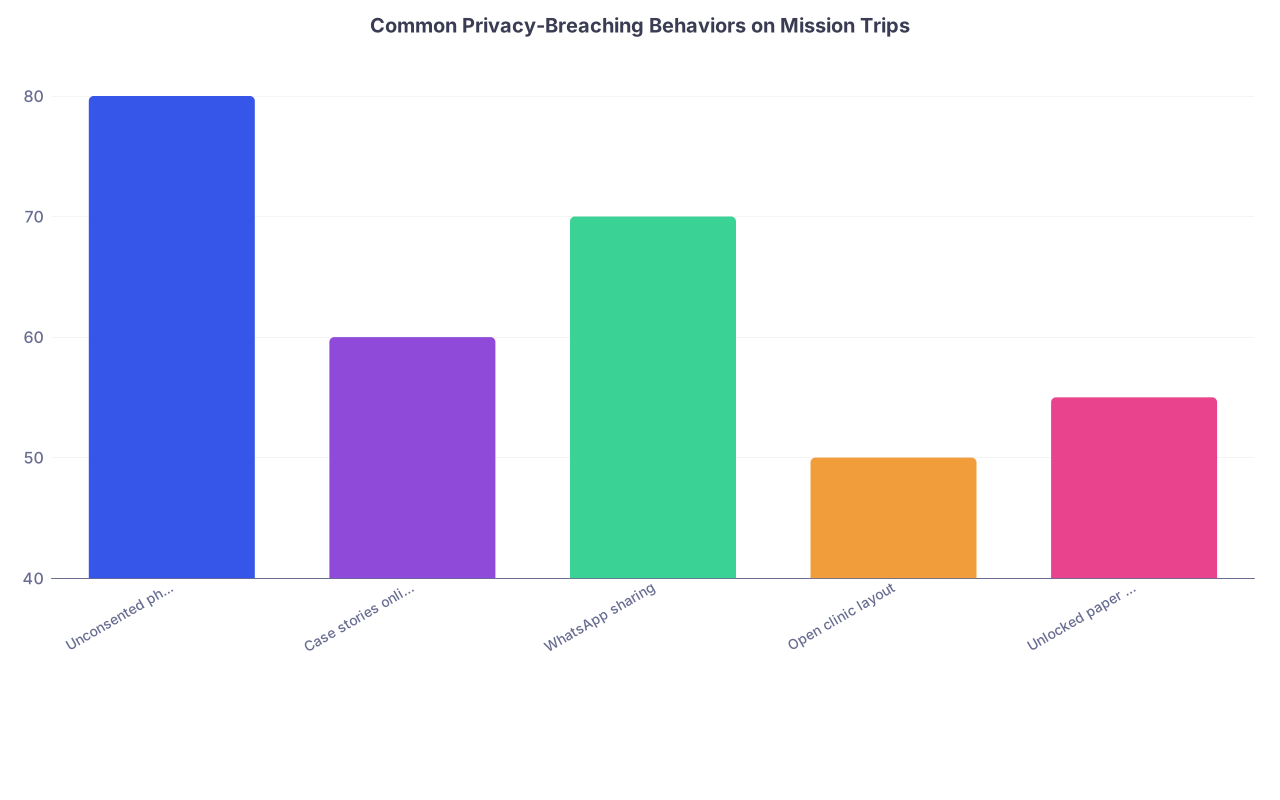
| Category | Value |
|---|---|
| Unconsented photos | 80 |
| Case stories online | 60 |
| WhatsApp sharing | 70 |
| Open clinic layout | 50 |
| Unlocked paper charts | 55 |
You need firm rules:
No clinical photos without documented consent that includes:
- Purpose (education, publication, internal teaching only, public social media, etc.)
- Whether face will be shown or de-identified
- Explicit right to say no without affecting care
No posting of identifiable patient information—ever—in:
- Personal social media
- Group chats beyond the direct care team
No “poverty porn”—images that highlight suffering to make donors feel good or to glorify your sacrifice. That’s exploitation, not storytelling.
If your organization doesn’t already have a written photo and story policy, that’s a serious red flag.
4. Misapplying or Ignoring Privacy Laws (HIPAA ≠ Global Gold Standard)
Here’s the lazy thinking pattern:
“We’re outside the US, so HIPAA doesn’t apply.”
or
“We’re US-based, so we just follow HIPAA and we’re fine anywhere.”
Both are wrong.
HIPAA is not the only privacy framework in the world, and it’s not the ceiling of ethical behavior. Some countries have stricter laws. Others have weaker ones—but you still have professional ethical duties that don’t magically disappear.
Common mistakes:
Assuming no law = no obligation
- “They don’t really do privacy here.”
- That’s not a license to discuss patient diagnoses loudly in a crowded waiting area.
Ignoring host-country regulations
- National data protection laws (e.g., GDPR in the EU, POPIA in South Africa)
- Ministry of Health policies on data export or research use
Using US-centric tools that violate local law
- Cloud systems that store data in another country without local approval
- Apps that transmit data through unsecured networks
Here’s the basic rule:
You must at least meet your own professional standards and not violate the host country’s laws. That means:
- Keeping identifiable health information limited to those involved in care
- Securing records (physical and digital) against casual access
- Not exporting or sharing data for research or teaching without appropriate approvals
The ethical bar: “Could I defend this practice, in detail, to an ethics board in either country?” If the answer is no or you’re not sure, you need to slow down.
5. Sloppy Handling of Paper Charts and Logs
Paper is not inherently unsafe. Careless use of paper absolutely is.
I’ve walked through mission clinics after hours and seen:
- Patient registers wide open on tables
- Names, diagnoses, HIV status visible to anyone walking by
- Prescription logs left where curious teens could read them
This is how patient confidentiality is actually broken—not in some abstract hack, but by leaving notebooks lying around.
Places where people mess up:
- Public triage tables with uncovered logbooks
- Shared community spaces where charts get left after clinic
- Team lodging where records are stacked in common areas
You need very basic, disciplined habits:
- Designate one controlled area for record storage
- Assign one or two people responsible for physical security of charts
- At end of day:
- Count charts
- Lock them in a cabinet or designated secure room
- Never remove them to hotels or mission housing unless absolutely necessary and agreed with local partners
Also: don’t write more identifying info than needed on public-facing items. Name + diagnosis on an external sign-in sheet? Terrible idea.
6. Unsafe Digital Practices and “Convenient” Data Sharing
Here’s where modern teams get dangerous.
The pattern:
- Team uses WhatsApp or unencrypted texting for clinical photos, consults, and patient lists
- Cloud spreadsheets with names, diagnoses, HIV status, pregnancy tests shared to everyone on the team
- Emails with full patient details sent to mentors back home
Fast. Easy. Completely reckless when not tightly controlled.
You’ve got several overlapping risks:
- Data breach if a phone is lost or stolen
- Unauthorized access if someone’s personal account is compromised
- Cross-border data transfer without consent or legal basis
Typical sloppy moves:
- Using a shared Google Sheet with no access controls
- Keeping sensitive photos in personal photo galleries after the trip
- Adding non-clinical volunteers to clinical messaging groups “to keep them in the loop”
If you must use messaging apps:
- Use the most secure, locally acceptable tool
- Limit group membership to those directly involved in care
- Avoid using full names when you can use IDs
- Have a policy for deleting data after the mission concludes
Do not keep “interesting cases” on your phone for months. That’s not clinical care—that’s a liability and an ethical failure.
7. Using Patient Data for Teaching and Research Without Real Consent
Here’s a subtle but serious trap:
You see rare conditions, fascinating pathology, unfamiliar presentations. You want to:
- Present at grand rounds
- Write a case report
- Publish data on disease prevalence
Nothing wrong with that if you do it properly. But missions often bypass every safeguard they’d respect at home.
Common violations:
- De-identification that isn’t actually de-identifying in a small community
- Collecting extra data “for research” without IRB or local ethics approval
- Calling it “quality improvement” to dodge review, then publishing in a journal
- Using consent forms that patients cannot realistically understand
| Scenario | Ethical? |
|---|---|
| Sharing anonymized aggregate data with local Ministry of Health | Yes, with agreement |
| Publishing case report without local ethics approval or clear consent | No |
| Presenting photo of a rare facial deformity with face visible | No |
| Using de-identified stats to improve next year’s clinic planning | Yes |
| Exporting full charts to home institution for retrospective study | No (without approvals) |
If you plan to use mission data for research or publication, you need:
- Approval from a recognized ethics or IRB body—often in both countries
- Clear agreements with local partners about data use and authorship
- Patient consent processes proportional to the sensitivity and risk
Mission trips are not data-mining expeditions. Patients are not “interesting content.”
8. Failing to Train the Entire Team (Not Just Clinicians)
A surprising source of privacy breaches: non-clinical volunteers.
I’ve watched:
- Translators repeat sensitive details within earshot of neighbors
- Logistics staff scrolling through patient lists “out of curiosity”
- Students talking loudly about “the HIV-positive mother from yesterday” at dinner in the village
If someone is on your team and has any access to patient information, they need training. Minimal but real.
That means:
A clear orientation before clinic opens:
- What counts as protected information
- Who they can talk to about patients (and where)
- What must never leave the clinical space
Explicit guidance for:
- Translators/interpreters
- Registration staff
- Students and observers
- Local volunteers
And yes, your own colleagues. Medical and nursing trainees are notorious for over-sharing “cool cases” when they think they’re in an informal context.
One person can undo the trust you’re trying to build with a single careless story in the wrong place.
9. No Exit Strategy for Records and Follow-up
The trip ends. You fly home. What happens next with all that data?
When there’s no plan, you get:
- Records stuck with a local leader who doesn’t have storage or training
- Digital files living on someone’s laptop with no backup
- No clear method for patients to access, correct, or revisit their records
This is how continuity of care breaks down—not because resources are limited, but because planning was lazy.
You need a concrete, boring exit plan:
- Who exactly holds the charts long-term?
- In what physical or electronic location?
- Who has keys/passwords?
- What is the plan for retention and eventual destruction, if any?
Also:
- How will follow-up be communicated if lab results come back after you leave?
- Who is responsible for contacting patients?
- Will future mission teams have appropriate, authorized access to prior records?
If you cannot answer these questions in specifics, you are not done planning.

| Step | Description |
|---|---|
| Step 1 | Before Trip |
| Step 2 | Agree on record ownership |
| Step 3 | Design documentation system |
| Step 4 | Train clinical and non clinical staff |
| Step 5 | Set photo and data policies |
| Step 6 | During Trip - Secure paper and digital data |
| Step 7 | Limit sharing to care team |
| Step 8 | Plan for follow up and handover |
| Step 9 | After Trip - Transfer records as agreed |
| Step 10 | Delete non essential copies |
FAQs (Exactly 3)
1. Is it ever acceptable to take clinical photos on a mission trip?
Yes, but only under strict conditions: you’ve obtained meaningful, documented consent in the local language; the patient understands where and how the image might be used; identifying features are removed when possible; and the use aligns with both local partner expectations and professional ethics. If you’re unsure, don’t take the photo.
2. What if the host site has no existing documentation system at all?
That’s not permission to wing it. Work with local leadership to design the simplest system that still protects patients: a basic paper chart with consistent identifiers, problem list, meds, and plans. Leave copies and ensure someone locally can maintain it. Avoid complex digital tools that no one can sustain after you leave.
3. Are messaging apps like WhatsApp always off-limits for clinical communication?
Not always, but they’re risky. If local practice and regulations accept their use, limit content to what’s necessary, avoid full names when possible, restrict group membership strictly to care providers, and agree on a deletion policy for sensitive content after the trip. And do not treat clinical WhatsApp threads as your permanent record.
Key points to remember:
- Short-term does not mean low-standard. Documentation and privacy obligations travel with you.
- Records, stories, and images belong first to patients and their communities—not to your mission brand or CV.
- If you can’t clearly defend your documentation and privacy practices to an ethics board in both countries, you need to tighten them before you see your first patient.


