
The worst way to do a “medical mission” in med school is to book a flight, pack a stethoscope, and hope your good intentions cover every ethical and clinical gap. They do not.
If you want your first medical mission to be ethical, useful, and genuinely educational, you plan it like a four‑year project. Year by year. Semester by semester. Otherwise you are just exporting chaos.
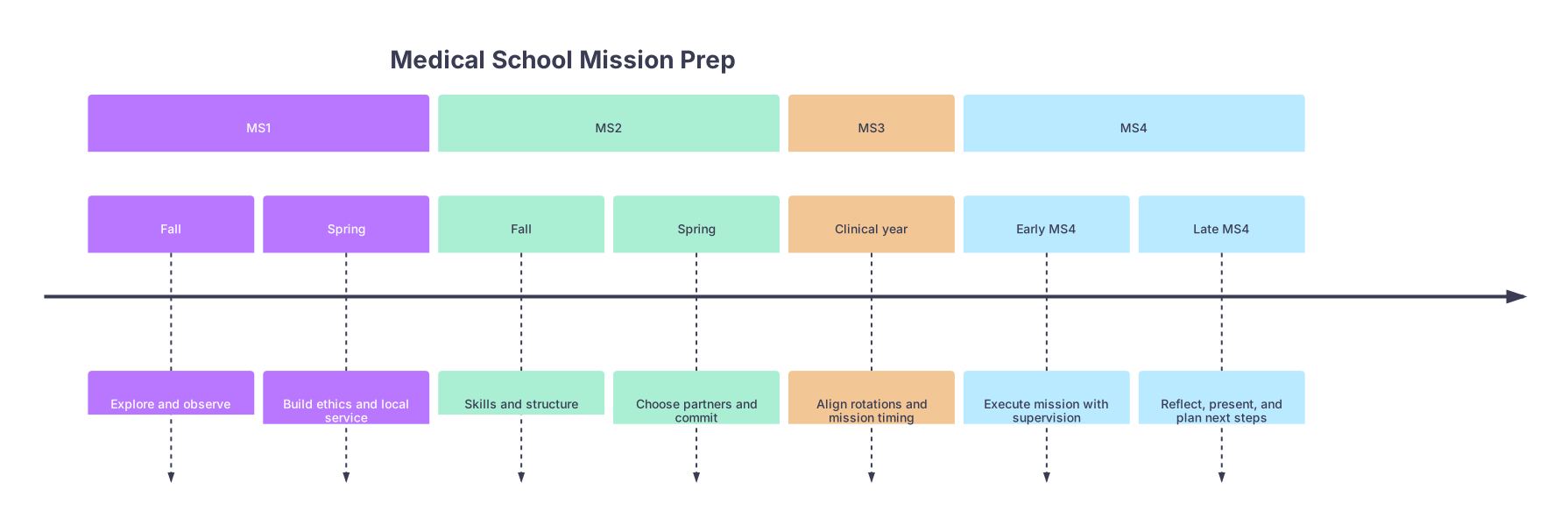
Below is a chronological roadmap: what to do in MS1, MS2, MS3, and MS4 so that by the time you step onto that plane, you know why you are going, whom you are serving, and how to do it responsibly.
Big Picture: What This 4‑Year Plan Actually Builds
By the time you leave for your first medical mission, you should have:
- A clear ethical framework for global health work
- Concrete clinical skills that match your level of training
- A vetted partner organization that does not use you as cheap labor or photo props
- Defined learning goals and supervision appropriate to your scope
That does not happen in a frantic 6‑week scramble. It happens in layers.
Here is how those layers stack.
| Period | Event |
|---|---|
| MS1 - Fall | Explore and observe |
| MS1 - Spring | Build ethics and local service |
| MS2 - Fall | Skills and structure |
| MS2 - Spring | Choose partners and commit |
| MS3 - Clinical year | Align rotations and mission timing |
| MS4 - Early MS4 | Execute mission with supervision |
| MS4 - Late MS4 | Reflect, present, and plan next steps |
MS1: Curiosity, Ethics, and Local Service (Not Flights)
MS1 is not the year to be “leading” international projects. At this point you should be watching, reading, listening, and getting your ethical house in order.
Fall MS1: Foundations and Reality Check
At this point you should:
Map your school’s global health landscape
Walk, do not email.
- Attend your school’s global health interest group meeting. Or start one if it does not exist.
- Find the faculty names attached to:
- “Global Health,” “International Health,” “Tropical Medicine”
- Ethics, health policy, refugee/immigrant health clinics
- Schedule brief meetings: “I am an MS1 interested in a future medical mission. What pathways here are actually sustainable and ethical?”
Take notes on:
- Existing partner sites (e.g., a 10‑year partnership with a hospital in Haiti)
- Usual timing students travel (between MS1–MS2? MS4? only residents?)
- Required prerequisites (language, coursework, research)
Start reading like you take ethics seriously
You do not need a PhD. But you do need more than Instagram posts.
Minimum reading list, first semester:
- Paul Farmer – any major chapter on structural violence and global health
- “Ethical Challenges in Short-Term Global Health Training” (common academic review)
- Articles critiquing “voluntourism” and short‑term missions
At this point you should be able to answer, in writing:
- Why can short‑term missions be harmful?
- What makes them less harmful?
- Where are you most likely to overstep your skills?
Start with local global health
Before you “help” abroad, prove you can show up across town.
At this point you should:
Commit to 1 local, underserved‑focused clinic or project for the whole year:
- Free clinic
- Refugee health program
- Neighborhood health fair in a medically underserved area
Show up twice a month, minimum. Same site, consistent.
Ethics and humility are habits. You build them where you are.
Spring MS1: Language, Structure, and First Real Commitments
By spring you are past the “I am interested” stage. Time to add structure.
At this point you should:
Choose a language and build a 2‑year plan
Going to Latin America? You cannot fake Spanish with Google Translate and good vibes. Same for French West Africa, Lusophone countries, etc.
- Pick one language relevant to where your school already partners.
- Enroll in:
- A for‑credit medical Spanish / French / Portuguese course, or
- A community class, or
- A structured online curriculum with weekly hours blocked
Block 2–3 hours / week in your calendar as if it were a course. Non‑negotiable.
Take or audit an ethics/global health course
If your school has a global health elective, you should be in it this year or next.
Aim to complete by end of MS2:
- Global health principles
- Health systems in low‑ and middle‑income countries
- Mission/short‑term trip ethics
Identify mission timing options
Talk to senior students and faculty. At this point you should know:
Does your school support missions:
- Summer after MS1?
- After Step 1 (MS2–MS3 break)?
- During 4th‑year electives?
Rough timing windows (e.g., June–July only, or 4–6 week MS4 electives)
You are not booking anything yet. But you are aiming at a window.
MS2: From Vague Intention to Concrete Plan
MS2 is execution year. You build skills, you pick partners, and you start locking logistics.
Fall MS2: Skills Before Tickets
At this point you should:
Upgrade your clinical competence
You are still a student. But you can be a competent one.
Focus on:
History and physical exam:
- Practice structured H&Ps weekly in OSCE or simulation settings
- Ask preceptors to critique your clarity, speed, and thoroughness
Common outpatient complaints:
- Fever, cough, diarrhea, abdominal pain, headache, skin infections
Basic procedures (if offered & supervised):
- Vitals, phlebotomy, simple wound care
You do not need to “do more procedures” abroad than you do at home. You prepare so you do not chase inappropriate procedures there.
Clarify your scope and supervision expectations
Sit with a global health or ethics faculty mentor and have the blunt conversation:
- What can MS2s ethically do on missions?
- Under what supervision?
- What should you refuse to do, even if a local doctor or visiting group pushes?
At this point you should be able to say out loud:
“I will not perform procedures abroad that I am not allowed to do at my home institution under equivalent supervision.”Narrow your destination and partner list
Stop thinking “somewhere in Africa.” You need specifics.
At this point you should have a short list (2–3 options):
- Existing university‑affiliated programs (best)
- Long‑standing NGO partners with:
- At least 5 years in the same community
- Local leadership, not foreign‑run only
- Clear goals beyond short‑term clinics (training, capacity building, etc.)
- “We let students do surgeries they cannot do at home”
- No mention of local partners
- One‑week trips with daily new villages and zero follow‑up
| Factor | University Program | Long-Standing NGO | Voluntourism Group |
|---|---|---|---|
| Local partners | Formal agreements | Embedded clinics | Often unclear |
| Student supervision | Faculty present | Mixed, variable | Often minimal |
| Duration | 4–8 weeks | 2–6 weeks | 1–2 weeks |
| Focus | Education + service | Service + training | Short-term clinics |
| Ethical oversight | IRB/ethics board | Some internal | Rare |
Pick where you want to end up on that table. You already know my answer.
Spring MS2: Commit, Prepare, and Align With Boards
Now decisions actually matter.
At this point you should:
Lock which year your first mission will be
Realistic options:
- Summer after MS2 / Step 1 – common in older curricula, less now with pass/fail
- Dedicated MS4 elective – increasingly the most sane, ethical choice
If your school already structures global health electives in MS4, plan for that. It gives you:
- Better clinical skills
- More mature judgment
- Real elective credit
If mission is post‑MS2: finalize partner and dates by late spring
You should have:
- Written acceptance or invitation from the program
- Clear dates, duration (aim for ≥3–4 weeks; 1 week is more tourism than medicine)
- Defined role: observer vs hands‑on under strict supervision
And importantly:
- A named supervising physician on site
- Emergency contact / safety plan
Integrate Step/board studying with mission timing
This is where students screw up: they cram mission prep into board prep.
At this point you should:
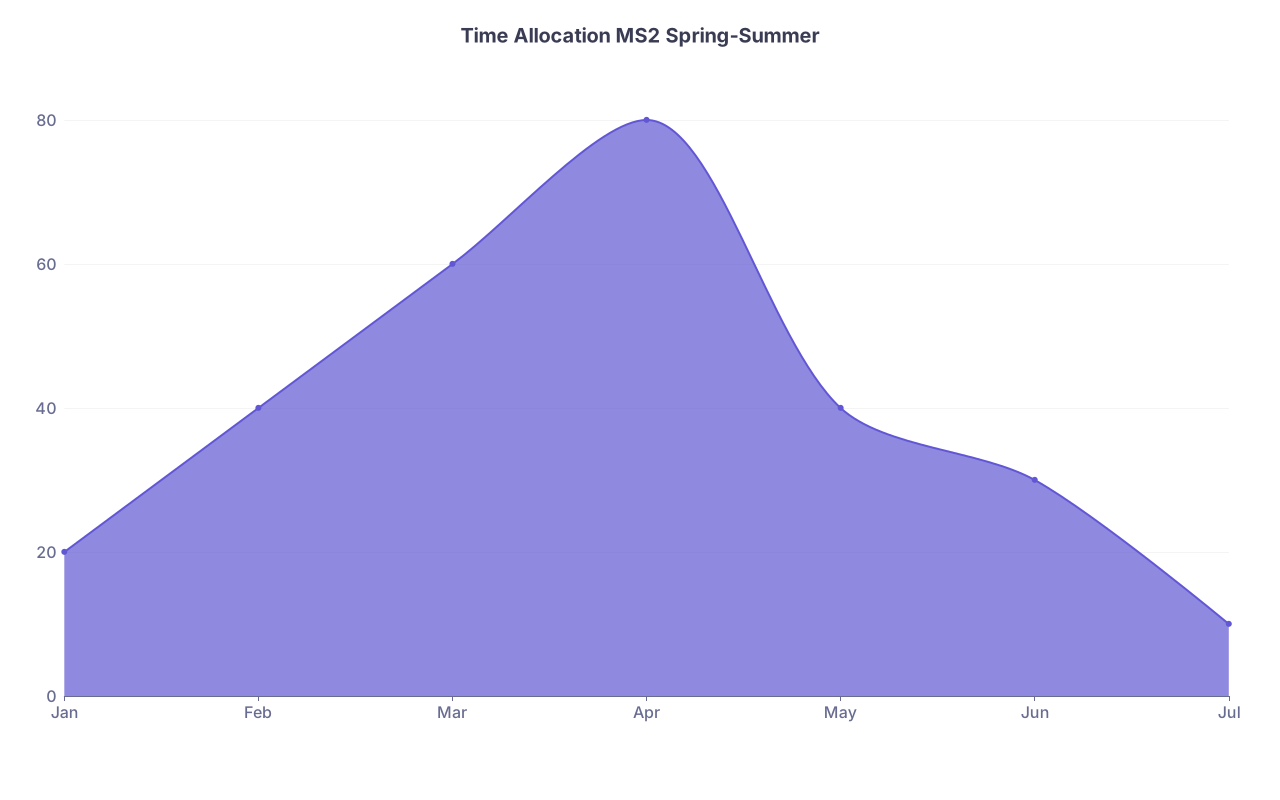
- Plot a calendar from January to August of MS2:
- Dedicated Step study block
- Mission dates
- Buffer time before and after the trip for rest and reflection
- Plot a calendar from January to August of MS2:
| Category | Value |
|---|---|
| Jan | 20 |
| Feb | 40 |
| Mar | 60 |
| Apr | 80 |
| May | 40 |
| Jun | 30 |
| Jul | 10 |
(Interpretation: peak energy to Step prep in March–April, then taper as you move into mission and recovery.)
If the mission timing obviously sabotages your Step performance, postpone the mission to MS4. You are not helpful abroad if you fail at home.
- Start fundraising and budgeting like an adult
By late MS2 you should have a simple budget:
- Flights
- Room/board
- Program fees
- Vaccines, prophylaxis, insurance
- Extra expenses (visas, transport)
Then:
- Apply for:
- School global health grants
- Specialty societies’ student travel scholarships
- Faith‑based mission funds if relevant to your group
Do this early. Funding moves slowly.
MS3: Clinical Maturity and Strategic Alignment
MS3 is clinical immersion. You may or may not travel this year. Either way, it shapes how useful you will be when you do go.
Whole MS3: Build the Skills You Will Actually Use
At this point you should use every core rotation to sharpen global‑health‑relevant skills:
Family medicine / internal medicine
- Efficient outpatient visits
- Chronic disease management with limited resources (what would you do without CT or MRI?)
- Basic EKG, chest X‑ray interpretation
Pediatrics
- Growth charts
- Vaccine schedules and catch‑up logic
- Diarrhea, pneumonia, malnutrition
OB/GYN
- Antenatal counseling
- Recognizing obstetric emergencies early
Emergency medicine
- Triage thinking
- Stabilization with limited diagnostics
On each rotation, ask one attending you respect:
- “If I were on a low‑resource rotation abroad in a few years, what 2–3 skills from this rotation would matter most?”
Write their answer down. Integrate those skills into your learning goals.
Late MS3: Locking an MS4 Global Health Elective
If you have decided to push your first mission to MS4 (good call, honestly), late MS3 is when you formalize it.
At this point you should:
Apply for the MS4 global health / international elective
Components usually include:
- Site description and partner details
- Supervising preceptor CV or credentials
- Learning objectives
- Evaluation plan
Clarify what “mission” means in your context
For MS4, the best model is usually not a pop‑up “mission trip” but a global health rotation at a partner hospital or clinic.
You are not:
- Leading a team of undergrads
- Dropping off boxes of donated expired meds
You are:
- A supervised senior student on a structured elective in a low‑resource setting
Treat it that way.
MS4: Execution, Reflection, and Next Steps
This is when you finally go. If you have done the previous years correctly, MS4 is not improvisation; it is the final stage of a multi‑year plan.
Early MS4: Final Prep and On‑Site Behavior
At this point you should:
Complete pre‑departure training
Good programs require pre‑departure sessions on:
- Safety and risk management
- Cultural humility and communication
- Clinical scope and supervision
- Debriefing and mental health
If your school does not offer this, push for it. Or piece it together from existing global health modules.
Refine a specific learning agenda
Do not step on the plane with “I want to help.” That is vague and useless.
Examples of good MS4 learning goals:
- “Compare management of pediatric pneumonia here vs at home, including indications for admission and antibiotic choices.”
- “Gain competence in diagnosing and managing common dermatologic conditions in dark skin with limited diagnostic tools.”
- “Understand referral patterns and barriers for high‑risk obstetric patients in this district.”
Share these goals with your supervising physician before arrival.
On site: act like a guest, not a savior
Day 1–3 at the site, you should:
- Watch more than you talk
- Learn:
- Clinic flow
- Who actually runs the place (hint: local nurses and staff)
- Where students plug in without disruption
And you keep repeating your ethical rule:
- Do not do abroad what you are not allowed to do at home.
- When in doubt, observe or assist, do not lead.
During the Mission: Daily Habits That Keep You Grounded
Each week you should:
Keep a brief daily reflection log (bullet points, not poetry):
- Cases seen
- Ethical tensions noticed
- Systems issues (med stockouts, transport barriers)
- Personal reactions
Do a weekly check‑in with your supervisor:
- Are your activities aligned with your training level?
- Are you adding value or just consuming staff time?
- Adjust responsibilities as needed
You are not there to “fix” anything in 4 weeks. You are there to learn responsibly and contribute within a system that existed before you and will exist after you.
Post‑Mission: Debrief, Share, and Plan Responsibly
You come home. The worst thing you can do now is just post photos and move on.
At this point you should:
Formal debrief within 2–4 weeks
With:
- Global health faculty mentor
- Peers who have done similar electives
- If possible, remote debrief with a local partner as well
Discuss:
- What surprised you
- Where you felt ethically uncomfortable
- What you would change about the structure of the elective
Turn experience into something useful
Options:
- Case presentation at school’s global health or ethics conference
- Quality improvement idea proposed to the partner site (only if they actually want it)
- Reflection paper for your own portfolio or residency applications, focused on humility and systems thinking, not heroism
Decide your future relationship with missions
Not everyone needs to become a global health career person. Decide honestly:
- Was this a one‑time educational experience?
- Do you want to build a long‑term relationship with this site?
- Are you interested in residency programs with structured global health tracks?
Base that on your actual experience, not on what sounds impressive.
A Compact Year‑by‑Year Checklist
Use this as a quick reference.
| Year | Core Focus | Non-Negotiables |
|---|---|---|
| MS1 | Ethics + local service | Read ethics, join clinic, pick language |
| MS2 | Skills + partner selection | Define scope, choose partner, plan timing |
| MS3 | Clinical maturity | Rotate intentionally, secure MS4 elective |
| MS4 | Execution + reflection | Pre-departure training, ethical practice, debrief |
Today, do one concrete thing that moves you out of the “vague interest” phase: email one global health faculty member and request a 20‑minute meeting, with the subject line “MS1/2 interested in ethical first medical mission—seeking a 4-year roadmap.”


