

The biggest ethical mistakes on medical missions are made six months before the plane takes off.
By the time you are standing in a rural clinic with a line out the door, it is already too late to fix most of them.
You are a resident. Your time is limited. Your training is real, but so are your blind spots. If you treat this like an adventurous elective instead of a slow, disciplined preparation process, you will export your gaps in judgment directly into someone else’s community.
Here is the six‑month countdown most residents never build—but absolutely should.
Six Months Out: Decide If You Should Even Go
At this point you should be brutally honest: are you the right person, at the right time, for this mission?
6 Months Out – Week 1–2: Motivation and Fit
Sit down for one hour, alone, and write answers to three questions:
- Why this mission, this year, in this country?
- What are you hoping to gain for yourself?
- What can you realistically offer that the local system actually needs?
Then, reality check with:
- Your program director
- Someone who has done at least two ethically serious missions (not a 1‑week photo tour)
- Ideally, a local partner or faculty with direct ties to the host site
Red flags you should treat as near-stop signs:
- You cannot describe the local health system beyond “low-resource” or “third world.”
- The mission organization cannot name its in‑country partners clearly, or those “partners” are only other Western NGOs.
- Your main motivation is “more procedures” or “I want to see rare pathology.”
At this point you should be ready to walk away if the structure is wrong. Better to cancel at month six than apologize at month six plus one day.
6 Months Out – Week 3–4: Scope and Role Definition
You need a written, specific role. “Help in the clinic” is not a role.
Clarify:
- Your level: PGY‑1 IM vs PGY‑4 anesthesia vs PGY‑3 EM changes everything.
- Your responsibilities: outpatient only, OR assistant, teaching role, call coverage?
- Supervision: who is your on‑site clinical supervisor with authority to stop you?
- Limits: what you will not do (no independent surgery, no pediatric anesthesia, no high‑risk OB, etc.)
Get this in email. Not “we’ll figure it out when you arrive.”

| Step | Description |
|---|---|
| Step 1 | Interest in mission |
| Step 2 | Contact organization |
| Step 3 | Ask for written role |
| Step 4 | Confirm participation |
| Step 5 | Escalate questions or withdraw |
| Step 6 | Role clearly defined |
If the organization pushes back—“we are very flexible,” “you’ll help wherever needed”—you are staring at a classic setup for scope creep and ethical problems. I would not go.
Five Months Out: Ethics Framework and Guardrails
At this point you should stop thinking about vaccines and packing lists and start thinking about power, harm, and consent.
5 Months Out – Week 1–2: Build Your Ethical Checklist
You are going to be tired, jet‑lagged, and emotionally flooded. You need decisions made now that will guide you then.
Draft a one‑page “Ethical Guardrails” document for yourself:
Clinical limits
- I will not perform procedures I am not credentialed to do at home.
- I will not be primary decision‑maker on life‑threatening cases without appropriate supervision.
Patient communication
- I will not bypass local clinicians to “save time.”
- I will require some form of understandable consent, even if abbreviated.
Data and photos
- I will not post patient images or identifiable stories on social media.
- I will not collect data for research without prior IRB and local approval.
Print it. Put it in your passport. Share it with the attending going with you.
5 Months Out – Week 3–4: Learn the Context, Not Just the Language App
You do not need to be fluent. You do need to respect that people have names, religions, and politics.
At this point you should:
- Read a short history of the country (not just its disasters).
- Learn:
- Majority religion and major holidays
- Recent political instability or conflict
- Basic health system structure (public vs private, insurance, common referral patterns)
Make a specific reading plan:
| Week | Focus Area | Resource Type |
|---|---|---|
| 1 | Country history | Short book or report |
| 2 | Health system | WHO or gov report |
| 3 | Local diseases | Review articles |
| 4 | Cultural norms | Local blogs or essays |
If you only have 30 minutes a week, fine. But do it. I have watched residents offend local staff in the first hour because they assumed everyone wanted to talk about “how bad things are here.” They did not.
Four Months Out: Clinical and Systems Preparation
Now you shift into targeted clinical prep—not to be a hero, but to avoid preventable harm.
4 Months Out – Week 1–2: Identify Top Clinical Domains
Talk with:
- The mission organizer
- A local partner (if possible)
- A faculty member with experience in that country or region
Ask very narrow questions:
- What are the top 5 diagnoses in adult clinic?
- What are the top 5 in pediatrics?
- What medications are actually available at the site?
- Is there reliable access to:
- Oxygen?
- Blood products?
- Imaging beyond plain film?
Then build a one‑page “Clinical Reality” sheet.
Typical surprises residents encounter:
- Hypertension and diabetes everywhere, but no labs for A1c and limited ACE inhibitors.
- Antibiotics that are 10–20 years behind your usual guidelines.
- Zero home oxygen. No CPAP. Limited ICU beds that are fully occupied year‑round.
4 Months Out – Week 3–4: Focused Clinical Study
Create a four‑week module for yourself. One evening per week, 60–90 minutes.
Example structure for an internal medicine resident going to rural East Africa:
Week 1: Infectious disease
- HIV first‑line regimens there (not yours at home)
- TB diagnosis without CT or GenXpert everywhere
- Malaria algorithms when RDTs are limited or mixed
Week 2: Noncommunicable disease in low‑resource settings
- Hypertension management with restricted formularies
- Diabetes management when glucometers and strips are scarce
- Chronic kidney disease when dialysis is not an option
Week 3: Emergency care with minimal resources
- Sepsis resuscitation without vasopressors
- Status asthmaticus with no continuous nebs, maybe limited steroids
- Trauma stabilization with limited imaging and blood
Week 4: Palliative care and “nothing more to offer” conversations
- How to talk about prognosis when “referral” is not possible
- Cultural nuances around death, hope, and truth‑telling
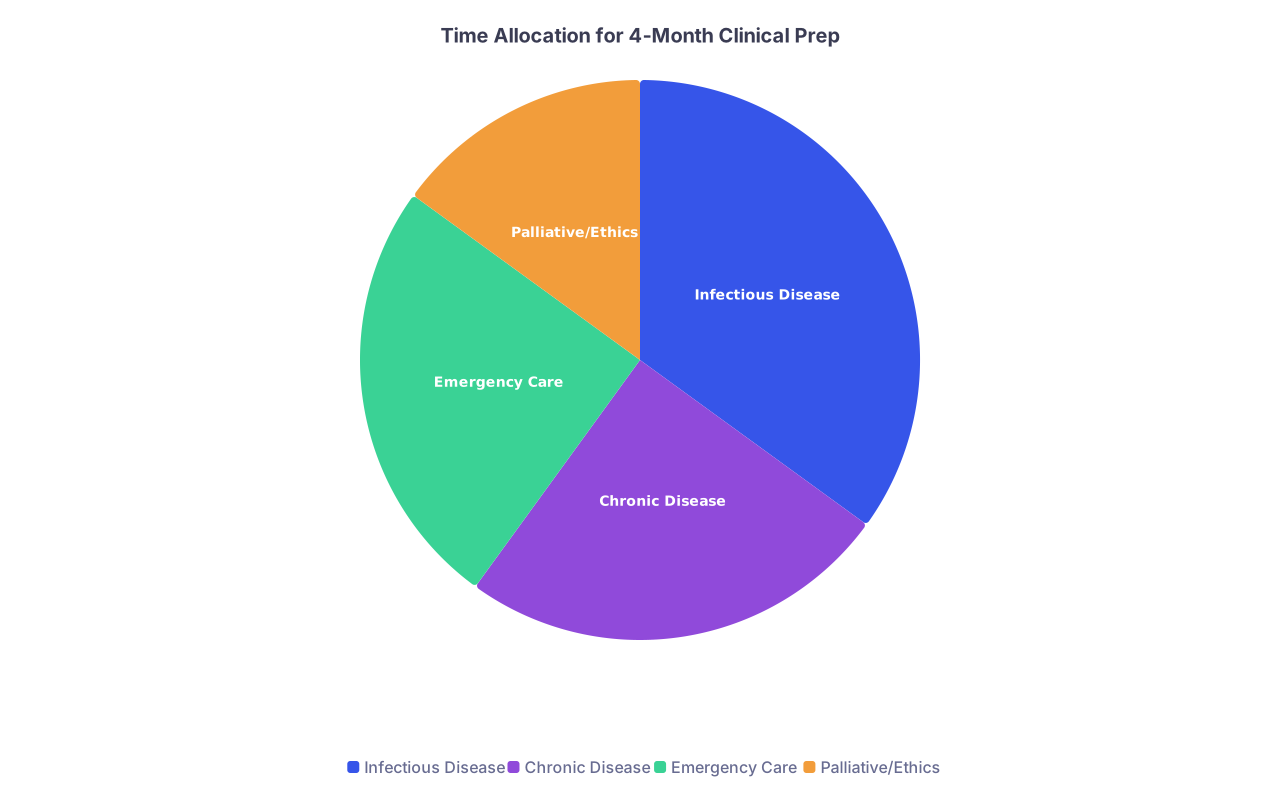
| Category | Value |
|---|---|
| Infectious Disease | 35 |
| Chronic Disease | 25 |
| Emergency Care | 25 |
| Palliative/Ethics | 15 |
Do not treat this like exam studying. Treat it like making sure you do not mismanage someone’s one chance to see a physician this year.
Three Months Out: Systems, Safety, and Accountability
At this point you should accept that you are not just a clinician—you are a visitor with power, and you must plan as such.
3 Months Out – Week 1: Personal Risk and Security
Sit with occupational health or travel medicine. Go through:
- Vaccination review: Hep A/B, typhoid, yellow fever (if regionally needed), MMR, tetanus, polio booster, etc.
- Malaria prophylaxis options and side effects.
- Needle‑stick and exposure protocols specific to that site.
Get direct answers:
- If I sustain a needle stick, what is the plan for:
- Post‑exposure prophylaxis availability locally?
- Testing of the source patient?
- Evacuation if needed?
If the mission has no answer besides “we never had a problem before,” take that as a warning.
3 Months Out – Week 2–3: Define Decision Hierarchies
On the ground, you will face messy calls: who gets the last unit of blood, what to do with obstructed labor when there is no OR, etc. You need a clear command structure now.
Clarify:
Who has final say in:
- Admission vs discharge
- Use of scarce resources (blood, ICU beds, ventilators)
- Operative vs non‑operative management
How disagreements are handled between:
- You and another visiting team member
- Visiting team and local clinicians
- Medical and administrative staff
Write down:
- Name and role of on‑site clinical lead
- Who you call when something feels ethically wrong
If the answer is “we’ll just talk as a team,” you are inviting disaster. Informal structures break the moment a child is crashing.
3 Months Out – Week 4: Build a Debrief and Support Plan
Missions are emotionally heavy. Cases you would feel bad about at home will feel worse there because you cannot “fix” the system.
At this point you should:
- Identify 2–3 trusted colleagues or mentors who will debrief with you after you return.
- Ask your program explicitly for:
- A formal debrief session
- Permission to present a morbidity and mortality–style discussion focused on ethics and systems
You are planning now to metabolize moral distress later, instead of burying it under “that is just how it is there.”
Two Months Out: Communication, Culture, and Boundaries
Now the focus shifts from clinical prep to human relationships.
2 Months Out – Week 1–2: Communication Skills for Low-Resource Settings
You are not going to learn perfect medical language in eight weeks. You can learn enough to show respect and avoid chaos.
Pick:
40–50 core phrases in the local language:
- Greetings and basic respect phrases
- Pain descriptions and common symptoms
- Simple explanations: “medicine,” “test,” “tomorrow,” “dangerous”
20–30 basic medical words:
- Heart, lungs, blood, sugar, infection, pregnancy, etc.
Schedule 2–3 short sessions with:
- A native speaker (ideally a clinician or staff member who knows medical context)
- OR a structured online tutor focused on that language
2 Months Out – Week 3: Cultural Boundaries and “Savior” Dynamics
At this point you should confront the worst version of yourself so you can catch it later.
Write down:
Signs you are slipping into savior mode:
- Overriding local staff “for the patient’s sake”
- Pushing for interventions that cannot be maintained after you leave
- Feeling indispensable after 48 hours on site
Your correction strategies:
- Pause and ask a local clinician: “How is this usually handled here?”
- Ask yourself: “What happens to this patient when I leave?”
I have watched residents proudly start complex insulin regimens in clinics where patients cannot afford test strips. That is not help. That is harm disguised as sophistication.
2 Months Out – Week 4: Social Media and Storytelling Rules
You must be clear about how you will (and will not) use this experience online.
Set written rules:
- No faces of patients.
- No “before and after” miracle stories.
- No captions that pity or objectify communities (“these poor people,” “they have nothing”).
Decide in advance:
- Will you post at all during the mission, or only after you return and debrief with local partners?
- Will you get local feedback before publishing anything substantial (blog posts, talks, etc.)?
Treat stories as shared, not free content.
One Month Out: Logistics, Contingencies, and Micro‑Ethics
Now you refine details, but do not abandon the ethical thread.
1 Month Out – Week 1: Review Clinical Guardrails
Re‑read your:
- Ethical Guardrails document
- Clinical Reality sheet
- Decision hierarchy notes
Update anything that has changed with new information from the mission organizers.
At this point you should schedule a 30‑minute meeting with:
- The faculty supervisor going with you or
- A senior physician experienced in global health
And say plainly:
“Here are the three situations I am most worried about causing harm in. Can we talk through them?”
Force yourself to imagine:
- Withdrawing care when resources are exhausted
- Saying “no” to a procedure you feel pressured to perform
- Disagreeing with another visiting clinician in front of local staff
1 Month Out – Week 2–3: Packing with Ethics in Mind
Your packing list is an ethical document. What you bring sends a message about what care is “normal.”
Focus on:
Sustainable contributions
- Teaching materials that stay behind (simple protocols, laminated guides)
- Basic tools the clinic can maintain (BP cuffs, pulse oximeters) if agreed upon
Avoiding dependence
- Do not introduce medications or equipment that the clinic cannot access regularly afterward.
- Do not flood the clinic with random donated meds that do not match local guidelines.
Check with local partners before bringing:
- Medications
- Equipment
- Consumables
Uncoordinated donations create chaos and black markets. I have seen expired US meds sold in local bazaars because a team “meant well.”
1 Month Out – Week 4: Final Systems Check
Run a quick, structured review:
| Domain | Status |
|---|---|
| Role clearly defined | Yes/No |
| Ethical guardrails written | Yes/No |
| Local partner contact confirmed | Yes/No |
| Clinical prep completed | Yes/No |
| Security and exposure plan | Yes/No |
If any “No” remains by two weeks out, you either fix it or seriously reconsider going.
Two Weeks to Go: Micro‑Habits and Daily Conduct
At this point you should think day‑by‑day, not month‑by‑month.
Last 14 Days: Set Daily Rules for the Field
Write down 5–7 daily habits you will follow on site, for example:
- Start each day with a 2‑minute review: “What can I not safely do here?”
- Ask at least one local staff member each day: “What is hardest about the system right now?” and actually listen.
- Debrief with your team every evening:
- One clinical learning point
- One ethical tension
- One thing you will do differently tomorrow

| Step | Description |
|---|---|
| Step 1 | Wake up |
| Step 2 | 2 min safety review |
| Step 3 | Clinical work |
| Step 4 | Ask local staff perspective |
| Step 5 | End of day debrief |
| Step 6 | Reflect and reset |
Travel Week: Lower Your Hero Complex
On the plane, re‑read:
- Your guardrails
- Local history notes
- Your communication phrases
And decide:
- Your priority is to protect patients and support local staff, not to maximize how “useful” you feel.
- You will leave with questions, not closure.
After You Return: The Month Everyone Ignores
Ethical mission work does not end when you land back home.
At this point (within 2–4 weeks of return) you should:
- Schedule that debrief with your identified mentors.
- Write down:
- One case that still bothers you.
- One structural injustice you saw that you cannot “solve” quickly.
- One change you will make in your own training or advocacy because of this trip.
If your only takeaway is “I am grateful for what I have,” you missed the point.
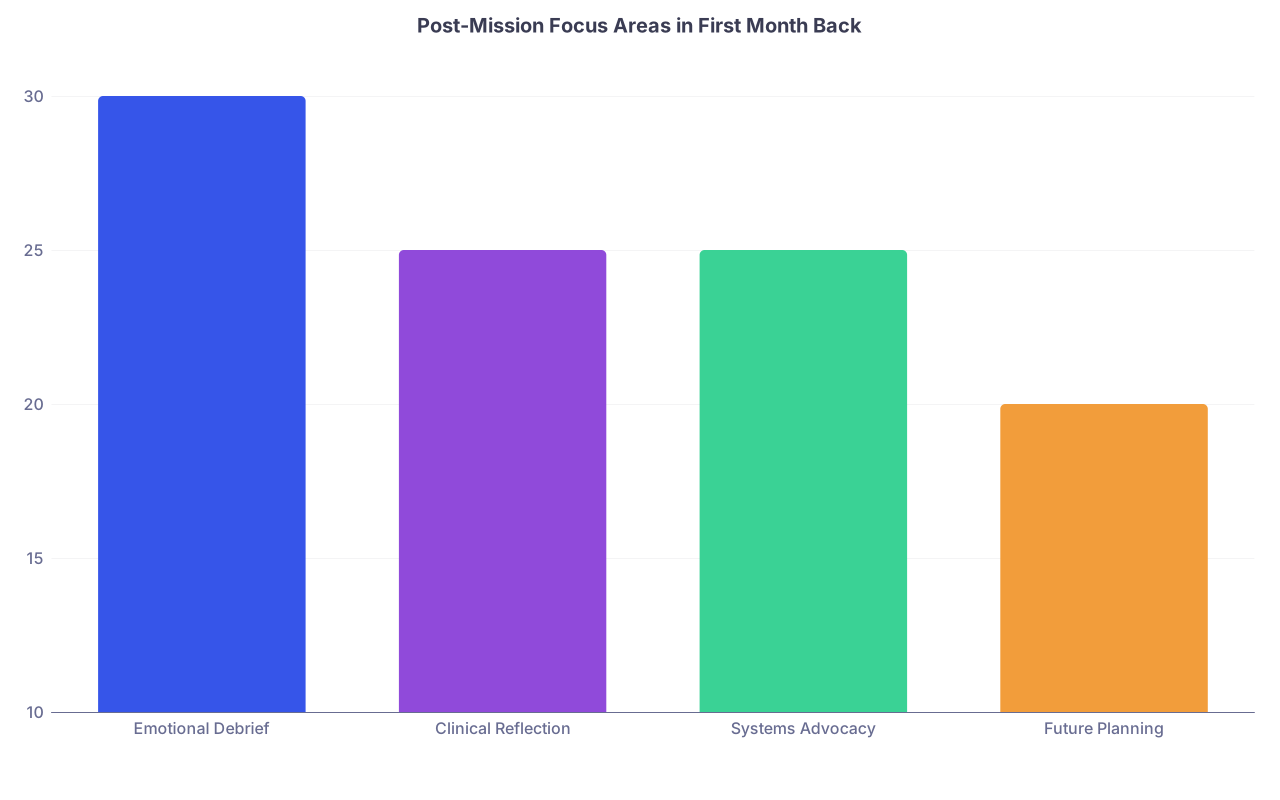
| Category | Value |
|---|---|
| Emotional Debrief | 30 |
| Clinical Reflection | 25 |
| Systems Advocacy | 25 |
| Future Planning | 20 |
Also ask the hard question:
“If our team never returned, would this site be better off, worse off, or unchanged?”
If you cannot honestly say “better off,” then your six‑month preparation for the next mission needs to look very different.
Today, your actionable step is simple:
Open your calendar, count six months back from your planned departure date, and block a 60‑minute session this week labeled “Mission Ethics and Role Definition.” Do not touch flights or packing lists until that hour is on your schedule and honored.


