
The way most students write about medical missions in their personal statements makes program directors nervous.
Not impressed. Nervous.
You think you’re signaling compassion and global citizenship. Half the time, what PDs actually see is savior complex, ethical naïveté, and poor judgment about scope of practice. Let me walk you through what gets quietly praised in committee meetings—and what gets your essay side‑eyed, flagged, or used as an example of “what not to do” to the med school’s global health office.
I’ve sat in rooms where PDs and faculty literally read out lines from “medical mission” essays and go, “So… who was supervising this?” or “Did they just admit to practicing medicine without a license?” You do not want to be that case study.
This is the insider breakdown of the red and green flags PDs see in your medical mission personal statement—especially through the lens of personal development and medical ethics.
The Core Truth: Missions Are a Risky Flex in a Personal Statement
Let me be blunt: the safest thing you can do is often not write about medical missions at all.
Medical mission content is high‑risk, medium‑reward. For every applicant who uses it to demonstrate humility, growth, and ethical awareness, there are five who accidentally confess to unethical behavior or broadcast that they see low‑resource communities as a backdrop for their own self‑discovery.
Still want to write about it? Fine. Then you need to understand what PDs are actually scanning for.
Here’s the unspoken calculus a lot of them are running, especially the ones who care deeply about global health:
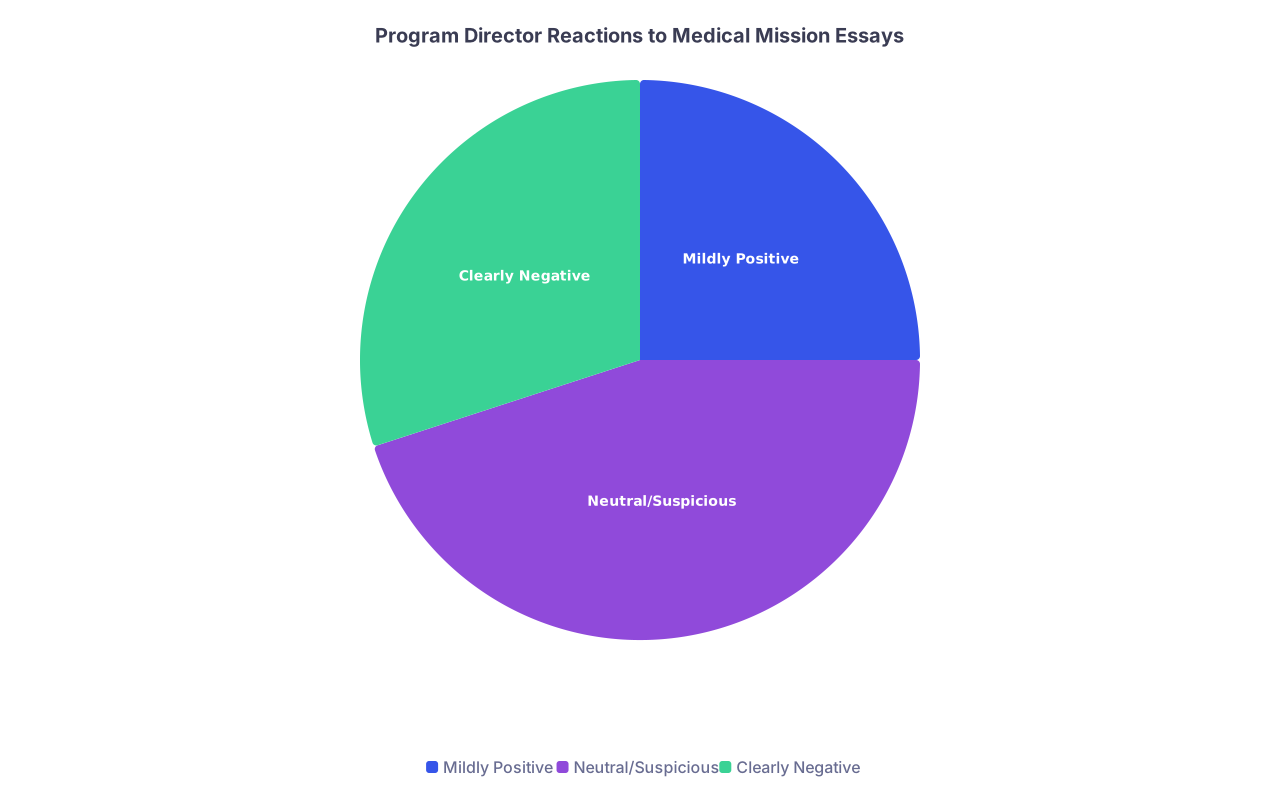
| Category | Value |
|---|---|
| Mildly Positive | 25 |
| Neutral/Suspicious | 45 |
| Clearly Negative | 30 |
A quarter of the time, you help yourself. Almost half the time, you leave readers unsure and a bit wary. A full third of the time, you hurt your application.
So the entire game is: move yourself out of the “suspicious/negative” category. That happens through how you frame the experience and what you do not say.
The Biggest Red Flags: What Makes PDs Roll Their Eyes (Or Call Their Lawyer Friend)
I’ll start with the ugly side because that’s what gets talked about behind closed doors.
1. Practicing Medicine Without a License (and Admitting It in Writing)
This is number one for a reason.
I have literally heard a PD say, “I can’t believe they wrote that down,” after reading a mission essay. The offending lines usually look like:
- “I was finally able to practice medicine and suture patients.”
- “Without any physicians available, I assumed responsibility for patient care.”
- “I delivered several babies on my own in the rural clinic.”
You think that sounds heroic. They think: liability, poor boundaries, unsafe care, massive blind spot around ethics.
If you were still a student and you talk like you were the primary provider, that’s a red flag. Even if it technically happened, you do not showcase it as a triumph.
Green version:
“I assisted local physicians with wound care under direct supervision and learned how to work within my scope as a trainee, even when the setting made it tempting to overstep.”
The difference is night and day.
2. The Savior Narrative and Poverty Tourism
Nothing tanks an essay faster than this combo: dramatic poverty descriptions + “I realized how lucky I am” + zero reflection on systems, local expertise, or power dynamics.
A few phrases that make PDs twitch:
- “They had nothing, yet they were so happy.”
- “I came to save lives in [country], but I left with so much more.”
- “They were so grateful for my help.”
Read that again and imagine you’re Haitian, Guatemalan, Nigerian. Or a global health ethicist. Not a good look.
Faculty who do serious global health work are hyper‑sensitive to exploitation and “development tourism.” When you make the community scenery in your story and never center their agency or competence, you reveal more about your mindset than you think.
Green version:
“I arrived expecting to ‘help,’ but quickly realized how little I understood about the local health system. The most impactful part of the trip was watching local nurses manage complex cases with limited resources and realizing how much I had to learn from them.”
That’s growth. That’s humility. That plays well in a room full of attendings.
3. No Mention of Supervision, Partners, or Structure
If your essay reads like you just flew to another country with a backpack and a stethoscope and started treating people, most PDs mentally check out.
On selection committees, someone always asks:
“Who were they with?”
“Was there a local partner?”
“Was this run through their med school or some random church group?”
Silence around structure is suspicious.
Green version includes:
- A local clinic, hospital, or NGO by name.
- Mention of local physicians and nurses.
- Clarity that you were part of a team, not a solo crusader.
- Evidence that the work fit into an ongoing system, not a one‑week pop‑up.
If you can’t honestly say those things… that’s already a problem. Do not then immortalize it in a personal statement.
4. Exaggerated Impact and “I Changed Global Health” Vibes
Another red flag: you spent one week abroad and talk like you solved health inequity.
Red‑flag phrases:
- “This experience showed me how I can fix the broken healthcare systems abroad.”
- “We dramatically improved healthcare in the village.”
- “I realized these patients would have died without our team.”
Slow down. You were there for seven days.
PDs know the limits of short‑term trips. Many of them used to do these as residents. They know the uncomfortable truth: your biggest impact was probably on yourself. And serious global health faculty are allergic to inflated claims.
Green version:
“I left more aware of how limited short‑term work can be. The trip mattered for my own development, but meaningful change clearly relies on long‑term local leadership and policy, not brief volunteer visits from trainees.”
That line? That gets nods around the table.
5. Zero Ethical Framing or Self‑Critique
If your essay is basically: “I went, I saw extreme poverty, I helped, the end” with no ethical wrestling, that’s a red flag in a section labeled “medical ethics.”
Programs don’t want global health heroes. They want ethically grounded, self‑aware physicians who understand:
- Scope of practice.
- Informed consent challenges.
- Power and privilege.
- Sustainability and unintended harm.
When there’s no hint that you’ve thought about any of this? People assume you have not.
The Green Flags: What Makes PDs Think “Okay, They Get It”
Let me tell you what quietly impresses faculty who do global health for real, not just on Instagram.
1. You Show Humility and Discomfort, Not Just Inspiration
Strong essays often have a moment of discomfort, even embarrassment. A time you realized you were wrong.
For example:
- You misjudged what a community “needed.”
- You realized you were more of a learner than a helper.
- You saw a decision you disagreed with, then understood the context.
There’s a particular kind of line that makes PDs perk up, because it signals depth:
“I was ashamed to realize how quickly I’d framed the clinic’s challenges as problems to be solved by outsiders like me, instead of seeing the creativity and resilience of the local staff who had been working there for years.”
That’s a green flag. You’re not just collecting passport stamps; you’re reflecting.
2. You Emphasize Learning From Local Clinicians
The power move in a mission essay is very simple: center local expertise.
You’re not the hero. You’re the student.
“I watched a local midwife manage a postpartum hemorrhage with almost no supplies, using skills honed over decades. I realized my ‘advanced’ training meant little without understanding the resource constraints and cultural context she navigated daily.”
This flips the dynamic. PDs love it. Because it aligns with the reality they know: local clinicians are the backbone; outsiders are guests.

| Step | Description |
|---|---|
| Step 1 | Go on mission trip |
| Step 2 | Initial excitement and shock |
| Step 3 | Red flag essay |
| Step 4 | Green flag essay |
| Step 5 | Humility about role |
| Step 6 | Respect for local partners |
| Step 7 | Realistic sense of impact |
| Step 8 | How do you interpret it |
3. You Acknowledge Limitations of Short‑Term Trips
PDs know mission trips are seductive. You feel effective. You get dramatic stories. It feels like “real medicine.”
The mature applicant admits the structural limits.
Green‑flag sentences sound like:
- “A week‑long trip cannot fix staffing shortages or drug supply chains.”
- “I left more aware of the potential harms of short‑term trips when they’re not grounded in local priorities.”
- “My main ethical responsibility was to not disrupt care that would continue long after I left.”
This shifts you from “enthusiastic tourist” to “emerging professional” in their minds.
| Category | Value |
|---|---|
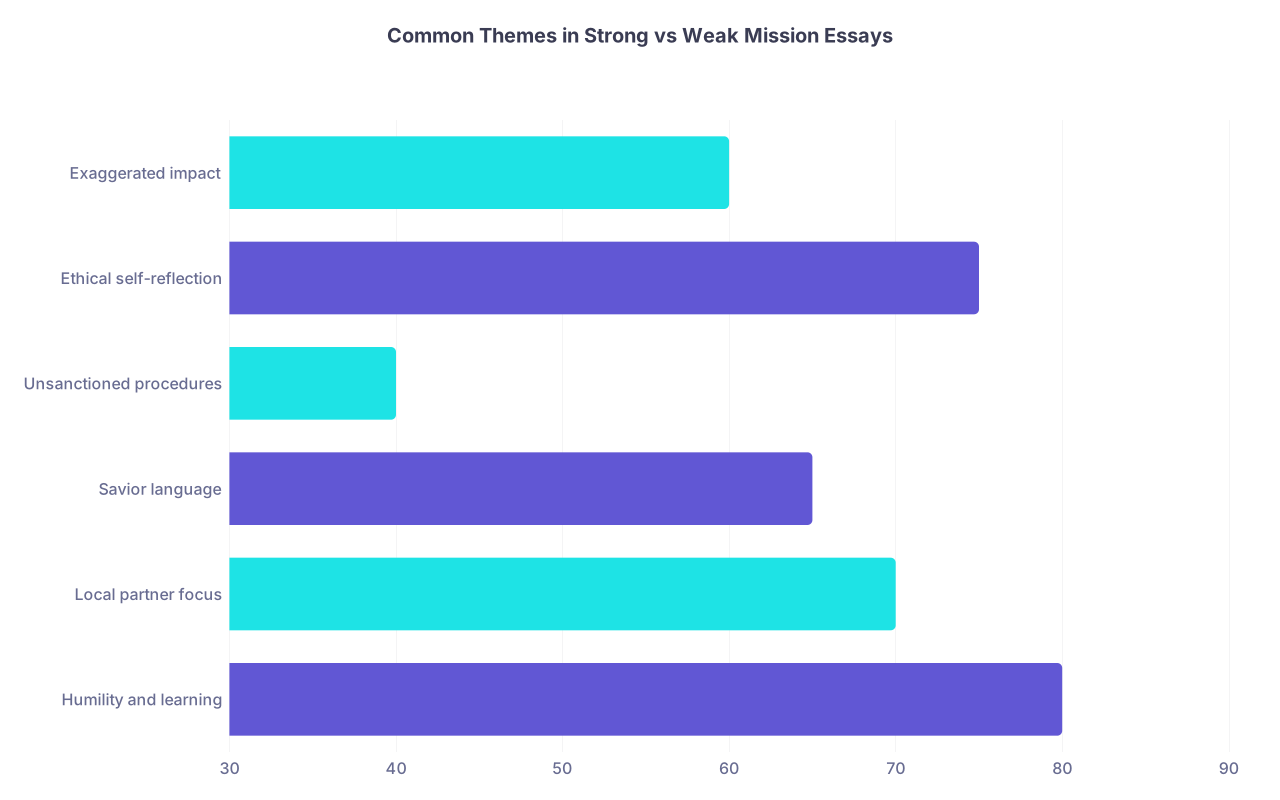
| Humility and learning | 80 |
| Local partner focus | 70 |
| Savior language | 65 |
| Unsanctioned procedures | 40 |
| Ethical self-reflection | 75 |
| Exaggerated impact | 60 |
(Higher percentages here indicate how often PDs mention these themes while praising or criticizing essays. Humility and ethical reflection come up constantly in positive discussions.)
4. You Are Honest About Your Role and Scope
The safest, strongest move: clearly state that you functioned as a student/volunteer, not an independent provider.
“I helped with triage, vital signs, patient education, and documentation, always checking my decisions with the supervising physician.”
That sort of line is gold. It reassures PDs that you understand boundaries.
If you learned clinical skills—fine. Just anchor them in supervision:
“I practiced basic suturing on a few patients under the close supervision of a local surgeon, which taught me not only the technique but also when not to intervene surgically in that setting.”
Ethical awareness and technical growth in one shot.
5. You Connect the Experience to Long‑Term Responsibility, Not Just Wanderlust
Some PDs are quietly skeptical of the “global health hobbyist”—one who bounces around countries but has no long‑term engagement with inequity at home or abroad.
Green‑flag essays make a bridge:
- From mission to local underserved populations.
- From one trip to long‑term policy, public health, or advocacy interests.
- From “I like helping poor people” to “I feel responsible for the systems that create these disparities.”
For example:
“Seeing patients walk hours to reach the clinic made me more attentive to transportation barriers in my own city. Since returning, I’ve worked with our free clinic to coordinate bus vouchers and appointment reminders for patients who routinely miss follow‑ups for the same practical reasons.”
That’s the kind of line that makes PDs nod and go, “Okay, they actually integrated this.”
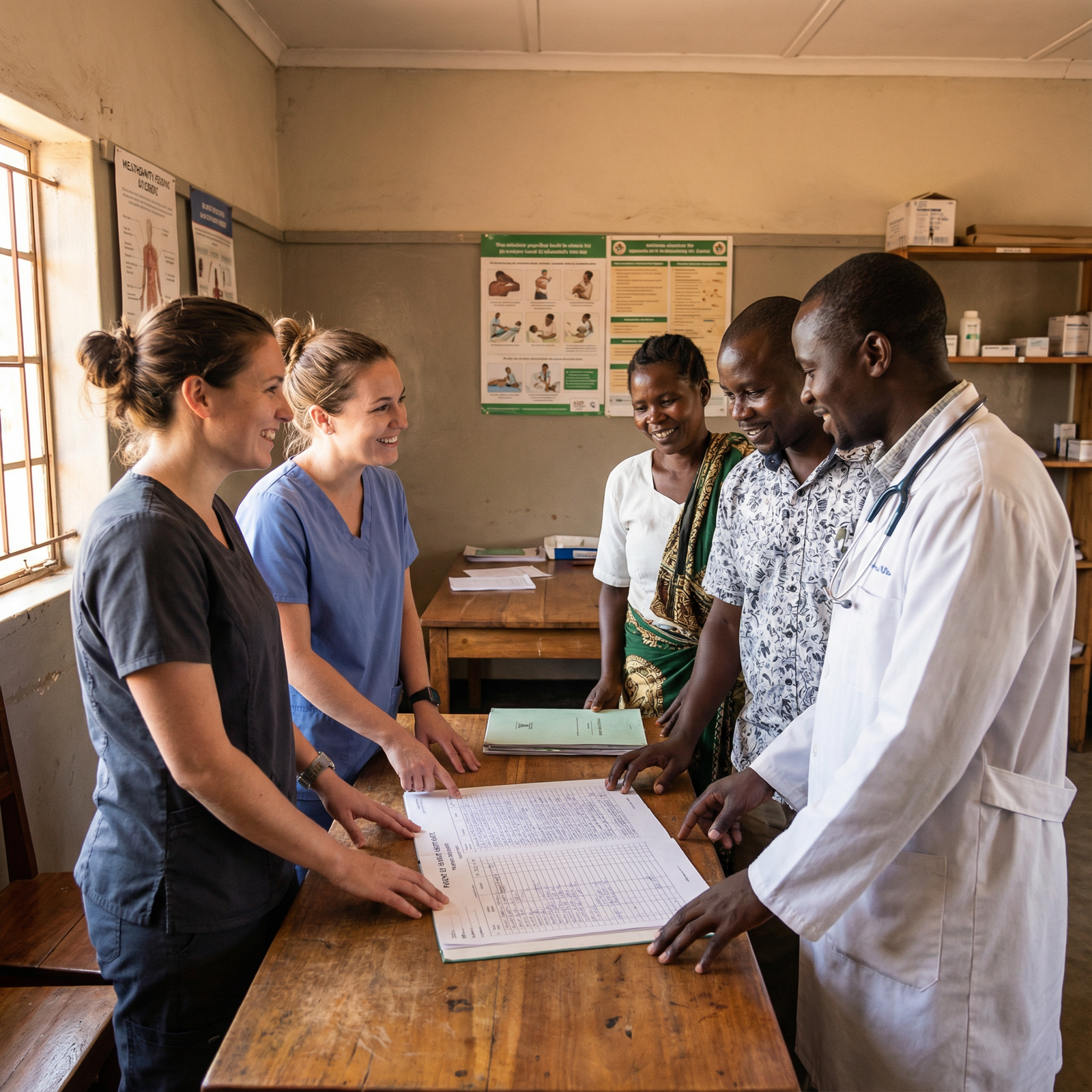
How PDs Actually Talk About These Essays in Committee
You need to understand the tone in those rooms.
When a mission essay is good, people say things like:
- “At least they’re not grandstanding. That’s refreshing.”
- “They actually mentioned local partners and sustainability. That’s rare.”
- “They clearly understand scope. I’m not worried about them freelancing in the ICU on week one.”
When it’s bad?
- “Did they just admit to treating patients unsupervised?”
- “This reads like poverty tourism.”
- “So they flew in, did a few procedures, then left and now feel like they saved the village.”
- “If they do this abroad, what will they do here when no one is watching?”
Sometimes the mission essay is neutral. Then it becomes a tiebreaker. And you don’t want it to be the tiebreaker that knocks you down a notch.
Programs have different tolerances. Academic centers with strong global health divisions can be the harshest judges because they’ve spent years cleaning up the mess of poorly run trips. Community programs might be a little less theoretical, but even they bristle at anything that sounds unsafe or arrogant.
Integrating Personal Development and Medical Ethics—Without Sounding Like a Textbook
You’re writing as a human, not a policy statement. So do not turn your essay into a lecture about bioethics. PDs hate that too.
You want your ethical awareness to come through in how you tell the story, not by name‑dropping “justice” and “beneficence” like you’re writing an exam answer.
Here’s how you thread that needle.
Tell a Narrow Story, Then Reflect Broadly
Bad essays try to summarize the entire trip. Laundry lists of activities, every village visited, every disease seen. PDs skim those.
Better: choose one or two moments that forced growth.
Maybe:
- A case you couldn’t “fix” because there were no resources.
- A time you realized your presence might be more disruptive than helpful.
- A disagreement between visiting volunteers and local staff, and what you learned from it.
Then show us what changed in the way you think about:
- Power and privilege.
- Who defines “help.”
- Your own professional responsibilities going forward.
Make Yourself the Student, Not the Protagonist
Your arc should be:
Naïve → Challenged → Reflective → Ethically grounded.
Not:
Heroic → Beloved → Triumphant → Destined for global leadership.
If your essay feels like a movie trailer where you’re the lead, you missed the point.
Show That You Can Hold Ambiguity
Serious global health work is messy. There are no clean solutions. If your take‑home message is too neat—“I realized global health is my passion and I will dedicate my life to serving the poorest of the poor”—you sound like a first‑year.
Stronger:
“I left with more questions than answers: how to balance wanting to help with not overstepping, how to support systems I don’t fully understand, and how to make sure my global interests are not just about my own sense of purpose. Those questions now guide the kind of training and mentorship I’m seeking.”
That’s the kind of sentence that makes attendings think, “Okay. This one might actually grow into a thoughtful physician.”

A Quick Reality Check: Mission Trips vs. Long‑Term Commitment
Let’s be very clear about how PDs rank your experiences, especially in the “medical missions / global health” bucket.
| Experience Type | Typical Perception |
|---|---|
| Long-term work with underserved population at home | Very Strong |
| Multi-year partnership with same global site | Strong |
| Structured elective with academic global health team | Strong if ethically framed |
| One-off short-term mission with strong reflection | Neutral to Mildly Positive |
| One-off trip with savior narrative | Negative |
The best thing you can do is not oversell a single trip as the center of your application. If you’ve been consistent—free clinic at home, longitudinal work, then one or two trips that fit into a bigger pattern—PDs see that.
They’re less worried you’re doing “global health as tourism” and more inclined to believe you when you say this work shaped your ethics and identity.
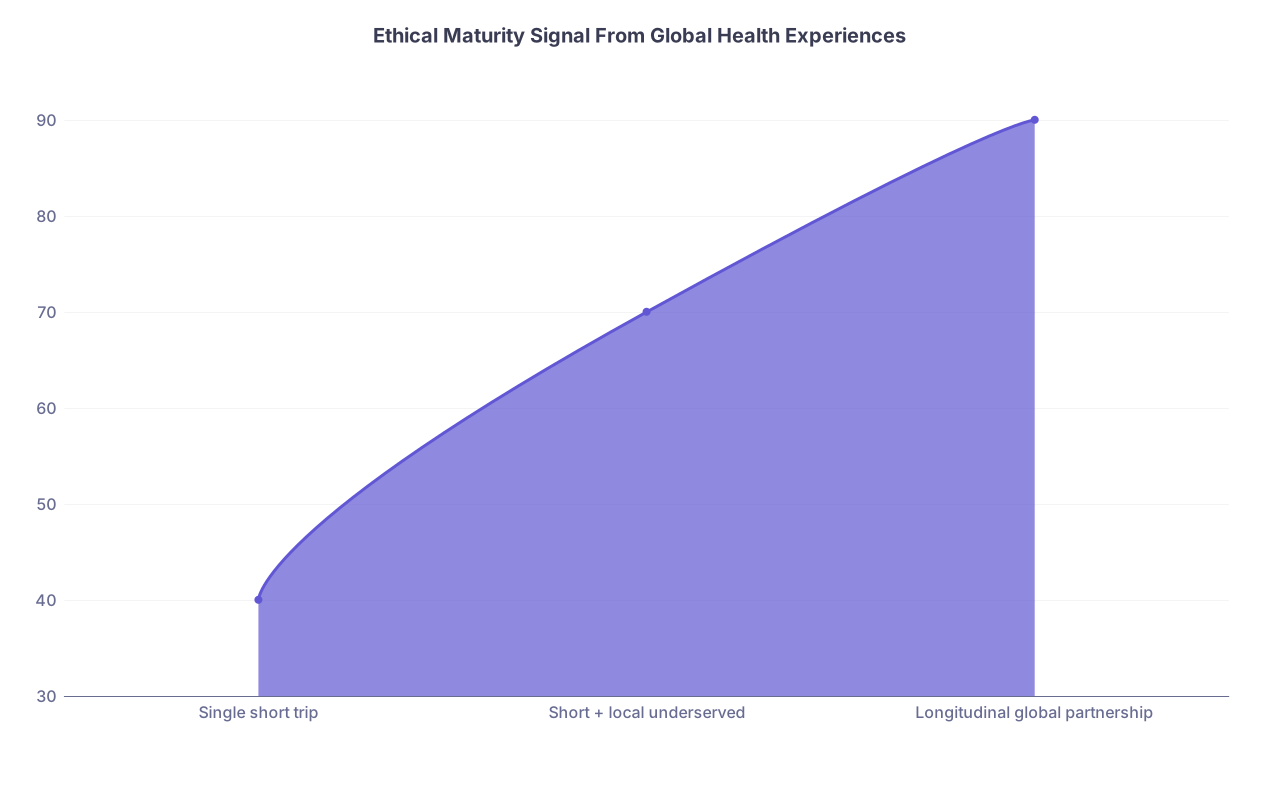
| Category | Value |
|---|---|
| Single short trip | 40 |
| Short + local underserved | 70 |
| Longitudinal global partnership | 90 |
FAQs
1. Should I avoid writing about medical missions altogether?
Not automatically. If your mission experience is genuinely the most formative thing you’ve done, you can write about it. But you need to handle it with surgical precision: no savior language, clear supervision, strong ethical reflection, and realistic impact. If it was just a cool trip, leave it out.
2. What if I did overstep my scope on a trip?
Do not glorify it. Do not frame it as a heroic moment. If you mention it at all, it has to be in the context of realizing later that it was ethically problematic and how that changed your behavior. Otherwise, you are literally advertising unprofessional conduct.
3. Is it better to focus on domestic underserved work instead?
For many PDs, yes. Long‑term, consistent work with underserved populations at home often carries more weight than a one‑off trip. You can still mention the mission briefly, but anchor your narrative in work that demonstrates sustained commitment and ethical maturity.
4. How specific should I be about the organization or country?
You can name the country and organization, especially if it’s reputable and has long‑term partnerships. That can actually reassure PDs. What you should avoid is turning the country into an aesthetic backdrop or naming tiny villages for no reason other than exoticism. Focus on the work and the relationships, not geographic tourism.
5. Can I include emotional reactions—like being shocked by poverty?
You can, but carefully. “I was shocked” is not the point; it’s the starting line. The important part is what you did with that shock. If you stop at, “I realized how fortunate I am,” you sound shallow. If you push further—into systems, privilege, and long‑term responsibility—you start sounding like someone a PD can trust.
Key takeaways:
First, mission trip essays are high‑risk: one sloppy sentence about what you “did” can brand you as ethically naïve or unsafe. Second, the green flags are consistent—humility, clear supervision, respect for local partners, and honest acknowledgment of the limits of short‑term work. If you cannot write about your experience in that way, you should not be building your personal statement around it.


