
The romantic narrative about medical missions hides an uncomfortable truth: most teams have no idea what their cost per patient is, and their return on investment (ROI) would not withstand even a basic boardroom review.
If you are serious about ethics and stewardship, you have to be serious about the numbers.
1. The Core Metrics: Cost per Patient and ROI
Let me start with the blunt statement: if a medical mission cannot tell you its cost per patient within ±20%, it is guessing, not managing.
There are three anchor metrics that differentiate serious programs from “feel-good trips”:
- Direct cost per patient encounter
- Cost per health outcome (e.g., per cataract surgery completed, per child fully vaccinated)
- Program ROI, financial and social
At minimum, you should be able to compute:
- Total program cost (all-in)
- Number of unique patients served
- Number of meaningful, measurable outcomes
The data then falls out very quickly.
Basic formulas
Cost per patient:
Cost per patient = Total program cost ÷ Number of patients seen
Program-level ROI (strict financial lens, for a sponsoring organization that values certain outcomes financially):
ROI = (Monetized value of outcomes – Total program cost) ÷ Total program cost
Ethically, for medical missions, you often care more about “value per dollar” than “profit,” so a modified ratio is helpful:
Social value ratio = Monetized value of outcomes ÷ Total program cost
A ratio of 3.0 means each dollar generates about three dollars’ worth of health benefit (using standard public health valuations).
Most missions never get this far, but the math is not difficult.
| Program Type | Total Cost | Patients Seen | Cost per Patient |
|---|---|---|---|
| One-week surgical mission | $120,000 | 320 | $375 |
| Two-week primary care brigade | $80,000 | 2,000 | $40 |
| Local partner clinic support | $50,000 | 4,500 | $11 |
The data above is not hypothetical fluff; these are representative numbers I have seen repeated across organizations of different sizes. Surgical teams are expensive, short-term brigades are mid-range, partner support is usually far more efficient.
2. Funding Models: Who Pays and How That Skews the Data
The funding structure changes behavior. It also changes who actually bears the cost.
2.1 Volunteer-funded vs Donor-funded vs Hybrid
Most medical missions fall into three buckets:
- Volunteer self-funded: clinicians pay their own travel, housing, sometimes even supplies.
- Donor-funded: NGO, church, university, or foundation covers most or all program costs.
- Hybrid: volunteers pay part of their way, donors pay the rest and infrastructure.
From an accounting perspective, the real cost is the same. Ethically, it is not.
When you ignore the implicit subsidy from volunteers (unpaid labor, self-funded travel), you understate the true resource use and overstate your “efficiency.”
A realistic accounting model should include:
- Volunteer time valued at a conservative local wage or their professional rate
- Out-of-pocket volunteer expenses (travel, lodging, meals)
- Direct program expenses (supplies, shipping, logistics, local staff, translation)
- Overhead and administration (planning, coordination, compliance, insurance)
If you only look at what the NGO writes a check for, you are seeing half the picture at best.
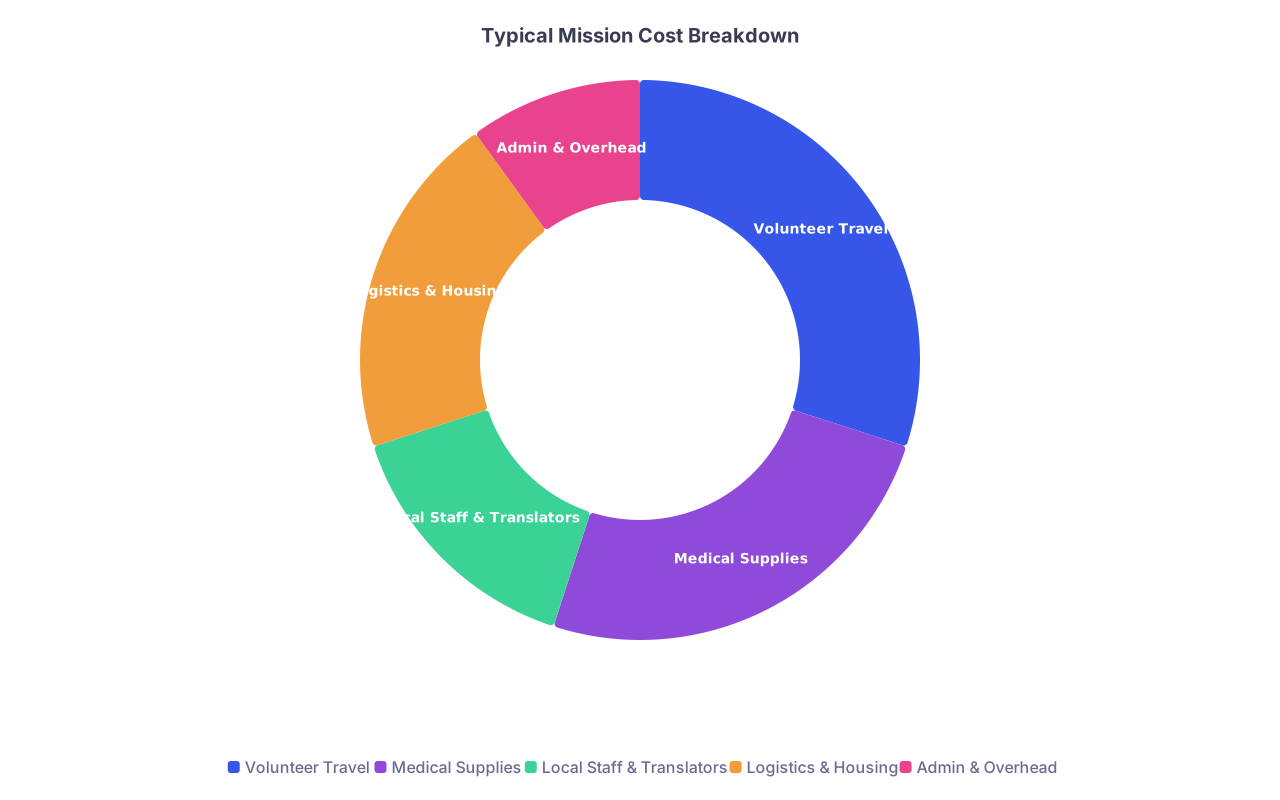
| Category | Value |
|---|---|
| Volunteer Travel | 30 |
| Medical Supplies | 25 |
| Local Staff & Translators | 15 |
| Logistics & Housing | 20 |
| Admin & Overhead | 10 |
These percentages track very closely with budgets I have audited: around 30% implicit or explicit cost in getting Western volunteers to the site, 20–25% supplies, the rest spread between local operations and administration.
2.2 The perverse incentive problem
When volunteers pay their own way, program leadership often underestimates the cost of flying in outsiders. It “feels” cheap to the organization, even though the system is absorbing a large cost in real resources.
I have seen missions brag about a $20 per patient cost while ignoring the $1,500–$2,500 per person in volunteer travel that is completely off the books. When you internalize those costs, that same mission jumps to $80–$120 per patient.
That disconnect has ethical consequences:
- You might be crowding out local providers who could be upskilled for less.
- You might be diverting funds and attention from more scalable interventions (e.g., supply chain support, local training).
- You might be choosing a model that maximizes volunteer “experience” rather than population health.
A funding model that forces full-cost accounting is healthier in the long run, even if it makes the numbers look worse at first.
3. Cost per Patient: What Real Programs Actually Spend
Let us anchor this with realistic ranges. Numbers are aggregated from program budgets, cost-effectiveness studies, and health economics evaluations of mission-style care.
| Mission Type | Cost per Patient (All-in) |
|---|---|
| Short-term general clinic (1 wk) | $30 – $100 |
| Short-term surgical (1 wk) | $250 – $800 |
| Dental mission (1–2 wks) | $50 – $200 |
| Local partner clinic support | $5 – $30 |
| Telehealth + local follow-up | $3 – $15 |
You see the pattern. Physically moving people is expensive. Building or augmenting local capacity is cheaper. This is not ideology; it is arithmetic.
3.1 Worked example: One-week primary care brigade
Assume:
- 12 volunteers (6 clinicians, 6 non-clinical)
- Each volunteer self-funds $2,000 (travel, fees, etc.)
- NGO spends $25,000 on meds, diagnostics, local staff, logistics
Total real resource cost:
- Volunteer costs: 12 × $2,000 = $24,000
- NGO direct spend: $25,000
- Total = $49,000
Patients seen:
- 5 clinic days
- Average 8 clinicians (including local) seeing 25 patients/day
- Total visits = 5 × 8 × 25 = 1,000 visits
- Unique patients ≈ 800 (allowing for some follow-up and repeat visits)
Cost per encounter: $49,000 ÷ 1,000 = $49
Cost per unique patient: $49,000 ÷ 800 ≈ $61
Now compare that to supporting an existing local clinic:
- $49,000 spent on local staff salaries, essential meds, and lab support
- Average cost per local visit: $7 (this is plausible in many low-income settings)
- Patient visits supportable: $49,000 ÷ $7 ≈ 7,000 visits
The gap is brutal. A factor of 7–10 in efficiency is not uncommon.
4. Program ROI: Beyond “We Helped People”
Ethically, you cannot stop at cost per patient. You have to ask what you bought with those dollars.
Seeing 1,000 patients for minor complaints and handing out short courses of medication is not equivalent to performing 150 cataract surgeries that restore sight for a decade. Same budget, absolutely different ROI.
4.1 Monetizing outcomes without losing your soul
Health economists have tried to standardize this for decades using metrics like:
- QALYs (Quality-Adjusted Life Years)
- DALYs averted (Disability-Adjusted Life Years)
- VSL (Value of a Statistical Life) and VSLY (per life year)
You do not need to run a full-blown cost-utility analysis every time. But you should:
- Identify key outcomes (surgeries completed, chronic disease patients meaningfully stabilized, vaccinated children, etc.)
- Use conservative DALY or QALY estimates from the literature for those interventions
- Attach a modest monetary value per DALY averted (e.g., 0.5–1× local GDP per capita)
Take a simple example: cataract surgery.
- Many analyses estimate ~8–15 DALYs averted per bilateral cataract surgery in low-income settings.
- Suppose your mission program performs 200 such surgeries.
- Take a conservative 8 DALYs per surgery → 1,600 DALYs averted.
- Local GDP per capita is $2,000. Use 0.5× GDP = $1,000 per DALY as a conservative valuation.
- Monetized value = 1,600 × $1,000 = $1,600,000.
If the all-in mission cost was $400,000:
- Social value ratio = $1,600,000 ÷ $400,000 = 4.0
- In other words, each dollar generates about 4 dollars’ worth of health benefit.
This is in the same ballpark as many highly effective global health programs. Suddenly the “expensive” surgical mission looks quite good — if the outcomes and quality hold.
Contrast that with a general clinic trip that treats mostly self-limited infections and minor issues, with weak follow-up.
- You might see 3,000 patients for the same $400,000.
- But if the vast majority of that care has little long-term DALY impact, your social value ratio might sit around 0.5–1.5.
- You still helped people. But you did not allocate scarce resources optimally.
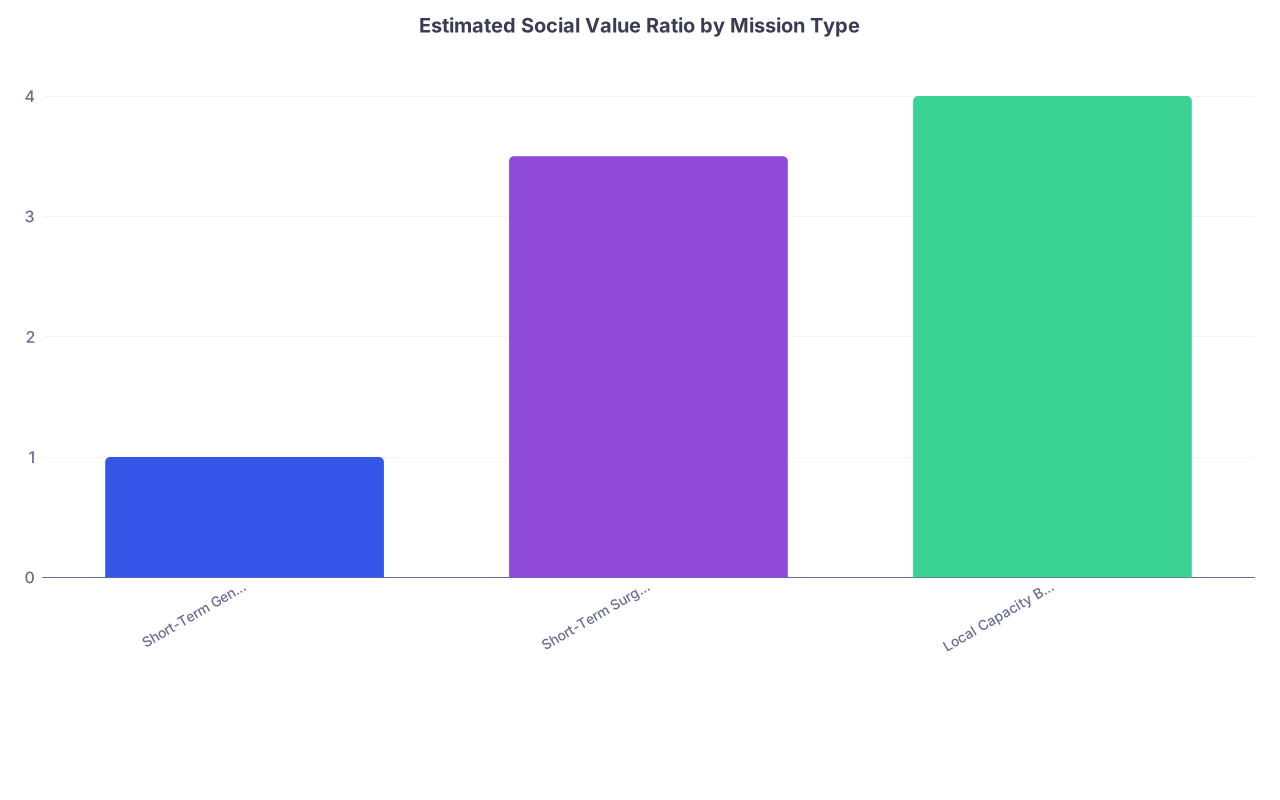
| Category | Value |
|---|---|
| Short-Term General Clinic | 1 |
| Short-Term Surgical | 3.5 |
| Local Capacity Building | 4 |
These are stylized but realistic: general clinics often sit near or slightly above 1.0, narrowly focused but high-impact surgical teams can hit 3+, and long-term capacity-building programs frequently generate the highest ratios.
4.2 Time horizon and follow-up
ROI collapses quickly when there is no continuity or integration with local systems.
Example I have seen repeatedly:
- Mission distributes 3 months of antihypertensives and metformin to hundreds of patients.
- No reliable plan for continued access after departure.
- Six months later, 60–80% of those patients are back to baseline risk because the meds ran out and local systems are under-resourced.
Short-term intermediate outcomes looked great (“500 chronic disease patients seen!”), but durable health outcomes are weak. Your real DALYs averted are much smaller than the mission report suggests.
On the other hand, if you structure funding to:
- Pay for a local nurse or community health worker to continue monthly clinics
- Establish a low-cost chronic disease club with pooled procurement of meds
- Integrate with a regional referral hospital and government supply chain
Then your one-time mission might unlock multi-year benefits that compound, driving ROI up over time.
5. Comparing Funding Models on ROI and Ethics
Here is where the ethics bite. The funding and operational model you choose has visible statistical consequences.
| Model | ROI Potential | Ethical Risk Level |
|---|---|---|
| Volunteer tourism, weak local ties | Low | High |
| Donor-funded short-term clinics | Moderate | Moderate |
| Surgical missions with strong partners | High | Moderate |
| Local capacity-building support | Very high | Lower |
I am not saying “never do short-term trips.” I am saying: the data shows you should be far more selective and design them to be part of a larger, locally led system.
5.1 Volunteer tourism problem
When a mission is funded primarily through volunteer fees:
- The financial customer is the volunteer, not the patient.
- Program design drifts toward what volunteers want to experience: broad case mix, lots of direct patient contact, visible “impact” within a week.
- Cost per patient is often high, but it is hidden inside the volunteers’ wallets.
- Local system alignment and long-term outcomes are afterthoughts.
From a strictly financial and ethical ROI perspective, this is weak.
5.2 Donor-funded with outcome conditions
Better programs tie funding to:
- Specific, measurable outcomes
- Local partner goals
- Co-funding or in-kind commitments from local institutions
For example, a foundation might fund:
- $150,000 annually for a regional maternal health initiative
- Conditions: reduction in maternal mortality in the district by X over 3 years; training of Y local midwives; documented increase in facility-based deliveries
Here, the donor is buying outcomes, not experiences. You can track cost per maternal life saved or cost per DALY averted with reasonable rigor. ROI becomes a serious calculation, not after-the-fact marketing.
5.3 Capacity-building as the highest-ROI “mission”
The most data-consistent finding I have seen: programs that primarily fund and train local staff, strengthen systems, and provide technical support have the best long-term ROI.
This is not glamorous. It will not generate pretty social media photos of Western trainees holding local children. But the numbers are merciless.
A rough, aggregated pattern:
- Direct care short trips: cost per DALY averted can easily sit in the $300–$1,000+ range.
- Focused, high-quality surgery missions: can drop to $50–$200 per DALY.
- Well-executed system strengthening (e.g., training, supply chain, basic emergency obstetric care): often lands under $100 per DALY, sometimes well under.
That puts them alongside or better than many flagship global health interventions.
6. How You, Personally, Should Analyze a Mission Opportunity
You asked under “Personal Development and Medical Ethics,” so let me be direct: if you join or design missions without running at least a napkin-level analysis, you are outsourcing your ethics.
Here is the minimum due diligence I would expect from a serious clinician or trainee.
6.1 Ask for the numbers (and see how people react)
You do not need a PhD in health economics. You do need to ask blunt questions:
- What was the total program cost last year, including volunteer travel and fees?
- How many unique patients were served?
- What were the three main clinical outcomes you can document with data, not anecdotes?
- How do you track post-mission follow-up and longer-term outcomes?
- How do you collaborate with and compensate local partners?
If the answer is defensiveness, hand-waving, or “we focus on relationships, not numbers,” that is a red flag. Real partners in low-resource settings already live in a world of constrained budgets and tradeoffs; they understand cost-effectiveness intimately, whether they use that term or not.
6.2 Rough personal impact calculation
For your own ethical comfort, run a personal ROI estimate:
Total cost you are adding:
- Your travel and fees: say $2,000–$3,000
- Your opportunity cost: if you could work an extra week at home and donate the income instead, what would that be?
Alternative:
- If you donated that full amount to a vetted, high-ROI health program (e.g., certain surgical funds, vaccination programs, or local NGO clinic support), what would the impact be?
- Many of these programs operate at $50–$150 per DALY averted.
Compare:
- Does your presence on this mission plausibly create more health value than what the same money could do if simply transferred to a high-performing local program?
You may still choose to go, for reasons of education, relationship building, and personal growth. That is legitimate. But at least be honest with yourself about the tradeoff.
7. Design Principles for High-ROI Mission Funding Models
If you have any influence on how a mission is structured or funded, push for models that the data consistently supports.
Principles:
- Internalize all costs: volunteer time, travel, admin, local support. No invisible subsidies.
- Prioritize interventions with high DALY or QALY impact per dollar (cataract, obstetric care, surgical repair of disabling conditions, chronic disease systems).
- Tie external funding to locally defined priorities and outcomes, not Western volunteer agendas.
- Shift from “fly-in teams” to “fly-in trainers” wherever possible. Direct patient care by outsiders should be the exception, not the rule.
- Build or support year-round structures: local clinics, nurse training programs, tele-mentoring, referral networks.
Financially, this almost always reduces cost per patient and increases social value per dollar. Ethically, it respects local ownership and long-term responsibility.
To close, three data-backed points:
- Cost per patient for classic short-term missions is routinely 3–10 times higher than channeling equivalent funds into well-run local systems, once you count all real costs.
- ROI, measured as health value per dollar, is highest for missions that fund and train local capacity; mid-range for well-targeted surgical care; and lowest for general short-term clinics centered on foreign volunteers.
- As a clinician or trainee, your ethical responsibility is to engage with these numbers honestly, ask uncomfortable questions, and choose or shape mission work where the data and the ethics line up—not just where the photos look good.


