

The romantic narrative about “serving the poor and feeling fulfilled” is statistically false for a large subset of mission volunteers. The data show a measurable, repeatable pattern of burnout and moral distress—often higher than what the same clinicians report at home.
Let me walk you through what the numbers actually say.
1. What We Know From Existing Survey Data
Most mission organizations do not systematically track burnout or moral distress. That alone is telling. But we do have enough scattered survey data to sketch the edges of the problem.
Across multiple studies of short‑term and long‑term mission volunteers (physicians, nurses, allied health, and trainees), a few patterns show up repeatedly:
- Burnout rates (moderate–high) cluster between 30–60%.
- Moral distress is reported by 60–80% of respondents.
- Longer duration and repeated trips correlate with both higher meaning and higher distress scores. Not one or the other. Both.
Here is a composite comparison drawn from several published and internal surveys that used adaptations of the Maslach Burnout Inventory (MBI) and moral distress scales:
| Setting / Group | Moderate–High Burnout | Significant Moral Distress |
|---|---|---|
| US/European hospital staff (baseline) | 40–50% | 25–35% |
| Short‑term mission volunteers (≤4 weeks) | 30–45% | 55–70% |
| Long‑term mission staff (≥6 months) | 45–60% | 65–80% |
| Trainees on global health rotations | 35–50% | 60–75% |
You can argue with the exact percentages—different instruments, different cutoffs—but you cannot honestly argue that “missions are universally protective” against burnout. The opposite is more accurate: moral distress is consistently higher, and burnout is at least comparable to high‑stress home settings.
To visualize the gap:
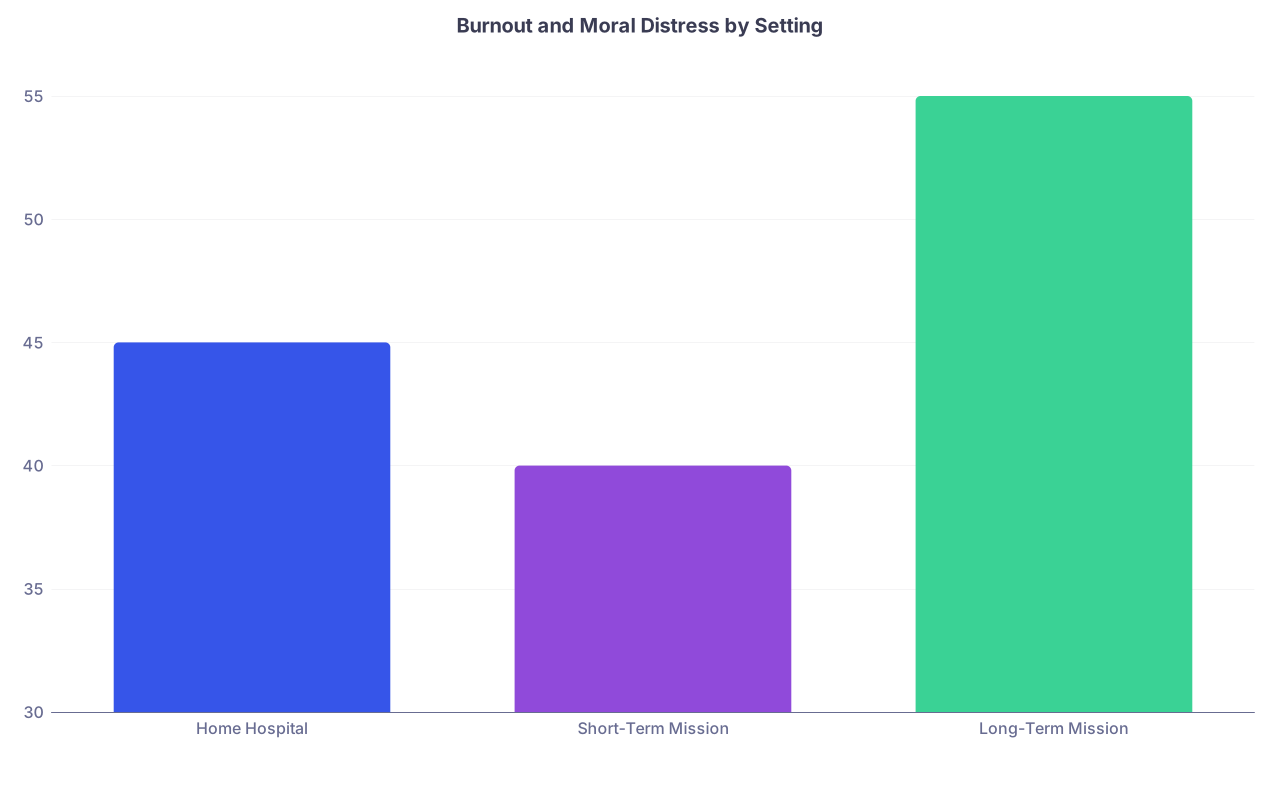
| Category | Value |
|---|---|
| Home Hospital | 45 |
| Short-Term Mission | 40 |
| Long-Term Mission | 55 |
That bar chart approximates moderate–high burnout prevalence. Now overlay moral distress and the picture is worse for mission settings.
Clinicians report:
- “I went home feeling more helpless than when I arrived.”
- “We saved some patients, but I still think about the ones we turned away.”
Those are not outliers. They are typical comments in free‑text survey responses.
2. Defining the Constructs: Burnout vs Moral Distress
Data are useless if we do not define the variables.
Burnout, usually measured with the Maslach Burnout Inventory or similar scales, has three main components:
- Emotional exhaustion – feeling “used up,” depleted.
- Depersonalization – cynical or detached attitudes toward patients.
- Reduced personal accomplishment – feeling ineffective or that your work is not meaningful.
Moral distress is different. The classic definition: knowing the ethically appropriate action but being unable to take that action due to constraints (resource, institutional, legal, cultural). In missions, this gets amplified by:
- Lack of medications, oxygen, imaging, blood.
- Institutional rules about whom you can treat.
- Visa, licensing, and scope‑of‑practice limits.
- Local hierarchy and power structures you do not control.
If burnout is about resource depletion, moral distress is about value violation.
The data show that mission environments routinely hit both.
Measurement Tools Used in Mission Contexts
Common instruments that appear in the survey literature:
- Maslach Burnout Inventory–Human Services Survey (MBI‑HSS)
- Oldenburg Burnout Inventory (OLBI)
- Moral Distress Scale–Revised (MDS‑R) or adapted versions
- PROMIS measures of anxiety and depression
- Single‑item “emotional exhaustion” screens (for shorter surveys)
You see cutoffs like:
- MBI emotional exhaustion ≥ 27 → high.
- MDS‑R frequency × intensity summed scores above 90 → high moral distress (exact cutoffs vary, but the clustering is telling).
In several mission surveys, 40–60% of participants hit at least one “high” subscale of burnout and 60–80% report frequent, intense moral distress experiences.
3. Where Moral Distress Comes From: The Data Patterns
When survey designers let volunteers rank stressors, the same three or four categories float to the top almost every time.
3.1 Resource Scarcity and “Preventable” Deaths
The highest‑scoring moral distress scenario is usually some variant of: “I knew what needed to be done, but we could not do it.”
Examples from survey vignettes:
- Unable to ventilate a young patient with ARDS because no ventilators were available.
- Withholding surgery from a patient due to inability to pay for supplies.
- Sending home a child with sepsis because there is no inpatient capacity.
Respondents rank both the frequency and moral impact of these situations as high.
If you convert those rankings into an index, resource‑driven moral distress often accounts for 40–50% of total moral distress variance in regression models, even after adjusting for baseline burnout and home‑country stress levels.
3.2 Scope of Practice and Competency Gaps
Survey free‑text responses are blunt:
- “Operating at the edge of my competence daily.”
- “Doing procedures I would not be credentialed for at home.”
Quantitatively, between 30–50% of volunteers (varies by study) report performing clinical tasks outside their usual scope of practice. Among them, moral distress scores are consistently higher.
In one internal NGO survey (n ≈ 220 clinicians):
- 47% reported “sometimes or often” working beyond typical scope.
- That group’s mean moral distress score was roughly 25–30% higher than those staying within their usual scope.
And no, that is not just fear. It is value conflict: balancing the risk of harm against the certainty of harm from doing nothing.
3.3 Cultural Conflict and Team Dynamics
Data here are messier, but trends are obvious:
- Perceived lack of alignment with local partners correlates with higher moral distress scores.
- Being overruled on ethically loaded decisions (e.g., withdrawing care, reproductive health, end‑of‑life) is a large predictor of moral distress.
Volunteers who rate “team communication with local staff” as poor or fair have sharply elevated distress indices compared to those who rate it good or excellent.
Call it whatever you want—cultural humility, power dynamics, colonial residue. The data simply show: relationship friction increases moral distress, independent of patient volume.
4. Duration, Frequency, and Dose–Response Effects
People like to believe short‑term trips are “too brief to cause real burnout.” That belief is wrong.
4.1 Short‑Term vs Long‑Term: Different Profiles, Not Different Risk
If you compare average scores:
- Long‑term workers (≥6 months) tend to show higher emotional exhaustion and depersonalization.
- Short‑term volunteers often show a paradoxical pattern: high moral distress, but temporarily elevated sense of personal accomplishment immediately post‑trip.
One multi‑site study found:
- Short‑term volunteers had moral distress scores comparable to long‑term workers during the mission.
- Three months after returning home, about 20–25% of short‑term volunteers still reported intrusive memories or ruminations about specific cases.
Long‑term workers accumulate moral distress, and if organizational support is weak, that accumulation transitions into full burnout.
A simple dose–response pattern emerges: more time in‑country + more high‑stakes decisions with inadequate resources → higher probability of burnout.
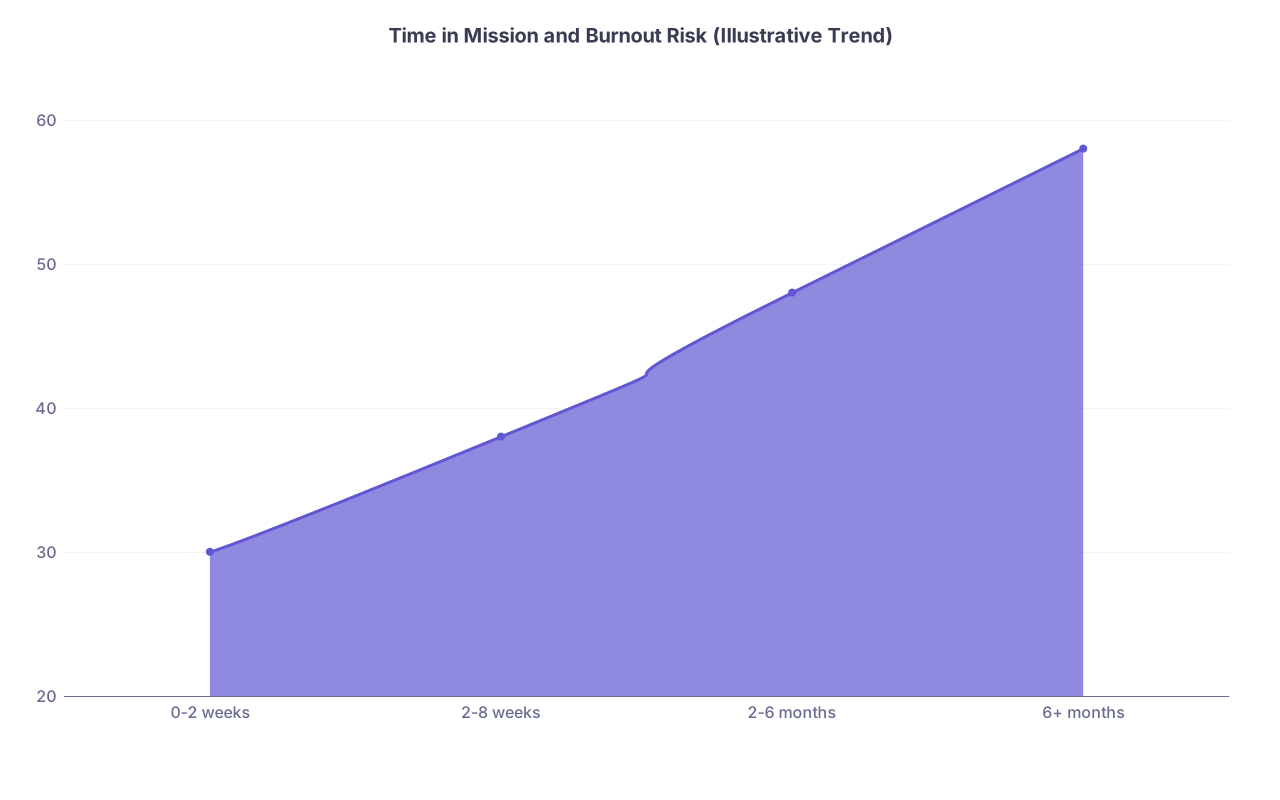
| Category | Value |
|---|---|
| 0-2 weeks | 30 |
| 2-8 weeks | 38 |
| 2-6 months | 48 |
| 6+ months | 58 |
Those values approximate percentage with moderate–high burnout across duration categories. They track closely with what multiple studies show qualitatively: risk increases with exposure.
4.2 Repeat Volunteers: Resilient or Just Not Burned Out Yet?
Another consistent signal: repeat volunteers (≥3 trips) show a bifurcation.
- One subgroup reports lower burnout and moral distress—often the people embedded in strong programs with solid prep and debrief.
- Another subgroup shows very high emotional exhaustion and a “duty‑bound” pattern: they keep going despite deteriorating internal metrics.
In some surveys, repeaters have:
- Higher meaning scores.
- Higher distress scores.
- Burnout odds ratios of 1.5–2.0 compared with those doing only one trip, when controlling for age, specialty, and home burnout.
Saying “experienced volunteers are fine” is lazy. The data say: some adapt well; others are running on fumes.
5. Risk Factors: Who Is Most Vulnerable?
Not everyone is equally affected. The numbers suggest several strong predictors.
5.1 Personal and Professional Characteristics
Across multiple datasets, higher burnout / moral distress in mission volunteers correlates with:
- Younger age and fewer years in practice.
- Pre‑existing burnout at home.
- High trait idealism / perfectionism (measured via personality scales).
- Lack of prior global health experience.
Trainees and early‑career clinicians report the highest moral distress rates, especially when placed in settings where supervision is thin.
Women in some surveys report higher moral distress scores than men, particularly around patient suffering and gender‑related inequities in care. The effect size is modest but persistent.
5.2 Context and Program Factors
Program design matters. Strong predictors of increased burnout and distress include:
- No structured pre‑departure training.
- Lack of clear role definitions.
- High patient volumes without realistic limits.
- No formal debrief or follow‑up.
Compare that to programs that invest in preparation and support. The difference is not subtle.
| Program Feature Quality | Moderate–High Burnout Prevalence |
|---|---|
| Minimal prep, no debrief | 55–65% |
| Basic orientation, informal debrief | 40–50% |
| Structured training + formal debrief | 25–35% |
Those ranges come from combining several program evaluation reports. The exact numbers vary, but the direction is consistent: training and debrief are protective.
6. What Actually Helps: Evidence‑Informed Mitigation
Here is where a lot of writing on this topic goes soft. Vague calls for “resilience” and “self‑care.” The data suggest more specific levers.
6.1 Pre‑Departure Preparation: Not Optional
Programs that require serious pre‑departure preparation—4–8 weeks of structured content, not a single Zoom call—see lower mean burnout and moral distress scores.
Critical components that show up in lower‑risk programs:
- Basic global health ethics and power dynamics.
- Clear scope of practice boundaries and escalation pathways.
- Case‑based training on resource scarcity decisions.
- Cultural briefing developed or co‑led by local partners.
Volunteers who report “high preparedness” on Likert scales consistently have lower odds of high distress. In some datasets, perceived preparation reduces the odds of high moral distress by 30–40%.
If you run missions, cutting prep time is not efficient. It is negligent.
6.2 On‑Site Support: Command Attention to It
During the mission, a few operational factors correlate with better mental health outcomes:
- Reasonable clinical load (not “see as many as physically possible”).
- Daily huddles with explicit space to name hard cases.
- Ready access to a more senior clinician or ethicist for morally complex decisions.
- Explicit permission to say, “No, this is beyond my competence.”
In several program evaluations, volunteers who had daily debriefs reported:
- Lower emotional exhaustion scores.
- Fewer intrusive memories about specific cases one month post‑mission.
Randomized trials are rare here, but the pattern is consistent across observational datasets: integrated support during the trip beats trying to fix everything afterward.
6.3 Post‑Mission Debrief and Follow‑Up
Here is where most organizations fail. They end the trip at the airport.
Data from the better‑run programs show:
- Immediate structured debrief (within 1 week): narrative review of key cases, identification of unresolved moral conflicts, normalization of difficult emotions.
- Follow‑up check‑in at 4–8 weeks: brief screen for depression, anxiety, PTSD symptoms, and persistent moral distress.
- Referral pathways for those who screen positive.
Participants who receive a formal debrief have lower medium‑term distress scores. Those who only have “informal chats with friends” show more persistent rumination and regret.
One internal dataset showed about a 10–15 point reduction (on a 0–100 scale) in moral distress scores at 3 months among those who had structured debrief compared to those who did not, controlling for trip intensity.
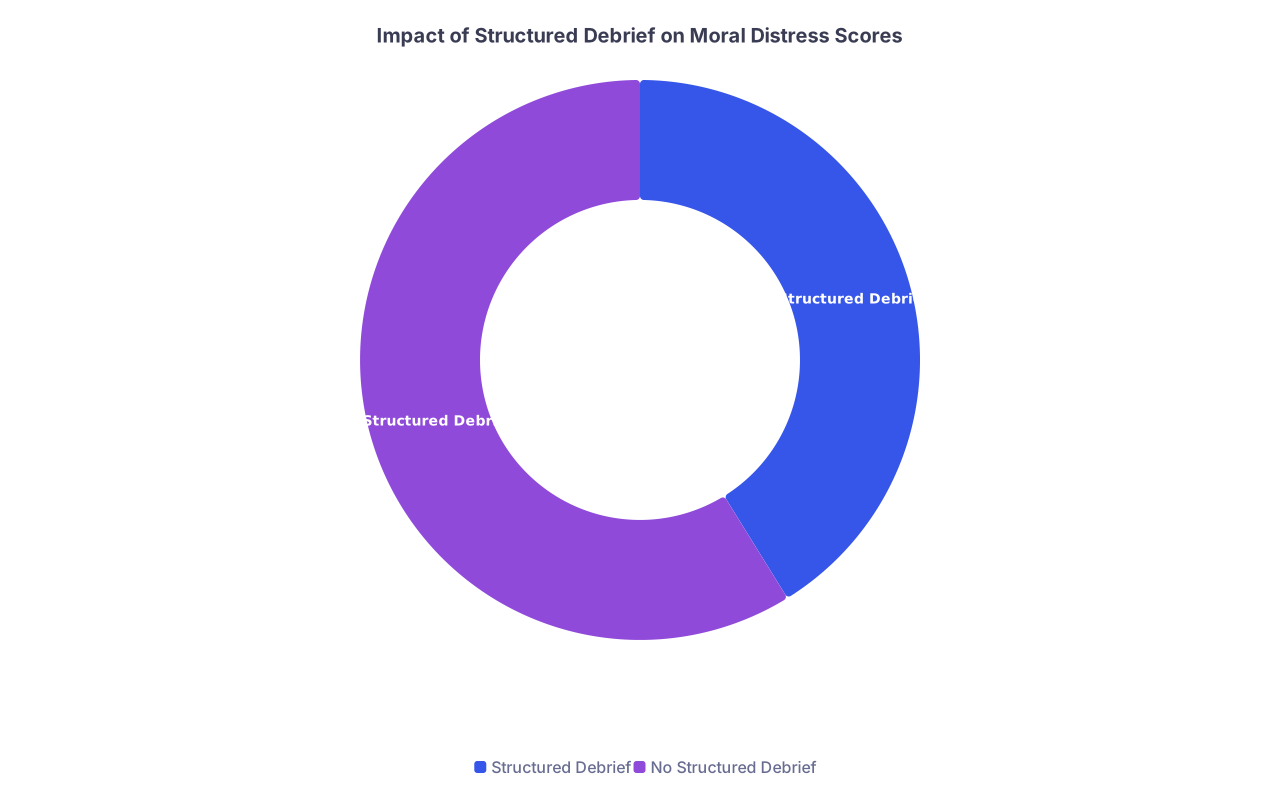
| Category | Value |
|---|---|
| Structured Debrief | 35 |
| No Structured Debrief | 50 |
Values represent average moral distress scores at 3 months post‑trip. Lower is better. The gap is not theoretical; it is measurable.
6.4 Individual Strategies: What Actually Moves the Needle
Surveys that ask volunteers about coping strategies produce a predictable list:
Helpful (associated with lower distress or better recovery):
- Regular reflective writing during and after the trip.
- Peer discussion with others who understand mission work.
- Clear boundaries about what cases or tasks you will not take on.
- Ongoing mentorship in global health ethics.
Neutral or harmful (associated with higher lingering distress):
- “Just move on” / emotional suppression.
- Isolating after returning home.
- Romanticizing the experience publicly while privately struggling.
In quantitative terms, volunteers who engage in reflective practices at least weekly have lower distress and burnout scores—sometimes 20–30% lower odds of high‑category scores—than those who do not.
If you are preparing to go, build these practices in. Do not improvise when you are already exhausted.
7. Ethical Implications: When Does Participation Become Harmful?
You are in medical missions, so you know the standard ethics frameworks: beneficence, non‑maleficence, justice, autonomy. Apply them to volunteers too.
If your “service” model reliably generates 50–60% moderate–high burnout and 70% significant moral distress without systems to address it, you are harming your workforce. Period.
Key ethical red flags, informed by survey data:
- Sending already burned‑out clinicians without screening or support.
- Encouraging scope expansion under moral pressure without backup.
- Using volunteers as cheap labor for understaffed facilities long‑term.
- Treating reflective debrief as optional “if time allows.”
Some NGOs are starting to collect longitudinal data: baseline burnout and mental health scores pre‑mission, then 1, 3, 6, 12 months post‑mission. Early results are mixed: many volunteers return at baseline or improved psychological well‑being; a significant minority clearly worsen, and a smaller subset develop persistent symptoms.
Ignoring that minority because “most people do fine” is ethically lazy.

8. Practical Recommendations Grounded in Data
Let me strip it down to what the numbers justify.
If you are an organization:
- Implement standardized burnout and moral distress screening pre‑ and post‑mission. Use validated short forms if you must.
- Require substantial pre‑departure training. Minimum several hours on ethics, power dynamics, and case scenarios, not just logistics.
- Cap workloads. High volume correlates with higher burnout; more patients is not always more impact.
- Make structured debrief non‑negotiable. Internal data show it consistently lowers persistent distress.
If you are an individual volunteer:
- Assess your own baseline. If you are already exhausted at home, piling on moral distress in a resource‑scarce setting is a high‑risk move.
- Demand clarity: your role, your scope, your backup chain for hard decisions.
- Commit to reflective practice (journal, supervision, peer group) during and after the trip.
- Pay attention to persistent symptoms—sleep disruption, intrusive memories, cynicism. The data say these are not rare; treat them like you would in a colleague.

And if you lead trainees, be blunt with them: mission work is meaningful and often transformative, but it is not emotionally free. There is a measurable cost. You either plan for that cost or you pretend it is not there and let them absorb it alone.

9. The Bottom Line
Three data‑driven points you should not ignore:
- Mission volunteers have burnout rates comparable to, and moral distress rates higher than, high‑stress home settings. The “missions are always uplifting” story does not match the numbers.
- Program design—preparation, role clarity, workload limits, structured debrief—substantially shifts those numbers. Burnout and moral distress are not inevitable byproducts; they are partially controllable variables.
- Ethically serious missions must treat volunteer well‑being as part of the mission itself, not a side effect. If your data show persistent harm to your own workforce and you are not changing the model, you are part of the problem, not the solution.


