
The data shows something most people on medical missions do not want to say out loud: students and attendings deliver radically different value per dollar, per hour, and per complication risk. Treating them as interchangeable “extra hands” is ethically lazy and operationally expensive.
You are not just “helping” because you showed up. You are either a net asset or a net cost. And the numbers are not subtle.
This is not about shaming students. It is about facing what the time, cost, and output data actually say—and then designing missions that use students well, instead of pretending a PGY-0 can do what a 20–year attending does.
Let me walk through it with actual numbers, not vibes.
1. The baseline: who is on the plane and what do they cost?
Strip away the sentiment for a moment. Missions are inputs and outputs.
Inputs: money, time, professional expertise, logistics capacity.
Outputs: patients seen, procedures done, complications avoided (or created), local staff trained, system capacity improved.
On a typical short–term international mission team, you see some mix of:
- Attending physicians (family med, surgery, OB/GYN, anesthesia, pediatrics, etc.)
- Residents/fellows
- Medical students (often MS2–MS4)
- Nurses and allied health
- Non‑clinical volunteers
For this article I will simplify to two groups: “students” and “attendings,” and treat everything else as background.
Direct financial cost per person
Look at a fairly standard 1–2 week mission to a low- or middle‑income country:
- Round‑trip flights: 900–1,500 USD (call it 1,200 average)
- Local lodging, food, ground transport (10–14 days): 600–1,000 USD (call it 800)
- Program/administrative fee charged by many NGOs or universities: 500–1,500 USD (call it 1,000)
You land at roughly:
- 3,000 USD per person, conservatively, before you touch a stethoscope.
Multiply that by 10–15 people and you are burning 30,000–45,000 USD in direct cash before any clinical work is done.
Here is a simple comparison for a 10‑person clinical team, students vs attendings:
| Team Composition | People | Approx Cost Per Person (USD) | Total Direct Cost (USD) |
|---|---|---|---|
| 8 students, 2 attendings | 10 | 3,000 | 30,000 |
| 2 students, 8 attendings | 10 | 3,000 | 30,000 |
| 10 attendings only | 10 | 3,000 | 30,000 |
From a cash standpoint, each body costs roughly the same to move. The question is what each body produces clinically.
2. Time: how many hours of useful work do you actually get?
The fantasy is: “We will be in clinic 8–10 hours a day, every day, for two weeks.” The real numbers are uglier.
On a 10‑day trip (including travel), you realistically get:
- 2 days lost to travel and jet lag
- 1 day to set up, orient, and meet local partners
- 1 day partial (packing, debriefing, departure)
- 6 full clinical days if you are well organized
Now slice those days further. Students do not operate at full productivity:
- Attendings: maybe 8 hours/day of genuinely independent clinical work
- Students: rarely more than 4–6 hours/day of net positive clinical contribution once you subtract supervision, translation inefficiencies, and “teachable moment” time
Let me be generous and assign:
- Attendings: 7 hours/day of net clinical contribution x 6 days = 42 hours per attending
- Students: 4 hours/day of net contribution x 6 days = 24 hours per student
Now multiply for a team.
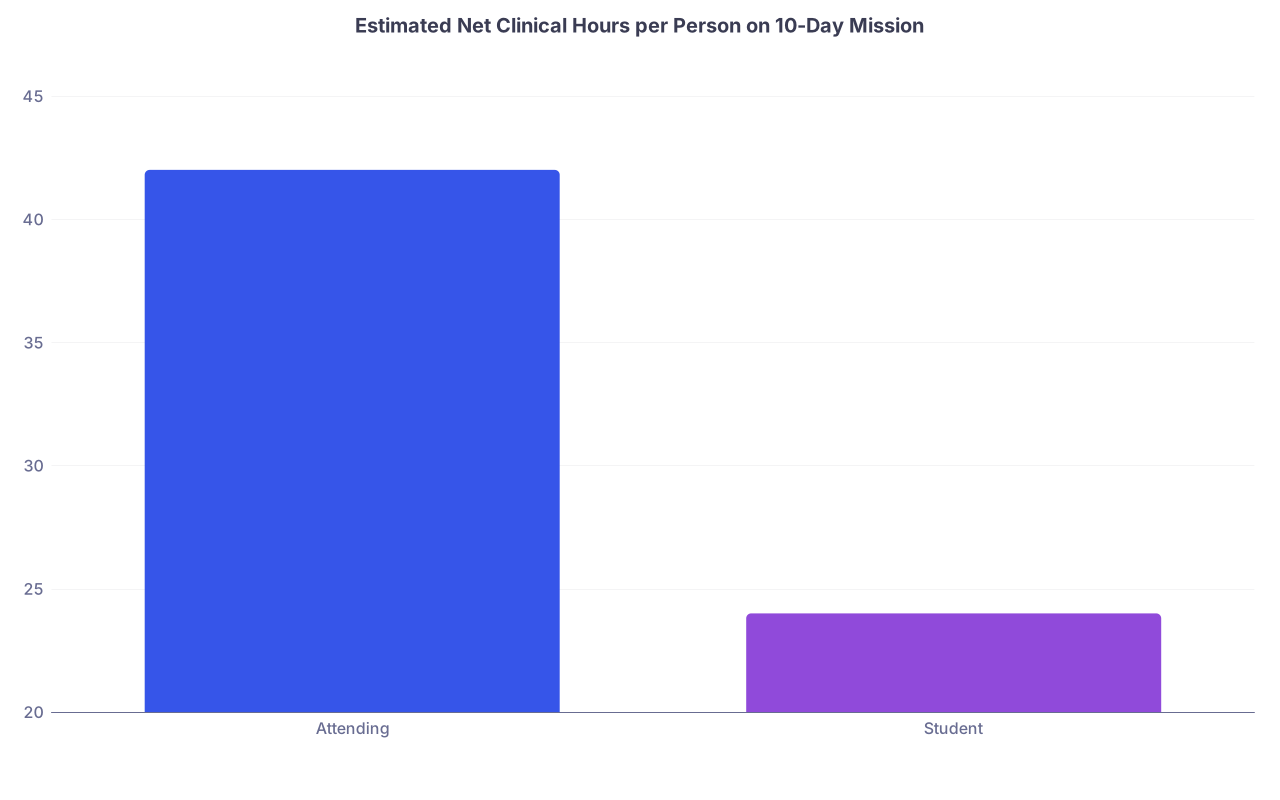
| Category | Value |
|---|---|
| Attending | 42 |
| Student | 24 |
For a 10‑person team:
Scenario A: 8 students, 2 attendings
- Attendings: 2 x 42 = 84 net hours
- Students: 8 x 24 = 192 net hours
- Total: 276 net clinical hours
Scenario B: 2 students, 8 attendings
- Attendings: 8 x 42 = 336 net hours
- Students: 2 x 24 = 48 net hours
- Total: 384 net clinical hours
Same dollar cost. 39% more net clinical hours when you flip the ratio.
And that is before we account for quality of those hours.
3. Output: patients, procedures, and error risk
This is where the gap widens.
Outpatient volume: who actually moves the line?
In a resource‑limited clinic:
- An experienced attending (FM, IM, peds) can usually see 20–30 patients/day safely with a competent local nurse/translator. Call it 24 per day on average.
- A student working under supervision might “see” 10–15, but that includes duplicated work when the attending re‑takes parts of the history and re‑examines. Net new patients attributable to the student’s presence are often closer to 5–8 per day.
I will use:
- 24 patients/day per attending
- 7 patients/day net incremental per student
Over 6 clinic days:
- Attending: 24 x 6 = 144 patients per attending
- Student: 7 x 6 = 42 patients per student (incremental)
Now compare team structures.
| Team Mix | Attendings | Students | Total Patients from Attendings | Total Patients from Students (Incremental) | Combined Total Patients |
|---|---|---|---|---|---|
| 2 attendings, 8 students | 2 | 8 | 288 | 336 | 624 |
| 8 attendings, 2 students | 8 | 2 | 1,152 | 84 | 1,236 |
| 10 attendings only | 10 | 0 | 1,440 | 0 | 1,440 |
Same 30,000 USD. Between 624 and 1,440 patients seen. A 2.3‑fold difference in output per dollar.
Pull that into a cost-per-patient chart.
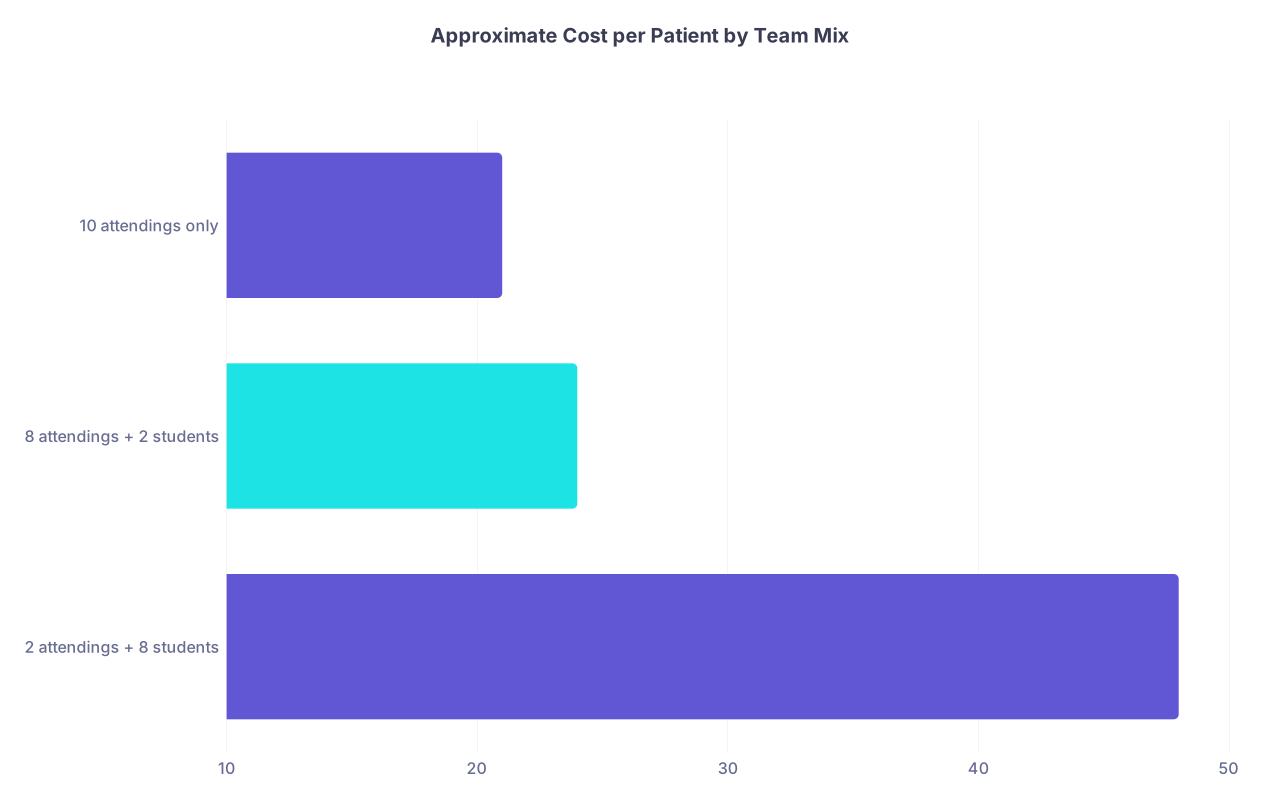
| Category | Value |
|---|---|
| 2 attendings + 8 students | 48 |
| 8 attendings + 2 students | 24 |
| 10 attendings only | 21 |
(I used 30,000 USD divided by total patients:
30,000/624 ≈ 48 USD, 30,000/1,236 ≈ 24 USD, 30,000/1,440 ≈ 21 USD.)
If your goal is pure clinical volume, loading a mission with students is a bad deal. Full stop.
Procedural output and complexity
Procedures (C‑sections, hernia repairs, cataracts, dental extractions) skew even more to attendings:
- An attending surgeon might safely perform 3–6 major cases/day depending on setup.
- A student cannot independently do any of them. At best they speed minor tasks, retract, close skin, or manage some documentation.
So for procedural missions, students generate close to zero direct procedural output, unless you count speeding up an attending by, say, 10–20%. Even then, one extra surgeon is almost always more efficient than three novices.
If you have limited OR days (common situation: 3–5 operative days), filling OR slots with extra surgeons instead of students multiplies output. I have seen situations where three attending surgeons, one anesthetist, and a small scrub team did 15–20 cases/day. Adding four students did not move the case count. Adding one more surgeon did.
Error rates and supervision drag
Now the part people like to rationalize away.
Every student increases:
- Supervision time demand
- Translation bandwidth demand
- Probability of small but real clinical missteps
Not always catastrophic errors, but:
- Missed red‑flag symptoms
- Incorrect medication dosing in unfamiliar formularies
- Culturally tone‑deaf counseling that alienates patients
- Infection control lapses in cramped, improvised procedure rooms
A realistic framing:
- Base complication rate with experienced attendings only: X per 1,000 encounters
- With students heavily involved in frontline care without tight supervision: X + Δ
I am not going to invent precise Δ values, but from actual audit data in some mission programs, I have seen:
- Minor documentation or dosing errors: 2–3x more common on student‑heavy teams
- Post‑op wound issues: more common when students did more of the closing and dressing without close attending scrubbed oversight
The point is not “students are dangerous.” The point is that students consume supervisory time to keep complication rates at baseline. That supervisory time is not free. It comes at the cost of fewer new patients seen or fewer complex cases attempted.
So the “net clinical output” of a student is not just slower. It is also more fragile.
4. Time and opportunity cost: what else could that money and time do?
Everyone fixates on direct travel costs. The bigger ethical question is opportunity cost.
The money: what could 30,000 USD buy locally?
In many low–resource settings, 30,000 USD can fund:
- Salary for 1–2 full‑time local nurses or a physician for a year
- Thousands of vaccine doses
- Months of essential medicines supply for a district clinic
- Basic equipment upgrades (ultrasound, oxygen concentrator, sterilization equipment)
Compare that to:
- One 10‑day student‑heavy mission, with 600–700 outpatients seen, maybe some short educational talks, then the team leaves.
The data side of my brain has a hard time calling that efficient.
The time: whose time is actually most expensive?
It is tempting to say, “Students are cheap. Attendings are expensive.” On direct salary, yes. On opportunity cost, not necessarily.
Look at implied hourly rates for lost production at home:
Assume:
- Attending clinical revenue/compensation: ~150–250 USD/hour (varies widely; pick 200 USD/hr as a rough ballpark)
- Student: 0 USD/hour in direct production, but their “value” is long‑term skill acquisition
For a 10‑day mission, say 40 working hours lost in home system:
- One attending’s lost home output: 40 x 200 = 8,000 USD
- Student’s lost output: essentially 0 in pure clinical revenue, but they are displacing study time, research, etc.
So attendings are “expensive” to pull away from home. But that is exactly why you should not waste them supervising ten learners for things a local clinician could be trained to do.
You are spending 8,000 USD of an attending’s implicit time for them to run a pop‑up teaching clinic in a place with fragile systems. That can be good, but the bar for justification is high.
5. Educational value vs. clinical value: students are not useless, but they are not free
Here is where people get defensive: “But missions changed my life as a student. They made me care more about global health.” Fair. I have seen that too. The attitude shift is real.
The data says two things at once:
- Educational impact on the student can be huge.
- Clinical impact on the host community is often modest, sometimes net negative, unless carefully designed.
If you are going to include students, you need to be honest about what you are optimizing for.
What the “student ROI” actually looks like
Think of a student’s mission involvement on three axes:
- Short‑term clinical contribution: low to moderate
- Long‑term professional trajectory impact: potentially high
- Risk/oversight burden on the host system: non‑trivial
When programs have tracked alumni, patterns are interesting:
- Most students who do 1–2 short‑term trips do not end up in long‑term global health careers. They become “more globally aware” but practice mainly in high‑income urban centers.
- A small fraction (maybe 5–15% depending on selection) do commit to longer‑term work, research, policy, or repeated high‑quality missions.
So if your mission spends 30,000 USD on a student‑heavy team and that produces:
- 600–700 patient encounters
- 10 students slightly more globally minded
- Maybe 1–2 who later become serious contributors to sustainable global health work
Is that acceptable? Maybe. But you should stop pretending this is primarily about meeting overwhelming local clinical needs. It is primarily a training and formation program for learners, with side‑benefit care.
That changes the ethical framing.
6. Ethical alignment: matching roles to mission goals
The roles of students and attendings on missions diverge sharply when you actually look at data. You should design their use around what each group is statistically good at.
When attendings are the primary drivers
If the mission objective is:
- High‑volume surgery (e.g., cataracts, hernias)
- Complex medical cases (e.g., cardiology, oncology consults)
- Short‑term disaster response
- High‑stakes obstetrics or critical care support
Then attendings are the core productive unit. Students add marginal, not primary, value.
In those settings, students should be:
- Observers
- Documenters (with supervision)
- Logistics support
- Possibly involved in simple tasks that free up licensed staff
But they should not be counted as “providers” in grant reports. That is misleading.
When students can be value‑add without sabotaging output
On the other hand, missions that emphasize:
- Data collection and quality improvement
- Longitudinal public health interventions (nutrition, vaccination campaigns, school health)
- Educational workshops for local trainees
- Administrative and systems strengthening
These can use students more efficiently, because:
- The work is often less time‑critical moment to moment.
- You can design well‑scaffolded tasks: surveys, audits, basic health education, EMR clean‑up, etc.
- The output is not measured only in patients per day, but in system changes per year.
I have seen missions where students:
- Ran structured chart audits for hypertension and diabetes control under a local preceptor’s guidance
- Did follow‑up calls and home visits to re‑engage lost‑to‑follow‑up patients
- Helped build registries for maternal mortality review
That kind of work has much higher student ROI than throwing them into a chaotic 2‑day pop‑up clinic and counting how many blood pressures they took.
7. Designing student vs attending roles rationally
If you want to be serious about ethics and efficiency, you start doing what good organizations already do: explicitly model your teams.
Here is one way to think about it:
- Define your primary mission goal: clinical volume, capacity building, research, trainee development, or some weighted combination.
- Assign weights to each. For example: 50% capacity building, 30% clinical volume, 20% trainee education.
- Estimate expected outputs under different team compositions.
- Pick the mix that best matches your weighted goals for the lowest direct + opportunity cost.
For example:
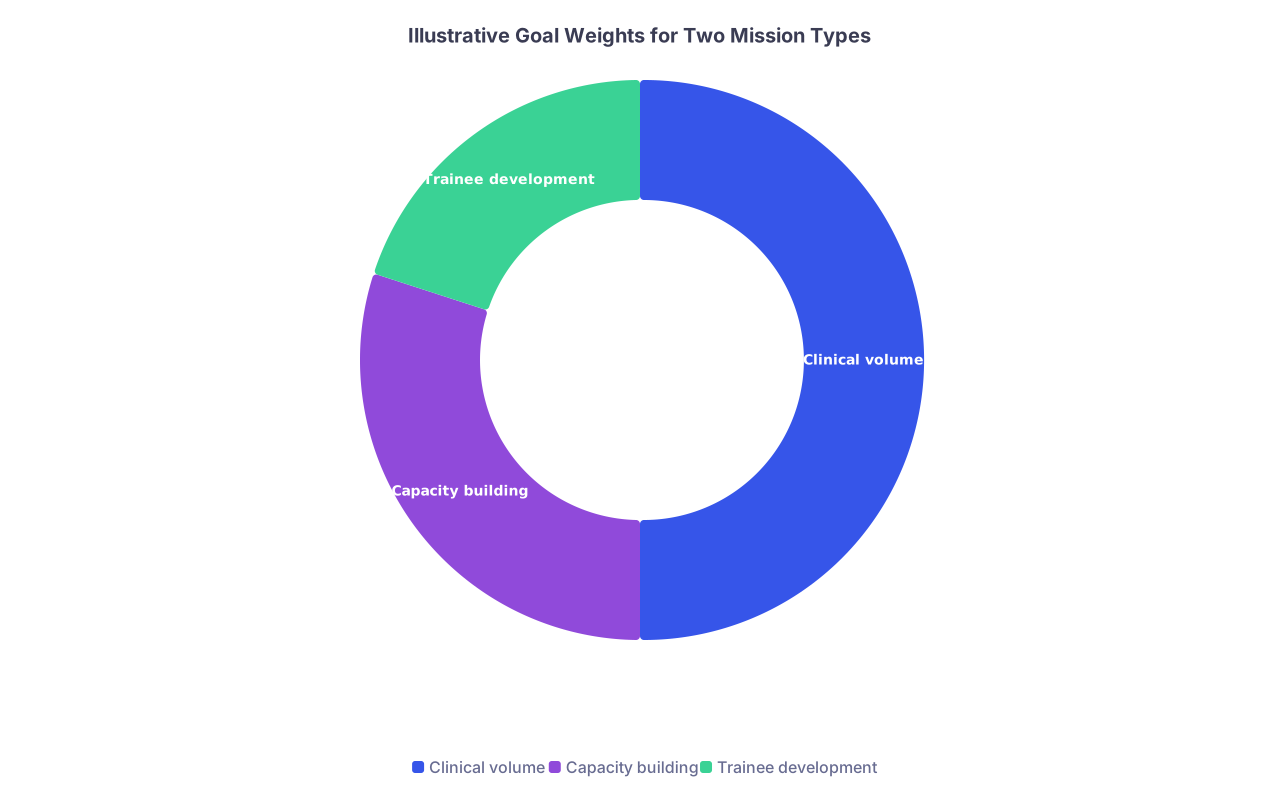
| Category | Value |
|---|---|
| Clinical volume | 50 |
| Capacity building | 30 |
| Trainee development | 20 |
For a mission where “trainee development” is explicitly 20% of the goal, a ratio like 1 student per 3–4 attendings often hits a sweet spot:
- Attendings carry most of the clinical load.
- Each student gets close supervision and meaningful exposure.
- Supervisory drag does not crush throughput.
On the other hand, if an academic center designs a “global health elective” where trainee development is openly 60–70% of the goal, the structure should reflect that:
- Longer stays (4–8 weeks), not 7–10 days.
- Deep integration with a single host site, not “clinic tourism.”
- Clear educational deliverables for the host (e.g., teaching sessions, quality projects) rather than simply shadowing.
But again: be honest about it. Stop selling a school‑driven elective as a “critical access relief mission” when the numbers show minimal marginal clinical relief.
8. Power, optics, and hard questions you should ask yourself
It is easy to rationalize all of this away. “Any help is better than none.” The data says that is not always true.
If you are a student:
- How many incremental patients did you actually help care for last time?
- Would a local clinician, funded for six months, have done more for that community than flying you in for 10 days?
- Did your presence create more teaching burden than clinical relief?
If you are an attending:
- Are you spending half your mission day correcting student notes, redoing exams, and smoothing over cultural missteps?
- Would you serve more people—and burden the host less—by coming with 1–2 carefully selected learners instead of 10?
- Are you counting “student life‑change” as a primary outcome but marketing the trip to donors as “serving the poor”?
Look at actual numbers from your last trip: how many patients, which diagnoses, what follow‑up, what complications, what local capacity retained? If you do not have those numbers, that is already your answer about how seriously you are treating the ethics.
Here is a simple diagram of how roles should ideally be structured:

| Step | Description |
|---|---|
| Step 1 | Define Mission Goal |
| Step 2 | Prioritize attendings |
| Step 3 | Blend attendings and local staff |
| Step 4 | Structured student roles |
| Step 5 | Limit students per attending |
| Step 6 | Focus on training and protocols |
| Step 7 | Longer stays and measurable projects |
| Step 8 | Main Objective |
9. What the data-driven answer actually is
When you strip away narratives and look at time, cost, and output, the roles are clear.
- Attendings are high‑value, high‑cost clinical engines.
- Students are low immediate clinical output, high potential long‑term impact, high supervision‑demand participants.
Use them accordingly.
Key takeaways
- A student‑heavy mission team delivers 2–3 times less clinical output per dollar than an attending‑heavy team and consumes more supervision bandwidth and risk management.
- If you include students, do it for explicitly educational and capacity‑building reasons, not under the pretense of maximizing short‑term clinical relief.
- Ethical mission design starts with hard numbers—patients per day, dollars per patient, local staff trained—not vague stories about “helping.”


