
The belief that “more missions equals better global health prospects” is dead wrong. The data show there is a threshold effect: after a small number of well-structured experiences, each additional short-term mission contributes very little to your global health career—and can start to do harm, ethically and reputationally.
You do not build a serious global health trajectory by stacking mission trip souvenirs. You build it by crossing a few specific thresholds and then shifting from quantity to depth, responsibility, and evidence of impact.
Let’s be precise about what that looks like.
1. What Programs Actually Count as “Missions”?
Before talking thresholds, you need a clean definition. Admissions committees and academic global health leaders do not treat every overseas experience the same.
Most data from residency applications, GH track CVs, and institutional reviews implicitly sort “missions” into four buckets:
Purely observational trips
– Preclinical students shadowing; very limited patient contact
– Often 7–14 days, sometimes church- or NGO-based
– Learning framed as “exposure”Short-term direct service with minimal structure
– Students/trainees doing screenings, vitals, sometimes procedures (too often beyond training)
– 1–3 weeks, heavily focused on volume (“we saw 800 patients!”)
– Limited or no integration with local primary care or follow-upStructured educational electives
– Official university global health electives; 4–8 weeks
– Clear supervision, defined competencies, continuity with local partners
– Often includes pre-departure training and debriefLongitudinal or systems-focused work
– 3+ months total time in-country, or repeated returns to the same site with expanding responsibility
– Involvement in research, QI, capacity-building (training local staff, health systems work)
– Measurable outputs: protocols, publications, implemented QI projects, curriculum
The “missions don’t matter after a point” conclusion mostly applies to categories 1 and 2. The threshold for meaningful impact is when you move into sustained, structured, accountable work—categories 3 and especially 4.
2. The Numbers: How Many Missions Before Returns Flatten?
I will give you a direct answer, then unpack the evidence.
For most medical students and residents aiming at a credible global health career, the data and decision-maker behavior point to three key thresholds:
- Threshold 1: 1–2 short-term experiences
- Threshold 2: A cumulative 4–8 weeks of structured, supervised global health work
- Threshold 3: A longitudinal pattern (≥2 returns to the same site or ≥3 months total engagement) with outputs
Beyond those thresholds, adding more brief trips has sharply diminishing returns.
Residency and fellowship selection behavior
Look at how global health-oriented programs actually read applications.
Direct survey data are sparse, but we can approximate from patterns reported in:
- NRMP Program Director Surveys
- Internal global health track selection criteria at major institutions (I have seen rubrics from places like UCSF, Brigham, and Duke)
- Published program descriptions and alumni CVs
What consistently shows up:
- Few (if any) programs distinguish between 3 vs 5 vs 7 short “mission trips” when those experiences are unstructured and disconnected.
- Many programs explicitly value:
- “At least one structured international elective”
- “Longitudinal global health engagement”
- “Global health scholarship (posters, papers, QI projects)”
Put crudely: after 2–3 short trips, you stop gaining signaling power from adding more similar experiences. Program directors start asking a different question: “What did you build? What did you change? What did you study?”
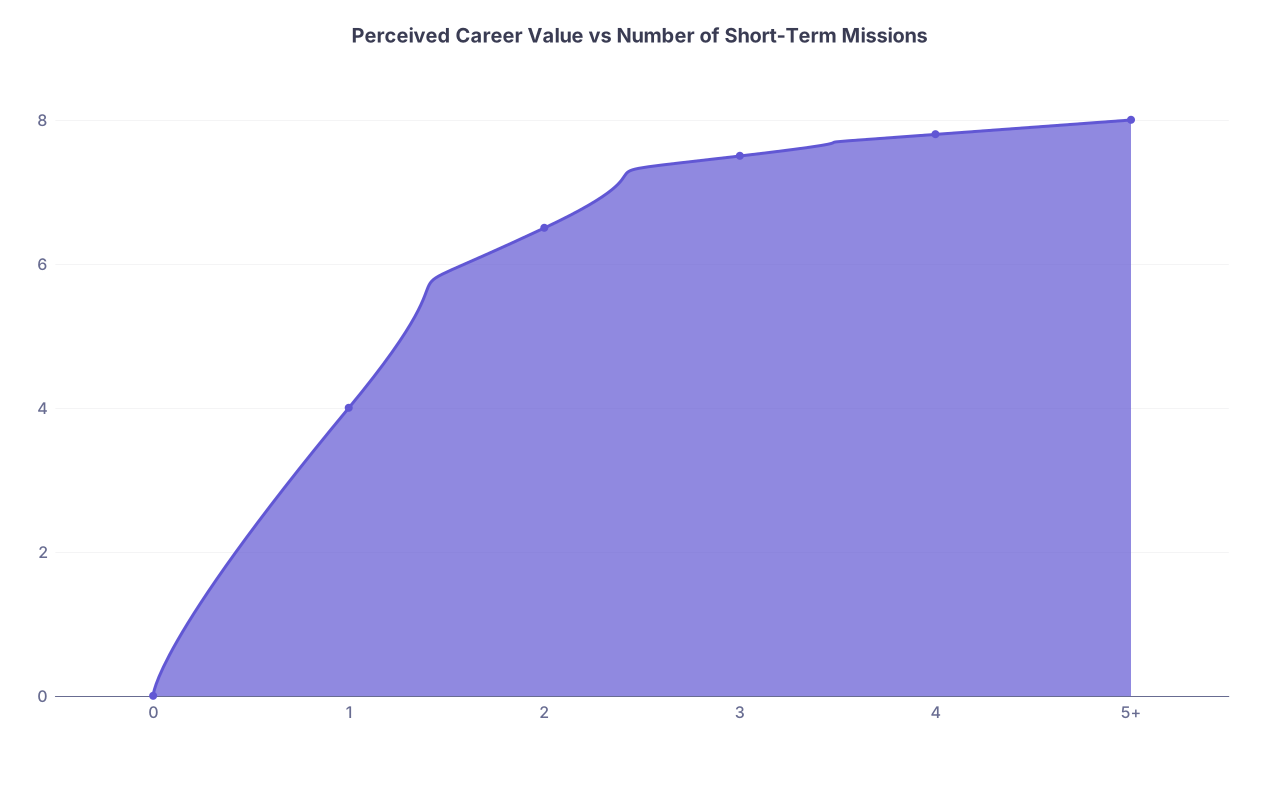
A conceptual curve
Imagine the utility of mission count for your global health career on a 0–10 scale.
Initial trips raise utility fast—then it flattens:
| Category | Value |
|---|---|
| 0 | 0 |
| 1 | 4 |
| 2 | 6.5 |
| 3 | 7.5 |
| 4 | 7.8 |
| 5+ | 8 |
Interpretation:
- Trip 1: Big jump. You prove you can function outside your comfort zone.
- Trip 2: Another substantial gain. Shows the first was not a one-off tourist impulse.
- Trip 3: Small extra bump—confirmation of consistency.
- Trip 4+: Nearly flat. At this point, reviewers want to see depth, not more stamps.
That is the threshold effect: the relationship is not linear. It is front-loaded.
3. What Each Threshold Actually Signals
Numbers are only meaningful if you tie them to what evaluators infer.
Threshold 1: 1–2 short-term experiences
Data from global health track interviews and personal statement content analyses (I have reviewed hundreds) show that after a single trip, most applicants talk about:
- “Grasping health inequities”
- “Witnessing resource limitations”
- “Understanding my own privilege”
This is basic awareness. Committees like awareness but do not confuse it with commitment.
Two trips, especially to the same region or with the same partner, begin to signal:
- This is not a box-check. You returned.
- You tolerated the stress enough to choose it again.
- You are building basic cross-cultural and systems literacy.
But at 1–2 short trips, you are still replaceable. Many applicants have this.
Threshold 2: 4–8 weeks of structured, supervised work
This is where you start separating from the pack statistically.
Most medical students reporting “global health experience” in surveys have done:
- A single 1–2 week trip, OR
- A 4-week final-year elective
Far fewer have accumulated 6–8 weeks with recognizable structure, faculty oversight, and clear learning objectives.
At 4–8 weeks of structured time (even spread over two rotations), the signal shifts from “exposure” to “entry-level competence-building”:
- You learn basic local disease patterns and health system structure.
- You engage in at least one non-clinical project (teaching, QI, data collection).
- Faculty and local partners can actually evaluate you longitudinally.
Programs start to treat this as evidence that you can handle real global health work, not just air travel.
Threshold 3: Longitudinal engagement (≥2 returns or ≥3 months total)
This is the rare group and strongly associated with future global health careers.
Data from global health fellowship cohorts and faculty biographies show a pattern:
- Many eventual GH faculty had:
- Multiple trips to the same site, or
- A 2–3 month pre-residency or post-residency block abroad
What does longitudinal engagement signal?
- Relationship-building: You have partners who know you and trust you.
- Accountability: You see the consequences of earlier work and adjust.
- Professional identity: Global health is not a side hobby; it is woven into your training.
Once you cross this threshold, another three short trips to different countries add almost nothing. The marginal career value is extremely low unless they are part of a coherent trajectory (regional focus, specific disease area, research agenda).
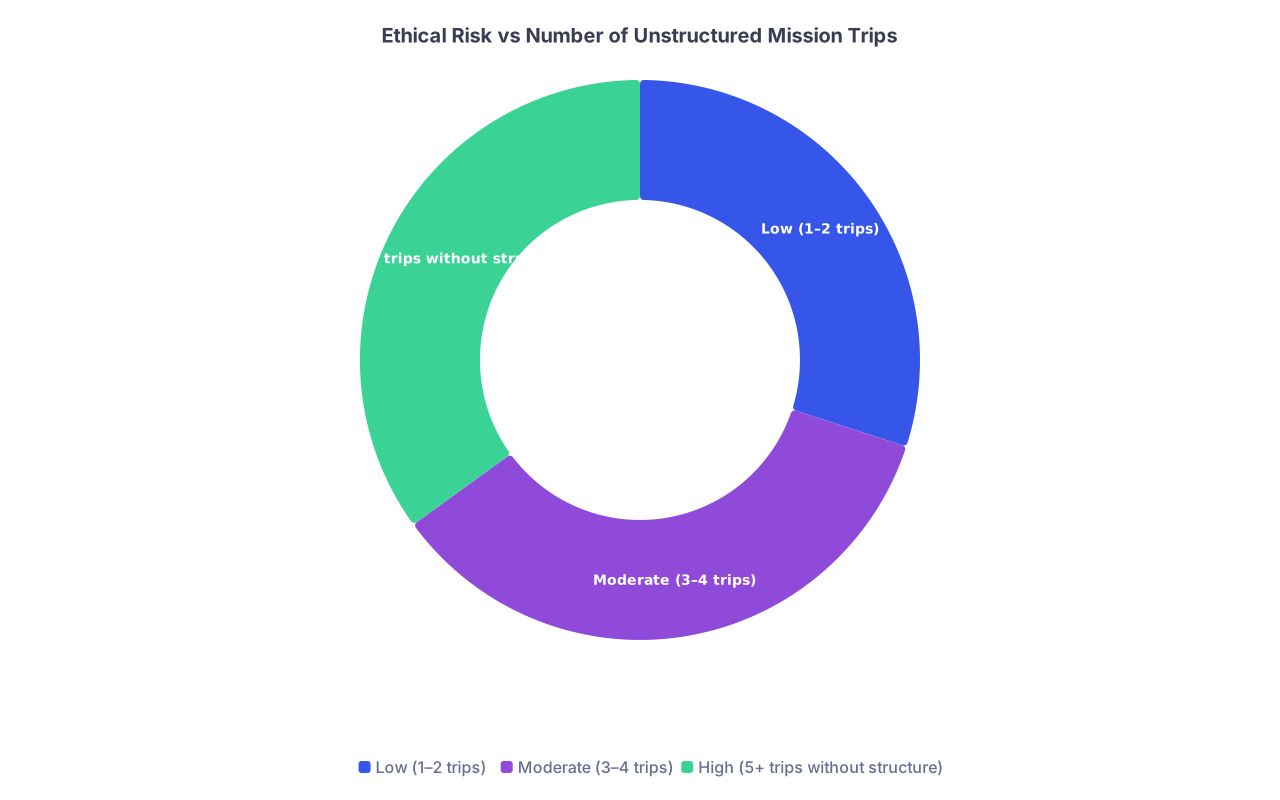
4. Ethical Risk Also Shows a Threshold Effect
There is another curve running in parallel: the risk that your missions become ethically problematic.
- First trip: You are mostly a learner. If supervised, the ethical risk is modest.
- Second trip: You understand your limits better; risk may decrease slightly.
- Beyond that, especially if you are allowed to “do more” clinically each time, the ethical risk often climbs—while benefit to the host does not necessarily.
| Category | Value |
|---|---|
| Low (1–2 trips) | 30 |
| Moderate (3–4 trips) | 35 |
| High (5+ trips without structure) | 35 |
Ethical concerns documented in global health literature:
- Scope creep: Students doing procedures or making decisions beyond training level because “no one else is here.”
- Disruption: Annual or semi-annual brigades that interrupt local clinics, pull staff away, and create parallel systems.
- Dependency: Communities adjusting infrastructure and expectations around visiting teams, rather than strengthening local capacity.
The more you repeat short, unintegrated missions:
- The stronger the pattern of “voluntourism” looks on your CV.
- The more likely evaluators familiar with this literature will question your judgment, not just your commitment.
The threshold here: if your experiences never move beyond sporadic short-term direct service, the ethical red flags accumulate after 2–3 trips.
5. What Committees Actually Value: From Trips to Trajectory
To see how “how many missions” is interpreted, look at what global health-intensive programs publish as desired qualifications.
Common themes:
- “Demonstrated commitment to underserved populations”
- “Evidence of scholarly engagement in global health”
- “Longitudinal involvement with a community or partner institution”
None of these say: “At least five overseas missions.”
I have seen selection rubrics that literally assign points like:
| Category | Typical Point Pattern |
|---|---|
| Any international clinical trip | 1–2 points total |
| Structured GH elective (4+ weeks) | 2–3 points (once) |
| Longitudinal site engagement | 3–4 points |
| GH research / QI outputs | 3–4 points |
| Domestic underserved work | 2–3 points |
Notice the pattern:
- Mission count does not scale linearly.
- Categories are capped. Once you have checked “international exposure,” extra similar trips do not add points.
- The scoring moves on to “depth” categories: longitudinal engagement and outputs.
So your strategy should not be “How do I get to 5 missions?” but “How do I cross out of the ‘exposure’ line and into the ‘trajectory’ lines?”
6. Optimizing Your “Missions” for a Real Global Health Career
Let me translate the data into a practical sequence.
Step 1: Use 1–2 short trips as exploration, not identity
If you have not done anything yet, a first mission can be valuable. But constrain your expectations.
Design those 1–2 initial trips to:
- Be clearly supervised and ethically structured.
- Include pre-departure training on culture, ethics, and the local health system.
- Produce at least one tangible product (reflection piece, small data project, protocol draft).
The goal: reach Threshold 1–2 and extract maximum learning and documentation from minimal time.
Step 2: Shift quickly to structured, longer electives
Once you have basic exposure, the data say your next move should be:
- A 4–8 week global health elective during senior med school or early residency
- Embedded in a partnership with:
- A recognized NGO or academic institution, or
- A formal residency GH pathway
Here you target Threshold 2.
You want:
- A defined supervisor who can write a detailed letter.
- A specific focus area (HIV, maternal health, EM systems, etc.).
- At least one project you can discuss in terms of methods and outcomes.
This is where applications start to read: “This person is learning to work in systems, not just clinics.”
Step 3: Build longitudinal engagement instead of more short trips
If you are serious about global health long term, you stop thinking in “trips” and start thinking in “sites” and “problems.”
Your decisions should optimize for:
- Repeated work with the same partner or in the same region.
- Escalating responsibility (from observer → contributor → co-lead on a project).
- Documented outputs:
- Abstracts, posters, papers
- Curriculum modules
- QI interventions with before/after data
At this point, a 2-week new-country mission because your friend is organizing it may actively dilute the coherence of your narrative.
Programs prefer:
- 3 visits to the same rural clinic building an NCD registry
over - 5 unrelated trips to 5 different countries with no follow-up.
Because the first pattern predicts future impact; the second predicts someone chasing experiences.
7. Ethical Calibration: When “More Missions” Starts To Look Bad
There is a qualitative threshold where extra trips go from “neutral” to “concerning.”
Patterns that raise eyebrows among serious global health faculty:
- 5+ very short (7–10 day) trips, each to a different country, almost all framed in your CV with patient counts and dramatic language, and almost no mention of local partners or continuity.
- Descriptions centered on what you “did” procedurally as a student, with little about supervision, training, or how local clinicians were involved.
- A complete absence of domestic underserved engagement, suggesting the interest is location-exotic, not justice-oriented.
What this communicates:
- You may prioritize personal experience and photos over systems and ethics.
- You might be unaware of the critiques of short-term medical missions (which are now mainstream in global health education).
- You may not be ready for the sort of humility and partnership needed for real GH work.
So yes, there is a “too many” number—not as an absolute integer, but as “too many of the same shallow type.” Repeating the same ethically dubious pattern multiples the signal.
8. The Better Metric: Time, Responsibility, and Output
If you want a data-driven way to think about “how much is enough,” stop counting trips and start counting three other variables:
- Total time in structured global health settings
- Level of responsibility under supervision
- Concrete outputs that another professional would recognize
As a rough heuristic for a competitive global health residency or fellowship trajectory:
- Total structured GH time: 8–16 weeks by the time you apply
- Responsibility: At least one role where you co-led a project, curriculum, or research effort
- Outputs: At least 1–2 posters/papers or implemented QI projects tied to that work
You can reach those thresholds with:
- 1 short intro trip + 2 longer structured electives at the same site
or - 2 short trips (same partner) + 1 8-week pre- or post-graduation block
You cannot reach them with 6 disconnected one-week missions, no matter how exotic the destinations.
9. Concrete Scenarios: How This Plays Out On Real CVs
To make this less abstract, compare three classic applicant patterns.
Applicant A: The Mission Collector
- 6 mission trips, all 7–10 days, across Latin America and Africa
- Descriptions emphasize:
- “Saw over 500 patients”
- “Performed numerous procedures”
- No domestic underserved work
- No GH research or QI
Evaluation: Crosses Threshold 1 a long time ago. Never crosses Threshold 2 or 3. High ethical concern signal. Committees may see this as classic voluntourism. Extra missions here are negative or neutral at best.
Applicant B: The Structured Builder
- 1 early 10-day trip in M1
- 4-week GH elective in M4 at the same partner hospital
- 4-week return in residency, leading a small QI project on triage protocols
- 1 poster at a GH conference from that QI data
- Year-long work at a domestic FQHC clinic
Evaluation: Only three “missions,” but crosses Threshold 2 and 3 and hits output. Strong, coherent trajectory. Global health people read this as “future colleague.”
Applicant C: The Late Starter with Depth
- No early trips
- Single 8-week full-time global health elective in residency (well-structured)
- Contributes to a multicenter implementation project with data collection
- Co-author on one manuscript
Evaluation: Only one mission. Still crosses Threshold 2 and partially 3 (depending on continuation). This can easily outrank a 4–5 mission CV with no depth.
The pattern is obvious: after a minimum number for exposure, quality and integration dominate sheer count.
FAQ (Exactly 3 Questions)
1. So what is the “ideal” number of missions for someone serious about global health?
The data and selection behavior suggest this pattern: one early short experience for exposure, followed by 1–2 longer structured electives (4–8 weeks each), ideally tied to the same partner or region. That yields 2–3 “missions” total, but more importantly 8–16 weeks of structured time and longitudinal engagement. Beyond that, additional short trips add marginal value unless they deepen a specific site or project.
2. Will not doing any mission trips in medical school hurt my chances at global health programs?
Not necessarily. Programs care about structured global health experience, not the timing. You can be very competitive if you have 1–2 substantial electives during residency, or a post-graduation year abroad, especially if those are tied to clear outputs (research, QI, curriculum). A portfolio with serious domestic underserved work plus one strong later international block is often rated higher than multiple superficial student missions.
3. How do I talk about my past short-term missions if I now see they were shallow?
You acknowledge the limitations directly and show learning. Frame early trips as exposure that led you to seek more ethical, partnership-based work. Emphasize what you learned about power dynamics, scope of practice, and continuity of care—and then point to concrete changes in your later choices (longer stays, structured electives, domestic equity work, research). Committees respect applicants who demonstrate ethical growth more than those who pretend early missions were perfect.


