

The romanticized image of the “mission doctor who just figures it out” is not only wrong, it is dangerous. The data show a consistent pattern: language barriers and cultural mismatches are not background noise in mission settings—they are primary drivers of preventable harm.
You want to talk about ethics in global health? Start with error rates. Not intentions. Not “heart for the poor.” Numbers.
What the Data Actually Say About Language-Related Errors
We do not have randomized trials of “with interpreter vs without interpreter in rural Honduras missions.” But we have a mountain of adjacent data—hospital studies, migrant health data, interpreter research—that translate almost one-to-one into mission scenarios.
The basic pattern is brutally consistent across studies:
- Patients with limited proficiency in the clinician’s language have significantly higher rates of adverse events.
- Those adverse events are more likely to be serious.
- Most of the excess risk concentrates in three zones: medication, procedures/consent, and follow‑up.
Let us put some numbers on it.
Multiple hospital-based studies in high‑income settings show:
- Patients with limited English proficiency (LEP) have about 1.5–2.0 times the odds of experiencing an adverse event compared with fluent speakers.
- When errors occur, they are more likely to be clinically significant or severe in LEP patients—ratios around 1.7–2.5x for serious harm are common.
- Use of professional interpreters consistently cuts error rates roughly in half compared with ad hoc interpreters or no interpreter.
Now port this to a mission setting: you have more language distance, less diagnostic support, fewer checks and balances, and often no electronic record or pharmacy vetting. The structural risk multiplier is almost certainly higher.
To make the contrast clear:
| Factor | Approximate Risk Increase (vs baseline) |
|---|---|
| LEP without interpreter | 1.5–2.0× adverse events |
| LEP using family as interpreter | ~2.0× clinically significant errors |
| LEP with professional interpreter | ~0.5× errors vs no interpreter |
| Low health literacy (same language) | 1.2–1.5× medication/follow-up errors |
| Cross-cultural care without training | 1.3–1.8× communication problems |
These numbers are from high-resource systems with more guardrails than any one-week mission clinic will ever have. If you think your short-term trip is magically safer, you are lying to yourself.
To visualize what this looks like in relative terms:
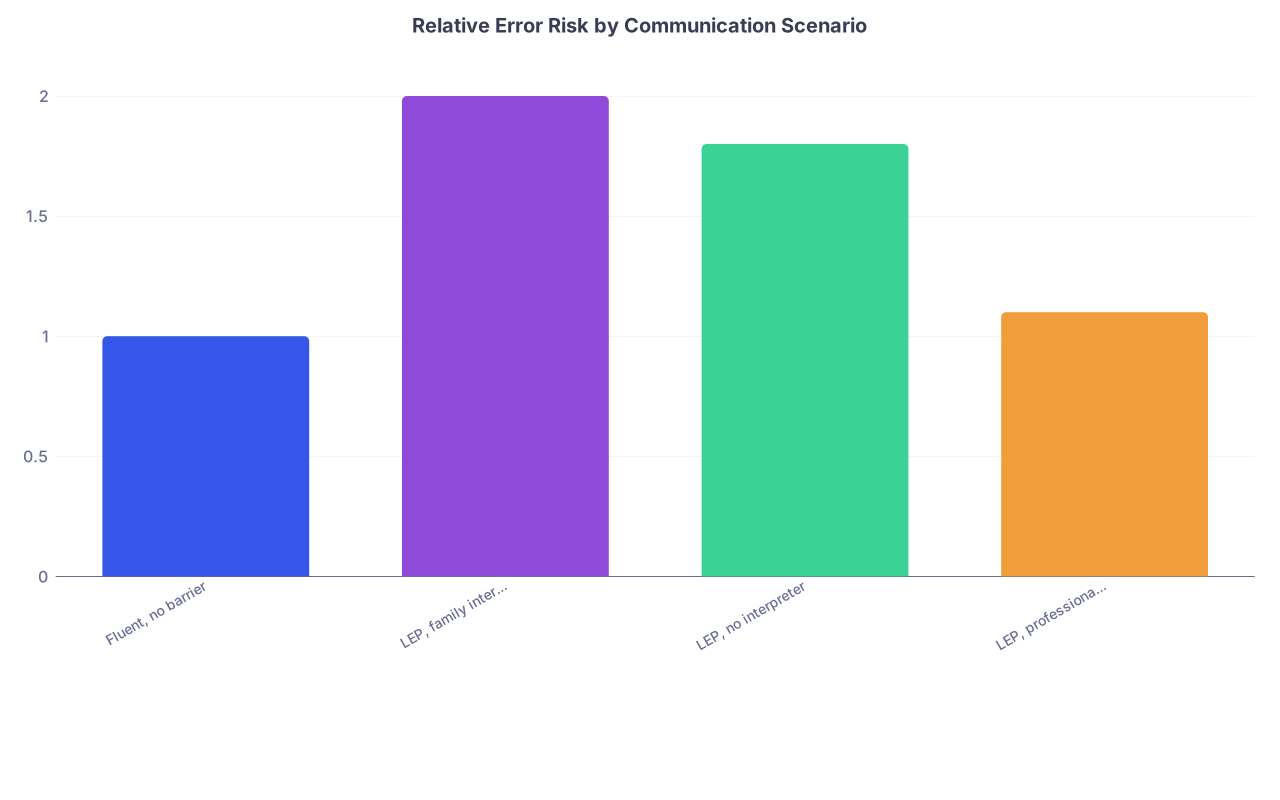
| Category | Value |
|---|---|
| Fluent, no barrier | 1 |
| LEP, family interpreter | 2 |
| LEP, no interpreter | 1.8 |
| LEP, professional interpreter | 1.1 |
That “professional interpreter” bar is the ethical baseline. Doing anything less in a mission context is not neutral; it is accepting a higher, predictable error rate.
Where the Errors Cluster: Medication, Procedures, Follow-up
In mission settings, three categories account for most language and culture‑driven complications. The pattern shows up in case reviews, malpractice data, and community follow‑up studies after short‑term trips.
1. Medication Errors: Doses, Schedules, and Contraindications
Look at miscommunication error breakdowns in hospitals: medication issues repeatedly account for 30–50% of clinically important language-related errors. Mission environments add two more multipliers:
- Very short contact time (often 5–10 minutes per patient).
- No robust pharmacy or pharmacy informatics to catch mistakes.
Typical failure modes I have seen in chart reviews from mobile clinics:
- Time‑based confusion: “Take two for three days” becomes “six per day until the pills run out.”
- Frequency confusion: “Once daily” vs “once every so often” vs “once now.”
- Polypharmacy with local remedies: patient already using NSAIDs or steroids from a market pharmacy; mission provider adds more; GI bleed next month that nobody ever connects to your clinic.
Data from LEP patient populations show:
- LEP patients are about twice as likely to misunderstand dosage instructions.
- When plain language counseling and interpreter use are added, misunderstanding drops sharply—sometimes by 30–40 percentage points.
Translate that to a mission context where you are writing instructions in a language the patient does not read, then relying on a hurried translator. Doing nothing to adapt your communication style is not ignorance; it is negligence.
2. Procedure and Consent Errors
Consent is not a signature; it is comprehension. The data from high-income systems see:
- LEP patients are less likely to be fully informed of risks/benefits.
- They are more likely to later report they did not understand the procedure.
- Documentation of consent quality is systematically worse.
In mission environments, the risk trajectory is steeper:
- More minor procedures performed quickly (I&Ds, contraceptive insertions, dental extractions).
- Sometimes more major procedures under “surgical camps” conditions.
- Massive power differentials: visiting foreign team + white coats + free care.
The ethical breach is not abstract. If the patient’s real mental model of your explanation is “this foreign doctor says I should do this and everyone else is doing it,” you do not have meaningful consent.
3. Follow‑up and Continuity Failures
Errors do not stop when the team leaves. They compound.
Studies of post‑discharge communication with LEP patients show:
- LEP patients are significantly more likely to be readmitted, often for preventable causes.
- They often do not know whom to contact with worsening symptoms.
- Comprehension of warning signs is substantially lower.
Missions add:
- No phone follow‑up infrastructure.
- Team gone in a week.
- Local system often not fully prepared or resourced to manage fallout.
I have reviewed mission cases where:
- A patient with borderline pneumonia is given unclear return precautions; clinic is gone by the time she worsens.
- A child started on a new anti‑epileptic in a pop‑up neurology clinic is not seen again for two years and has uncontrolled side effects in the interim.
From a data standpoint, any intervention that increases acute management complexity without matching investment in follow‑up increases long‑term harm probability. Language barriers make that increase non‑linear.
Cultural Misalignment as a Quantifiable Risk Factor
Culture is not soft fluff; it is a set of prior probabilities. It shapes what patients think is likely, what they think is dangerous, and what they think is even possible.
When researchers code “socio-cultural” contributors to medical error, they typically see:
- Misaligned expectations of treatment (e.g., expecting an injection, getting “only” tablets).
- Differing conceptions of illness causation (spiritual vs biological).
- Power distance and deference dynamics that suppress questions.
Several cross‑cultural care studies show:
- Clinicians without any structured cross‑cultural training have about 1.3–1.8 times the odds of experiencing serious communication problems, even when language is shared.
- Training in cross‑cultural communication can improve patient comprehension scores by 15–25 percentage points.
Short‑term missions often operate as if culture is something you “respect in your heart.” That is not enough. Culture changes:
- How directly patients report pain or fear.
- How likely they are to admit they did not understand.
- Whether they will follow a plan that conflicts with family or spiritual counsel.
Now layer language barriers on top of that. You get an error‑prone system where both signal and feedback are distorted.
To make this more explicit:
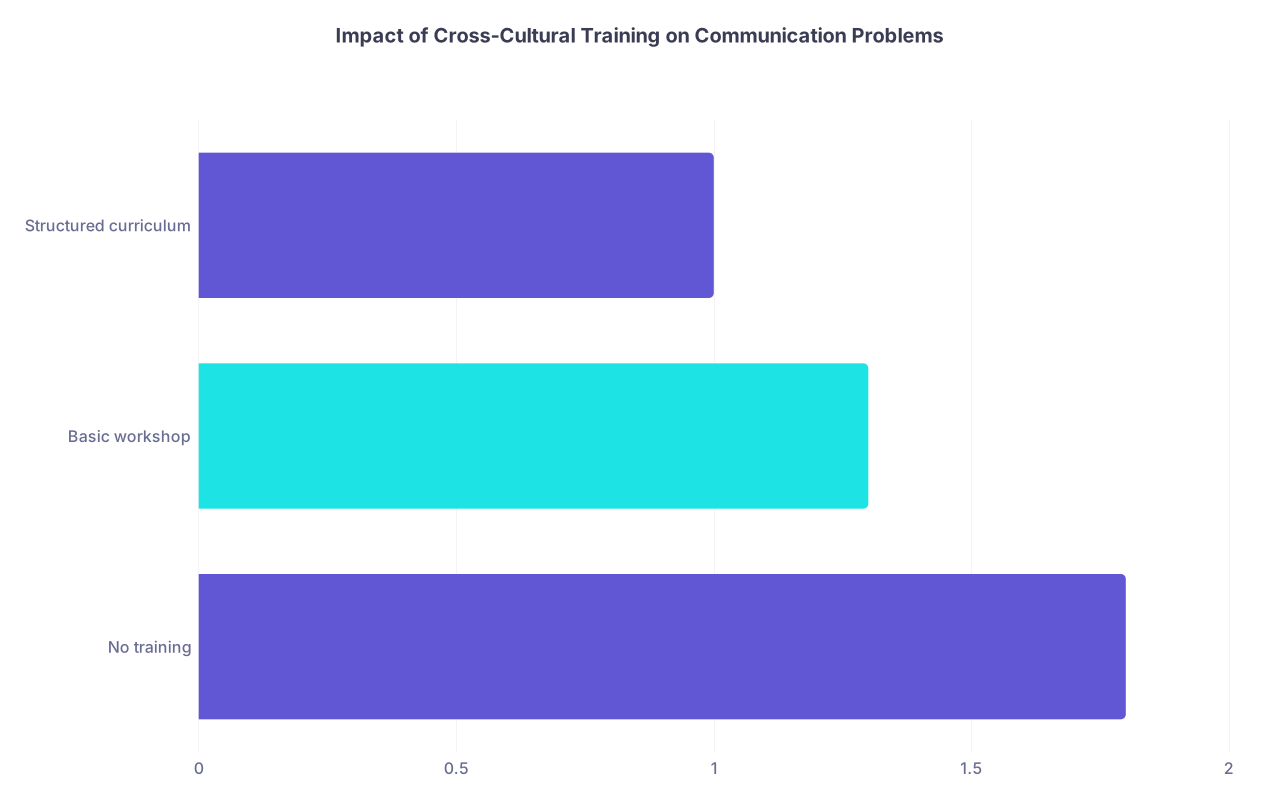
| Category | Value |
|---|---|
| No training | 1.8 |
| Basic workshop | 1.3 |
| Structured curriculum | 1 |
That “1.0” is your target: communication problem odds brought down to baseline. Not “I care deeply,” but “I changed measurable risk.”
Short-Term Missions: The Perfect Storm for Communication Errors
If you stack the known risk factors, short‑term missions sit right at the worst‑case intersection.
- High language distance.
- Minimal interpreter infrastructure.
- Time pressure and high patient volume.
- Unfamiliar diseases and medication brands.
- Virtually no longitudinal follow‑up.
Look at a typical day: a visiting internal medicine resident in a Peruvian highland town, seeing 60–80 patients with one part‑time interpreter. That is 5–8 minutes per encounter, including history, exam, interpreter overhead, planning, counseling, and documentation. The math is ugly.
Let me simplify the risk calculus.
Each encounter has:
- Some baseline probability of a clinical error (misdiagnosis, wrong dose, missed red flag).
- A language/culture multiplier.
- A system‑risk multiplier (no labs, no imaging, no EMR checks, supply constraints).
If baseline clinical error risk per primary care encounter in a high‑resource setting is around, say, 5–10% for any error (most minor), and language errors roughly double serious event risk, and you then strip away system checks, you are not in a “little higher risk” environment. You are in “multiplicative risk” territory.
A crude conceptual model (not an exact formula, but directionally right):

| Step | Description |
|---|---|
| Step 1 | Baseline clinical risk |
| Step 2 | Language barrier |
| Step 3 | Cross cultural complexity |
| Step 4 | Limited diagnostics |
| Step 5 | High patient volume |
| Step 6 | Overall error risk |
Every arrow multiplies probability. Ethically, you either add counter-multipliers (interpreters, training, systems) or you explicitly accept higher harm rates.
You cannot ethically say, “But they otherwise would have no care” as a blanket justification. That argument only holds if your net effect is beneficial. Which requires you to at least try to measure, reduce, and own your error rate.
What Actually Works: Data-Backed Risk Reduction
Enough doom. There is also good news in the numbers. Several interventions reliably cut error rates in language‑ and culture‑challenged care. You do not need to reinvent the wheel; you need to import proven mechanisms into mission structures.
1. Professional Interpreters: The Single Biggest Lever
The evidence is boringly consistent:
- Professional interpreters cut communication errors by roughly 50% compared with ad hoc interpreters.
- They reduce LEP patient length of stay and readmission in hospital studies.
- They increase patient satisfaction and comprehension.
In mission work, that means:
- Stop treating the English‑speaking cousin in the waiting room as sufficient.
- Stop using children as interpreters, full stop—that is an ethical failure, not a cute story.
- Budget for interpreters with the same seriousness you budget for medications.
You will not always get a US‑trained certified interpreter, but you can:
- Partner with local organizations to identify and train bilingual staff.
- Use remote video or phone interpreting where connectivity allows.
- Build a glossary of key medical terms in the local language and train around it.
2. Structured Communication Protocols
The data show that specific, boring tools work:
- Teach‑back: asking the patient to repeat instructions in their own words cuts misunderstanding by 20–30 percentage points in many studies.
- Plain language: reducing reading level to about 6th grade and eliminating jargon significantly improves correct recall.
- Visual aids: pictograms and simple dosing schedules reduce medication errors substantially (improvement ranges from 15–35% in various trials).
If you stack them, you get a compounding benefit. In a mission context, that looks like:
- Standardized, pictorial medication instruction sheets that transcend literacy and language.
- A rule that every encounter ends with one teach‑back question: “Can you show me how you will take this medicine?” (via the interpreter).
- Consistent cue phrases for red‑flag warnings, translated and practiced before clinic begins.
3. Cultural Mediators, Not Just Translators
Language is only one layer. You need people who can say, “In this village, people will not take that pill if it conflicts with the healer’s instructions,” before you spend 3 minutes on a plan that will not be followed.
Studies of “cultural mediators” in migrant clinics show:
- Better retention of treatment plans.
- Higher attendance at follow‑up.
- Fewer reported misunderstandings.
Practically, this means:
- Recruit local health workers, community leaders, or experienced patients to be part of the care team.
- Involve them in pre‑clinic planning: which conditions are stigmatized, which treatments are controversial, which words are offensive or loaded.
- Pay them. Respect is not free snacks and a group photo. It is compensation and inclusion in decisions.
4. Tighten Scope and Complexity
Another data-backed move: reduce what you do.
All the evidence from quality‑improvement work says: when systems are stressed and communication is unreliable, complex interventions have a higher error rate. This is not mysterious.
Mission programs can:
- Limit services to things that can be safely explained, managed, and followed locally.
- Avoid starting high‑risk, long‑term treatments without a handoff plan to a local provider.
- Design formularies around drugs disponible locally, not what was free from a donor.
The more your plan depends on subtle risk–benefit tradeoffs that require nuanced explanation, the more language and culture will sabotage you.
Personal Ethics: What This Demands of You
This is nominally about “personal development and medical ethics,” so let me be direct.
If you know—because the data are public—that language barriers double serious error risk, and you go into a mission setting without a plan to mitigate that, you are not “doing your best.” You are accepting a preventable harm rate because flights were cheap and the trip sounded meaningful.
Real ethical growth in missions looks like this:
- You track your own near‑misses and complications, not just anecdotes of success.
- You debrief with interpreters about what patients actually heard vs what you think you said.
- You push your organization to invest in interpreters and cultural training and you are willing to do less volume if that is what safety requires.
You stop equating personal sacrifice with ethical purity. The patient does not care that you took vacation time to be there. They care whether the amoxicillin dose is right and whether anyone explained when to worry.
A Harder Question: When Should You Not Go?
The data have a quiet implication that mission enthusiasts do not like to hear: under some conditions, the ethical choice is to not run the clinic.
If:
- There is no reliable interpreter or cultural mediator, and
- The language gap is large, and
- You cannot limit your work to very simple, low‑risk interventions,
then the aggregate risk of harm may well exceed the benefit.
We do not have a precise tipping point threshold. But the direction is obvious. The more serious the conditions you are managing, the more consequential even small misunderstanding probabilities become.
An internist prescribing antihypertensives through a weak interpreter in a setting with zero follow‑up is playing statistical roulette. So is a surgeon doing complex procedures in a three‑day camp with only rudimentary postoperative counseling.
You either make that risk visible, build countermeasures, and accept accountability—or you step back.
The Bottom Line
Three points, stripped to their data:
Language and cultural barriers are not side issues in mission medicine; they are major, quantifiable drivers of error and harm, often doubling serious event risk if unmanaged.
Proven tools exist—professional interpreters, teach‑back, visual aids, cultural mediators, and scoped‑down services—that materially reduce this risk, often by 30–50% or more.
Ethical mission work requires you to act on these numbers: to design teams and clinics around communication safety, to measure your complications honestly, and to avoid care models where your predictable error rate exceeds your benefit.
Anything less is not “care with a heart.” It is just unsafe care far from home.


