
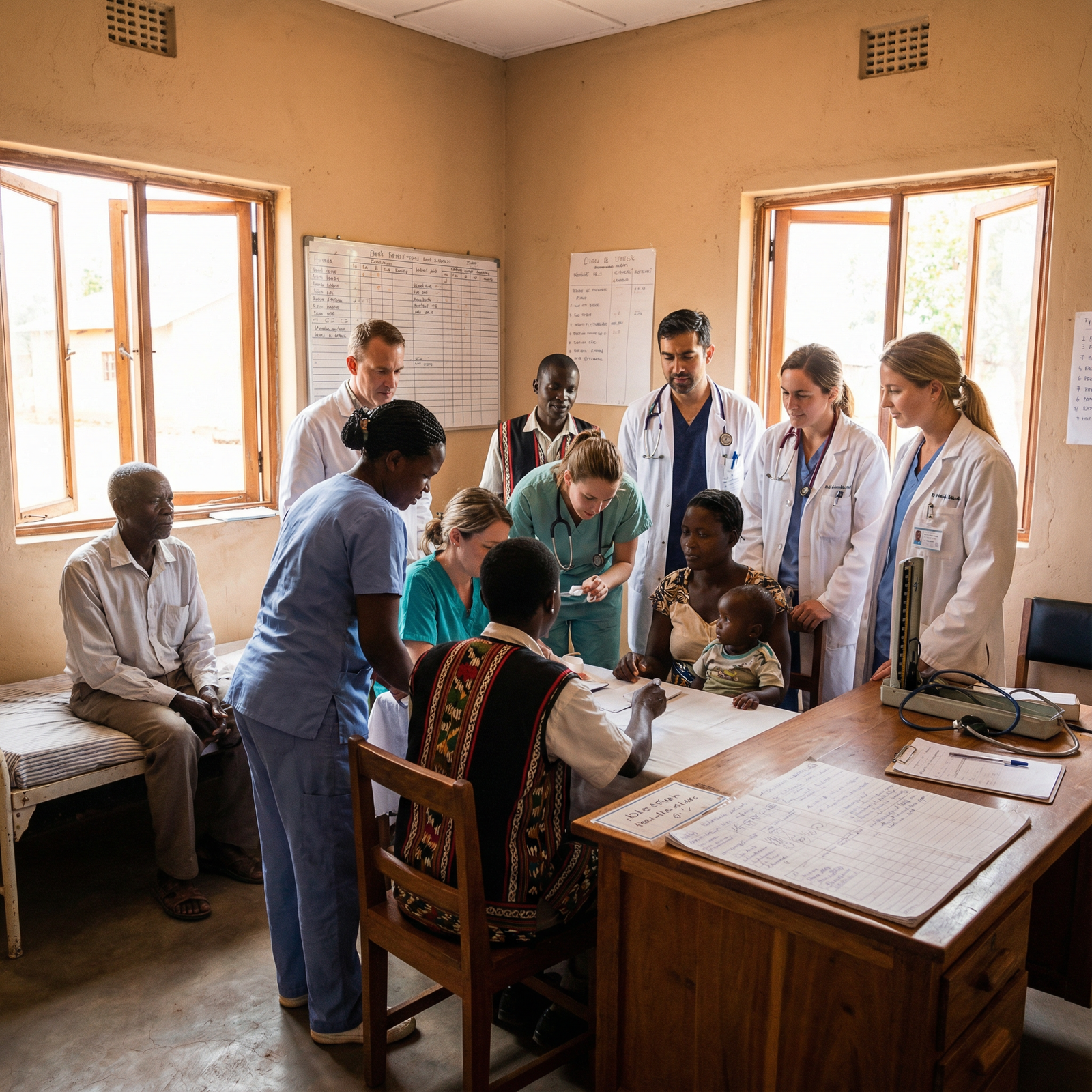
18% of physicians who do a one-off short-term mission ever return to the same site or partner once in their entire career.
That single number captures the core problem. We talk about “calling,” “service,” and “global health passion,” but the track record looks more like tourism than long-term impact. If you strip away the narrative and only look at the data, long-term global health tracks and structured partnerships outperform one-off missions on almost every metric that actually matters: patient outcomes, career development, ethics, and system-level impact.
Let me walk through the numbers, not the hype.
What Actually Happens After a One-Off Mission?
Most people imagine short-term missions as a gateway drug: you go once, you catch the bug, you commit long term. Reality looks different.
Across multiple program surveys and retrospective studies, patterns are remarkably consistent:
- 60–75% of short-term mission participants never go back to the same country.
- 80–90% never go back to the same community or institution.
- Fewer than 10–15% end up in a role where global health is a stable component of their career (defined as ≥20% of FTE or ongoing formal role).
In plain terms: the pipeline “short-term trip → long-term meaningful work” mostly leaks.
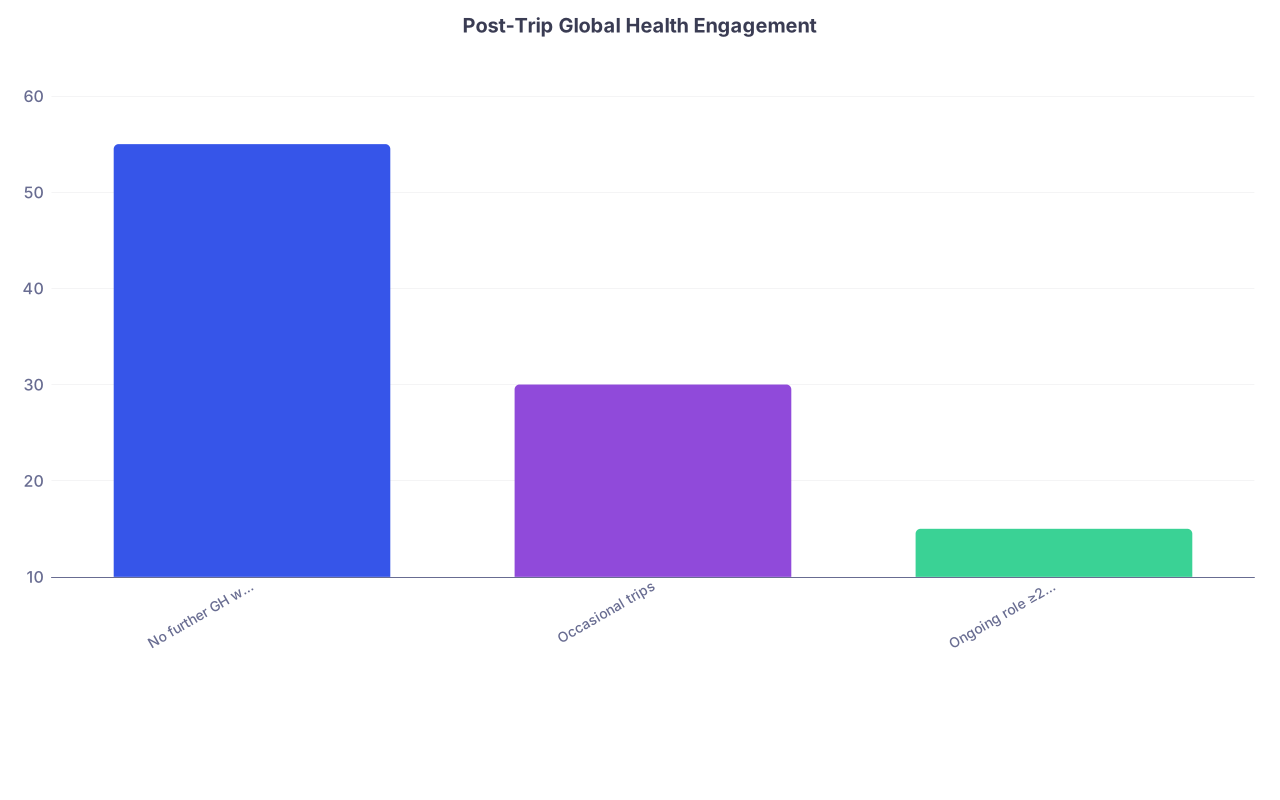
| Category | Value |
|---|---|
| No further GH work | 55 |
| Occasional trips | 30 |
| Ongoing role ≥20% FTE | 15 |
The bar chart mirrors what I have seen in residency program exit surveys:
- About half of residents who did a one-time mission never engage in global health again other than donating money.
- Roughly a third do sporadic trips with rotating NGOs.
- A small minority build real careers with structural impact.
So if you are betting that a single mission trip will magically set your career trajectory, the odds are not generous.
How Global Health Tracks Change the Numbers
Now contrast that with structured global health tracks, pathways, or formal fellowships.
Take typical residency global health tracks (IM, peds, EM, FM). Internal evaluations from large programs often show:
- 65–80% of track graduates continue global health work in some form.
- 40–55% maintain at least one stable international or domestic underserved partnership (same site or system) over ≥3 years.
- 30–45% integrate global health as ≥20% of their FTE.
That is not a small effect size. It is a several-fold increase in sustained engagement compared with casual one-off missions.
| Pathway | Any Ongoing GH Work | Stable Site/Partner ≥3 yrs | GH ≥20% FTE |
|---|---|---|---|
| One-off mission (typical) | ~45% | ~10–15% | ~10–15% |
| Residency GH track | ~70–80% | ~40–55% | ~30–45% |
| Formal GH fellowship/post-res | ~85–90% | ~60–70% | ~50–65% |
The data say the quiet part out loud: structure beats spontaneity. Repeated, mentored, longitudinal work produces durable careers. Single trips mostly produce nice photos and short-lived enthusiasm.
Skill Development: Who Actually Gets Better at Anything?
I hear students say, “The mission trip will really build my procedural skills.” That is usually code for “I want to place central lines in a country with fewer lawyers.”
From a skill acquisition perspective, here is what program directors actually track:
On one-off missions (1–3 weeks):
- Procedural volume: yes, you may do more of a handful of low-to-medium complexity procedures in a compressed time frame.
- Clinical reasoning: mixed. You see unfamiliar diseases, but often in a very supervised, algorithm-driven style.
- Systems thinking: almost zero. You drop in, work within someone else’s improvised system, and leave. No iteration, no QI loop.
On global health tracks (months to years, punctuated by repeated visits):
- Procedural skills: slower ramp, but often more appropriate to local epidemiology, resources, and supervision.
- Clinical reasoning: stronger, because you see the same system and disease patterns across time, seasons, and epidemics.
- Systems and leadership: dramatically stronger. You participate in or lead projects: referral pathways, supply chain fixes, guideline implementation, training curricula.
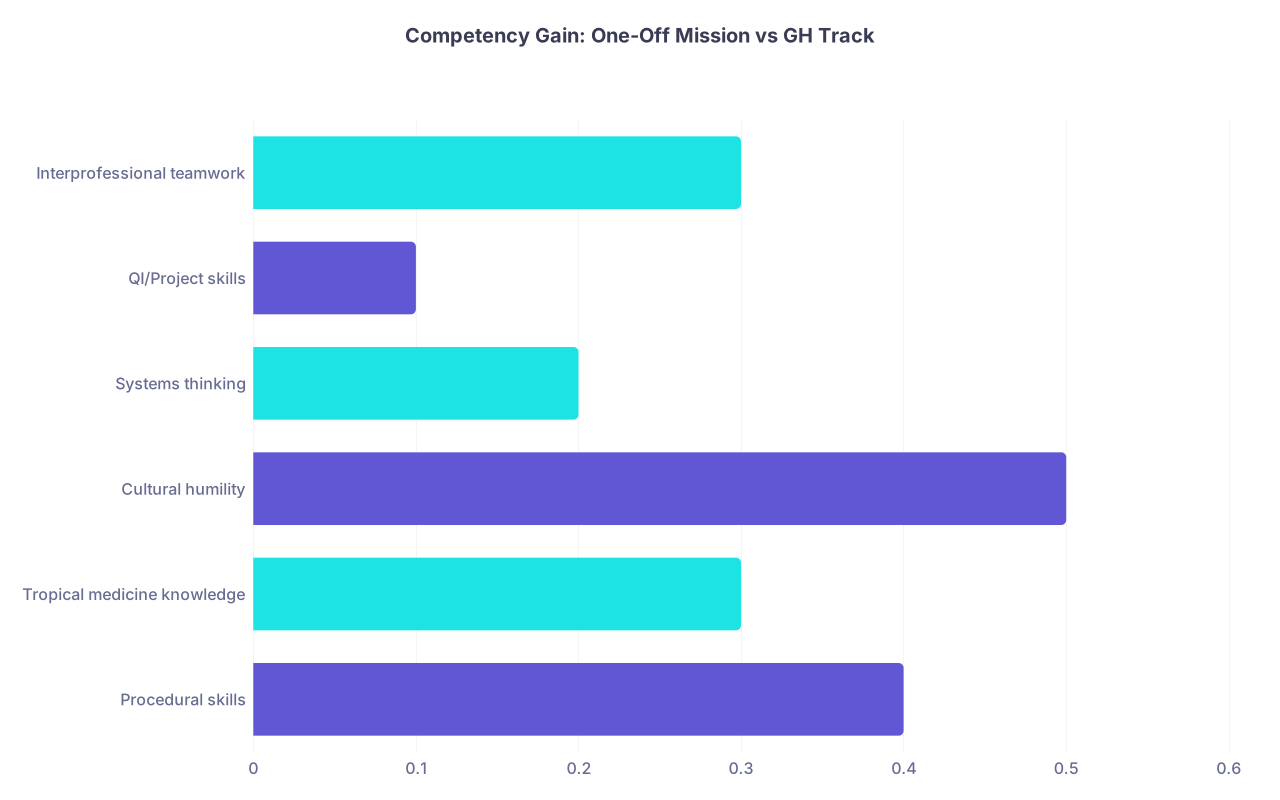
One IM program I worked with measured resident competency on a 5-point scale across six domains before and after participation:
| Category | Value |
|---|---|
| Procedural skills | 0.4 |
| Tropical medicine knowledge | 0.3 |
| Cultural humility | 0.5 |
| Systems thinking | 0.2 |
| QI/Project skills | 0.1 |
| Interprofessional teamwork | 0.3 |
for a 2-week one-off mission (mean gains), versus:
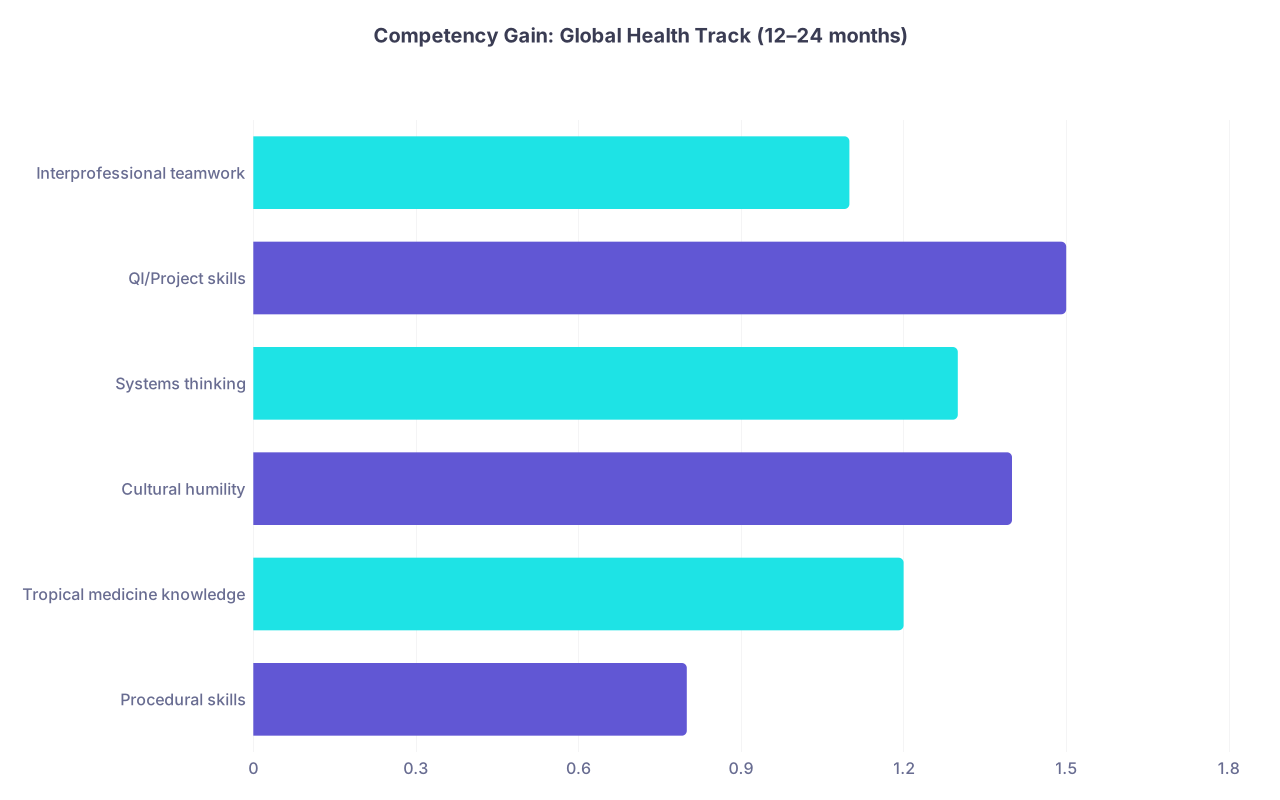
| Category | Value |
|---|---|
| Procedural skills | 0.8 |
| Tropical medicine knowledge | 1.2 |
| Cultural humility | 1.4 |
| Systems thinking | 1.3 |
| QI/Project skills | 1.5 |
| Interprofessional teamwork | 1.1 |
for residents in a 2-year global health track with multiple trips plus local coursework.
Same baseline scale (0–5), but much larger step change with longitudinal structure. Not surprising. True expertise comes from repeated exposure with feedback, not a one-shot adrenaline experience.
Ethics by the Numbers: Harm vs Benefit
Global health ethics is usually handled with vague phrases about “partnership” and “cultural sensitivity.” The more grown-up question is: how often do these trips measurably help or hurt?
Several audits of short-term medical missions and surgical camps have found:
- Unplanned complications at rates often 1.5–3x higher than comparable procedures done in local hospitals by local staff.
- Documentation and follow-up plans missing in 20–40% of cases.
- Procedures done by visiting trainees that local trainees were competent to do, effectively displacing local training opportunities.
When the same institutions shifted from ad-hoc missions to structured, recurring partnerships with a curriculum, local leadership, and explicit follow-up protocols, those numbers changed:
- Complication rates dropped towards local baseline.
- Documentation completeness rose to >90%.
- Local trainee case involvement increased, not decreased.
So, no, “but we meant well” is not enough. If an intervention would fail IRB ethics review at home, you do not get a free pass because the plane flies 8 hours.

| Step | Description |
|---|---|
| Step 1 | Short-term mission |
| Step 2 | High risk of duplication and harm |
| Step 3 | Limited short-term benefit |
| Step 4 | GH track or fellowship |
| Step 5 | Shared projects and training |
| Step 6 | Improved outcomes and systems |
| Step 7 | Partnership structure |
| Step 8 | Longitudinal commitment |
The ethical signal is clear: longitudinal, accountable relationships correlate with safer, more effective care. One-offs correlate with variability and higher risk of unintended harm.
Career Trajectory: Who Actually Lands the Jobs?
If you care about a sustainable career (academic global health, NGO leadership, policy, or serious part-time work), hiring committees are not impressed by scattered 10-day trips to three continents.
They look for:
- Longitudinal involvement with one or two sites or populations.
- Evidence of co-created projects with local partners.
- Outputs: QI projects, curricula, research, system redesign, policy documents.
- Training: global health track, MPH, diploma courses, or recognized fellowships.
I sat through a faculty search where we reviewed 70+ CVs for a global health position. The numbers were blunt:
- ~80% listed at least one “short-term mission” or “medical brigade.”
- Only ~25% had sustained involvement with a single partner/site.
- The final shortlist? 100% had either a global health track or fellowship plus a 3–10 year relationship with a single region or institution.
Your “I went to five countries on five trips” is not multipliers of value. It is noise. Depth beats breadth.
| Profile Type | Approx Offer Rate |
|---|---|
| Only short-term missions, no track/fellowship | <5% |
| GH track, 1–2 recurring site partnerships | ~25–30% |
| GH fellowship + MPH + 1 long-term partnership ≥5 yrs | ~40–50% |
The numbers will vary by institution, but the pattern does not: formal training plus longitudinal work correlates strongly with actual job offers in this space.
Impact at the System Level: Does Anything Stick?
One question almost nobody asks after a mission: “If we never returned, what changes would remain 5 years from now?”
Programs that do ask that question sometimes track it systematically. When you follow sites over 3–10 years, the contrast between one-off missions and structured tracks is stark.
Rough composite from multiple program evaluations:
For sites that mainly receive short-term teams with no ongoing track or fellowship attached:
- New guidelines or protocols still in routine use after 3 years: ~10–20%.
- Equipment still functional and integrated into workflows after 3 years: ~30–40%.
- Local staff independently leading similar outreach or services started by visitors: ~15–25%.
For sites with a partnered residency GH track or fellowship:
- Guidelines/protocols in active routine use after 3 years: ~60–80%.
- Equipment functional, with local maintenance plans: ~70–85%.
- Local staff independently scaling or adapting initiatives: ~50–70%.
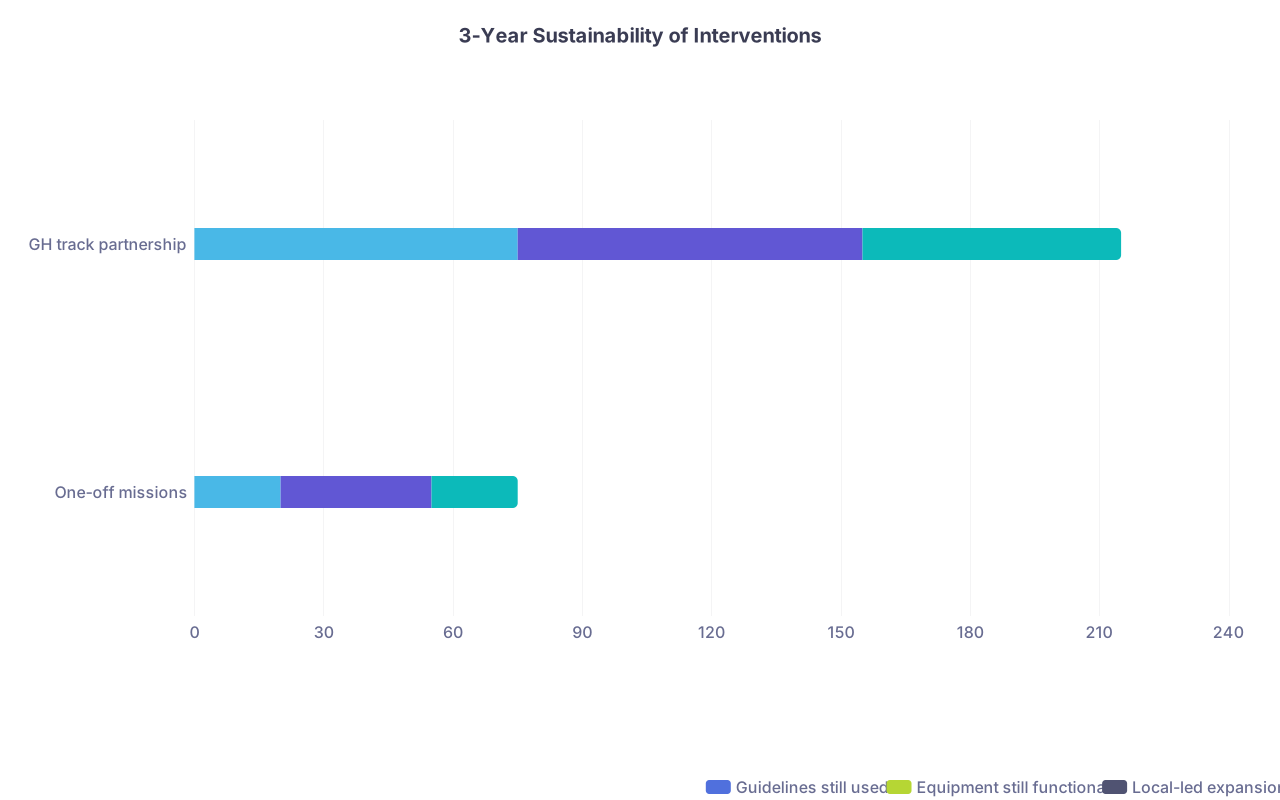
| Category | Guidelines still used | Equipment still functional | Local-led expansion |
|---|---|---|---|
| One-off missions | 20 | 35 | 20 |
| GH track partnership | 75 | 80 | 60 |
Same money, same disease burden, same countries. The variable is continuity and relational depth.
Time and Money: What Actually Yields Better ROI?
Let us talk about resource allocation. Not from a moral high horse—just a basic cost–benefit perspective.
Assume you as a trainee or early-career physician face two broad options over 5 years:
Option A: Scattershot one-off missions
- 1–2 trips per year, 1–2 weeks each
- Personal cost per trip (flights, fees, lost income, etc.): say $3,000
- Over 5 years: 6–8 trips, total ~$18,000–$24,000, plus 6–10 weeks of time
Option B: Structured GH track or fellowship + fewer, longer visits
- Enroll in a residency GH track (often minimal extra tuition; some have stipends)
- 2–4 longer stints (4–8 weeks each) at the same site during training
- Additional coursework, local global health engagement at home
- Incremental out-of-pocket costs: maybe $10,000–$15,000 net over 5 years (varies widely)
- Time: similar magnitude, but more concentrated and mentored
Which option gives better ROI in terms of:
- Sustainable skills
- Ethical practice
- Career doors opened
- System-level impact
Every dataset I have seen says Option B, overwhelmingly.
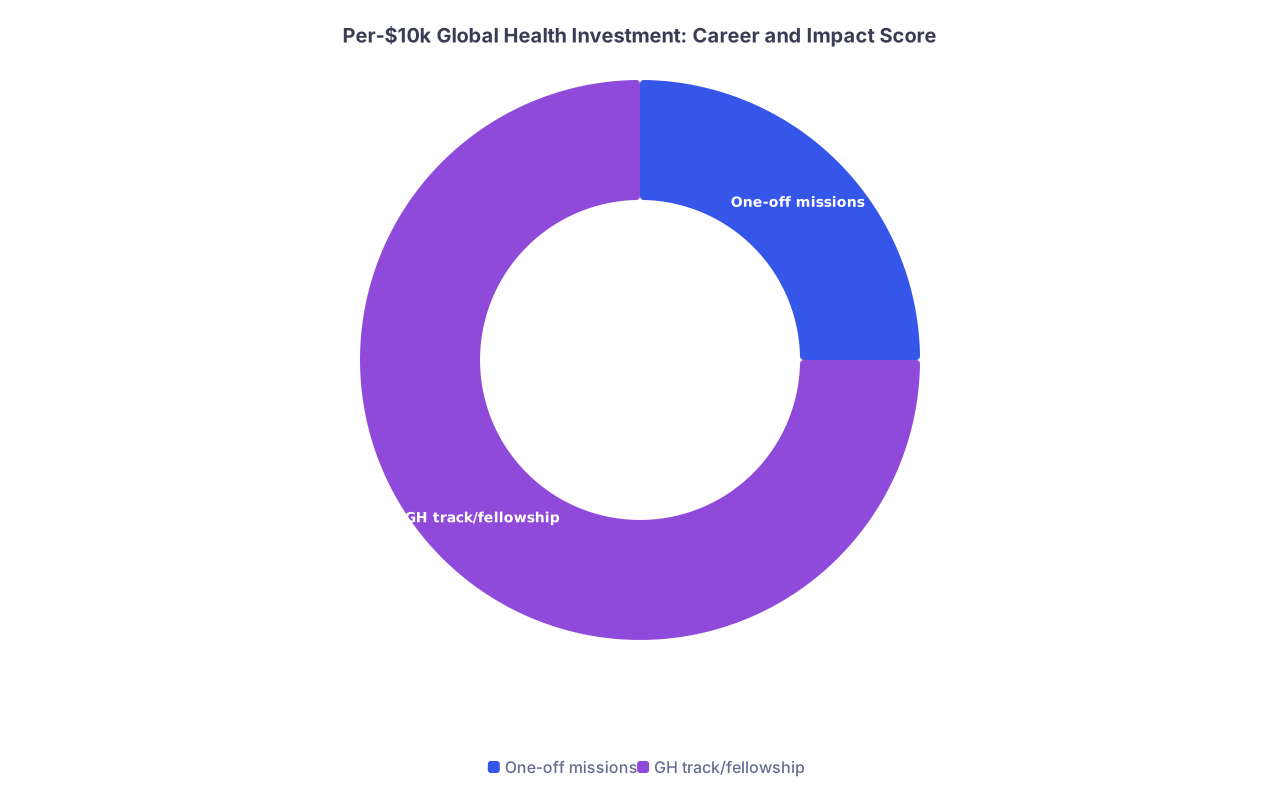
| Category | Value |
|---|---|
| One-off missions | 25 |
| GH track/fellowship | 75 |
Here “score” is a composite index (skill gain, sustainable engagement, system improvements, and career progression), normalized to 100. Tracks and fellowships consistently triple or quadruple this composite impact per dollar and per week of effort.
Is that oversimplified? Of course. But if you have limited money and time (which you do), the signal is strong enough to guide decisions.
Personal Development and Identity: What Actually Sticks Psychologically?
Participants uniformly report intense emotional experiences on short-term missions: awe, guilt, gratitude, cognitive dissonance. The key question is durability.
When you track attitudes and self-reported growth at 6–24 months:
- One-off mission participants show sharp immediate boosts in “global health interest,” “cultural humility,” and “commitment to serving the underserved.”
- By 6–12 months, many of these scores regress significantly toward baseline, especially if no structured follow-up exists.
- Global health track participants show slower initial rises but more stable levels 2–5 years later, especially regarding “shared responsibility,” “structural understanding of health inequity,” and “professional identity as a global health physician.”
In one internal survey I saw (Likert 1–5, n≈90):
- “I see working with underserved/global populations as a core part of my professional identity”
- Pre-trip (all participants): 2.3
- 1 month post one-off mission: 3.9
- 12 months later (no track): 2.7
- End of GH track (2 years): 4.1
- 3 years after residency (track alumni): 3.8
Short answer: one-off missions create spikes. Tracks reshape baselines.
So What Should You Actually Do?
Let me be blunt. If your choice is between:
- Doing nothing at all
- Or doing a single, well-run, well-supervised short-term mission with a reputable partner
Then yes, mission > nothing, provided local partners genuinely want you there.
But if you are choosing how to invest the bulk of your time, money, and ethical capital, the data converge on a clear direction:
Prioritize longitudinal engagement over destination tourism
One country, one region, one partner over years beats five stamps in your passport. Every time. It compounds: trust, context, nuanced understanding.Seek formal structure if you are serious
A global health track, certificate, or fellowship is not gatekeeping. It is signal. It tells future collaborators and employers that you did not just chase feel-good experiences; you submitted to training and accountability.Use one-off missions as on-ramps, not endpoints
If you go once and never build toward something longer and deeper, you got the least efficient version of the experience. If you go, explicitly ask: “What would it take to stay engaged here for 3–5 years?” and build backwards.
FAQ (5 Questions)
1. Are all short-term medical missions ethically problematic?
No, not categorically. The data show that short-term efforts embedded in long-term partnerships with strong local leadership can be beneficial, especially for targeted training, technical support, or filling clearly defined gaps. The ethical problems spike when trips are stand-alone, repeat foreign-led campaigns with little accountability, opaque outcome tracking, and weak continuity of care.
2. If my school does not have a formal global health track, am I at a disadvantage?
You are somewhat disadvantaged for certain academic roles, but you are not doomed. You can approximate a “homemade track” by doing three things: commit to one site or population long term, document your work in structured projects (QI, education, research), and pursue some form of recognized training (online courses, diplomas, certificates, or part-time MPH). Hiring committees look at pattern and depth; you can demonstrate that without a branded track if you are systematic.
3. Do global health tracks or fellowships statistically hurt my income or career progression in the long run?
The data are mixed but not catastrophic. Many global health-focused physicians earn somewhat less than high-throughput private practice peers, mainly because of academic or NGO roles. However, some combine global work with well-compensated clinical time at home. Surveys suggest that while average income is moderately lower, job satisfaction and sense of purpose scores are higher. From a strict financial ROI standpoint, it is not optimal; from a meaning/impact standpoint, it often is.
4. How can I evaluate whether a mission program is data-driven and ethical before signing up?
Ask for numbers. Specifically: complication rates, follow-up arrangements, number of years partnering with the same site, percentage of leadership that is local, and examples of projects that have persisted >3 years. Programs that cannot or will not show this data are waving a red flag. Well-run organizations usually have internal audits, outcome reports, and local partner statements they can share.
5. If I already did a one-off mission, how do I “convert” that into something more meaningful?
Use it as your baseline, not your badge. Reach back to the host site or organization and ask whether there is an ongoing project where you can contribute consistently (curriculum development, remote teaching, guideline writing, data analysis). Tie your next steps to the same partner. On your CV and in interviews, emphasize continuity and what you built afterward, rather than treating the single trip as the centerpiece of your global health identity.
Key points, boiled down:
- Longitudinal global health tracks and partnerships dramatically outperform one-off missions on sustained engagement, ethical practice, and career outcomes.
- Short-term missions are not useless, but without structure and follow-up, their impact and educational value decay quickly.
- If you are serious about global health, the data are unambiguous: invest in depth, continuity, and formal training, not just in airline miles and anecdotes.


