

The biggest myth about prestigious medical missions is that access is about “passion for service” and “global health interest.” It is not. It’s about gatekeepers. And you probably do not even know who they are.
You see the glossy flyers: “Global Surgery in Rwanda,” “Cardiology Mission to Guatemala,” “Disaster Response Team – Apply Now.” You think: statement of interest, CV, maybe one faculty letter, and they’ll pick based on “fit” and “commitment.” That’s the public story.
Let me tell you the private one.
The Real Org Chart Behind Prestigious Missions
Every mission has an official structure and a shadow structure. The official one is what you see on the website: program director, faculty leads, maybe a coordinator. The shadow one is who actually decides if your name goes on that plane.
Typically, there are five hidden power players:
- The Mission Kingmaker
- The Quiet Administrator
- The Local Partner Boss
- The Donor or NGO Gatekeeper
- The Informal Whisper Network
You will not find these roles on any org chart, but they determine who gets “global health experience” on their CV and who gets left behind scrolling Instagram.
Let’s pull back the curtain.
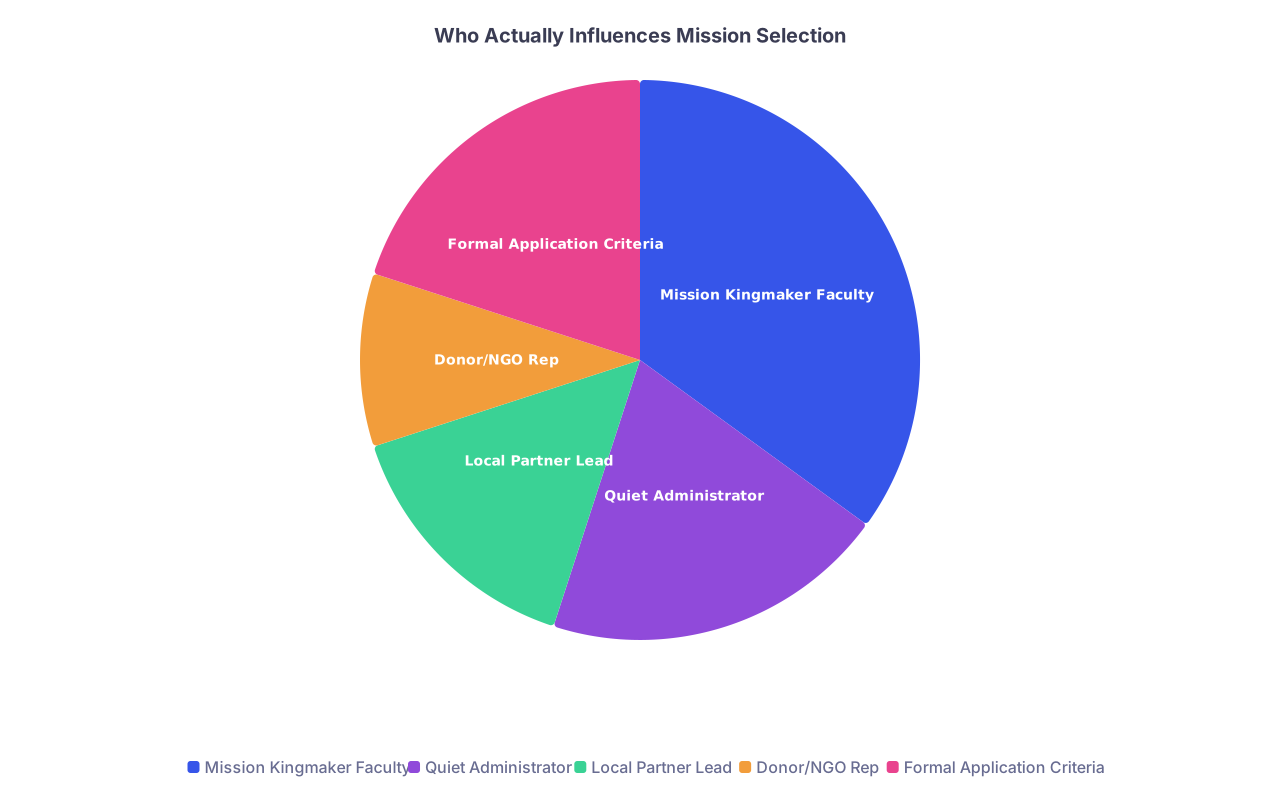
| Category | Value |
|---|---|
| Mission Kingmaker Faculty | 35 |
| Quiet Administrator | 20 |
| Local Partner Lead | 15 |
| Donor/NGO Rep | 10 |
| Formal Application Criteria | 20 |
1. The Mission Kingmaker (Usually a Senior Faculty)
There is almost always one senior attending who “owns” the mission. They may be listed as “Program Director,” “Global Health Lead,” or just some humble-sounding title. Do not be fooled. They control the short list.
Behind closed doors, selection sounds like this:
- “I can vouch for her, she was great with families on wards – let’s bring her.”
- “He’s technically good but a bit arrogant with nurses. I do not want that energy representing us abroad.”
- “Who’s this? I do not know him. Anyone?” silence “Okay, maybe next year.”
You think you’re writing an essay for a committee. In reality, you’re auditioning for one person’s mental file cabinet of “people I trust not to embarrass me internationally.”
This Kingmaker is usually:
- Late-career or mid-career faculty with political capital in the department
- Someone who travels frequently to that specific site
- Seen as the “face” of global health for your institution
And here’s the unspoken rule: if they don’t know you or do not have a trusted ally who knows you, you start two steps behind.
So when you email some generic “[email protected]” address, the decision is not made in that inbox. It’s made when that Kingmaker asks their inner circle: “Anybody know this person?”
2. The Quiet Administrator (Who Can Kill Your Application in 30 Seconds)
The person who “coordinates logistics” often has outsized power. They’re the ones who:
- Track your paperwork
- See your immunization records and compliance history
- Know if you chronically turn in required forms late
- Remember if you were a nightmare on email during your last rotation
If you’ve ever ignored an email from “Program Coordinator,” that’s the person standing between you and a mission slot.
I’ve watched this happen more than once: selection meeting, names on a list, Kingmaker faculty leans toward saying yes, and then the admin quietly says:
“Just so you know, this resident needed multiple reminders for every single form last year and missed the travel deadline twice.”
And suddenly that “almost yes” becomes, “We need someone more reliable – this is too logistically tight.”
They care about:
- Responsiveness
- Clean paperwork
- Professional tone in emails
- Whether you treat them like a colleague or like “just staff”
You can have a glowing letter from the chief of surgery. If the admin thinks you’re disorganized and high-maintenance, your application quietly slides to the bottom.
The Players You Don’t See on Campus
Now let’s talk about the people not wearing your institution’s ID badge who still control your fate.
3. The Local Partner Who Actually Hosts You
On paper, you’re “supporting capacity building” at a partner hospital. In reality, you’re a guest in someone else’s house. That someone has a name. And they’ve probably already told your faculty exactly what kind of trainee they never want to see again.
Conversations I’ve heard summarized later in office hallways go like this:
“Our colleagues in [country] asked we stop sending people who treat them like a training ground. They want people who listen first.”
Or more blunt:
“They specifically requested we not send anyone who cannot function independently with basic cases or who needs constant supervision. They are not a residency program.”
So when your institution picks trainees, they’re thinking of what the local partner already complained about last time. The local lead — often a senior clinician or medical director there — has veto power even if you never see it.
Red flags they warn your faculty about:
- Trainees doing procedures they’re not competent to do, just to “get experience”
- Disrespect toward local protocols, supplies, or hierarchy
- Behaving like tourists with stethoscopes
- Posting patients’ photos on social media without airtight consent
That’s where ethics stop being theoretical. One bad ethical lapse from one prior trainee can slam the door on you, years later.
4. Donor and NGO Gatekeepers
The money talks. Quietly, but loudly enough in the right rooms.
If an NGO or major donor is underwriting flights, supplies, and housing, they often have requirements. Sometimes explicit, sometimes implied.
You’ll hear things like:
- “We promised the donor we’d bring at least two surgery residents this year.”
- “This NGO wants strong storytellers who can help with advocacy afterward.”
- “They prefer people with an interest in long-term engagement, not just one-offs.”
Occasionally it’s more uncomfortable than that:
- “Board wants at least one photogenic ‘ambassador’ they can feature in the annual report.”
- “For this trip, they’re prioritizing people who can represent the hospital well in media.”
Is that in the public criteria? Of course not. Publicly it’s “commitment to global health and service.” Internally, there’s a selection constraint linked to marketing, optics, or future funding.
You can yell about how unfair that is. Or you can recognize the game and decide if you want to play it — ethically, intentionally, or not at all.
The Whisper Network That Decides Before You Apply
Here’s what almost no one will tell you: decisions about you get made when you are not in the room, months or years before you ever apply to a mission.
That happens in three places: on rounds, at debrief dinners after prior trips, and in casual faculty conversations.
I’ve heard this sentence, almost verbatim:
“She’s been talking about global health since MS2. Always shows up on time. Good with nurses. If she applies, I’d put her on the top of the list.”
I’ve also heard:
“He says he wants to do ‘global surgery’ but every time we have a resource-limited situation here, he gets frustrated and blames the system. I am not putting him in a lower-resource hospital overseas.”
None of that goes in your file. It goes in people’s memories. And memory is a very real selection tool.

| Step | Description |
|---|---|
| Step 1 | Clinical Behavior |
| Step 2 | Faculty Impressions |
| Step 3 | Nurse and Staff Impressions |
| Step 4 | Whisper Network |
| Step 5 | Mission Short List |
| Step 6 | Formal Application Review |
By the time your “formal application” hits the review table, your name has already been pre-colored: green (safe, good), yellow (unknown), or red (risky, high-maintenance, ethically questionable).
That pre-coloring is more decisive than your essay about “serving vulnerable communities.”
How Selection Really Works: A Typical Closed-Door Meeting
Let’s walk through how a selection meeting for a prestigious mission actually unfolds. I’ve sat in enough of these to give you a realistic sketch.
You imagine: scoring rubric, blinded evaluation, objective criteria.
What you get instead:
- They print the list of applicants. Names, PGY level or student year, maybe a brief summary.
- The Kingmaker faculty goes down the list out loud. For each name, there’s a short informal commentary.
- People in the room chime in with “I’ve worked with them” or “Don’t know them.”
- The administrator jumps in if there are logistics, professionalism, or prior-travel issues.
- A first pass “Yes / No / Maybe” pile is created before anyone even deeply reads your essay.
And here’s the quietly brutal part: the “Don’t know them” group is functionally disadvantaged. Not always rejected, but rarely prioritized when there are limited spots.
Your 1000-word essay might get 45 seconds of attention, max, compared to a 10-second comment like, “Oh, she was excellent on ICU nights, calm under pressure.”
That’s how human this process is. Messy, informal, and far more personality- and reputation-driven than students are led to believe.
| What They Publish | What Actually Decides |
|---|---|
| Interest in global health | Faculty trust and reputation |
| Strong letters | Who wrote them and how well |
| Academic performance | Reliability under pressure |
| Language skills | Not being a liability abroad |
| Prior experience | How you behaved in that experience |
Ethics: Who Should Control Access vs Who Does
Let’s talk ethics, because this is supposed to be “personal development and medical ethics,” not just “how to game the system.”
There’s a real ethical tension here:
- On one hand, missions need people who are safe, mature, and not going to harm patients or embarrass institutions. That inherently requires subjective judgment.
- On the other hand, opaque selection based on whisper networks and personal familiarity can easily morph into favoritism, bias, and the same old gatekeeping that keeps certain groups out.
Here are the ugly truths no brochure mentions:
People who are socially close to the Kingmaker — same research group, same nationality, same cultural background, same church, same residency track — often get more chances. Not always malicious. Just human.
Trainees who are quietly excellent but introverted, or who don’t know how to self-promote, get passed over because no one at the table has a story to tell about them.
“Ethical fitness” is used as a catch-all phrase. Sometimes appropriately. Sometimes as a vague justification when no one can articulate why they just “don’t feel good” about an applicant.
The ethical thing for you is twofold:
- First, decide what kinds of missions you’re willing to join. If the structure looks exploitative, hero-worshipping, or more about white-coat tourism than reciprocal partnership, maybe the selection gate is doing you a favor by excluding you.
- Second, build a reputation that is actually aligned with good global health ethics: humility, respect for local colleagues, awareness of power dynamics, honesty about your own skill limits.
Because here’s the deeper point: a lot of the “gatekeeping” you’re upset about exists to keep exactly the wrong kind of trainee out of ethically complex environments.
You want to be on the right side of that line.
How to Position Yourself With the Power Players (Without Selling Your Soul)
If you’re still reading, you’re probably thinking: “Fine, who do I actually need to impress and how do I do it without turning into a politician?”
You do not need to be fake. But you do need to be deliberate.
Get on the Kingmaker’s Radar in the Right Way
Do not cold-email them saying, “I’m passionate about global health and would love to pick your brain.” That line shows up in their inbox every week.
Instead:
- Work with them clinically if you can. Even one week on their service is more valuable than ten emails.
- Do a small, concrete task related to their mission work: help with data entry, organize supplies, review charts. Something unglamorous. Reliability is their #1 currency.
- When you talk about global health, emphasize partnership, humility, and continuity, not just “exposure” and “experience.”
Your goal is not to pitch yourself for the next trip. Your goal is to become someone they think of as low-drama, clinically safe, and ethically grounded.
Treat the Administrator Like a Colleague, Not a Secretary
Respond to their emails. On time. With clear answers.
If you screw up paperwork, own it and fix it without drama. If you do one mission and they find you easy to manage, your name jumps in priority every subsequent year.
Quiet truth: I’ve seen admins explicitly advocate for trainees who were respectful and responsive: “She was a dream to manage last time — if she’s applying again, I’d bump her up.”
That matters.
Learn What the Local Partner Actually Wants
Before you ever apply, attend any talks, Zoom sessions, or debriefs where local partners speak. Listen for what they emphasize.
Some sites want:
- Strong proceduralists who can handle volume
- Teachers who can do bedside education
- Tech-savvy people who can help set up registries or EMRs
Others want:
- Fewer “visitors” and more long-term research collaboration
- People who speak the language
- Residents, not students
If your skills and interests don’t match what they’ve said, forcing yourself into that mission is not noble. It’s self-serving. And they will feel it.
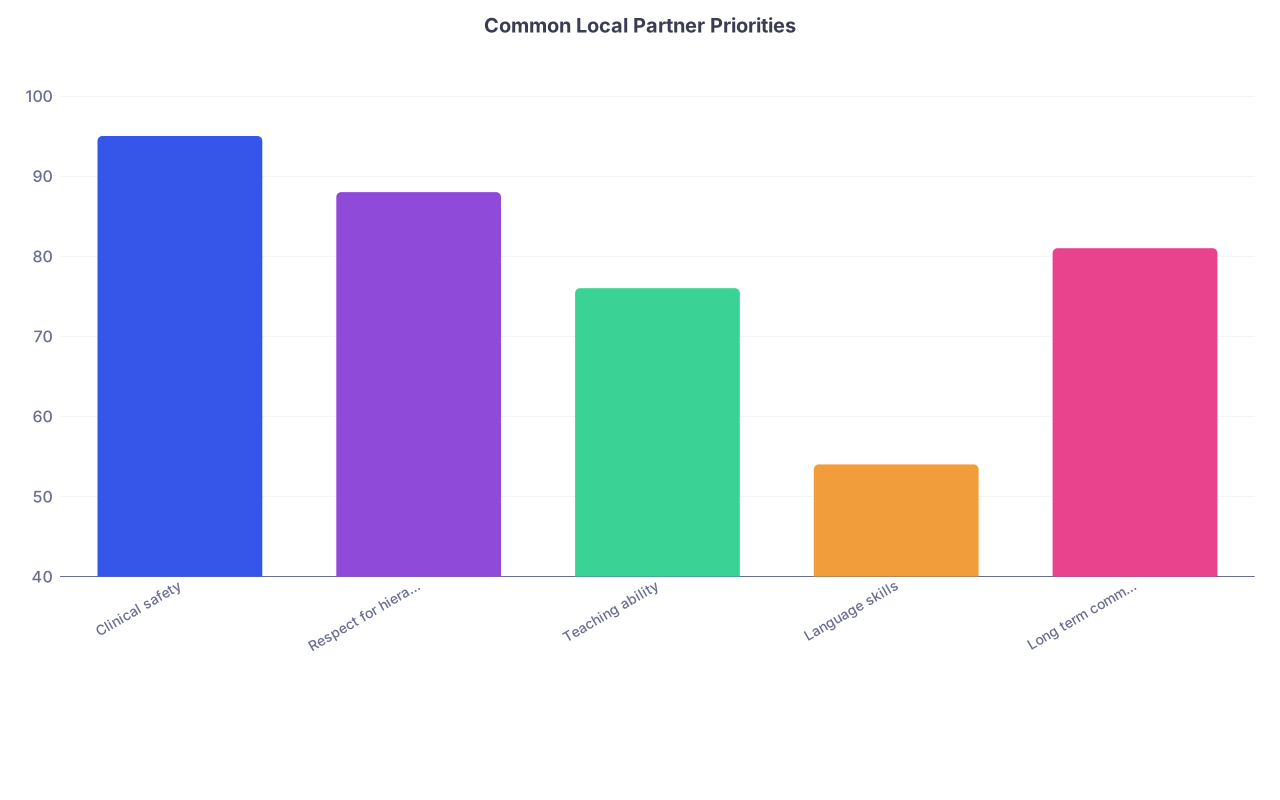
| Category | Value |
|---|---|
| Clinical safety | 95 |
| Respect for hierarchy | 88 |
| Teaching ability | 76 |
| Language skills | 54 |
| Long term commitment | 81 |
Check Yourself Ethically Before You Click “Apply”
Ask yourself, bluntly:
- Am I safe enough clinically for what this mission actually does? Or am I chasing procedures I am not ready for?
- Would I be okay not touching a scalpel / scope / ultrasound if the ethical thing is to let local trainees do it while I support?
- Am I viewing this as “helping the poor” or as a professional exchange between colleagues?
If your honest answers are shaky, your energy is probably better spent first building your competence and your mindset, then going later. There is no moral prize for being early.
The Long Game: Why This All Matters for Your Career
Prestigious missions are not just lines on a CV. They’re narrative anchors. Program directors, fellowship committees, and future employers look at them as signals of who you are in hard environments.
What they’re silently asking when they see “Global Surgery Mission – Rwanda 2025” is:
- Who trusted you enough to take you?
- What kind of work did you do — real, or staged?
- Did you go once for the photo or repeatedly over years?
- Did you learn enough about ethics to talk intelligently about power, colonialism, and partnership? Or do you just say “it was so humbling”?
Missions shape your ethical spine. Or expose its weakness.
So yes, access is controlled by hidden power players. But those same people can become your lifelong advocates if you approach this correctly — grounded, humble, and genuinely serious about global health as more than a backdrop for your Instagram.
FAQs
1. I have no prior global health experience. Am I already behind for prestigious missions?
No, but you’re behind if you have no reputation with the people who run those missions. Start local: show you can function with limited resources in your own hospital, work well with nurses and staff, and be reliable with logistics. Then seek out small, unglamorous roles related to global work — data projects, supply inventory, remote case discussions. Faculty notice who’s willing to do the non-Instagram parts.
2. Do I need to be a technical superstar to be selected?
Not usually. Competent and safe beat flashy. Faculty would rather bring a solid, humble PGY-2 who knows their limits than a procedural hotshot who freelances outside their scope. If you’re early in training, lean on your maturity, teachability, and ethical awareness. Make it clear you understand you are a guest, not the hero.
3. How do I avoid being part of an unethical or “voluntourism” style mission?
Interrogate the structure before you sign on. Ask who requested the mission — local partners or your home institution. Ask what happens when the foreign team leaves. Ask what local trainees get out of it. Watch how faculty talk about the site: as colleagues or as a “beautiful, humbling experience.” If the answers are all vague or defensive, walk away. Your name on a questionable mission follows you.
4. What’s the single biggest thing that quietly kills applications?
Unprofessional behavior that everyone remembers and no one writes down: disrespecting staff, chronic lateness, sloppy communication, or one ethically bad decision with a patient. That story will be told, years later, when your name comes up. The best “prep” for a prestigious mission is not a polished essay. It’s behaving like the kind of physician they’d be proud to introduce to their closest partners.
Key points: Access to prestigious missions is controlled by specific people — not forms. Your informal reputation with those people matters more than your essay. And the way you approach this — ethically, humbly, and with a long view — will shape not just your chances of being selected, but the kind of physician you become once you get there.


