

You are in a crowded clinic in rural Uganda. Or a church basement in Guatemala. Or a mobile camp in rural India. The waiting area is full. You have a line of patients, a translator who is juggling three tasks at once, and you are already behind schedule.
In the middle of all that, someone on your team says:
“We should really collect some data for quality improvement.”
If that sentence makes your stomach drop, this article is for you.
You do not have time for a 20-page protocol, REDCap build, and six-month IRB process. You barely have time to eat. But you can build a simple, ethical, and actually usable data collection plan that:
- Improves care during this trip
- Respects patients and local partners
- Sets up sustainable quality improvement, not data extraction
Here is how to do it, step by step, at the level that is realistic for a short-term, resource-limited medical mission.
1. Decide What You Are Actually Trying To Improve
The dumbest mistake I see: teams trying to collect “everything” because “it might be useful later.” That is how you end up with:
- Useless spreadsheets
- Burned-out volunteers
- Annoyed local staff
- No actual improvement
Start here: Pick one concrete problem to improve. One.
Examples that work well on short-term trips:
- “We miss a lot of hypertensive patients at triage.”
- “Our antibiotic prescribing for URIs is probably too high.”
- “Follow-up instructions are inconsistent and confusing.”
- “Point-of-care glucose checks are not documented reliably.”
Bad goals look like:
- “Improve quality of care in the community” (too vague)
- “Measure health outcomes of all our patients” (too big)
You want something that:
- You can observe during the mission.
- You can influence with simple behavior changes.
- The local partner cares about. Not just you.
Sit down with the local leadership (clinic director, head nurse, health officer) and ask one blunt question:
“If we could fix just one part of how this team works while we are here, what would you pick?”
Use their answer unless it is totally impractical. This is basic ethics: local priorities first.
Then turn it into a clear aim statement:
- “Over the next 10 clinic days, we will increase the percentage of adult patients with documented blood pressure at triage from about 60% to at least 90%.”
Or:
- “By the end of this mission, we will reduce unnecessary antibiotic prescriptions for uncomplicated cough/cold visits by 50% compared to our first 2 days.”
Write that aim on paper. Put it on the wall where your team signs in. This is your North Star. Everything else in your data plan hangs off this.
2. Define the Minimum Data You Truly Need
Now solve this puzzle:
“What is the smallest possible set of data we need to know if we are getting better?”
Max 5–7 data points per patient for most QI aims. Any more and your team will quietly stop doing it by day 3.
Example: Improving Blood Pressure Documentation at Triage
To measure this, you need:
- Was the patient an adult? (You might limit your measure to ≥18 years.)
- Was a BP measured? (Yes/No)
- Optional: systolic/diastolic values if you want quality, not just completion.
- Visit date (so you can track improvement over days)
- Maybe a simple ID so you do not double-count if you sample charts
You do not need:
- Full demographics
- Diagnosis
- Lab results
- Email or phone
- Ten other vitals
Example: Reducing Unnecessary Antibiotics for Simple URIs
For this type of project, keep it like this:
- Adult vs child
- URI visit? (Yes/No – meaning “cough/cold without red flag findings”)
- Antibiotic given or prescribed? (Yes/No)
- Date
- Optional: provider ID (if you want feedback by prescriber)
Notice the pattern:
You are collecting yes/no or simple binary indicators that answer, “Did we do the thing we care about?”
Stop there. If someone suggests adding five more variables “just because,” ask:
“Will we actually use that data to change what we do this week?”
If the answer is no, it does not go on the form.
3. Build a One-Page Data Collection Tool That Humans Will Actually Use
Next step: get this out of your head and onto a simple, ugly, functional tool.
Forget slick apps if you are not already using them. Short-term missions die on the altar of over-complication.
Start With Paper, Then Upgrade If You Have Capacity
Paper never runs out of battery. It does not crash. It is easy to teach.
You want one physical page per patient or one checklist per clinic session, depending on your aim.
Example layout for a triage BP project (clipboard at the triage desk):
- Header: “Triage BP QI Log – Site/Date/Session”
- A simple table:
| # | Age group (A=adult, C=child) | BP done? (Y/N) | BP value (optional) | Notes |
|---|---|---|---|---|
| 1 | ||||
| 2 | ||||
| 3 | ||||
| 4 | ||||
| 5 |
That is it. Nothing fancy.
For a prescribing project, you might keep the log in the pharmacy or provider area and record every URI visit with a simple tick for antibiotic given or not.
Core Rules for Your Form
- One page. Not a packet.
- Check boxes wherever possible.
- Clear yes/no questions.
- No long free-text. It will be illegible anyway.
- Labels in the local language if your local staff will use it.
- Big font, good spacing. You are working in a hurry.
Then ask yourself: where in the patient flow does this logically live?
- Triage project → form lives with triage nurse / vital signs.
- Prescribing project → form lives with providers or pharmacy.
- Discharge instructions project → form lives with whoever gives instructions.
Do not make people walk around with separate forms. Integrate.
If you already use an EMR (rare but not impossible), then add 1–2 required fields and a quick daily export, but do not overengineer. Paper is still your backup.
4. Keep It Ethical and Non-Extractive
This is the part many short-term teams get badly wrong.
If you are collecting data for research (to publish, to generalize beyond this setting), you need formal ethics review (IRB or equivalent, including local ethics board) and proper consent. That is non-negotiable.
For quality improvement that:
- Stays within this program
- Aims to improve care here
- Is not designed primarily for publication
…many institutions treat this as operations work, not formal research. Still, you owe patients and partners some basic ethical safeguards.
Checklist: Ethical QI Data Collection on Mission
Local approval.
Discuss your plan with the local clinical leadership. Get explicit agreement:- “We are going to track X and Y for the next 2 weeks to improve [specific process].”
Transparency with patients.
A simple statement by staff is enough in many settings:- “We are keeping track of how we do blood pressure checks so we can improve clinic care. Your information stays private and used only for the clinic.”
Minimal identifiers.
For basic QI, you probably do not need names or full DOB. Use:- Visit number, chart number, or simple sequential number
- Age in years instead of exact birthdate if possible
Secure storage.
Lock paper forms in a cabinet or room. If you transfer to a spreadsheet:- Remove direct identifiers
- Password-protect
- Back it up securely if you must keep it (or delete once analyzed if not needed)
No exporting data without permission.
Do not take local patient-level data home and use it without explicit agreement from the host institution. Ethically speaking, you are a guest.Be clear about publication.
If you think there is a chance this will become a publication, say so to local partners up front and involve them as authors or co-investigators from the beginning.
If you are unsure whether it is QI vs research, treat it as research and ask for guidance from both your home IRB and the local authority. Err on the conservative side.
5. Decide Who Collects What, When, and How Often
If “everyone” is responsible, then no one is responsible. That is how QI dies on mission trips.
You need:
- A project owner (one named person on your team)
- 1–2 data champions on-site (often local nurses or staff)
- A simple schedule for collection and review
Assign Clear Roles
Project owner (usually from your visiting team):
- Finalizes the data form
- Trains staff on day 1
- Checks forms daily for completeness
- Enters or oversees data entry
- Leads daily or every-other-day feedback sessions
Data champions (ideally local staff):
- Use the form as part of usual workflow
- Correct colleagues gently when they forget
- Bring completed sheets to the project owner at the end of the session
Do not assume anyone will “just do it.” Spell it out like this:
- “Sarah (RN) is responsible for the triage BP form each morning.
- Ahmed (local nurse) is responsible each afternoon.”
Write that on your whiteboard in the team room.
Decide on Sampling vs Every Patient
In a busy mission, you do not need data on every single patient to see change. That is fantasy.
Options:
- First 20 eligible patients each day
- Every other patient
- One random clinic session per day
Pick something that:
- Fits the volume
- Your staff believes they can actually do
- Still reasonably represents your workflow
If you see 200 patients a day, sampling the first 30 adult triage patients is plenty for a basic BP documentation project.
6. Plan for Simple, Fast Data Entry and Basic Analysis
Data that never leaves the clipboard is not quality improvement. It is just extra paperwork.
You need a simple way to:
- Turn the checkmarks into counts or percentages.
- Show the team whether they are improving.
- Do that during the mission, not six months later at home.
Keep the Math Simple
Example: Triage BP project
- At the end of each day, count:
- Number of adult patients in your sample (denominator)
- Number with BP documented (numerator)
Then calculate:
- Percentage = (BP documented / adult patients) × 100
If you hate math, make a quick lookup table:
| Numerator / 20 patients | Percent |
|---|---|
| 10 | 50% |
| 12 | 60% |
| 14 | 70% |
| 16 | 80% |
| 18 | 90% |
Or just enter into a spreadsheet on your laptop or phone. But again: simple.
Visualize Progress With the Lowest-Tech Method That Works
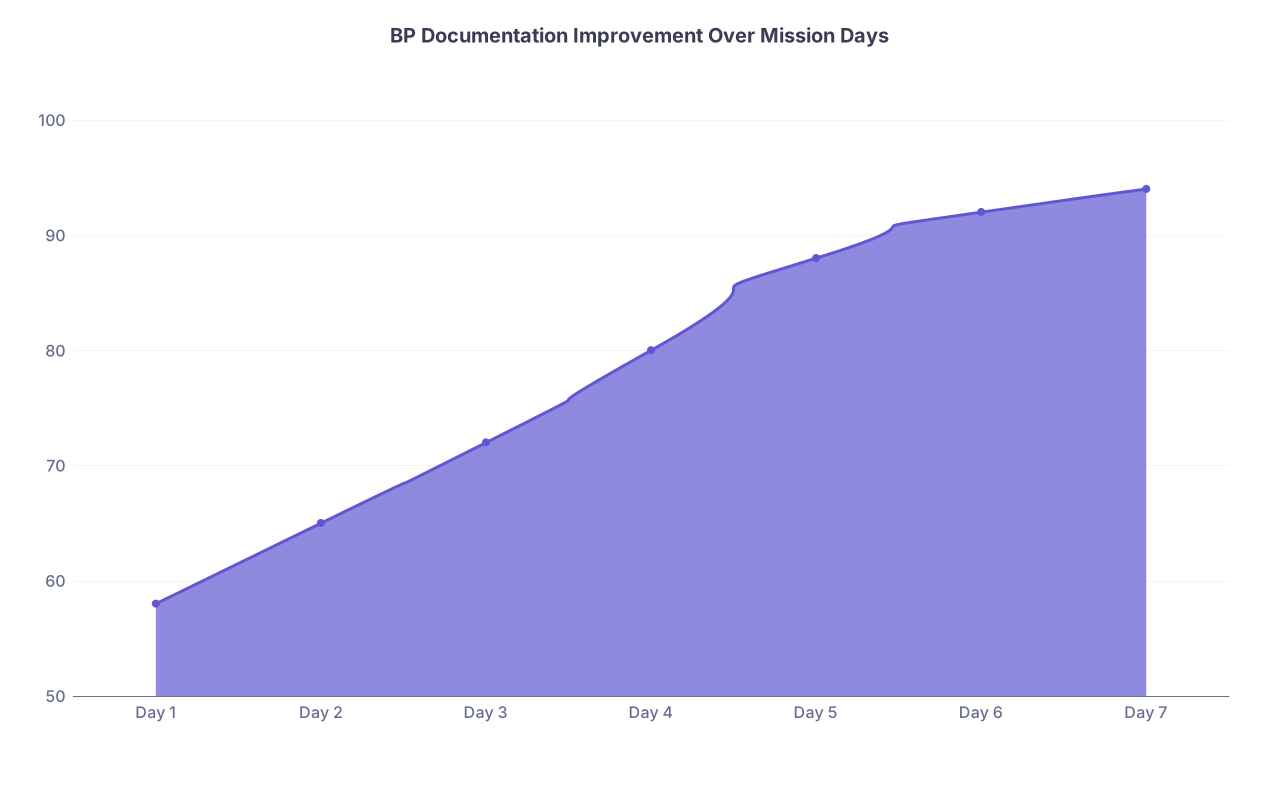
Draw a run chart on paper and tape it to the wall. You do not need fancy software.
- X-axis: days of clinic
- Y-axis: percentage with BP documented
- Add a horizontal line at your target (say 90%)
Then plot your daily percentages:
| Category | Value |
|---|---|
| Day 1 | 58 |
| Day 2 | 65 |
| Day 3 | 72 |
| Day 4 | 80 |
| Day 5 | 88 |
| Day 6 | 92 |
| Day 7 | 94 |
You can make that exact chart by hand with a marker. People understand pictures.
For a prescribing project, same idea:
- X-axis: days
- Y-axis: % of URI visits given antibiotics
- Your target might be something like ≤20%, depending on context and guidelines
7. Build a Micro PDSA Cycle That Fits a Short-Term Mission
Full-blown QI frameworks are overkill here. You need the bare minimum of Plan–Do–Study–Act (PDSA) that you can run in a chaotic clinic.
Your First PDSA Cycle – Keep It Tiny
Using the BP example:
PLAN
- Problem: Many adult patients are not getting BP checked at triage.
- Prediction: If we add a bright “BP?” checkbox to the triage log and assign one nurse to own it each session, BP documentation will rise from ~60% to ≥80% in 3 days.
DO
- Day 1–3: Implement the new triage form and role assignment. Collect sample data.
STUDY
- End of each day:
- Calculate percentage
- Ask triage staff: “What made it hard?”
- After 3 days, look at the run chart. Did it move?
ACT
- If improved but not at goal:
- Adjust flow (e.g., move BP machine closer, change who does BP)
- If no change:
- Re-think your assumption (maybe triage is already overloaded; maybe better to do BP at provider station)
Notice the scale: 3 days. Not a 6-month Plan–Do–Study–Act novel.
You might run 2–3 short cycles during a 2-week mission:
- Cycle 1: Form + role assignment
- Cycle 2: Physical process change (equipment placement / extra staff)
- Cycle 3: Make it sustainable with local workflow
Document the changes with actual scribbles on paper. You are not writing a grant here.
8. Integrate Your Data Work Into the Daily Rhythm, Not as an Extra Burden
If your data collection lives off to the side, it will be ignored by day 4. You want it built into:
- Morning huddle
- End-of-day debrief
- Equipment placement and room layout
Practical Integration Tricks
Morning huddle (5 minutes):
- Show yesterday’s number: “Yesterday: 76% of adult patients had BP documented at triage. Our goal is 90%.”
- Ask: “What is one thing we will try today to bump this up?”
End-of-day debrief (5–10 minutes):
- Quick look at the run chart.
- Ask front-line staff, not just visiting docs:
- “Did this new form slow you down?”
- “Where did it break?”
- “What do you suggest we change tomorrow?”
Physically tape the form where it gets used.
- Clipboards at triage table.
- Data log next to prescription pad or EMR terminal.
Use peer pressure gently.
- “Team A had 90% completion yesterday; Team B had 65%. What are you doing differently?”
- Keep it constructive, not shaming.
9. Plan the Handoff: What Happens After You Leave?
The most ethical question in all of this:
“What will happen to this process when we get on the plane?”
If your answer is “nothing,” then your data work was partly performative. You gave yourself the feeling of doing QI without building anything durable.
Your goal: leave behind something simple enough that local staff can continue if they choose to, on their terms.
Build for Local Ownership, Not Your CV
- Co-design the form with local staff.
- Put their logo, not just yours, on the header.
- Train a local “QI champion” (nurse supervisor, clinical officer).
Then, during the final days:
- Ask: “Do you actually want to continue tracking this after we leave?”
- If yes:
- Simplify the form again if needed.
- Agree on realistic frequency (maybe once a week, not daily).
- Leave blank printed copies or send a file they can print.
If the answer is no, accept that. It is their system, not yours. Short-term teams often overestimate how compelling their pet QI project is to a chronically understaffed clinic.
Also: share back your findings.
- Present a one-page summary to the local leadership before departure:
- Aim, methods in plain language, key numbers, and what changed.
- Promise—and then actually do this—to send an electronic summary and any poster/paper draft that comes later, with local staff invited as co-authors if it reaches publication.
10. A Concrete Example: 2-Week Mission, One Simple QI Project
Let me put this together into a realistic mini-plan.
Scenario: 2-week primary care mission to a rural clinic. Daily volume ~150 patients, mixed adults and children. Local staff: 3 nurses, 1 clinical officer.
Problem identified by local staff:
“Many adults with high blood pressure are not being identified at triage. We only find out in the consult room, or not at all.”
Your Aim
“Over 10 clinic days, increase the percentage of adult patients (≥18 years) with BP documented at initial triage from baseline (~50–60%) to at least 90%.”
Data Elements
For first 30 adult patients each morning and 30 each afternoon:
- Adult? (A)
- BP done? (Y/N)
- BP value (optional)
- Date and session (AM/PM)
Tool
One-page form per session with 30 rows and checkboxes. Clipboards at triage station.
Roles
- Project owner: You (visiting physician or nurse)
- Morning champion: Local nurse #1
- Afternoon champion: Local nurse #2
Workflow
Day 1:
- Brief 10-minute training for triage team.
- Baseline data: use old process, just log whether BP was done.
Day 2–3:
- Implement new protocol:
- BP cuff moved to triage desk.
- BP checkbox added to triage sticker or paper.
- Nurse cannot pass chart forward without checking “BP done.”
You track daily % and update the wall chart.
Day 3–4:
- Study data. Maybe you go from 55% to 75%.
- Nurses say afternoon rush is the main barrier.
- Plan: add a second volunteer to triage in the afternoon to handle BP only.
Day 5–7:
- Run new process. You hit 88–92%.
Day 8–10:
- Focus on maintenance and handoff.
- Adapt the log to something even simpler (e.g., weekly spot checks instead of daily).
- Agree with local leadership if and how they will keep it.
You leave behind:
- A one-page summary of baseline vs last 3 days data.
- The final version of the form, co-labeled.
- An offer to check in after 3 months if they want remote support.
No fancy tech. No 40-variable database. Just a targeted, ethical, partner-driven improvement.
11. Common Mistakes to Avoid
A few patterns I have seen repeated on mission after mission:
- Collecting too much data, then abandoning it.
- Designing the project without local input.
- Picking an aim that is impossible to evaluate in two weeks.
- Focusing on “publishable” topics instead of locally relevant ones.
- Forgetting to close the loop with the host site.
If you feel your plan starting to bloat—more variables, more steps, more complexity—force yourself through this filter:
“If the trip were cut short tomorrow, would this data have already helped this clinic change one thing in a concrete way?”
If not, simplify or scrap it.
12. Where to Start Tomorrow
If you are heading out soon and feel behind, here is your 60-minute emergency prep:
- Pick one problem you and your host agree matters.
- Write one clear aim statement on a half-sheet of paper.
- List 5 or fewer data points that directly answer whether you are improving.
- Draft a one-page form with checkboxes.
- Decide who owns it and how often you will review it.
- Print 20 copies. Pack clipboards and pens.
That is enough to start. You can iterate once you are on the ground.
Key Takeaways
- Pick one concrete, locally driven aim and build an ultra-simple data plan around it.
- Design tools and workflows that real humans in a busy, resource-limited clinic can actually use—and integrate them into daily routines.
- Treat data collection as an ethical partnership, not extraction: local approval, minimal data, clear handoff, and changes that outlast your trip.


