

The way mission letters of recommendation are actually weighed is almost never how students imagine it.
You think they’re reading about your “global health passion” and picturing you in heroic lighting under a Kenyan sunset. What really happens is a committee of tired faculty skimming for about 25 seconds asking three quiet questions:
- Who wrote this?
- Can I trust them?
- Did they stick their neck out for you or just phone it in?
Let me walk you through how mission LORs really get dissected behind closed doors—in residency selection meetings, global health fellowship reviews, and medical school committees trying to sort out who actually has judgment and ethics, and who just bought a plane ticket and a photo op.
What committees really look for in a mission LOR
Forget the brochure language about “demonstrated commitment to underserved populations.” That’s surface-level.
In the room, the conversation about a mission letter sounds more like this:
- “Did they actually work? Or just show up?”
- “Would this writer trust them with independent patient care?”
- “Were they ethical, or did they cowboy their way through procedures they shouldn't be doing abroad?”
Mission letters are RISK documents, not travel awards. They’re answering:
If we put this person in a high-responsibility, low-resource setting—an ICU, a busy night float, or a global health track—are they going to be safe, humble, and not a liability?
The letter is being scanned for three non-negotiables:
- Clinical reliability and judgment
- Ethics and humility in a context where power dynamics are heavily skewed
- Capacity to function in unstable, uncertain environments without falling apart or becoming reckless
You can write “I care deeply about global health” in your personal statement. Nobody cares. They care what the mission attending, the NGO medical director, or the local physician wrote when they had a chance to talk honestly about you.
Who wrote the letter: prestige vs proximity vs honesty
Here’s the first filter almost everyone on a committee uses without saying it out loud: they scan the signature block before they read a single word.
The hierarchy in their heads
Let’s not pretend this is “fair.” It isn’t. But it’s real.
| Writer Type | How Committees Read It |
|---|---|
| Academic global health attending who supervised you clinically | High trust, high impact |
| Local partner physician (from host country) with clear role/title | High authenticity, variable impact |
| Mission trip director with MD/DO and institutional appointment | Moderate–high impact |
| Generic volunteer coordinator / pastor / trip organizer | Low impact |
| Peer, resident, or fellow without direct evaluation authority | Very low impact |
They’re asking:
Does this person routinely work with learners? Do they know what a good trainee looks like? Do they understand the standards we use?
Letters from:
- A global health faculty at an academic medical center with a track record in education → heavily weighted.
- A mission hospital’s long-term medical director who’s known for supervising trainees → also strong, even if they’re not U.S.-based.
- A short-term team leader whose main job was logistics or church outreach → polite background noise. Not decisive.
Now, the secret most students never hear:
A detailed, concrete letter from a lesser-known but embedded local attending is often more powerful than a vague, glowing letter from a big-name U.S. professor who barely worked with you.
I’ve heard exact phrases like:
“I’d take this letter from the Tanzanian surgeon over that ‘he’s great, she’s great’ fluff from Boston. This guy actually saw them operate for two weeks straight.”
Name recognition opens the door. Specificity and credibility carry it through.
What makes a mission LOR strong vs useless
The content pattern is almost always the same: we divide mission letters into three categories in our heads.
Category 1: The travel brochure letter (almost worthless)
You know this one:
“It was a joy to have [Student] with us on our recent trip to Guatemala… They showed great compassion to the people, were always friendly and smiling, and were a wonderful presence on the team…”
You might as well submit a church bulletin.
Red flags in these letters:
- No concrete tasks or responsibilities
- No mention of clinical reasoning, reliability, or independence level
- Heavy on adjectives: “compassionate,” “caring,” “passionate about missions”
- Zero comparison to peers
These letters tell the committee: this trip was primarily tourism + charity, and your “evaluation” was social, not professional. Into the mental recycling bin it goes.
Category 2: The safe, mildly positive letter (background positive)
These letters sound like:
“During our two-week rotation at the mission hospital, [Student] participated in rounds, assisted in clinic, and helped with basic procedures under supervision. They were punctual, respectful, and eager to learn.”
This isn’t bad. It’s just… bland. It says:
- You weren’t a problem.
- You didn’t scare anyone.
- You functioned as a normal, decent student.
These letters are fine if your file is strong elsewhere. They won’t carry you, but they won’t hurt you.
Category 3: The “we’d gladly have them back” letter (this moves the needle)
The mission letters that make people in the room look up from their laptops have the same fingerprints:
- Clear description of the context: resource-limited, language challenges, high patient volume
- Specific, named behaviors: cases you handled, tasks trusted to you, clinical reasoning examples
- Explicit comparison: “Among the many students I’ve supervised on our rotations, [Name] is in the top X%”
- Ethical judgment comments: where you didn’t overstep, where you asked for help appropriately
- Future endorsement: “I would happily have them as a resident/colleague”
A line I’ve heard that instantly changed the tone in a meeting:
“If I had a residency position in internal medicine, I’d recruit [Student] without hesitation. I trusted them more, in a low-resource environment, than many senior residents I’ve seen in the U.S.”
That kind of statement overrides a lot of minor weaknesses elsewhere in your application.
How mission letters are weighed against domestic letters
Here’s a nuance nobody bothers to explain to you: mission letters are usually secondary letters, not anchors.
Programs want to know:
- Can you function in our system?
- Are you safe and reliable in standard teaching hospitals?
- Do people who work with you every day rate you highly?
Mission letters are then read as evidence of character, adaptability, and ethics in extreme conditions.
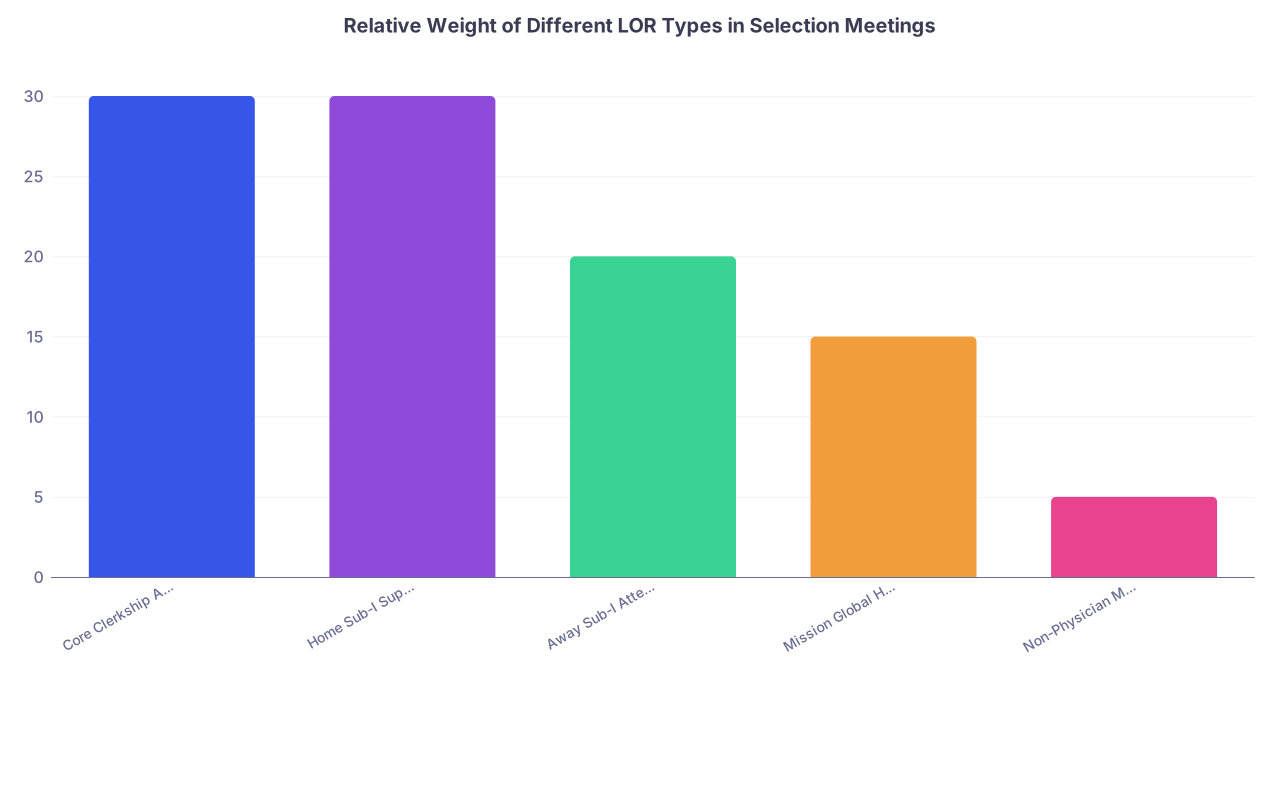
| Category | Value |
|---|---|
| Core Clerkship Attending | 30 |
| Home Sub-I Supervisor | 30 |
| Away Sub-I Attending | 20 |
| Mission Global Health Attending | 15 |
| Non-Physician Mission Leader | 5 |
The trick is this:
A strong mission letter doesn’t replace strong core clinical letters. It amplifies them—shows your performance isn’t a fluke of one environment.
What actually happens in the room:
- If your core letters are lukewarm and your mission letter is glowing → we say, “Okay, interesting, but I need to see that performance at home too.” It raises curiosity, not confidence.
- If your core letters are strong and your mission letter is also strong → now we start talking about you as someone who can handle complexity, resource limitations, and ethical ambiguity. That’s a big deal for any program that deals with underserved populations—even domestically.
Programs with global health tracks or high uninsured/immigrant populations weigh mission letters more. They’ve seen the same pathology: students who “care about global health” but melt down when they don’t have a CT scan in 20 minutes and a full specialty panel on call.
When a mission attending says you stayed calm and thoughtful when the system was chaotic? That matters.
The ethical dimension: unspoken red flags
Mission LORs are uniquely dangerous for you if the writer is honest—and some are very honest.
There are three phrases that quietly kill your file:
- “Enthusiastic, sometimes to a fault”
- “Eager to take on procedures” (with no clarification about supervision)
- “Very independent” (with no explanation)
In a U.S. letter, those might sound mildly positive. In the mission context, faculty who’ve seen the dark side read that as:
- You pushed to do things beyond your training.
- You were more excited about doing procedures than about being safe.
- You might have been practicing on patients who had no real alternative.
I’ve sat in meetings where someone said:
“This screams scope creep on a mission trip. Hard pass.”
The letters that impress us ethically look very different. They mention:
- You refused or questioned tasks you felt were above your level
- You consistently sought supervision
- You prioritized informed consent and transparency, even with language barriers
- You treated local staff as partners, not background props for your Instagram
One real line that made an entire committee nod:
“[Student] was one of the few trainees I’ve worked with who regularly asked, ‘Would I be allowed to do this at my home institution?’ and adjusted their behavior accordingly.”
That’s the kind of thing that makes mission experience an asset instead of a liability.
How committees read “between the lines” in mission letters
Here’s the part applicants never see: what we say about the letter once you leave the room.
Let me show you how a mission letter gets decoded.
Example 1: The vague praise letter
“It was wonderful to have [Name] with us in Haiti. They were eager, friendly, and always volunteered to participate. The patients loved them and they showed great compassion. I am confident they will be an asset wherever they train.”
How we translate:
- No mention of reliability.
- No mention of clinical reasoning.
- No comparison to other students.
- No specific responsibility.
Outcome: “Okay, nice trip, doesn’t help us decide. Move on.”
Example 2: The mixed letter with subtle concerns
“[Name] was very enthusiastic and always wanted to be involved in procedures. At times we had to remind them about the limits of their training, but they were receptive to feedback and clearly passionate about serving. They will continue to grow as a clinician.”
How we translate:
- “Always wanted to be involved in procedures” = procedure-hungry.
- “At times we had to remind them” = boundary issues.
- “Will continue to grow” = not there yet.
Outcome: “We already have too many risk-takers. Hard no.”
Example 3: The high-trust letter
“During a three-week rotation at our mission hospital in Kenya, [Name] saw 15–20 patients per day in clinic under my supervision, presenting assessment and plan in real time. Their differential diagnoses were consistently thoughtful and appropriate to the resource constraints.
On multiple occasions, when short-staffed, I specifically requested that [Name] be paired with our most complex cases because of their reliability and conscientiousness. They asked for help appropriately and were very aware of their limitations. I would gladly welcome them back as a resident.”
How we translate:
- Clear volume and responsibility → this was real work, not shadowing.
- Resource-appropriate reasoning → they didn’t order fantasy labs in their heads.
- “Specifically requested” → trusted more than peers.
- “Aware of their limitations” → safe judgment.
Outcome: “This is one of the better letters in the file. I trust this applicant.”
How to set up a mission experience that yields a powerful LOR
You can’t fix a letter after it’s written. The work happens on the ground.
Here’s how experienced faculty know—within 48 hours—whether you’re going to earn a letter they’ll stake their name on.
They’re subconsciously scoring you on:
- How you show up on day one: humble, eyes open, or already acting like the savior
- How quickly you adapt to constraints without whining
- Whether you ask good questions, not just “Can I do this procedure?”
- Whether you treat nurses, translators, and local staff with genuine respect
If you want a letter that actually matters, you have to operate like you’re already being evaluated as a junior colleague, not a tourist.
That means:
- You show up early. Consistently. No drama.
- You learn the local system fast, by watching, not demanding.
- You offer help with unglamorous tasks: wound care, notes, organization, education of local trainees.
- You are visibly cautious about scope. You say things like, “I’d like to do this someday, but I don’t think I’m there yet. Could I observe or assist?”
The attendings and local docs talk about that student at dinner. That’s the student they’re willing to write a serious letter for.
How much one mission LOR can actually help you
Let’s be blunt.
A single mission LOR is not going to magically erase a mediocre clinical record, low scores, and weak home letters.
What it can do:
- Differentiate you from the pack of applicants who just listed “medical mission trip” in the extracurriculars
- Reinforce a narrative of resilience, ethics, and adaptability
- Make you especially appealing to programs with underserved, global health, or safety-net missions
And here’s the quiet truth:
Programs with a serious service mission are actively looking for people who’ve already been stress-tested when the system is messy, under-resourced, and unfair.
Mission work—when documented well by someone we trust—is one of the few ways to show that before you ever step onto their wards.


