

Last summer, a third-year resident emailed me from a tiny clinic in Central America at 2 a.m. She was shaking, alone in a back room, staring at a tray with tools for a C‑section she’d never done. The local doctor had just said, “You’re from America. You’ve done this, right?”
She hadn’t. And she was terrified that saying no meant someone might die. But saying yes might ruin someone’s life.
That’s the nightmare scenario, right? You fly out on this “medical mission” to help, and suddenly people are asking you to intubate kids solo, place central lines, manage eclampsia, or even do surgeries you’ve only seen once on a rotation. And in your head it’s just this constant loop:
What if I say no and they die?
What if I say yes and I hurt them?
What if everyone thinks I’m weak or useless?
What if this follows me forever—legally, professionally, ethically?
Let me walk through this like I’m sitting next to you in that tiny call room, because I’ve seen versions of this play out over and over. And honestly? You’re not crazy to be worried. You’re the only one in the room actually thinking clearly about the risk.
First: You’re Not Overreacting. This Is a Big Deal.
You didn’t invent this problem in your head. It’s not “impostor syndrome” when someone literally hands you a procedure you’re not trained to do and expects you to “figure it out.”
That’s not growth. That’s negligence.
You’re juggling at least four competing pressures:
- Patient safety – the only truly non-negotiable thing.
- Local expectations – “You’re from the US, you can do everything, right?”
- Team pressure – mission trip leaders who are like, “We don’t have anyone else.”
- Your own fear – fear of harming, fear of refusing, fear of being labeled difficult.
That knot in your stomach? That’s your ethics screaming at you not to cross a line. And they’re right.
What’s Actually at Stake (Beyond Your Anxiety Loop)
Let’s make this concrete. When an organization invites you to do procedures beyond your training, several things are quietly on the table:
- Patient harm – obvious, but people like to pretend “any help is better than no help.” That’s a lie. Brain damage, infection, lifelong disability… those are not “better than nothing.”
- Moral injury – that horrible, lingering feeling you get after doing something that violates your values. It sticks.
- Legal risk – yes, even abroad; yes, even “volunteer.” You’re not magically shielded from consequences.
- Your license / training status – if something truly horrific happens and this blows up, your home institution may get dragged into it.
- Reputation – locally and at home. Word of a disastrous complication spreads fast.
Here’s the really uncomfortable truth:
Organizations and local staff may genuinely be desperate for help—but their desperation does not increase your competence.
You can care deeply and still not be the right person for that specific task. That’s not cowardice. That’s honesty.
Concrete Red Lines: What You Should Not Do
If you need someone to say this out loud, I’ll do it. There are certain things you should not do without proper training and supervision, no matter how far you flew or how urgent it feels.
| Category | Examples You Should Refuse Solo |
|---|---|
| Major Surgery | C‑section, laparotomy, open fracture repair |
| Critical Airway | Pediatric intubation without backup |
| Invasive Lines | Central lines without prior supervised experience |
| OB Emergencies | Forceps/vacuum delivery you’ve never done |
| Anesthesia | General anesthesia management without training |
This isn’t an exhaustive list, obviously. But if your gut immediately goes, “I’ve never done this independently, and I wouldn’t be allowed to at my home institution,” that’s a big red light.
Standard I use:
If your home attending would be horrified to hear you did this solo, you shouldn’t be doing it.
What You Can Do In the Moment When Asked
Let’s say you’re standing in the clinic right now and someone just said, “You can do the spinal, right?” And you can feel your heart pounding.
You need scripts. Actual words. Because in the moment, your brain is mush.
Here are a few that work and don’t completely destroy relationships:
The direct but respectful no:
“At my hospital, I’m not credentialed to perform this independently. I’d be unsafe doing this without supervision. I can assist, but I shouldn’t lead.”The patient-focused redirection:
“This procedure is higher risk than it seems. For the safety of the patient, I’m not the right person to do this. Can we explore another option together?”The forced hierarchy card:
“My licensing and training rules don’t allow me to do this alone. If something goes wrong, it could jeopardize care for many more patients.”If there’s a slightly more experienced person around:
“I’m happy to help, but [Dr. X] has more experience with this. They should lead; I can assist.”
You don’t need to confess every detail of your CV. You just need to clearly say: I’m not trained to do this independently.
It will feel like you’re failing them. You’re not. You’re failing the fantasy that a single visiting trainee can replace a functional health system. That fantasy needs to die anyway.
“But If I Don’t, the Patient Might Die…”
Yeah. This is the part that keeps people up at night. The scenario where you’re the only one, there’s zero backup, and it’s life or death.
Here’s the hard line I hold:
If the risk of you doing the procedure is incredibly high and your actual chance of success is low, offering that procedure is more about easing your guilt than helping the patient. That’s brutal, but it’s true.
Two questions to ask yourself in the moment:
Can I reasonably perform this as safely as I’m expected to at home with supervision?
If the answer is no, you’re outside your zone.If this goes badly, will the harm likely be worse than doing nothing?
If yes, then “doing something” isn’t obviously better.
You’re not a superhero. You’re a trainee or young doc with finite skills. You cannot fix decades of systemic failure in one high-adrenaline procedure.
If you truly are in the absolute-back-against-the-wall scenario (which is rarer than it’s portrayed), you still owe it to the patient to:
- Be transparent with the team about your level of experience.
- Document your rationale if possible.
- Do only what you can realistically perform with some competence.
- Focus on supportive care and stabilization when you can’t safely do the heroic thing.
But don’t build your mental ethics framework around rare edge cases. Most of the time, what’s happening is not “a child will die in front of you if you say no”; it’s “they want you to upgrade the scope of what’s offered because you’re visiting from a wealthy country.”
How to Evaluate a Mission Organization Before You Go
Okay, zooming out. You’re probably thinking, “How do I avoid ever ending up in that terrifying situation?”
You vet the organization. Aggressively. Not with their glossy brochure. With hard questions.
| Topic | Ask Them This |
|---|---|
| Scope of Practice | How do you define what trainees can and cannot do? |
| Supervision | Who will supervise procedures? Their training? |
| Liability | What malpractice coverage is in place? |
| Local Partners | Who are the local clinicians and what’s their role? |
| Follow-up Care | How is post-op/complication care handled? |
If they:
- Can’t answer these cleanly,
- Seem annoyed you’re asking,
- Or say anything like “We just do what we can, we’re here to help,”
that’s a bright red flag. They’re not taking structure and ethics seriously. They’re outsourcing that moral responsibility to you and calling it “service.”
You need clarity about:
- Your exact role (observer, assistant, independently managing certain tasks).
- Who is ultimately responsible for patient care.
- What you are explicitly not allowed to do.
If all they offer is, “You’ll get great hands-on experience,” that’s code for “We will 100% push you beyond your training.”
Balancing Learning, Service, and Not Being a Walking Lawsuit
There is a middle ground between “never touch anything” and “sure, I’ll do your emergency C-section.”
You can:
- Perform procedures you’re comfortable with and routinely allowed to do at home (e.g., simple laceration repairs, basic US-guided IVs, uncomplicated deliveries if you’ve done them under supervision).
- Assist on more complex procedures while someone qualified leads.
- Teach basic skills to local staff that are solidly within your competence.
- Provide triage, chronic disease management, patient education, and follow-up planning.
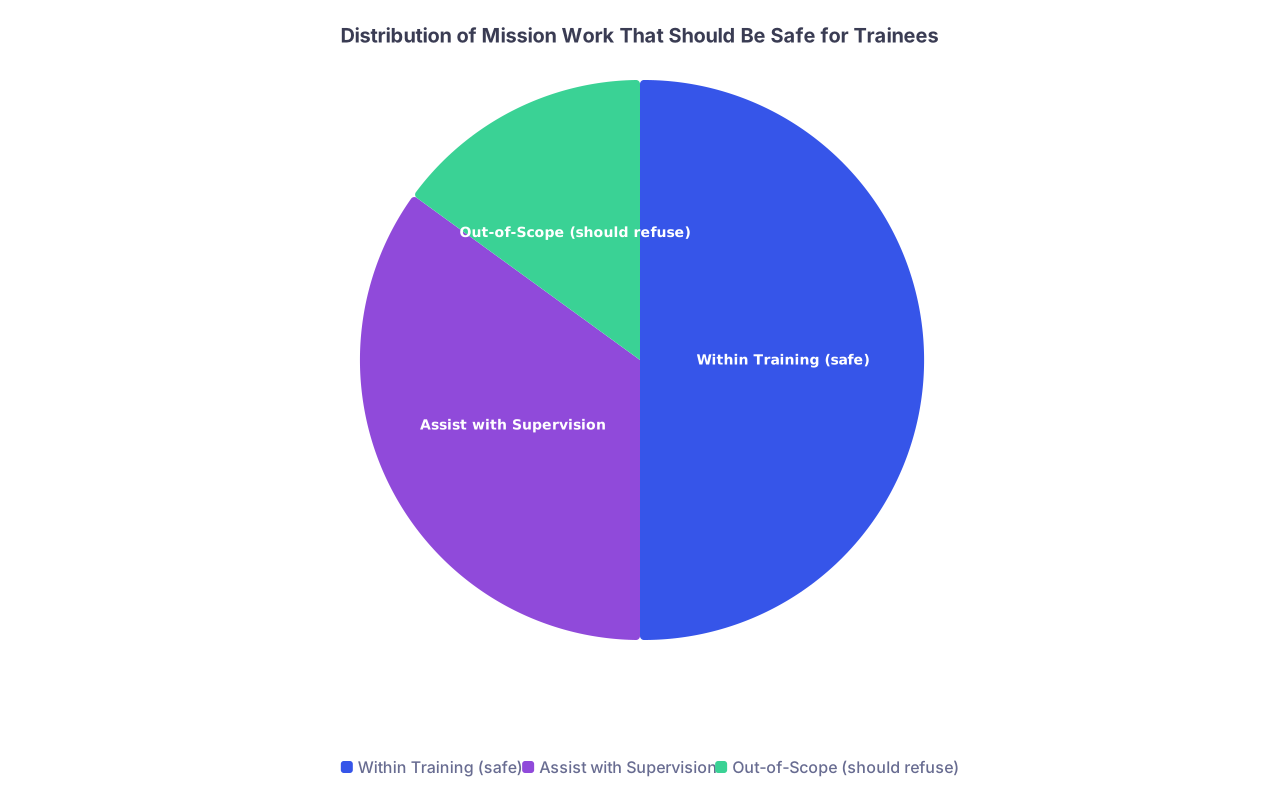
| Category | Value |
|---|---|
| Within Training (safe) | 50 |
| Assist with Supervision | 35 |
| Out-of-Scope (should refuse) | 15 |
If you’re doing only high-adrenaline procedures you’d never be allowed to do at home, you’re not on a service trip; you’re in an unsupervised skills lab using real human beings. That’s grotesque.
Ethical missions:
- Expand local capacity, not your CV.
- Match your tasks to your actual training.
- Accept “no” as a legitimate, ethical answer.
If you’re the only one in the whole operation talking like that, that’s a sign you picked the wrong operation.
How to Talk About This With Mentors Without Sounding “Difficult”
I know the other anxiety lurking under all of this:
“If I say no or push back, will I look like I lack grit? Will they quietly blacklist me from future opportunities? Will this hurt my residency/fellowship applications?”
Here’s how you frame it so that anyone with a functioning conscience respects you more, not less:
Lead with patient safety.
“I’m concerned that I’ll be pressured to do procedures beyond my level of training, and I don’t want to compromise patient safety.”Be specific.
“Last year they had an MS3 doing spinals. I’ve never done one, and I wouldn’t be allowed to at my home institution.”Ask for guidance, not permission.
“If I’m asked to do X, what do you think is an ethical line? Where would you draw it?”
Most serious mentors will be relieved you’re thinking this way. The ones who scoff and say “That’s just how global health works” are telling you a lot about themselves—and honestly, maybe you don’t want to follow their playbook.
Your Anxiety Isn’t the Enemy Here
You probably feel like your anxiety is the problem—that if you were just more confident, you’d march in there and “help.”
But the fear you’re feeling is actually aligned with reality. You’re scared because:
- You understand your limits.
- You understand the stakes for patients.
- You care about doing this right, not just doing it.
That’s not weakness. That’s exactly the kind of person I’d trust with patients—especially vulnerable ones in under-resourced settings with no second chances.
So no, you’re not being dramatic.
Yes, it is okay to say: “This is beyond my training. I can’t safely do this.”
And if that sentence makes your heart race just reading it?
Good. Write it down. Practice it. Out loud. A few times. It needs to be muscle memory before you step on that plane.

| Step | Description |
|---|---|
| Step 1 | Asked to do procedure |
| Step 2 | Say no, offer to assist |
| Step 3 | Proceed with supervision |
| Step 4 | Assess risk and context, document decision |
| Step 5 | Have I done this independently at home? |
| Step 6 | Is supervision available? |
| Step 7 | Would my home attending approve me doing this solo? |
A Quick Reality Check: What You Can Do Today
Before you commit to that trip, or before you go back next year:
- Pull up the organization’s website and emails and write down every procedure they’ve hinted you might “get to do.”
- Next to each one, mark:
- “I already do this routinely at home,”
- “I’ve assisted but never done it solo,” or
- “I’ve never done this.”
- For everything in the last two columns, decide your non-negotiable line now: Will you assist only? Will you outright refuse?
Then email the trip coordinator with one specific question:
“Can you clarify what procedures trainees are expected or allowed to perform independently, and what supervision will be available?”
See how they answer. Their response will tell you more than any mission statement.
FAQ: Exactly 6 Questions
1. If I refuse to do something and the patient has a bad outcome, will I be responsible?
Emotionally, you’ll probably try to take responsibility. You’ll replay it in your head and wonder if you could’ve saved them. But ethically and practically, you’re not responsible for fixing an under-resourced system with skills you don’t have. You’re responsible for acting within your actual competence and not making things worse. Refusing to do something you’re not trained to do is not abandonment; it’s refusing to fake expertise on a real person.
2. Should I even go on medical missions as a student or resident if this is the reality?
You don’t have to swear off global health to be ethical. But you do need to be picky. Go with programs that are tied to academic institutions or long-term partnerships, where your role is clearly scoped and supervised. If the selling point of the trip is “tons of procedures you’d never be allowed to do at home,” that’s not a learning opportunity—it’s a danger sign.
3. What if my attending or program director is the one pushing me to “step up” abroad?
This is where it gets messy. You can respect them and still decide they’re wrong about this. You don’t have to argue philosophy; you can keep it simple: “I’m not comfortable doing things abroad that I wouldn’t be credentialed to do here without supervision.” If they push harder, that actually tells you something about their ethics. Document your concerns in an email if you’re really worried. Self-protection is not paranoia.
4. Do I need extra malpractice insurance for these trips?
Often, yes—or at least you need clarity on what coverage you actually have. Some mission organizations carry group coverage. Some don’t. Some countries have different legal frameworks. You can contact your malpractice provider or institutional risk management and ask directly: “If I participate as a volunteer abroad, performing only tasks within my training level, am I covered?” If no one can give you a clear written answer, that should make you pause.
5. How do I explain on applications that I refused to do certain procedures?
You don’t have to confess every ethical fork in the road. But if you choose to talk about it, it can actually be a strength. You can frame it like: “On a trip to X, I was asked to perform procedures beyond my training. I declined and instead focused on tasks within my competence and on teaching local staff skills I was qualified to share. That experience solidified my commitment to ethical global health.” That doesn’t make you look weak. It makes you look like someone who thinks.
6. What if I’ve already done something I wasn’t really trained for and I feel sick about it?
You’re not the first. And you’re not doomed. You can still choose to be different going forward. Talk to someone you trust—mentor, counselor, maybe a global health faculty member—about what happened. Don’t bury it. Learn from it, let it shape your boundaries, and if needed, debrief the moral injury piece. You can’t undo the past case. You can decide that next time, you’re going to listen to that sick feeling sooner and say, “No. I can assist, but I can’t safely lead this.”
Open a blank note on your phone right now and type this sentence:
“This is beyond my training. I can’t safely do this, but I can assist.”
That’s your line. Practice it until it doesn’t choke you anymore—because someday, saying those exact words might be the most ethical, courageous thing you do on a mission.


