
This article is for educational purposes only. It is not financial advice, not legal advice, and not tax advice. Figures vary by individual circumstances, so consult a qualified professional before acting.
The Secret You Were Never Told: You Don't Need a Lab to Publish
It's 7:40 a.m. on inpatient wards. Your attending finishes the list, turns to the group almost casually, and asks: "So, what research is everyone working on?" Your stomach drops. You say something about being "really interested in cardiometabolic disease," which is a sentence that means absolutely nothing, and she nods and moves on. Let me tell you what really happens next. The student two spots to your left says, "I'm finishing a first-author analysis using NHANES data," and the entire energy of the hallway shifts. The attending asks follow-up questions. The senior resident makes a mental note. That student just separated from the pack, and here's the part nobody mentioned: she never touched a pipette in her life.
I've sat in residency ranking meetings. I've watched program directors scroll ERAS applications at eleven at night, twenty seconds per file. Nobody reads the saga of your six months washing beakers for a postdoc who forgot your name. They scan for three things: first author, indexed journal, and a one-sentence summary they can repeat in the meeting. That's it. And a secondary analysis of a public database checks every one of those boxes exactly as well as bench work does. I know faculty who built their entire early careers this way, quietly, while telling their own students to "go find a lab."
The goldmine is sitting in the open. NHANES, BRFSS, CDC WONDER, SEER, MIMIC-IV, the NIS, national datasets, already de-identified, most of them free, downloadable tonight. And because the data are public and de-identified, most institutions classify this work as non-human-subjects research, which means a determination letter in days rather than the months-long IRB odyssey your classmates assume is mandatory. The barrier was never access. The barrier is that nobody hands you the map.
Consider this the map. By the end, you'll know which dataset to start with, how to carve a publishable question out of it in under an hour, who to recruit (it's not who you think), and how to get the paper across the finish line without embarrassing yourself. No mentor. No budget. No excuses.
The Dataset Goldmine: What to Use and What to Avoid
Here's the starter roster I give every student who finds my office. NHANES is the workhorse, roughly 10,000 Americans per cycle with lab values, imaging, diet recalls, and questionnaires on everything from sleep to depression. BRFSS is 400,000+ phone interviews of behavioral risk data, beautifully simple. CDC WONDER gives you national mortality data with a point-and-click interface. SEER is your cancer registry. The NIS covers millions of hospital discharges, and MIMIC-IV holds granular ICU data from tens of thousands of critical care stays.
Start with NHANES. Full stop. It's the most forgiving first dataset in existence, the codebook reads like a menu, every variable is documented down to the phlebotomy protocol, and thousands of published papers exist for you to reverse-engineer the methods section. Whatever you want to study, someone's done a cousin of it in NHANES, and their paper is your template.
Now the two traps. First, people call the NIS "free." It isn't. It costs a few hundred dollars, requires a signed data-use agreement, and the weighted, clustered analysis will drown a beginner. Second, and I say this with love, MIMIC-IV is a siren song. Yes, it's real ICU data. Yes, it's exciting. It also demands credentialing steps, a human-subjects training module, SQL joins across a dozen tables, and genuine clinical literacy about critical care. If you don't know what a vasopressor does, your analysis will be elegant nonsense, and it will eat your entire semester.
My rule of thumb: if a dataset requires more than one training module before you can export a single spreadsheet, save it for your second paper.
<chart-data-api config='{"type":"hbar","title":"Public Datasets: Friendliness vs. Complexity (Mentor's 1–10 Scale)","labels":["NHANES","BRFSS","CDC WONDER","SEER","NIS (HCUP)","MIMIC-IV"],"datasets":[{"label":"Beginner Friendliness","values":[9,8,8,6,4,2]},{"label":"Data Complexity","values":[3,2,2,5,7,9]}],"yAxisLabel":"Score out of 10"}'>
The 45-Minute Formula: How to Pick a Question That Writes Itself
The biggest mistake I watch students make is starting with a noble topic. "I want to study disparities in diabetes." Wonderful. Completely unworkable. You'll spend four months wandering. Here's the real secret: don't start with a topic at all. Start with the variable list. Open the codebook, scroll, and build the question from parts: one exposure, plus one outcome, plus standard demographics, equals a testable hypothesis. "In adults from NHANES 2017-2020, is self-reported sleep duration associated with HbA1c after adjusting for age, sex, and BMI?" That sentence is a paper. Everything else is execution.
Forty-five minutes, total. Fifteen to pick your variables from the codebook. Ten on PubMed confirming nobody has run your exact question in your exact population. Twenty running a quick crosstab or unadjusted regression before you write a single word. If the signal is there, lock the hypothesis and start drafting. If it isn't, pivot to another variable, the loop costs you an evening, not a semester. This is precisely how faculty do it. They just don't advertise that the "hypothesis" was born on a Tuesday night with a spreadsheet.
One technical non-negotiable: NHANES is a complex survey, so use the sample weights, the WTMEC2YR variable and the survey commands in R or your software of choice. Reviewers check for this, and it's about three lines of code. Skip it and you'll get desk-rejected by anyone competent.
And calibrate your ambitions. Reviewers don't need a Nobel idea. They need clean methodology, the STROBE checklist followed, and a clinically meaningful "why." Boring and rigorous beats brilliant and sloppy every single time.
Build Your Ghost Team: Publishing Without a Formal Mentor
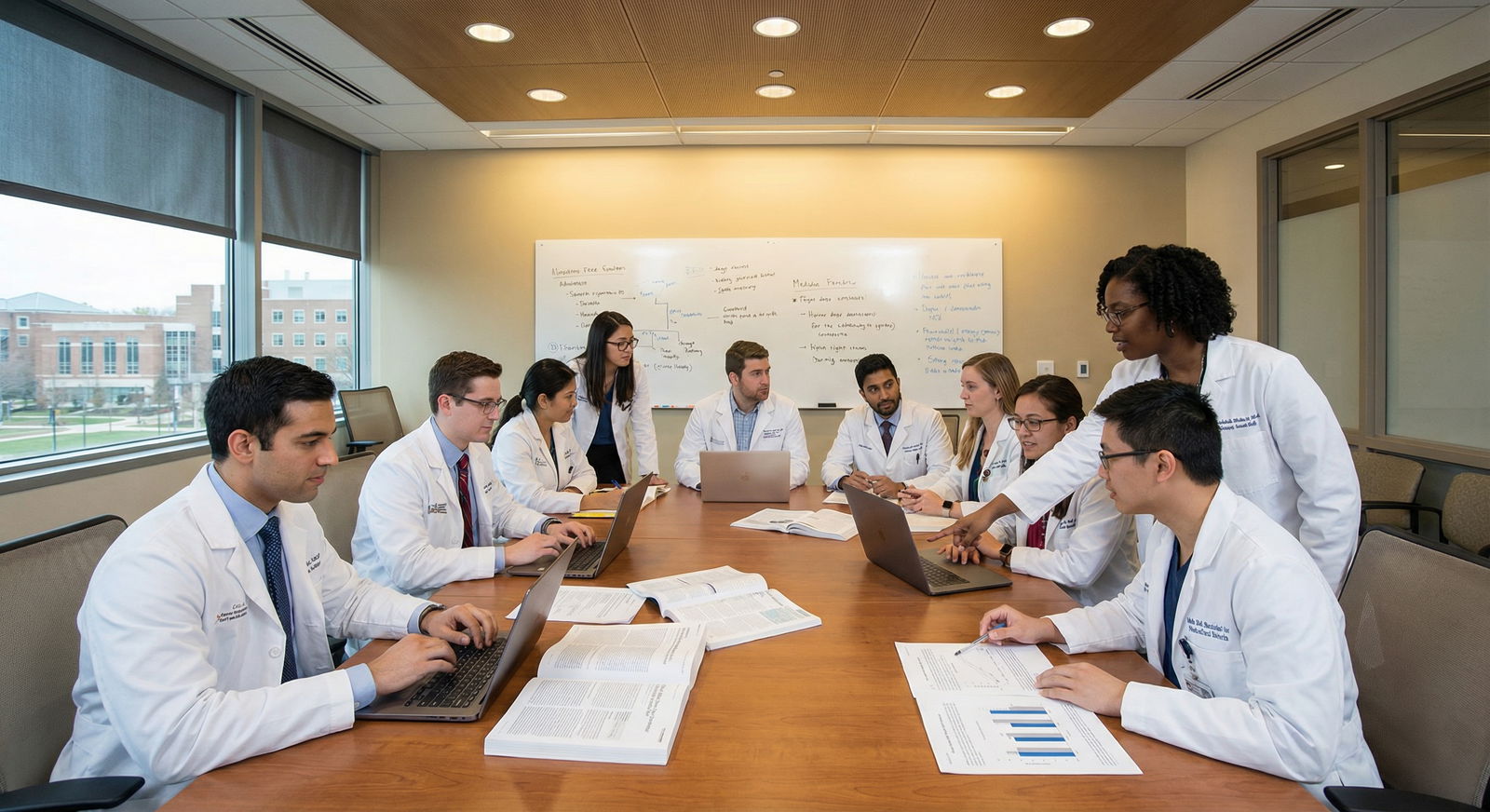
Insider truth: database research runs on three roles, librarian, statistician, and clinical interpreter. Nobody does all three alone, and nobody expects you to. Your job is project manager. Assemble the ghosts.
Start with the librarians, the most criminally undervalued people on any medical campus. They hold advanced degrees, they'll design your search strategy, fix your citations, and untangle your reference manager, and most are genuinely thrilled to be asked. An acknowledgment costs you nothing; occasionally their contribution earns middle authorship, which strengthens the paper anyway. For the statistics, don't email someone asking them to "teach you stats", that request dies on arrival. Instead, ask a biostatistics core or a stats graduate student one specific question: "I'm running a survey-weighted logistic regression on NHANES and my standard errors look wrong." Specific questions get answered within the day.
Now the attending move, and pay attention, because this is where students blow it. Do not send the "do you have any research opportunities?" email. That message is a burden, and it dies in the inbox. Instead, show up with a finished Table 1 and ask: "Could you take fifteen minutes and tell me whether this is clinically plausible?" I've never watched a physician say no to that. You've converted their role from unpaid supervisor to fifteen-minute consultant, and now their name is adjacent to your paper and their brain is available for the discussion section.
Last, the code. Borrow analysis skeletons from public repositories, everyone does, but understand every single line you run. On the interview trail, someone will ask how you handled the weighting, and "my code did it" is not an answer. Master the pipeline and you become the mentor you were waiting for.
The Backdoor Route to Publication: Submit, Survive, and Protect Your Future
Targeting matters more than writing. Aim for a modest, indexed, peer-reviewed journal, and verify "indexed" means findable in PubMed or MEDLINE, not whatever the journal's homepage claims. Glamour journals will burn six months of your life on a desk rejection because you're an unknown name with database research. That's not cynicism; that's just how the triage works. The insider move is to submit a conference abstract first, regional ACP or SGIM meetings take student work gladly, or post a preprint. You get an immediate line on your CV and low-stakes reviewer comments that make the eventual manuscript stronger.

When reviews come back, do not spiral. "Major revisions" sounds like a verdict. It usually means "clarify these three tables and add a limitations paragraph." It's mechanical, not personal. Respond to every comment politely and point by point, even the dumb ones, especially the dumb ones, and resubmit quickly. A desk rejection means you send it to the next journal within two weeks, not that you reconsider your life choices.
Now protect your name, because you only get one. Honor every dataset's data-use agreement. Disclose any AI assistance according to the journal's policy, editors are checking now, and an undisclosed shortcut is a retraction waiting to happen. And never, under any circumstances, answer the "Dear Esteemed Researcher" emails promising publication in five days for $1,800. A predatory journal line is worse than an empty CV. Program directors check indexing, and a fake journal reads as a character problem, not a productivity one.
So here it is, the whole secret: no lab, no mentor, no excuses. Tonight you can download NHANES, pick two variables, and set yourself a two-week deadline to have tables worth showing someone. The students who match aren't smarter than you. They just started before they felt ready.
Key Takeaways
- Public dataset research is the most accessible route to a first-author paper, and program directors read it as proof of autonomy and follow-through.
- Match your question to existing variables, the 45-minute formula prevents months of dead-end work.
- Build a ghost team from librarians, statisticians, and approachable clinicians. No formal PI required.
- Protect your credibility: honor data-use agreements, skip predatory journals, and understand every step you publish.