
Why Research During Residency Matters for Non‑US Citizen IMGs in EM‑IM
For a non-US citizen IMG in an Emergency Medicine–Internal Medicine (EM IM combined) residency, research is far more than a “nice to have.” It can:
- Strengthen your academic profile in a competitive job or fellowship market
- Open doors to visas and institutional sponsorships
- Facilitate a transition to an academic residency track or faculty role
- Anchor your professional identity in U.S. medicine, especially if your clinical experience at home is hard to fully translate
Because EM-IM combined training spans both emergency medicine and internal medicine, you are uniquely positioned to ask cross-cutting research questions: sepsis pathways from ED to ICU, transitions of care, chest pain protocols, hospital throughput, or outcomes for complex multi-morbid patients entering through the ED.
This article is designed specifically for the foreign national medical graduate in EM-IM who wants to leverage research during residency to build a sustainable, visa-secure, academically oriented career in the U.S.
Understanding the Research Landscape in EM‑IM Residency
Types of Research You’ll Encounter
As an EM-IM resident, you’ll see a wide spectrum of resident research projects, often falling into these categories:
Clinical research
- Chart reviews (retrospective cohort studies)
- Prospective observational studies
- Randomized controlled trials (less common for residents to lead, but you can be part of the team)
EM-oriented examples:
- Outcomes of high-sensitivity troponin protocols in chest pain patients
- Door-to-antibiotic times for sepsis and mortality in the ED
IM-oriented examples:
- 30-day readmission predictors for heart failure admitted via the ED
- Inpatient management strategies for diabetic ketoacidosis initiated from the ED
Quality improvement (QI) and patient safety
- Protocol implementation and evaluation
- Process changes in ED–hospital handoffs
- Reducing diagnostic delays or medication errors
QI is especially accessible to residents because:
- Timelines are shorter
- Data is often simpler to access
- IRB requirements can be lighter (though not always exempt)
Education research
- Simulation-based training for EM-IM residents
- Impact of bedside ultrasound teaching on diagnostic accuracy
- Use of structured feedback tools for cross-specialty rotations
Health systems, operations, and population health
- ED crowding and boarding impact on inpatient outcomes
- Social determinants of health in frequent ED utilizers
- Transitions of care from ED to hospitalist services or ICU
As an EM-IM resident, you can also collaborate on combined emergency medicine internal medicine projects, such as:
- Evaluating integrated sepsis pathways from ED triage through inpatient management
- Comparing outcomes of chest pain patients managed by ED vs IM observation units
- Rapid diagnostic and treatment protocols that span both departments
Where Research Fits into Your EM‑IM Schedule
The combined EM IM training pathway is intense, but there are predictable windows where research can fit:
Intern year (PGY-1):
- Learn the system, meet faculty, observe problems worth studying.
- Start with small tasks: literature reviews, data collection for a senior’s project.
- Identify your research interests and potential mentors.
Middle years (PGY-2–3):
- Ideal period to initiate your own project.
- Your clinical skills are strong enough that you can balance research with service.
- Many programs provide elective or research blocks.
Senior years (PGY-4–5 for EM-IM):
- Time to finish projects, write manuscripts, and present at conferences.
- Position yourself for fellowships, chief residency, or an academic track.
As a non-US citizen IMG, plan earlier and more deliberately than your US graduate peers, because you may depend on research productivity to stand out and support long-term visa or sponsorship options.
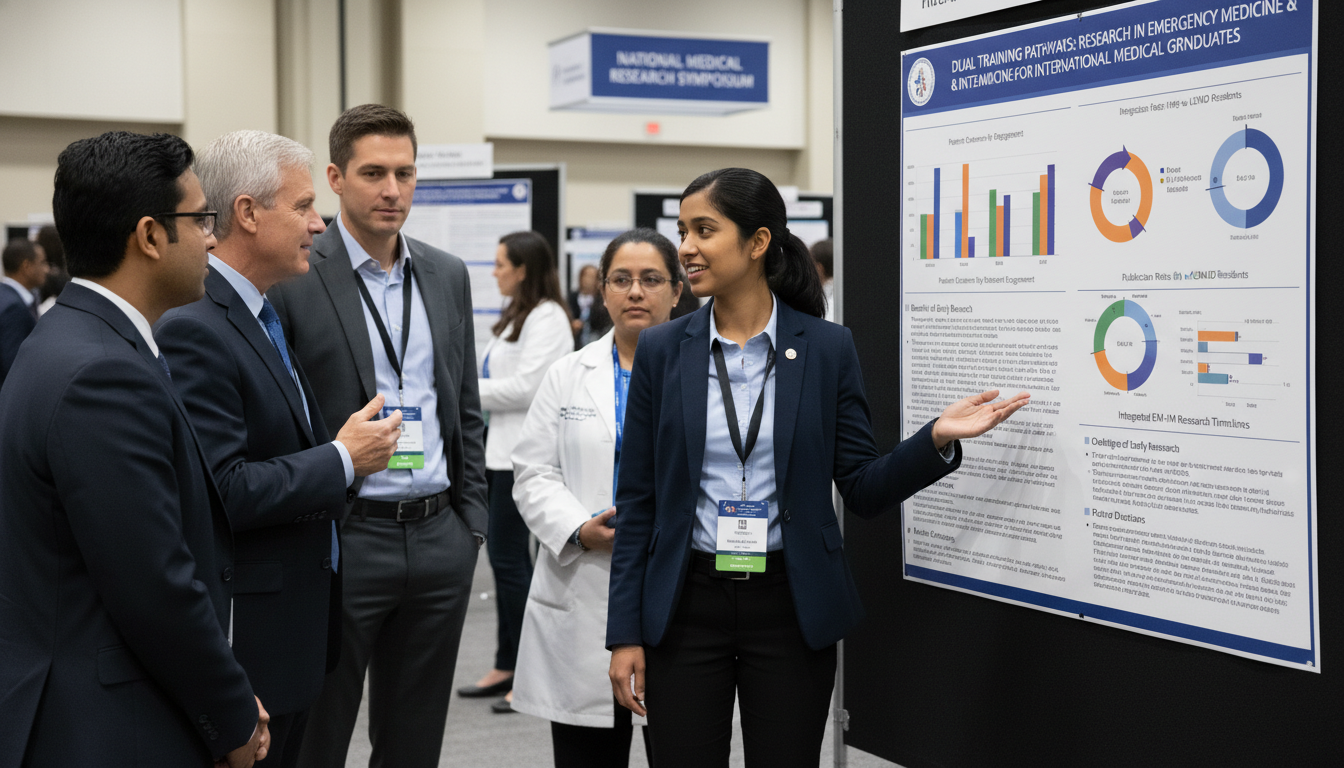
Strategic Advantages of Research for Non‑US Citizen IMGs
1. Enhancing Your Visa and Career Stability
Your immigration and visa context shapes your career strategy:
J‑1 visa holders
- Research alone won’t waive your home-country requirement, but a strong research profile can:
- Help you secure competitive fellowships (critical care, cardiology, nephrology, ED ultrasound, etc.)
- Increase chances of matching at institutions familiar with J-1 waivers or Conrad 30 programs
- Academic-track roles that involve research can be more open to J-1 waiver sponsorship.
- Research alone won’t waive your home-country requirement, but a strong research profile can:
H‑1B visa holders
- Strong research portfolios can justify institutional investment in continued H‑1B sponsorship or later green card petitions.
- Hospitals and universities with large research infrastructures often have established immigration support.
Long-term goal: permanent residency or academic appointment
- Publications, conference presentations, and participation in funded projects can support:
- EB-1 or EB-2 NIW petitions (with attorney guidance)
- Recruitment to research-heavy positions that value your scholarly output
- Publications, conference presentations, and participation in funded projects can support:
In short, for a non-US citizen IMG, research can directly contribute to your long-term stability in the U.S. healthcare system.
2. Standing Out in a Crowded Market
Emergency medicine internal medicine combined graduates are already somewhat niche. If you additionally show:
- A coherent research theme
- Ongoing productivity (multiple projects, not just a single mandatory QI)
- Ability to work across departments (EM, IM, ICU, hospitalist, ED administration)
You become more competitive for:
- Academic EM, IM, or EM-IM hybrid positions
- Leadership tracks (e.g., ED operations, hospital quality)
- Fellowship programs in critical care, cardiology, pulmonary, nephrology, or ED-based subspecialties
3. Pathway to an Academic Residency Track
Many programs have an academic residency track (sometimes called research track, clinician-educator track, or scholar track). Features may include:
- Protected research time (a few months total, or half-days a week)
- Formal mentoring and research curriculum
- Support from statisticians and methodologists
- Priority for internal funding or conference travel grants
As a foreign national medical graduate, joining an academic residency track can help:
- Embed you in the institution’s scholarly community
- Generate mentorship and letters from well-known U.S. faculty
- Increase your visibility to department leadership who often influence future hiring and visa sponsorship decisions
How to Start: Finding Your Niche and Mentors
Step 1: Clarify Your Interests at EM‑IM Interfaces
Think about clinical problems where EM and IM meet:
Time-sensitive conditions
- Sepsis, strokes, myocardial infarction, pulmonary embolism
- Research focus: Pathway adherence, time-to-treatment, and outcomes
Chronic disease in acute settings
- COPD, CHF, ESRD, uncontrolled diabetes
- Research focus: ED-based interventions that alter long-term outcomes or readmissions
Organizational and systems issues
- ED boarding and its impact on inpatient mortality
- Communication breakdowns at ED-to-ward handoffs
- Early ICU triage versus rapid response systems
Your research niche doesn’t need to be perfect, but it should be:
- Feasible (data accessible, time realistic)
- Relevant to EM and IM practice
- Personally meaningful enough to sustain your motivation
Step 2: Identify the Right Mentors
Look for two types of mentors, ideally from both specialties:
Content mentor (clinical expert)
- EM attending with interest in ED operations, sepsis, ultrasound, etc.
- IM attending with interest in hospital medicine, chronic disease, critical care, or QI.
Methodology mentor
- Someone familiar with biostatistics, study design, and IRB processes
- May be a research scientist, PhD, or MD with extensive research experience.
For a non-US citizen IMG, mentors who have prior experience working with international graduates are especially valuable. When you meet potential mentors:
- Be direct about your status: “I am a non-US citizen IMG on a J‑1/H‑1B visa with academic career goals.”
- Outline your goals succinctly: research output, potential academic track, fellowship, and long-term U.S. career.
Step 3: Start Small but Visible
Instead of waiting to design the perfect large project:
Join an ongoing project where you can:
- Assist in data collection or chart abstraction
- Help with literature reviews and reference management
- Draft sections of a manuscript (methods, introduction, discussion)
Request increasingly substantive roles:
- Present part of the data at research-in-progress meetings
- Lead a sub-analysis or secondary project
- Present a poster at a regional EM or IM conference
This progressive involvement builds:
- Skills
- Trust with mentors
- Early citations and conference lines on your CV

Designing and Completing Strong Resident Research Projects
Choosing the Right Project Scope
As an EM-IM resident, time is your most limited resource. To keep your project realistic:
Prefer retrospective or QI projects that:
- Use data already in the EMR
- Relate to existing institutional priorities (e.g., sepsis bundles, chest pain pathways)
- Can be completed within 12–18 months
Be cautious with:
- Prospective interventional trials requiring large enrollments
- Multicenter projects where your influence is limited
- Projects needing specialized equipment or complex funding unless your mentor has a strong infrastructure in place
A feasible project might be:
Evaluating the impact of an ED-initiated heart failure pathway on 30-day readmissions and ED revisits, comparing outcomes before and after pathway implementation.
This leverages your EM-IM view of both acute and longitudinal care, while being doable with retrospective data.
Understanding IRB and Ethics (Important for IMGs)
In the U.S., research involving patient data requires Institutional Review Board (IRB) oversight. As a foreign national medical graduate, you might be less familiar with these systems, so:
- Attend any offered IRB or research ethics workshops.
- Complete mandatory online training (CITI or equivalent) early.
- Ask your mentor to walk you through:
- Whether your project is research vs QI under your institution’s definitions
- The IRB submission process (forms, protocol template, data protection measures)
Pay special attention to:
- Data security requirements
- Use of identifiable patient information
- Rules about taking data off-site or across borders—this can interact with visa and institutional policies
Data Management and Analysis
To improve your independence (and value) as a research collaborator:
Learn basic data tools:
- Excel or Google Sheets (for simple datasets)
- REDCap (widely used for research databases)
- Introductory stats in R, SPSS, or Stata if available at your institution
Recognize what you can do vs what requires expert help:
- You can often handle straightforward descriptive stats and simple comparisons (e.g., t-test, chi-square).
- More advanced analyses (multivariate regression, time-to-event analyses) are best designed with a statistician.
Pro tip for a non-US citizen IMG:
Demonstrating that you can manage data responsibly and respect privacy rules is highly valued; this may also reduce hesitation from mentors who fear regulatory issues.
Writing and Publishing: Turning Work into CV Value
Many residents complete a project but never publish it. To avoid that outcome:
Outline a manuscript early
- Aim to write with an actual target journal in mind.
- Follow standard structure: Introduction, Methods, Results, Discussion.
Set deadlines with your mentor
- Draft by date X
- Revisions by date Y
- Journal submission by date Z
Aim for tiered dissemination:
- Local presentation at your department’s research day
- Regional/national conference (SAEM, ACEP, SHM, ACCP, SCCM, etc.)
- Peer-reviewed journal with reasonable turnaround time
This step matters greatly for non-US citizen IMGs; published work is far more visible to future employers, fellowship directors, and immigration evaluators than “unpublished project” lines on a CV.
Balancing Clinical Duties, Research, and Immigration Realities
Practical Time-Management Strategies
EM-IM schedules can be brutal. To integrate research without burnout:
Use low-intensity blocks (e.g., some IM rotations, elective months) for:
- Data collection and analysis
- Writing and revising manuscripts
Build research into your weekly routine:
- Two 1–2-hour focused blocks per week
- Turn downtime (canceled clinic, low ED volume slow hours) into small writing sprints if allowed by your program and not interfering with patient care.
Protect your energy:
- Avoid starting new projects during your heaviest EM stretches (e.g., night float, trauma month)
- Be honest with mentors about your rotation schedule
Communicating Your Constraints as a Non‑US Citizen IMG
It’s essential to be transparent with mentors and program leadership:
- Explain your visa expiration timeline and likely post-residency pathways (fellowship vs job).
- Link research timelines to critical decision points:
- “I need a first-author paper submitted by early PGY-4 to strengthen my fellowship applications.”
- “I’m targeting an academic emergency medicine internal medicine job; conference presentations by next year would help.”
Most faculty are unfamiliar with the nuances of immigration law, but they do understand:
- Deadlines for applications
- The value of published work
- The importance of visibility in your final 1–2 years of training
Leveraging Institutional Resources
Ask your program coordinator or GME office about:
- Resident research grants or mini-funding
- Statistical support and research cores
- Travel funding for national conferences
- Internal awards for best resident research project
As a foreign national medical graduate, ensure:
- You understand policies on reimbursement for travel and publications—sometimes they interact with visa or tax rules.
- You ask early about time off for conferences; some programs require months of advance notice.
Frequently Asked Questions (FAQ)
1. I am a non‑US citizen IMG with limited prior research. Is it too late to start during residency?
No. Many residents begin meaningful research during residency, especially in EM-IM programs. If you start in PGY-1 or early PGY-2, you have enough time for:
- One to two substantial projects (retrospective or QI)
- Several conference abstracts or posters
- At least one manuscript submission
Focus on feasibility, strong mentorship, and consistency rather than chasing a single “perfect” project.
2. How many publications do I need for an academic career after EM‑IM?
There is no strict number, but a typical competitive profile might include:
- 2–4 peer-reviewed publications (not necessarily all first-author)
- Multiple abstracts or posters at reputable national conferences
- Evidence of a coherent theme (e.g., sepsis, ED operations, transitions of care) rather than scattered one-off projects
For a non-US citizen IMG, quality and continuity often matter more than quantity, especially when letters of recommendation highlight your role and initiative.
3. Does research during residency help me get fellowships after EM‑IM?
Yes, particularly for competitive fellowships (critical care, cardiology, pulmonary, nephrology, ultrasound, medical education, etc.). Fellowship committees value:
- Demonstrated scholarly productivity
- Ability to complete projects
- Experience working with mentors and research teams
Your EM-IM background is particularly attractive for fellowships involving ICU, acute care cardiology, or hospital systems—research at these interfaces is a strong signal.
4. Should I prioritize emergency medicine or internal medicine research as an EM‑IM resident?
Ideally, choose projects that live at the intersection of both:
- ED-based interventions affecting inpatient outcomes
- Transitions of care projects (ED to ward, ED to ICU)
- Pathway adherence and outcomes from arrival to discharge
If you must prioritize one side due to mentor availability or departmental culture, it’s acceptable—but keep a dual identity in mind and highlight the relevance of your work to both specialties in your CV and personal statements.
Research during residency can be an extraordinary lever for a non-US citizen IMG in an EM-IM combined program. Done strategically—with realistic project scope, strong mentorship, and alignment to your visa and career goals—it transforms you from “just another excellent clinician” into a visible, recruitable, and academically grounded physician whose skills are highly valued in both emergency medicine and internal medicine.