The way most premeds choose research is brutal and unsustainable if you have chronic illness and fatigue.
Everyone else is told: “Do as much as you can. Say yes. Grind now, rest later.”
If you have lupus, POTS, long COVID, IBD, fibromyalgia, severe migraines, or any other chronic condition that steals energy unpredictably, that advice is a shortcut to flare-ups, missed deadlines, and feeling like you’re “not cut out for medicine.”
(See also: Commuter Student With No Nearby Hospital: How to Find Research for strategies on finding research opportunities.)
You are not the problem. The model is.
This is the playbook for choosing research roles that work with your body instead of against it—while still making you competitive for medical school or future training.
Step 1: Get Very Clear on Your Real Capacity (Not Your Aspirational One)
You cannot pick sustainable research until you’re brutally honest about what your body can handle on a bad week, not your best week.
Do a two-week energy audit
For 14 days, track three simple things:
- Hours of “clear-headed” time per day (where you could read, think, and write)
- Symptom spikes (pain, fatigue, brain fog, GI symptoms, POTS symptoms, etc.)
- Major fixed commitments (classes, work, caregiving, appointments)
Be specific:
- “Tuesday: 8–10 am, felt sharp. 2–4 pm, brain fog. 6–9 pm, pain 7/10.”
- “Thursday: post-IV treatment, basically wiped out all day.”
After two weeks, look for patterns:
- What time of day are you most functional?
- How many reliable hours per week do you actually have for extra work?
- Do you crash after intense days? After social events? After labs?
You are not trying to prove you can “handle it.” You’re mapping your terrain so you stop stepping into landmines.
Decide your non-negotiables
You must protect:
- Sleep
- Medical appointments and treatments
- Baseline self-care (food, movement if able, mental health)
- Core academic responsibilities
Then ask: “What’s my firm, not fantasy, capacity for research most weeks?”
For many students with chronic illness, that number is 4–8 hours/week. Some can handle 10–15. Fewer can maintain 20 consistently.
Whatever your number is, that’s your guardrail. Your research role has to fit inside it.
Step 2: Understand Which Types of Research Are Chronic-Illness-Friendly
Not all research is created equal. Some structures are inherently hazardous for people with unpredictable health.
Let’s break this down.
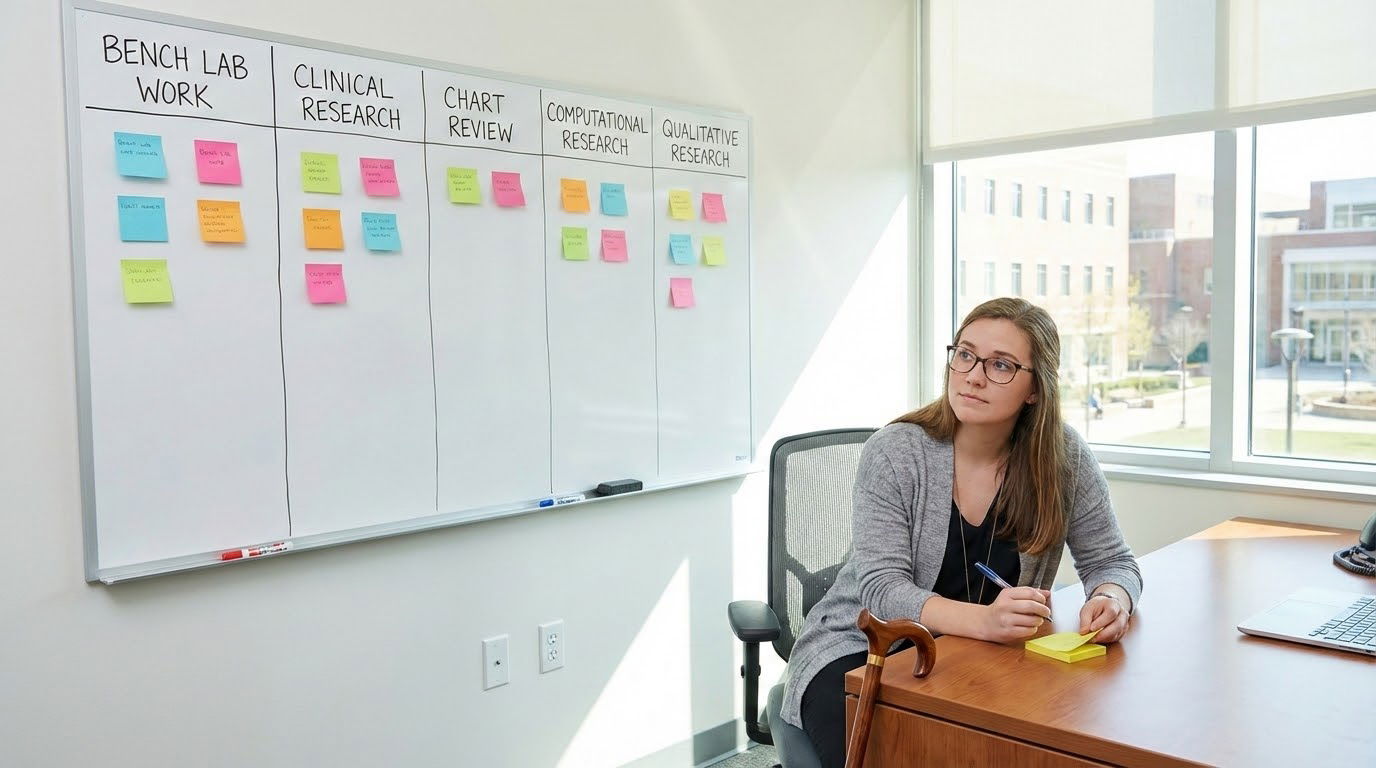
High-risk structures if you have fatigue and flares
These can still work in certain situations, but you need to know what you’re walking into:
Wet lab/bench research with time-sensitive experiments
- Cell culture, animal work, timed assays, anything that:
- Requires you to be physically present at fixed times
- Punishes absence (cells die, experiments are ruined)
- Has long stretches where you must stand, pipette, or stay in the lab
- Red flag phrases in lab descriptions:
- “Must commit to 15–20 hours/week”
- “Experiments cannot be missed”
- “Evening and weekend work required at short notice”
- Cell culture, animal work, timed assays, anything that:
In-person patient recruitment with rigid schedules
- Screening in clinics, approaching patients on rounds, OR-based research requiring you to be there at 5:30 am three times a week
- If you have orthostatic issues, severe fatigue, pain, or GI unpredictability, this can be physically punishing.
Projects dependent on you for time-critical steps
- “You’re the only person who knows how to do X”
- Tight deadlines where delays harm the whole group
- Roles where your absence causes data loss, missed enrollments, or wasted samples
These are possible for some students with chronic illness, but they require rock-solid baseline function, accommodations, or a very understanding PI. If your symptoms flare unpredictably, you want structures that flex with you.
Chronic-illness-friendly research structures
These are the kinds of roles you want to actively seek out:
Retrospective chart review projects
- You access the EMR remotely or onsite.
- Work is:
- Asynchronous
- Modular (you can do 10 charts today, 0 tomorrow, 20 on the weekend)
- Most of the work: data abstraction, data cleaning, maybe some basic stats.
Literature reviews, scoping reviews, systematic reviews
- Reading and summarizing papers.
- Can be done:
- From home
- In shorter bursts
- Great if brain fog fluctuates—you can build in rereads and slower processing.
Data analysis / biostatistics / computational projects
- If you’re comfortable with R, Python, SPSS, Stata, or even Excel-level work:
- Code and analysis can be done at 2 pm or 2 am.
- You can commit to deliverables (“I’ll have this script ready by next Friday”) instead of fixed presence.
- If you’re comfortable with R, Python, SPSS, Stata, or even Excel-level work:
Qualitative research
- Transcribing interviews, coding transcripts, theming responses.
- Flexible pace, often remote.
- If fatigue is severe, you might do 30–60 minutes at a time and still move the project forward.
Medical education or curriculum projects
- Creating cases, educational modules, question banks, or teaching materials.
- Often highly flexible, computer-based, and asynchronous.
Roles with clear fallback coverage
- Even if there are time-sensitive elements (like data collection):
- Someone else can step in if you’re flaring.
- The system isn’t built around “if you’re out, the whole thing collapses.”
- Even if there are time-sensitive elements (like data collection):
When you evaluate any research opportunity, you’re not just asking “Is this interesting?”
You’re asking “Can this structure survive my bad days?”
Step 3: Questions to Ask PIs Before You Commit
You do not have to disclose your diagnosis to everyone. But you do have to test whether a PI’s expectations match your reality.
Here are questions that surface the truth without you having to overshare.
About time and flexibility
- “How many hours per week do students typically spend on this project?”
- “Is the work mostly on a fixed schedule or can it be done more flexibly?”
- “Are there specific times I’d be required to be in the lab/clinic/office?”
- “If I had an unexpectedly busy week with exams or personal obligations, would it be possible to shift some tasks around?”
Listen for:
- Rigid: “We really need you here every weekday afternoon.”
- Reasonable: “Most of the work can be done on your own time; we just have a weekly meeting.”
About backup coverage and responsibility
- “For tasks like screening or enrolling patients, is there a team that shares this or would I be the only one doing it?”
- “If someone needs to be out unexpectedly, how is that handled for student team members?”
- “Are students usually interchangeable on tasks, or does each person have a unique role?”
You want a team model where your absence is an inconvenience, not a disaster.
About outcome expectations
- “For students who contribute consistently, what kinds of outcomes have they typically had? (Posters, abstracts, manuscripts?)”
- “Over what timeline do students usually reach a tangible product like a poster or paper?”
You’re looking for a PI who understands that students need outputs, not “years of effort and nothing to show for it.”
Deciding how much to disclose
Scenario-based guidance:
If your illness is mild/moderately stable and mostly affects occasional days:
- You might say very little:
- “I have some ongoing health responsibilities that mean I can’t commit to more than about 6–8 hours/week, but I’m very reliable within that limit.”
- You might say very little:
If your illness causes unpredictable absences (e.g., flares, IV treatments, hospitalizations):
- Consider partial disclosure to test their reaction:
- “I have a chronic health condition that sometimes requires appointments or rest days on short notice. I’ve learned I need roles that are flexible and not entirely dependent on me at specific times. Would this project be compatible with that?”
- Consider partial disclosure to test their reaction:
If you’ll need formal accommodations (remote work, limited standing, etc.):
- It might be worth looping in disability services first, so you know what institutional backing you have.
Red flag responses:
- “We really need someone who can be here constantly.”
- “We’ve had issues with unreliable students before, so we’re pretty strict.”
- “Everyone here puts the project first. That’s just how research is.”
Walk away. That’s not a structure built for you.
Step 4: Matching Your Symptoms to the Right Kind of Work
Let’s get specific. Different chronic illness patterns match better with different research setups.
If your main issue is severe fatigue
Priorities:
- Asynchronous work
- Ability to work in very short blocks
- No long commutes or standing requirements
Best fits:
- Chart review
- Lit reviews
- Data entry/cleaning
- Qualitative coding
- Remote data analysis
How to negotiate:
- “I’m very interested in projects where most work can be done remotely and in flexible 1–2 hour blocks throughout the week. Are there tasks like chart review, literature review, or data cleaning that fit that pattern?”
If you struggle with brain fog or cognitive variability
Priorities:
- Repetitive tasks with clear structure
- Ability to re-check work
- PIs who are patient with slower processing times
Better fits:
- Structured data abstraction forms
- Well-defined literature matrices
- Qualitative coding with consensus meetings
- Projects with checklists and clear protocols
Avoid:
- High-pressure real-time tasks where you must respond quickly in person (e.g., approaching patients on rounds with little prep; OR-based tasks at 5:30 am)
If your illness involves pain or mobility issues
Priorities:
- Minimal standing, walking, or physically demanding tasks
- Ergonomic-friendly work (you can sit, adjust posture, stretch)
- Avoidance of labs with long bench hours
Best fits:
- Desk-based projects: chart review, lit review, data analysis, med ed
In your initial talks:
- You do not have to say “I have X condition,” but you can state:
- “I do best in roles that don’t require prolonged standing or walking between hospital units. Is this project mostly computer-based work?”
If your condition causes frequent appointments or treatment days
Priorities:
- A project where deadlines are weekly/monthly, not daily
- A PI who’s goal-oriented, not micromanaging how/when you work
Best fits:
- Any project where your tasks can be chunked and planned around infusion days, clinic days, etc.
Your pitch:
- “I have ongoing medical responsibilities that occasionally take up full days. I manage this by planning ahead and working in advance, but I need a project where day-to-day presence isn’t critical. Is that doable here?”
Step 5: Structuring Your Role So It Stays Sustainable
Even the right project can become unsustainable if you handle it like a healthy 22-year-old with infinite bandwidth. You need structure.

Time-block around your best hours
From your energy audit, you know when you’re usually sharp.
Example:
- Best hours: 9–11 am, 3–5 pm
- You schedule:
- Monday 9–11 am: lit review
- Wednesday 3–5 pm: data abstraction
- Saturday 10–12 pm: writing
If you crash one day, you still have buffer later in the week.
Use “low-brain” vs “high-brain” task lists
Have two parallel lists for your research work:
- High-brain tasks: complex stats, deep reading, writing, interpreting results
- Low-brain tasks: formatting references, simple data entry, cleaning spreadsheets, renaming files, organizing PDFs
On high-fatigue days, drop the high-brain list and still move the project with low-brain items. This keeps you engaged without overtaxing yourself.
Negotiate clear, realistic deliverables
Instead of vague “work on the project this semester,” agree on specifics:
- “By the end of this month, I’ll finish abstraction for 50 charts.”
- “In the next six weeks, I’ll complete the initial literature search and summarize 20 papers.”
For you, this does 3 things:
- Lets you plan around your flares and appointments.
- Makes your value obvious to the PI.
- Gives you leverage to say, “I’m on track with the deliverables we agreed to” if your hours per week fluctuate.
Step 6: When Things Go Wrong (Because Sometimes They Will)
Even with the best planning, chronic illness is chronic illness.
You might get hospitalized the week before a deadline. You might have three weeks of relentless fatigue. Here’s how to handle the fallout.
Scenario: You’re behind and scared to tell your PI
How to handle it:
- Own it early, not at the last minute.
- Frame it around solutions.
Example email:
Dear Dr. Smith,
I wanted to update you on the chart review project. Over the past two weeks I’ve had some unexpected health issues that significantly limited the time I could spend on research. As a result, I’ve completed abstraction on 25 charts instead of the 40 we’d targeted.
I’m now stable again and can realistically complete the remaining 15 charts over the next two weeks if that timeline still works for the project. If the team needs the data sooner, I’m happy to help transition my abstraction sheet so someone else can pick up where I left off.
Thank you for your understanding,
[Name]
You do not need to give details about your condition. Focus on:
- What happened (unexpected health issues)
- What you’ve completed
- A realistic modified plan
- Your willingness to protect the project if they’re under a tighter deadline than you can meet
Scenario: The PI’s expectations clearly exceed your capacity
Signs:
- They expect you at every meeting, even when they say “they understand.”
- They keep adding tasks without adjusting timelines.
- They frame your limitations as “lack of commitment.”
Your options:
Try to reset expectations once.
- “Based on my current health and academic load, I can reliably contribute about 5–6 hours per week. I want to make sure the tasks I’m assigned fit within that so I can deliver consistently. Could we prioritize 1–2 key responsibilities and let go of the others for now?”
If that fails, exit strategically.
- “Given my current health and academic responsibilities, I’m not able to meet the level of time commitment this project requires. I don’t want to hold the project back, so I think it’s best if I step back from my role after I finish [X handoff] so you’re set up for continuity.”
A bad-fit research role that constantly triggers flares and shame is worse than having less research on your application. Protect yourself.
Step 7: What This Looks Like on an Application
You might worry: “If I choose flexible, smaller roles, won’t med schools think I’m less serious?”
Two important truths:
- Admissions committees care about depth, continuity, and outcomes, not whether you suffered in a lab at 11 pm.
- Chronic illness can be part of your narrative—carefully and strategically.
Building a strong research story with limited capacity
Aim for:
- 1–2 projects where you:
- Stayed involved for 1+ years (even at low weekly hours)
- Earned authorship on a poster, abstract, or paper
- Took ownership of a specific piece (lit review, data analysis, methods section, etc.)
This is more compelling than 5 short-lived lab experiences where you barely did anything.
If you choose to disclose your chronic illness
Possible angles:
- Show that you learned to work within your limits and still deliver.
- Example in a secondary or interview:
- “Because I live with a chronic illness, I’ve had to be deliberate about the commitments I take on. In research, that meant choosing projects where I could contribute consistently over a long period, like [project], where I handled [role] and helped produce [outcome]. Working within constraints taught me to be realistic, reliable, and focused on impact rather than volume.”
You are not apologizing for doing less. You are showing you learned sustainable, adult decision-making under real constraints.
Final Takeaways
- Choose research structures, not just topics: asynchronous, modular, and not fully dependent on your daily presence are your safest bets with chronic illness and fatigue.
- Be honest about your baseline capacity and protect it fiercely—your health is not negotiable background noise.
- Prioritize long-term, realistic commitments that produce tangible outcomes over high-intensity roles that break your body and your schedule.