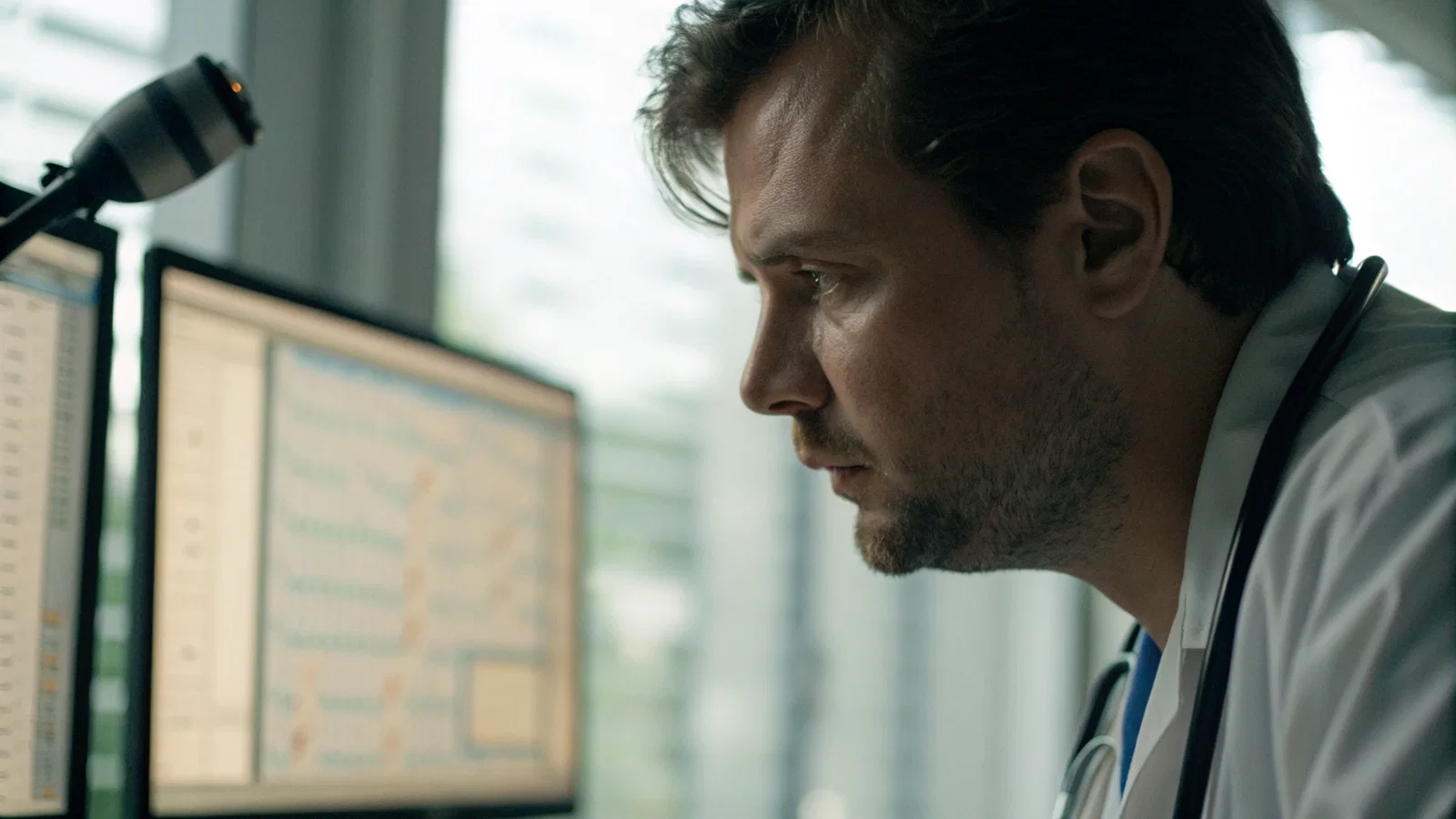
You finally leave the exam room on time. First time all week.
Your AI scribe was running the whole visit. It captured the patient's rambling 20-year history of abdominal pain, cleaned it up into a perfect HPI, built the review of systems. You glance at the note, it looks complete enough. You bill a 99205. High complexity, 80 minutes, extensive history. Done.
Three months later you get a letter. Not a denial. An audit. A fraud alert.
The payer's algorithm flagged your claim because your note says "physical exam unremarkable" and nothing else. You billed a Level 5 new patient visit, but your documented exam wouldn't support a Level 2. Now you have to pay it back, explain yourself, and hope they don't open 20 more charts.
I've seen this exact trap snap shut on new attendings. Don't be next.
This article is for educational purposes only and is not financial advice, not legal advice, and not tax advice. Figures vary, so consult a qualified professional for guidance specific to your situation.
The Silent Trap: When Automation Triggers Compliance Red Flags
Here's the landscape no vendor tells you about. AI scribes are sold on speed. What they actually sell is summarization, and summarization kills compliance.
Payers don't listen to your audio. They don't care what you did in the room. They read what you wrote. And every payer has an automated system that matches your E/M code against what's in the note. When those two don't line up, you get a flag. Not a gentle reminder. A fraud alert.
Let me be blunt: if you stop manually documenting your physical exam, you are creating a legally vulnerable record and risking your license.
The scenario is always the same. You see a complex patient for 99205 or 99215. The medical decision-making is genuinely high. The AI does a decent job on the history, it loves history. But for the exam, it writes: "Cardiopulmonary exam normal. Abdomen soft. No acute distress."
That's not an exam. That's a placeholder. For a Level 5, auditors expect a multi-system examination with specific findings, both positive and pertinent negatives, documented with enough detail to justify the work. When they see a skeletal exam attached to a high-level code, their system assumes one of two things: you upcoded, or you didn't do the work. Both trigger recoupment.
You didn't intend to commit fraud. But your signature on that short note says you did.
The Documentation Gap: Why AI Misses What Auditors Catch
AI scribes are not built for clinical rigor. They're built for natural language fluency. They want to make the note sound nice and smooth. Auditors want it to be specific and bulletproof. Those goals conflict.
The AI listens to you say "lungs are clear, heart regular, belly benign" while you're talking to the patient, and it condenses it. It doesn't quantify. It doesn't list systems. It summarizes.
Three things it routinely destroys:
1. Pertinent negatives. These are gold for proving you thought through a differential. "No CVA tenderness, no rebound, Murphy's negative" tells an auditor you actually ruled out badness. AI deletes this because the patient didn't mention it. To the AI, silence means irrelevant. To an auditor, silence means not done.
2. Specificity. "Normal cardiopulmonary exam" is a compliance death phrase. What did you hear? Where? How? Auditors are trained to reject vague language. They want "Lungs clear to auscultation bilaterally, no wheezes, no rales. Heart: regular rate and rhythm, II/VI systolic murmur unchanged, no additional murmurs, no JVD."
3. Extent of exam. For years, E/M rules hinged on how many systems and bullet points you documented. Even under new MDM-heavy rules, if you use exam and history to support complexity, and especially if you're billing based on time with a comprehensive exam, you need to prove you looked. AI loves to drop entire systems, neuro, skin, psychiatric, because they weren't the chief complaint.
Warning: Do not trust default templates. I've reviewed vendor templates that auto-insert "All remaining systems negative" without you ever examining them. That is copy-forward cloning. That is what the OIG explicitly calls fraud.
The loop is predictable. You enter, AI summarizes, content is vague, payer scans, discrepancy found, flag triggered. You're left holding the bag because the AI vendor isn't liable. You are.
Common Pitfalls in Physical Exam Documentation via AI
If you use an AI scribe, these are the four mistakes I see in nearly every audit case:
Pitfall 1: The Copy-Paste Syndrome on Steroids. Old EMRs had copy-paste. AI has hallucinatory cloning. It will pull "No lower extremity edema, pulses intact" from a note six months ago because it sounds right. I saw a resident's AI note document a full pelvic exam on a 68-year-old male because the template thought it was comprehensive. The patient had never had that exam that day. That's not just sloppy. It's indefensible in court.
Pitfall 2: Missing Head-to-Toe Completeness. For a comprehensive new patient, you need evidence of a thorough exam. AI tends to drop what it deems unrelated. Your chief complaint is headache, so AI documents neuro and skips abdomen, skin, lymph nodes. Then you bill a 99205 that requires a higher level of documented evaluation. Denied.
Pitfall 3: Ambiguous Qualifiers. AI loves words like "unremarkable," "stable," "normal." Those words mean nothing without an organ system attached. "Unremarkable" compared to what? "Stable" since when? Auditors trash this language.
Look at the difference:
Bad (AI default): "PE: Normal. No acute distress. Cardiopulmonary normal."
Good (audit-proof): "PE: VS stable. Gen: NAD, alert. HEENT: PERRL, conjunctiva clear, oropharynx without erythema. Neck: Supple, no LAD. CV: RRR, no m/r/g, no JVD, 2+ DP pulses bilat. Lungs: CTAB, no wheeze/crackles, good air movement. Abd: Soft, NTND, no rebound/guarding, bowel sounds present x4 quadrants. Ext: No edema, no cyanosis. Neuro: CN II-XII intact grossly, strength 5/5 throughout."
Same patient. Second note took 30 seconds longer to edit. First note costs you $280 in recoupment plus audit risk.
Those numbers aren't theoretical. In internal reviews I've conducted, 90% of unedited AI notes contain boilerplate that wasn't actually performed that day.
Strategies to Safeguard Your Practice While Using AI
You don't have to ditch the tool. You have to stop trusting it.
1. Mandatory Review Protocol. No exceptions. Never, ever click "sign" from the hallway. Treat every AI output as a draft dictated by a student who wasn't in the room. You are the final author. Your NPI is on it.
2. The Red Pen Technique. This is what I teach all new attendings. Open the physical exam section and physically rewrite it. Every single time. Add laterality, severity, specifics. "No edema" becomes "No pedal edema bilat, calves soft, non-tender." If you listened, say what you heard. If you palpated, say what you felt.
3. Hybrid Workflow. The only workflow that works. Let AI do what it's good at: HPI, patient narrative, ROS chatter. Force a hard stop for Physical Exam. Build your own dot-phrase or macro for PE that requires you to fill in fields. Or dictate your exam out loud in a structured way: "On exam, I find..." That forces the AI to transcribe verbatim instead of summarizing.
4. Regular Self-Audits. Once a month, pull 5 charts where you billed 99204, 99205, 99214, 99215. Ask: does my exam support this? If a payer asked you to prove it tomorrow, would you win? If not, you have a problem.
5. Staff Training and Accountability. If your scribe vendor tells your team "it's fine to sign without edits," that's a liability factory. Document that you trained your staff to verify. Put it in policy.

Your team needs to know: efficiency cannot come at the cost of compliance. A 30-second saved note that triggers a $50k extrapolation audit is not efficient. It's reckless.
Final Verdict: Protecting Your Career in the Age of Automation
Let's be clear about what's at stake.
AI is a tool. Not a clinician. Not a witness. Not a legal shield.
When you sign a note that says "exam normal" and bill high complexity, you are legally attesting that a comprehensive exam was performed and that your vague phrase is sufficient evidence. It isn't. And payers know it.
The consequences go beyond one denial. Repeated patterns get you flagged for pre-payment review. That means every claim you submit gets held. Your revenue dries up. You get reported to the NPDB in severe cases. You can be excluded from networks. I've watched a brilliant young hospitalist spend 18 months fighting recoupments because an AI scribe cut her exam documentation in half for a year.
Don't be the doctor who blindly trusts.
Be the doctor who verifies.

Implement this today. A simple checklist before you sign:
- Does this note tell the whole story of my physical exam?
- Did I document specific positive AND negative findings?
- Is every system I counted in my head actually written down?
- Would I be comfortable defending this paragraph to an auditor tomorrow?
If the answer to any of those is no, rewrite it. Right now. That 60 seconds protects your career.
Key Takeaways
- AI scribes often omit specific physical exam details required for high-level billing, triggering automated fraud alerts.
- Always manually review and edit the Physical Exam section of AI-generated notes; never sign blindly.
- Vague terminology and omitted negative findings are primary red flags for payers and auditors.
- Implement a 'Hybrid Workflow' where AI handles history but humans verify exam specifics.
- Your signature on a sloppy AI note makes you legally liable for billing inaccuracies and fraud.