
The fastest way to invite an audit in modern medicine is not bad medicine. It is lazy copy‑forward in the EHR.
I’m not exaggerating. I’ve watched smart, ethical attendings get pulled into painful utilization reviews, payer audits, and internal investigations not because they harmed a patient—but because their documentation looked sloppy, cloned, and frankly unbelievable.
You’re post‑residency now. You’re not protected by “I’m just a trainee” anymore. Your name and NPI are targets. If your notes scream “copy‑paste robot,” someone will eventually come looking.
Let’s make sure that is not you.
Why Copy‑Forward Is So Dangerous (And So Tempting)
You already know why you use copy‑forward: the note burden is insane, RVUs are tied to documentation, and you’d like to see your kids before they graduate college. Every EHR vendor practically encourages it, with “smart phrases,” “copy from previous,” “bring forward last exam,” etc.
But here’s the part people ignore: auditors and plaintiff attorneys love copy‑forward even more than you do.
They look for:
- Inconsistencies across days
- Internal contradictions in the same note
- Repeated language that shows no clinical thinking
- Billed levels that don’t match any real‑world change in patient status
Once they see a pattern of cloned notes, they do not assume “overworked doctor.” They assume fraud, waste, or at least negligence.
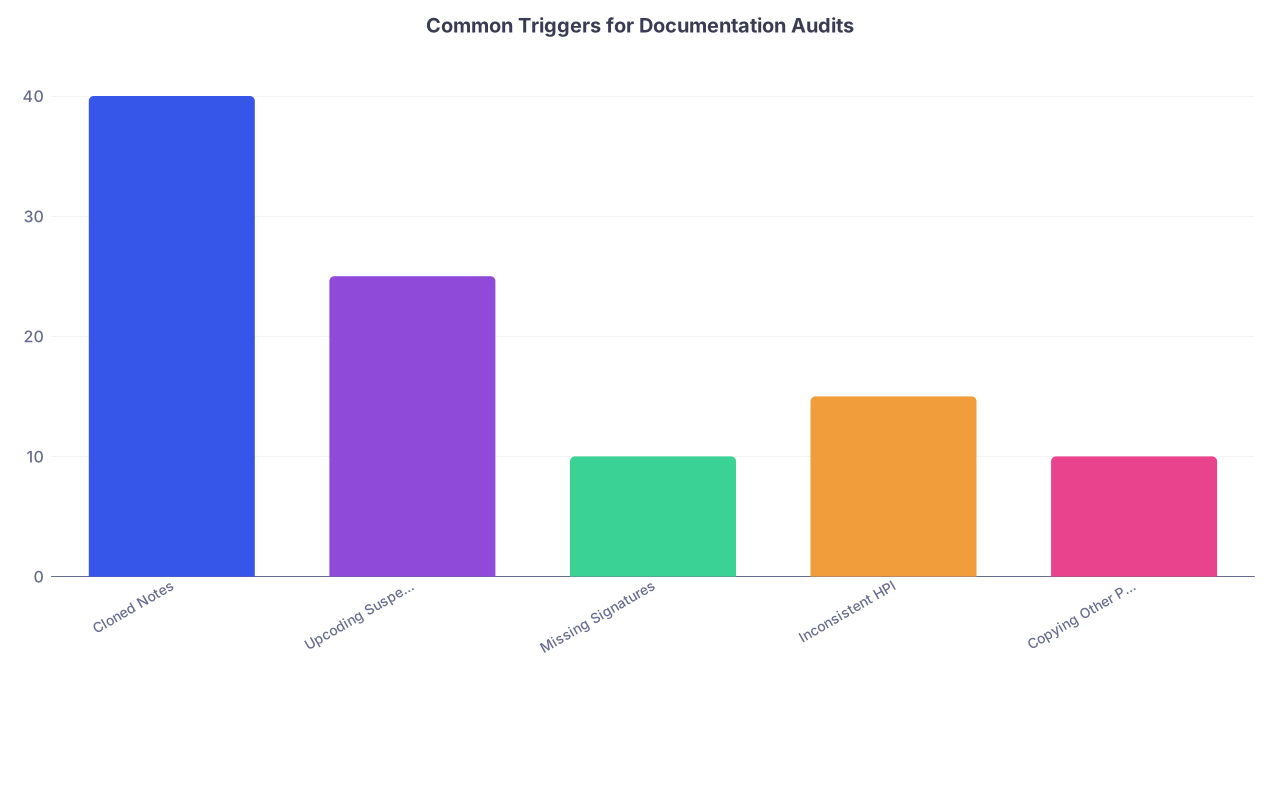
| Category | Value |
|---|---|
| Cloned Notes | 40 |
| Upcoding Suspected | 25 |
| Missing Signatures | 10 |
| Inconsistent HPI | 15 |
| Copying Other Providers | 10 |
That bar chart isn’t hypothetical. Those categories mirror exactly what compliance officers talk about behind closed doors.
You cannot eliminate copy‑forward. But you absolutely must control it. Let’s walk through the mistakes that get physicians hammered.
The 7 Copy‑Forward Red Flags Auditors Hunt For
1. The “Immortal Exam” – Perfectly Normal Every Day
This one is everywhere: the ICU patient on three pressors with an unchanged “unremarkable” physical exam for 5 days straight. Or the inpatient with worsening pneumonia but their lungs are “clear to auscultation bilaterally, no wheezes, rales, or rhonchi” every single day.
That’s not just lazy. It’s a liability.
What auditors see:
- Implausible stability in ill patients
- No correlation between exam and orders (escalating therapy with a “normal” exam)
- Evidence of cloned documentation instead of updated assessment
What plaintiff attorneys see:
- A jury‑friendly narrative: “Doctor, did you actually touch this patient, or did you just copy your own words?”
Avoid this mistake:
- Never bring forward the entire exam for sick or changing patients.
- Use copy‑forward as a skeleton, then actually edit:
- Remove systems you did not examine.
- Change language from “normal” to “unchanged from prior” when that’s true—and only if yesterday’s exam was actually done and documented correctly.
- If you only spot‑checked a system, document exactly that, not a full template of “10‑system normal exam.”
I’ve seen cases where the chart suggested a complete neuro exam every single day on a completely obtunded patient. That is not defensible.
2. Yesterday’s Story in Today’s HPI
Huge red flag: HPIs that never change. Day after day. Same sentences. Same typos. Same phrasing.
Examples:
- “Patient denies chest pain, SOB, or palpitations” copied forward even on the day the patient was intubated for respiratory failure.
- “No overnight events” on a night the patient coded.
- “Pain 2/10” on days where nursing flowsheets clearly show pain 8–9/10.
Auditors cross‑check. They compare:
- Nursing flowsheets
- Vital trends
- Procedure reports
- ED provider notes
- RN/RT notes
If your HPI or interval history ignores reality, it signals one thing: you did not bother to update.
Avoid this mistake:
- Force yourself to rewrite at least 1–2 sentences of the interval history each day.
- Explicitly acknowledge significant events: “Since last visit, patient developed acute hypoxic respiratory failure and was intubated.”
- Do not use “no events overnight” unless you checked.
If you’re too busy to rewrite a few lines, you’re too busy to safely practice. I’m being blunt on purpose.
3. Copying Other People’s Work As If It’s Yours
This one has both ethical and legal landmines.
Common scenario:
You open the card’s note, highlight their exam and assessment, paste into your note, tweak a word, sign. Congratulations. You’ve just attested to work you did not do.
Regulators view this as:
- Misrepresentation
- Possible fraud
- “Incident‑to” or shared visits done incorrectly
Some EHRs auto‑pull other clinicians’ notes into yours. That’s fine if it’s clearly labeled as “previous note” or “consult note.” It’s not fine when your signed note makes it appear you performed another clinician’s thinking or exam.
Avoid this mistake:
- Never copy another provider’s full exam or assessment into your personal attestation. Summarize instead: “Per cardiology note today: EF 25%, plan for cath tomorrow.”
- Always differentiate your thinking: “My assessment: …”
- For shared visits (e.g., APP + physician), ensure the documentation clearly supports who did what, and that your attestation isn’t a lazy “Agree with above” with no personal contribution.
Billing auditors are trained to dissect this exact behavior.

How Copy‑Forward Triggers Billing and Compliance Nightmares
Let’s be blunt: the main reason copy‑forward disasters matter isn’t just quality. It’s billing.
4. Same Bloated Note, Same Level, Every Time
Pattern that screams “audit me”:
- Level 4 or 5 visit billed nearly every time
- Near‑identical note structure and content
- ROS and exam clearly far beyond what was actually done
Payers run algorithms. They don’t announce them. But they definitely flag:
- High percentage of level 4/5 visits compared to peers
- Long templates with low clinical yield
- Minimal variation in note structure across dates and patients
Your copy‑forward habit quietly turns you into an outlier.
| Pattern | Audit Risk Level |
|---|---|
| Identical exams daily | High |
| Level 4/5 > 80% visits | High |
| Minimal note variability | Medium |
| Short, focused notes | Low |
| Clear changes day to day | Low |
Avoid this mistake:
- Do not auto‑populate full 12‑system exams and 14‑point ROS for routine visits.
- Let the complexity of the actual visit drive your documentation, not your template.
- Vary your phrasing naturally when clinically appropriate—robotic repetition is highly suspicious.
5. Documentation That Doesn’t Match Orders or Reality
Classic example I saw in an audit:
- Note says “Patient significantly improved, stable for discharge soon.”
- Same day: start new IV antibiotics, order CT chest, consult ID and pulmonary, keep in ICU.
To an auditor, that mismatch screams either:
- Copy‑forward error, or
- Intentional misrepresentation (“upcoding for stability” or “documenting more stable than reality to justify something else”)
They do not assume “busy doctor.” They assume “problem.”
Avoid this mistake:
- Before you sign, glance quickly at:
- Orders you placed today
- Major vitals trends
- New consults or imaging
- If your plan escalated care, your assessment should clearly reflect why.
If a random reviewer can’t reconcile your story with the orders, you look sloppy at best, deceptive at worst.
Copy‑Forward That Hurts Patient Care (And Exposes You Medically)
This isn’t only about money. Copy‑forward also quietly corrodes clinical judgment.
6. Carrying Forward Old Diagnoses and Outdated Problems
I’ve seen “rule out PE” live in a problem list for 9 days. CT angiogram was negative on day 2. Nobody removed it. Overnight covering docs kept glancing at an outdated problem list and ordering nonsense labs “just in case.”
Common copy‑forward sins:
- Leaving “rule out” diagnoses in the active list after they’re ruled out
- Carrying forward past differentials as if they are still current
- Keeping stale issues (e.g., “await MRI” after it’s already done and read)
This is exactly how groupthink and anchoring errors get hard‑wired into the chart.
Avoid this mistake:
- On any meaningful change in course, clean your problem list:
- Move resolved or ruled‑out issues to “past” or remove them.
- Update working diagnosis explicitly.
- Do not bring forward an entire A/P block without checking if each line is still true today.
If your A/P doesn’t reflect today’s thinking, it’s not a plan. It’s a liability.
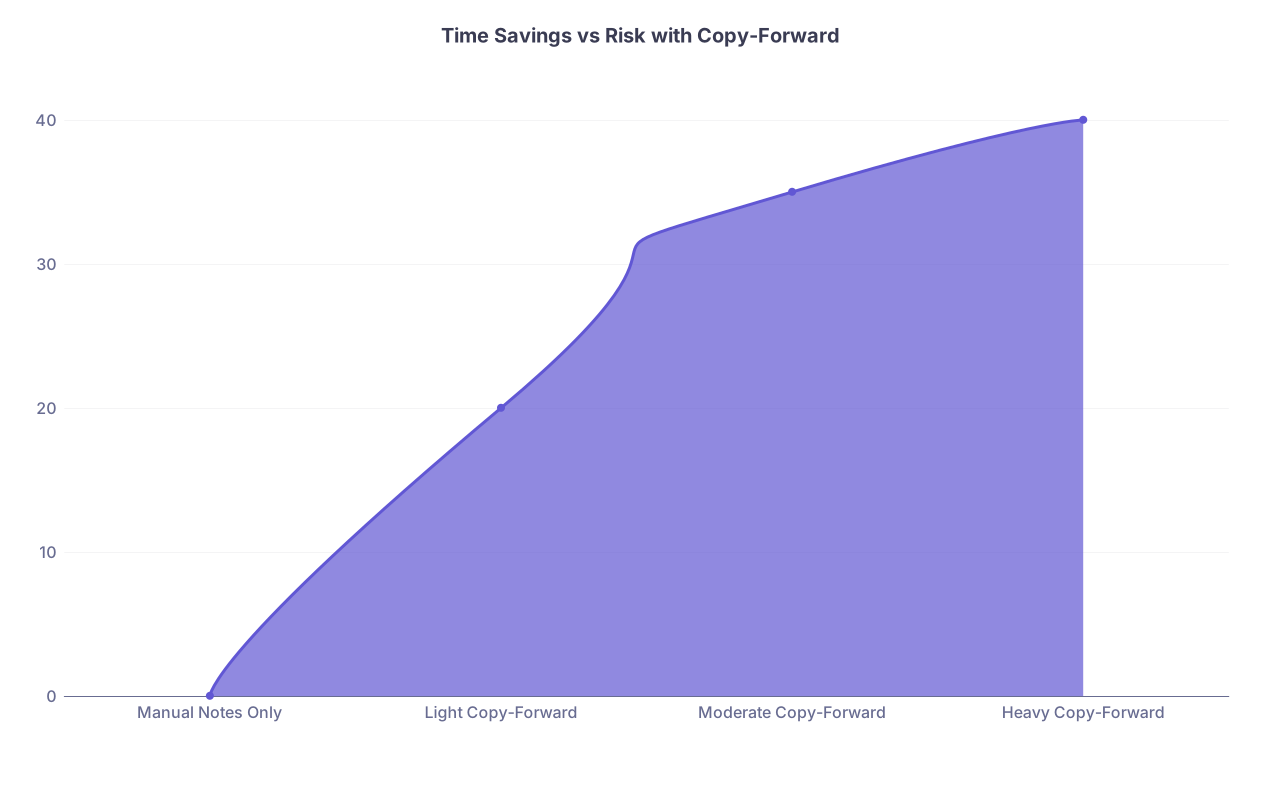
| Category | Value |
|---|---|
| Manual Notes Only | 0 |
| Light Copy-Forward | 20 |
| Moderate Copy-Forward | 35 |
| Heavy Copy-Forward | 40 |
*(Left axis approximate % of time saved; risk increases disproportionately beyond “moderate”) *
7. Copy‑Forward in Critical Events: The Plaintiff Attorney’s Dream
Worst scenario: bad outcome plus lazy charting.
Example patterns in malpractice cases:
- Day of deterioration: note looks 95% like previous days, with minor edits.
- Exam copied forward as normal despite obvious change.
- ROS unchanged even after a new symptom appears in nursing notes hours earlier.
When a patient crashes, lawyers go line by line through the days or hours beforehand. They circle every sentence that was obviously carried forward and ask you, under oath, to justify it.
You do not want to be on video saying, “I must have forgotten to update that part.”
Avoid this mistake:
- When a patient significantly worsens, that day’s note should be visibly different.
- Re‑write the HPI/interval history
- Update the exam structure
- Rewrite the assessment instead of editing line by line
- If something changed rapidly, document the uncertainty, the watchful waiting, the phone calls. That proves you were thinking, not sleepwalking through a template.

| Step | Description |
|---|---|
| Step 1 | Open Yesterday Note |
| Step 2 | Start Fresh Template |
| Step 3 | Copy Minimal Sections |
| Step 4 | Update HPI and Interval History |
| Step 5 | Edit Exam to Match Today |
| Step 6 | Revise Assessment and Plan |
| Step 7 | Crosscheck Orders and Labs |
| Step 8 | Fix Inconsistencies |
| Step 9 | Sign Note |
| Step 10 | Copy Forward? |
| Step 11 | Any Contradictions? |
Practical Guardrails: How To Use Copy‑Forward Without Getting Burned
You don’t need to swear off copy‑forward entirely. You need rules.
Here are guardrails I recommend physicians adopt in any setting—hospital, clinic, telehealth.
Guardrail 1: Define “Safe to Copy” Zones
Safer to copy:
- Demographics
- Past medical / surgical history (with periodic review)
- Family / social history (with confirmation & updates)
- Long‑term unchanged problems in a stable chronic patient, with date of last full review
Dangerous to copy:
- Today’s HPI or interval history
- Physical exam details
- Medical decision‑making language and risk stratification
- Time statements (e.g., “Spent 40 minutes…”)
- ROS that wasn’t actually asked today
If your EHR lets you, limit auto‑carry for the risky sections.
Guardrail 2: Time‑Limit Your Copy‑Forward
A note from yesterday might still be a reasonable skeleton. A note from three months ago? That’s malpractice bait.
As a rule of thumb:
- Inpatient: Don’t copy more than 24 hours back without heavy editing.
- Outpatient: If it’s been >6 months, assume every section needs real review and updates.
If the issue is “chronic stable,” your wording can reflect that: “Hypertension, well controlled, no med changes since last visit in March 2025.” That proves you at least looked.
Guardrail 3: Build Quick Reality Checks into Your Workflow
Before you sign, do a 20–30 second mental checklist:
- Does the HPI reflect what the patient actually told me today?
- Does the exam match what I actually did?
- Does my plan match my orders?
- Does the level of service I’m selecting fit the complexity I actually handled?
This isn’t perfectionism. It’s self‑defense.
Post‑Residency Reality: Your Documentation Profile Follows You
You are not a resident anymore. Your patterns are being measured.
Here’s what you probably don’t see happening in the background:
- Payers benchmarking your billing profile against your specialty peers.
- Hospital compliance teams running reports on cloned notes, level distribution, and time stamps.
- Large health systems building internal “provider risk scores” based partly on documentation behaviors.
If you keep copy‑forward on autopilot, you might:
- Lose favored status with payers.
- Trigger targeted pre‑payment or post‑payment audits.
- Get “education meetings” with compliance.
- In worst cases, be referred for possible fraud investigation.
None of that looks good when you try to change jobs, join a new group, or negotiate a contract.
What a Clean Documentation Pattern Looks Like
You want your data to show:
- Reasonable variation in note length and content
- Logical correlation between patient complexity and billing level
- Less frequent, but higher quality, use of high‑level codes
- Clear, timely attestation language and minimal cloned material
If you’re not sure where you stand, ask your compliance officer or billing department for your personal metrics. Most systems can pull them in seconds. Very few doctors ever bother to ask.

Your First Line of Defense: Partnering With Coding and Compliance
Here’s a mistake people make out of fear: they avoid compliance like it’s the IRS. Big mistake.
The coders and compliance folks—the good ones—are not trying to catch you. They’re trying to keep the whole institution out of trouble. Including you.
Use them.
- Ask for a brief 1:1 review of your documentation and billing patterns.
- Bring them 3–5 sample notes you’re unsure about.
- Specifically ask: “Where does my copy‑forward use look risky?”
You will learn more in one honest session with a seasoned inpatient coder than in dozens of generic CME modules.
FAQ (Exactly 4 Questions)
1. Is copy‑forward ever actually safe, or should I avoid it completely?
You do not have to completely stop using copy‑forward. It’s safe when used on relatively static, factual information: demographics, past medical history, stable family/social history, long‑standing unchanged diagnoses. The danger is in copying today’s thinking, today’s exam, and today’s risk assessment from yesterday’s context. If you treat copy‑forward as a starting template that you aggressively edit—rather than an easy shortcut—you can keep the time savings without the audit risk.
2. What’s the single biggest copy‑forward mistake that gets physicians into trouble?
The worst offender is carrying forward full physical exams and decision‑making across days in hospitalized or unstable patients without meaningful updates. That leads to obviously impossible patterns—critically ill patients documented as “normal exam” for days—or plans that don’t match escalating interventions. Those inconsistencies are glaring to auditors and almost impossible to defend in a quality review or malpractice case.
3. How can I tell if my documentation pattern is likely to trigger an audit?
Look at three simple things: how often you bill high‑level visits compared to your peers, how similar your notes look from day to day for the same patient, and how often your exam and HPI are near‑identical across visits. If level 4 and 5 codes dominate your profile, your notes look like clones, and your ROS/exam are always maximal even for simple visits, you are painting a target on your back. Ask your billing or compliance team for your personal coding distribution and a quick pattern review.
4. What small change can I make this week to dramatically reduce my risk?
Start with this rule: never copy‑forward the HPI or full exam in unchanged form. You can copy the structure, but you must re‑type or meaningfully edit the interval history, key symptoms, and relevant exam findings. Do that for a week. You’ll notice two things: your notes become more believable to any outsider, and your own clinical thinking sharpens because you’re forced to restate the story each day. That one habit—rewriting the narrative instead of cloning it—eliminates a massive portion of copy‑forward disasters.
Open your last three patient notes right now—ideally one inpatient, one outpatient, one complex case. Find anywhere you copied text without really thinking about it. Rewrite just those sections so they truly reflect today’s encounter. Then decide: is this how you want your entire career’s documentation to look, if someone audits you tomorrow?