
You’re post-residency, on service, trying to clear a bloated list before noon conference. The EHR pings yet another sepsis alert on a patient who looks fine, lactate is normal, and you’ve already seen them twice. At the same time, your hospital just rolled out a shiny “AI-powered” risk score that your CMO swears will reduce mortality and readmissions.
You’re not anti-tech. But you’re also not about to let an algorithm practice medicine with your license.
Here’s the real question you’re wrestling with: When is it actually safe to lean on clinical decision support (CDS), and when do you ignore it and trust your own judgment?
Let’s answer that directly.
The Short Version: When You Can Safely Rely on CDS
You can usually trust clinical decision support when:
The question is structured and narrow
Think: drug–drug interactions, dose ranges, renal dosing adjustments, guideline-based prophylaxis. Not vague “what’s wrong with this patient?”The logic is transparent and evidence-based
You know the rule: “If X lab is above Y with symptom Z, suggest A.” Or it’s clearly based on a named guideline or validated risk score.The system is well-calibrated and locally validated
It’s been checked against your hospital’s data, not just a vendor white paper.The stakes are low to moderate or reversible
Starting VTE prophylaxis you can discontinue is different from sending someone to the OR based on a black-box score.The CDS is used as a second check, not as a blind autopilot
It confirms what you already think or reminds you of something you might overlook.
When those five line up, you can lean on CDS pretty heavily and sleep fine.
Where you get into trouble is using it as a replacement for thinking in messy, high-uncertainty, high-stakes cases.
Types of Clinical Decision Support: Not All Created Equal
You shouldn’t treat every alert or tool the same. Some are basically safety rails; others are marketing hype in a GUI.
| CDS Type | Trust Level (Typical) | Good Use Case |
|---|---|---|
| Drug interaction alerts | High (with tuning) | Complex med lists, ICU |
| Dosing calculators | High | Renal dosing, chemo, peds meds |
| Order sets / care pathways | Moderate–High | Standard conditions (COPD, ACS) |
| Risk scores (classic) | Moderate | VTE risk, pneumonia severity |
| AI prediction models | Low–Moderate | Readmission, sepsis risk |
Where CDS shines
I’d call CDS “very safe to rely on” when it:
Automates math you’d otherwise do manually
Creatinine clearance, weight-based heparin dosing, complex chemo regimens.Encodes widely accepted, stable guidelines
DVT prophylaxis criteria, perioperative beta-blocker rules, vaccine schedules.Acts as a hard safety net
Flagging a ceftriaxone order in someone with anaphylactic penicillin allergy. Alerting you to QT-prolonging combinations.
You’re not abdicating judgment here. You’re outsourcing arithmetic and memory. That’s smart.
When Your Judgment Should Dominate (And CDS Takes a Back Seat)
There are situations where relying primarily on CDS is unsafe or frankly irresponsible.
Atypical or complex presentations
Multimorbid patients, weird presentations, “he just doesn’t look right” cases. Algorithms trained on clean data sets are bad at weird.High-stakes, irreversible decisions
Pulling the trigger on thrombolytics, emergent surgical decisions, code status calls. Use CDS as input, not the deciding vote.Areas with rapidly evolving evidence
Think early COVID days. If the guideline-based CDS hasn’t caught up, it will confidently suggest outdated care.Situations with obvious context the system cannot see
Family dynamics, social determinants, goals of care, the “something is off” bedside impression.When the CDS conflicts with clinical reality
If the sepsis alert keeps firing but the patient is afebrile, normotensive, normal WBC, lactate 1.0, cultures negative—believe the patient, not the pop-up.
Here’s the rule of thumb: If you’d be embarrassed explaining to a peer that you followed the computer over your own eyes and exam, don’t do it.
A Simple Framework: How Much Can I Trust This CDS Tool?
When you’re deciding how much weight to give a specific CDS recommendation, walk through this quick mental checklist.
1. What type of decision is this?
- Calculation / dosing / interaction check → High trust potential
- Guideline reminder / order set suggestion → Moderate
- Diagnosis suggestion / general risk prediction → Much lower
2. What’s the risk if it’s wrong?
- Mild inconvenience, easy to reverse → You can lean more on CDS
- Potential for harm but reversible → Use it as a strong nudge, still think
- Catastrophic or irreversible harm → Your judgment must lead; CDS is advisory only
3. How transparent is the logic?
If you can see or understand:
- The formula (e.g., CHA₂DS₂-VASc, Wells, TIMI)
- The clinical variables used
- The evidence behind it
…you can assign a clearer role in your decision. When it’s “proprietary AI model” with no interpretability, treat it like a consultant’s opinion you barely know: interesting, not binding.
4. How well does it fit this specific patient?
Ask yourself:
- Were the underlying data likely similar to this patient population?
- Does the model ignore factors that obviously matter here (frailty, social situation, rare conditions)?
- Does the recommendation match your bedside impression?
If the answer to the last question is “no,” pause hard before following the tool.
Where It’s Actually Smart to Rely Heavily on CDS
Let’s walk through areas where I’d tell you flat out: you should embrace CDS and not apologize for it.
Medication safety and dosing
This is the big one. No one, including “brilliant” attendings, can hold all this in their heads:
- Interaction checks on 20+ medication lists
- Renal and hepatic dose adjustments across dozens of drugs
- Cumulative QT risk
- Max safe doses by age/weight/organ function
For this domain:
- Let CDS lead on catching possible errors.
- Let your brain adjudicate what’s a real issue vs noise.
If you’re overriding more than ~80–90% of interaction alerts, your problem isn’t CDS — it’s a badly tuned implementation and your pharmacy/IT leadership needs to fix it.
Standardized pathways for common conditions
For bread-and-butter stuff—uncomplicated CAP, low-risk chest pain, mild COPD exacerbation—CDS-based order sets and pathways are usually net positive.
Use them to:
- Ensure you don’t miss key labs or interventions.
- Streamline orders and communication with nursing.
- Align with hospital quality metrics (because yes, that matters for your life).
But keep control. If your patient clearly doesn’t fit the “classic” mold, feel no guilt ignoring half the order set.
Where You Should Be Very Skeptical of CDS
This is where the marketing language gets thick and your risk goes up.
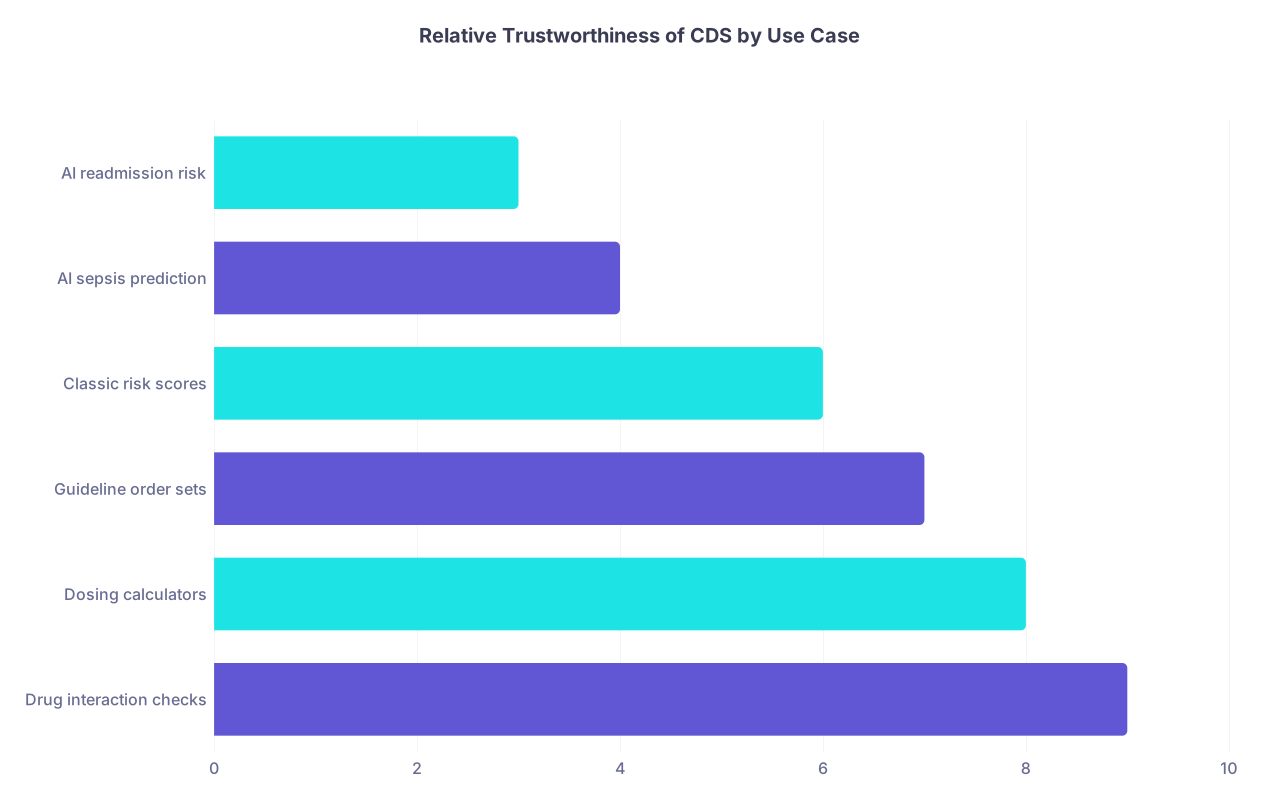
| Category | Value |
|---|---|
| Drug interaction checks | 9 |
| Dosing calculators | 8 |
| Guideline order sets | 7 |
| Classic risk scores | 6 |
| AI sepsis prediction | 4 |
| AI readmission risk | 3 |
AI-based prediction models (sepsis, readmission, deterioration, etc.)
Hospitals love putting sepsis risk dashboards and “deterioration scores” all over the place. You’ve already seen how many of those turn out: tons of alerts, tiny signal.
Use them:
- As an early warning nudge to re-evaluate a patient.
- To prioritize your list when you’re stretched thin.
Do not use them:
- As the primary reason to start or stop high-risk therapies.
- To override your clear bedside assessment.
If your exam and labs scream “not septic,” and the model disagrees, you’re not obligated to treat the screen.
Diagnostic decision support / “AI differential” tools
The chatbot that offers 12 differential diagnoses for abdominal pain based on chart data? Interesting. Occasionally useful as a backstop in obscure cases.
But if it’s trying to replace what you do in a careful history and exam, skip it. It’s decent as a reminder: “Did I consider mesenteric ischemia?” It’s terrible as a decision-maker: “Admit vs discharge.”
Legal and Ethical Reality: Who’s Actually Responsible?
Here’s the part that matters for your license and your sleep.
Legally and practically, you are responsible for the decision, not the software.
Right now:
- Courts and boards hold clinicians accountable for how they use CDS.
- Vendors explicitly disclaim that their tools are “for informational purposes only.”
- Hospitals will absolutely review your chart saying, “The alert fired and was ignored” if there’s an adverse event.
So your safest posture is:
- Document when you intentionally deviate from strong CDS recommendations in high-stakes situations.
- Use brief, clear rationale: “CDS suggested X, but patient has Y comorbidity / prior reaction / clear alternative diagnosis.”
- Don’t let CDS push you into something that conflicts with basic standards of care.
If following CDS would violate a guideline you’d consider baseline community standard, it’s not a shield. It’s a problem.
Practical Workflow: How to Handle CDS Without Going Nuts
Let me give you something you can actually use tomorrow.

| Step | Description |
|---|---|
| Step 1 | CDS alert or suggestion |
| Step 2 | Follow CDS and document briefly if needed |
| Step 3 | Reassess patient and document rationale |
| Step 4 | Follow or use as nudge |
| Step 5 | Ignore or override, move on |
| Step 6 | High risk decision? |
| Step 7 | Matches my clinical impression? |
| Step 8 | Low or moderate risk? |
Key points:
- Don’t reflexively accept or reflexively ignore.
- Anchor first on your own impression, then see if CDS adds, contradicts, or is irrelevant.
- Save your energy for high-stakes conflicts; don’t over-document every benign override.
Questions You Should Be Asking Your Hospital About CDS
You’re post-residency now. You’re allowed to push back.
When a new CDS or “AI tool” shows up, ask:
- Has this been validated on our local population? Show me the numbers.
- What’s the alert burden (per patient-day, per provider)?
- For predictive models: what are the sensitivity, specificity, and PPV in our own data?
- Who is monitoring performance drift over time?
- What’s the recommended use case: advisory, gatekeeper, or must-acknowledge?
If they can’t answer those, that’s your signal: this tool gets partial trust at best.
How to Blend CDS with Expert Judgment Without Losing Either
The best clinicians I’ve seen do three things well with CDS:
They treat it as a junior colleague
Helpful with numbers, reminders, and guidelines. Unreliable with nuance and context. Not allowed to make solo decisions.They recognize where they’re weak and let CDS plug gaps
Example: using dosing calculators religiously, relying on interaction checks with complex polypharmacy, but not outsourcing diagnosis.They stay skeptical but not cynical
They don’t ignore everything. They know which alerts are high-yield. They adjust when local data show a tool actually helps outcomes.
That’s the sweet spot.

Common Scenarios and How I’d Handle Them
Let’s make this very concrete.
Scenario 1: Sepsis alert on a stable patient
Patient: 45-year-old with cellulitis, afebrile, HR 92, BP 118/72, lactate 1.1. EHR fires sepsis alert.
What I do:
- Quickly re-check vitals and exam.
- If nothing concerning: override the alert, maybe add a one-liner: “Sepsis alert triggered by SIRS; patient clinically stable, source clear, no organ dysfunction.”
Your judgment > CDS here.
Scenario 2: Renally-dosed medication in CKD 4
CDS: “Adjust dose of enoxaparin for CrCl 25.” Suggests specific dose.
What I do:
- Verify creatinine, weight, and timing.
- If math checks out, I follow the recommendation. That’s literally what CDS is for.
Here, CDS can safely lead, and you’re just sanity-checking.
Scenario 3: AI deterioration score high, patient looks OK
CDS: High-risk deterioration alert on a floor patient you just saw and thought looked pretty decent.
What I do:
- Walk back, reassess, eyeball for subtle changes.
- If still low concern: document brief note: “AI deterioration score high; bedside reassessment reassuring; will monitor with standard q4h vitals.”
CDS is a nudge, not a command.
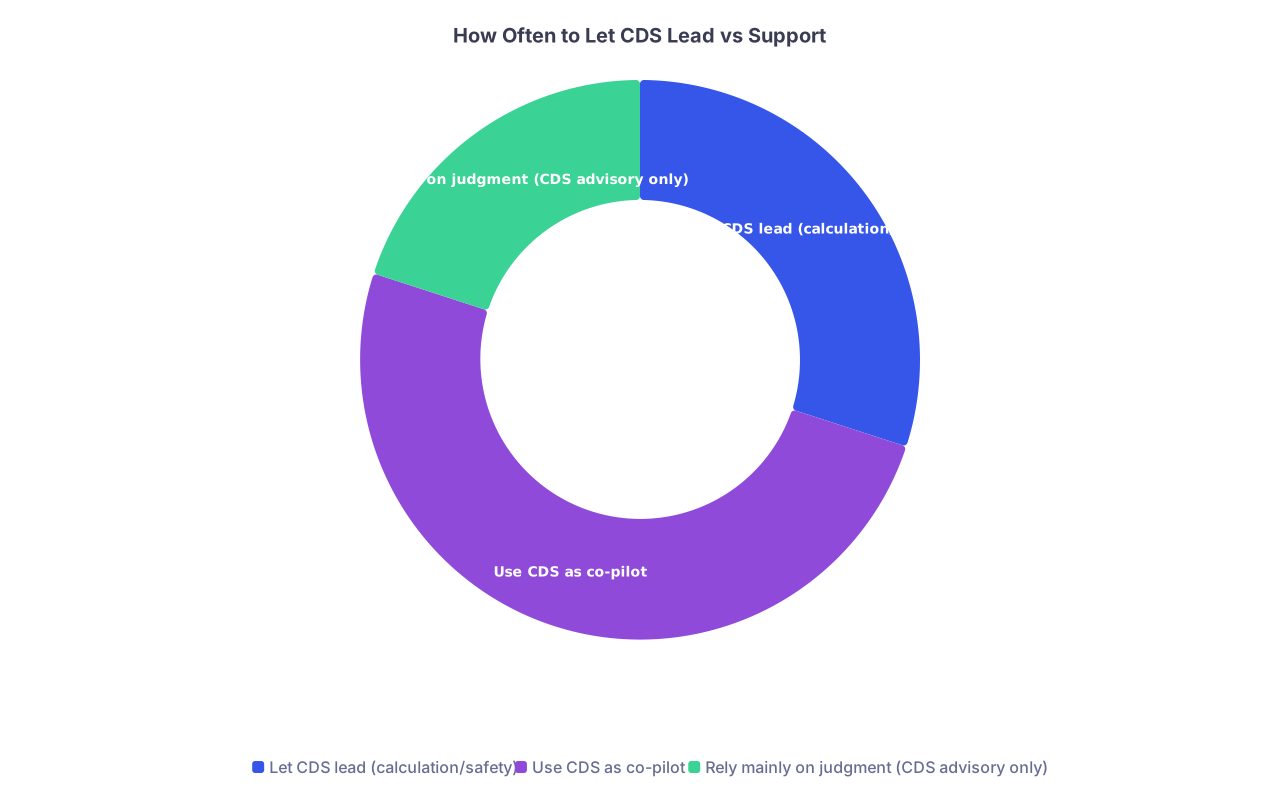
| Category | Value |
|---|---|
| Let CDS lead (calculation/safety) | 30 |
| Use CDS as co-pilot | 50 |
| Rely mainly on judgment (CDS advisory only) | 20 |

FAQ: Clinical Decision Support vs Your Judgment
If I follow CDS and something goes wrong, am I protected medicolegally?
No. CDS is considered advisory. You’re still responsible for the medical decision. If CDS recommended something clearly inappropriate for this patient and you followed it without thinking, that’s on you. Documenting that you considered CDS but made a different decision with rationale is safer than blindly following it.Is it ever appropriate to follow CDS even when I’m slightly unsure clinically?
Yes, especially for things like dosing, interactions, and guideline-based prophylaxis. If your uncertainty is about math or recall, CDS is exactly what you should lean on. If your uncertainty is “I don’t understand what’s happening with this patient,” that’s not something CDS will solve. Get help from another human.What about new AI tools hospitals are piloting—should I use them?
Use them as information, not authority. Let them prompt you to reassess or think differently, but don’t make major decisions based solely on a new AI model until you’ve seen local data and understand at least the basics of its performance and limitations.How often should I document when I ignore CDS alerts?
Not for every nuisance alert. Focus on high-stakes situations: sepsis bundles, anticoagulation, critical medication dosing, major care pathway deviations. A one-sentence rationale is usually enough: “CDS suggested X; not followed due to Y.”How can I quickly decide if a new CDS tool is trustworthy?
Ask three questions: Is the logic transparent or at least well-described? Has it been validated on patients like mine, with local performance metrics? What’s the specific, limited decision it’s designed to support? If those answers are vague or hand-wavy, you keep it at arm’s length and treat it as advisory only.
Key takeaways:
- Rely heavily on CDS for math, meds, and stable guidelines; let it assist—but not replace—your judgment in complex or high-stakes decisions.
- Your license, not the algorithm, owns the outcome. Use CDS as a junior colleague: helpful, not in charge.
- When CDS conflicts with clear bedside reality, trust your exam, reassess, and document why you chose your path.