
Last winter, a new hospitalist at a community system sent a three-paragraph email to IT about a “small” EHR issue: discharge summaries weren’t auto-populating follow-up appointments correctly. Six months later, that email was quietly cited in a presentation to the C-suite, used in a vendor escalation, and referenced when the same physician applied for a leadership stipend role. He thought he was just venting. Everyone else used it as data, leverage, and evidence of leadership.
Let me tell you the part no one explains during orientation: once you’re attending level, your emails about the EHR are not just “tickets.” They become currency. Signals. Sometimes even weapons. And they follow you a lot further up the food chain than you realize.
How IT Actually Sees Your EHR Email
Most clinicians think IT reads their messages as: “Doctor is annoyed, system is slow, please fix.” That’s not what’s happening behind the curtain.
I’ve sat in those operations meetings. Here’s the reality.
Your email is rarely seen by just one IT analyst. It often goes through at least three layers:
- The front-line analyst or help desk.
- The EHR application team.
- Sometimes the clinical informatics lead and project manager.
And if it’s juicy enough—safety, legal exposure, revenue risk—it gets screenshotted into slide decks for the CMIO, the CMO, even the CFO.
The first thing they look at is not your technical suggestion. It’s your signal:
- Are you the attending who only complains when stuff is truly broken?
- Or the one who screams about every preference change and password reset?
One seasoned Epic analyst I know has a private three-color tagging system for clinicians:
- Green: “Smart, specific, useful. Respond quickly, loop in for pilots.”
- Yellow: “Legitimate but noisy. Handle, don’t invest.”
- Red: “Vague, hostile, political. Limit engagement, CYA in documentation.”
Your email tone and content decide your color. That color influences:
- How fast your tickets get worked.
- Whether your “wish list” items get any traction.
- Whether anyone wants you at the table when big redesigns happen.
No one will ever tell you this in writing. But every hospital I’ve seen has some version of this mental triage.
The Quiet Power of Being “Clinically Credible” to IT
There’s a line that gets tossed around in behind-closed-doors committees: “We need a clinically credible champion on this.”
You know how they pick that person? Not from the employee engagement survey. From the names that keep popping up as:
- The clinician who sends precise EHR feedback.
- The one who reports issues with actual examples.
- The rare doctor who can say, “Here’s the workflow, here’s the risk, here’s a proposed fix.”
That starts with your day-to-day emails.
I’ve watched this play out:
A pulmonary/critical care attending at a mid-size system kept sending structured, calm emails about EHR order set problems in the ICU. Not rants. Very matter-of-fact:
- What the current build did.
- What the bedside workflow actually looked like.
- Why this created a safety/efficiency problem.
- Two or three specific change ideas.
He thought he was just “being helpful.” Within a year:
- He was invited to join the ICU physician advisory group.
- He got tagged for an internal “EHR superuser” stipend.
- His name went on the short list for associate CMIO when the role opened.
I’ve seen the opposite. A surgeon who wrote caps-lock, all-caps subject line emails every time an upgrade moved a button three pixels. Same level of training. Same seniority. On every IT/informatics list, that surgeon became: “Do not bring into meetings unless absolutely necessary.”
Both people had legitimate frustrations. Only one turned them into influence.
Your emails about the EHR are how non-clinicians decide: “Is this someone we trust to represent the front line?”
What IT Reads Between the Lines of Your Message
IT is not clinically trained, but they’re very good at pattern recognition. They read your message on three levels:
- What you say is happening.
- What it implies about risk, compliance, revenue, or politics.
- What it reveals about who you are as an attending.
They’ll never say this to you, but here’s the mental checklist I’ve heard in rooms when we bring up “Dr. X’s email.”
“Is this a one-off annoyance or a pattern that hints at something bigger?”
“Is this a personal preference or a safety issue we could be blamed for later?”
“Is this physician going to be a partner or a grenade if we pull them into a project?”
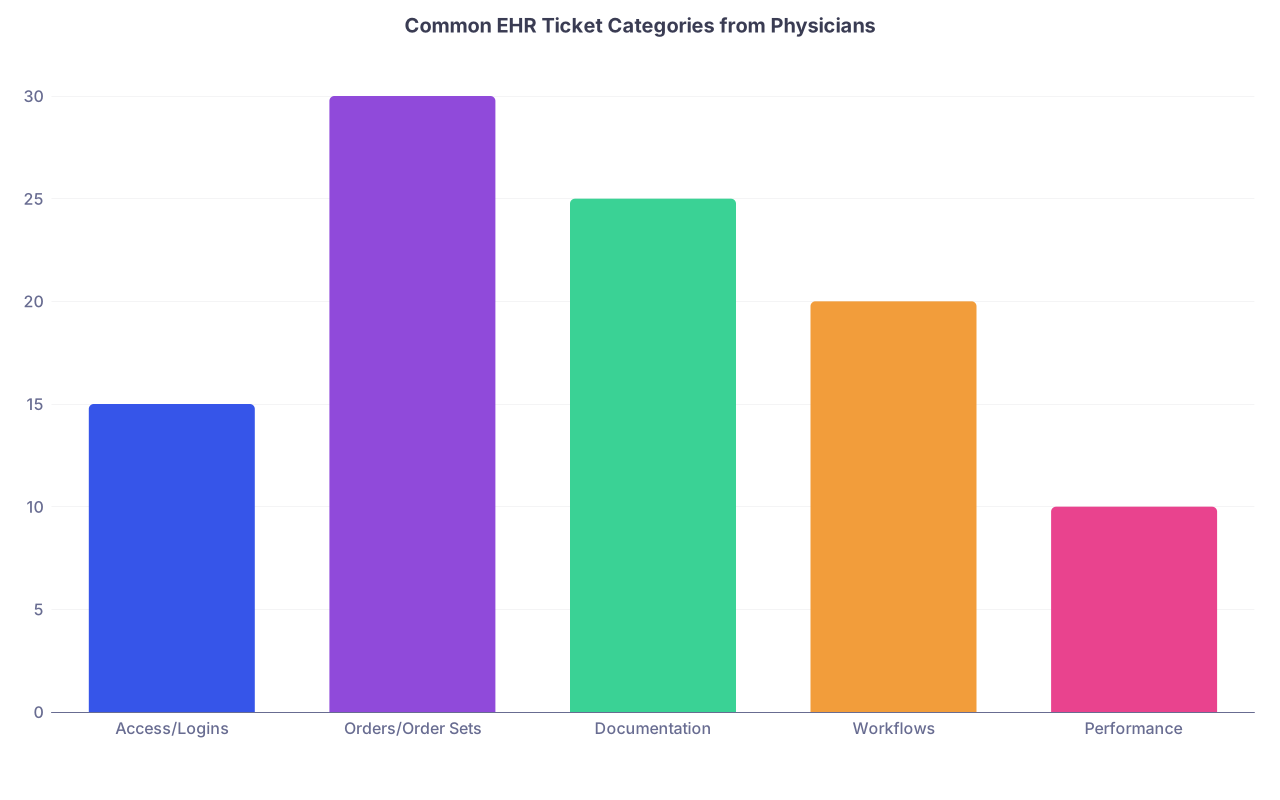
They’re also quietly tracking issue types. At decent-sized systems, EHR complaints aggregate into dashboards.
| Category | Value |
|---|---|
| Access/Logins | 15 |
| Orders/Order Sets | 30 |
| Documentation | 25 |
| Workflows | 20 |
| Performance | 10 |
Those bars aren’t just tech problems. They’re ammunition. They get dragged into:
- Vendor contract renegotiations (“Look how many safety-related tickets we’ve logged.”)
- Capital budget asks (“We need another FTE or we keep bleeding productivity.”)
- Internal turf wars (“Nursing vs physician workflows—who’s really driving the mess?”)
If your email lands in one of those categories with clear, reusable examples, it becomes part of that ammunition. If it’s just anger with no details, it gets logged as “noise.”
How EHR Complaints Move Through the System (and Back to You)
Let’s pull the curtain all the way back and show you the actual path.

| Step | Description |
|---|---|
| Step 1 | Clinician sends email |
| Step 2 | Help desk ticket created |
| Step 3 | App analyst review |
| Step 4 | Replicate and document |
| Step 5 | Review with informatics |
| Step 6 | Route to superuser/education |
| Step 7 | Escalate to CMIO/leadership |
| Step 8 | Standard fix or workaround |
| Step 9 | Prioritize in build queue |
| Step 10 | Create tip sheet or 1 on 1 |
| Step 11 | Vendor escalation or project |
| Step 12 | Ticket closed with note |
| Step 13 | Type of issue |
| Step 14 | Safety or revenue risk |
Where your email really matters is at those decision diamonds: “Type of issue” and “Safety or revenue risk.”
Because here’s what gets elevated:
- Anything that smells like malpractice if ignored.
- Anything that clearly delays discharges or billing.
- Any pattern that could blow up on social media or in staff surveys.
You control how visible the risk is by how you write.
“EHR annoying, patients waiting longer” is venting.
“Because the discharge med list doesn’t show the formulary alternatives, patients remain boarded 2–3 extra hours while we reconcile meds manually. This has happened on at least 5 of my last 10 discharges” is risk.
One lives and dies in the help desk. The other gets forwarded to three directors and the CMIO.
The Political Reality: Your Name Gets Remembered
Let’s talk politics, because pretending they don’t exist is how people get blindsided.
After residency, you’ve entered a market where titles like “Medical Director, Informatics” and “Physician Advisor for EHR Optimization” come with real money and real schedule protection. Everyone says they want a “clinician voice” in tech decisions.
What they don’t say is how they pick that voice.
They pick:
- The person whose EHR emails are readable.
- The one who sounds like they understand both bedside care and basic systems thinking.
- The one who can be dropped into a meeting with finance, IT, and operations and not embarrass leadership.
Your EHR emails are the audition tapes.
That time you slammed IT in a rage email and CC’d the CMO? It’s remembered. Analysts talk. CMIOs talk. Service line leaders talk.
Equally, that time you wrote a clear, calm, evidence-based description of why the new ED triage screen was unsafe—and were right? Also remembered. You become “the doc who actually helped fix that mess.”
You’re either writing your way into the room where decisions are made. Or you’re writing yourself out of it.
Why Leadership Cares About Your EHR Complaints (Even When They Ignore You)
Here’s the part that surprises people: leadership absolutely reads the EHR complaint summaries. They just don’t often respond to individuals.
Quarterly, sometimes monthly, your pain gets rolled up into metrics and charts. I’ve seen decks like this in more than one boardroom:
| Metric | Value |
|---|---|
| Total physician EHR tickets (Qtr) | 420 |
| Tickets tagged as safety-related | 68 |
| Avg days to resolution | 9.5 |
| Top specialty by ticket volume | IM |
| Most common complaint type | Orders |
Now add slides with anonymized quotes:
- “Discharge process now takes twice as long with new navigator.”
- “Heparin order defaults changed without notice—near miss yesterday.”
- “Click burden in clinic has turned 20 min visits into 10.”
Guess where those quotes come from? Your emails and ticket comments.
So why does it feel like no one is listening?
Because individual responses are expensive. Admitting fault in writing is risky. And hospitals are terrified of creating the precedent that every angry email gets a high-level reply.
But those complaints inform:
- Which modules get prioritized in the next upgrade.
- Whether they fund scribes or documentation support.
- How hard they lean on the vendor about specific pain points.
This is why how you frame an email matters so much. You’re feeding the dataset that leadership uses to argue with:
- The EHR vendor.
- The board.
- The C-suite that does not touch the EHR but controls the budget.
The Hidden Career Track: Clinical Informatics by Accident
A lot of attendings accidentally back their way into informatics careers because of how they handle EHR problems.
Pattern I’ve seen over and over:
Year 1–2 post-residency: You send a few thoughtful messages about order sets, documentation templates, or workflow mismatches.
Year 2–3: You’re invited to:
- Be a pilot site for a new workflow.
- Trial a new note template.
- Sit on a service-line EHR committee “just for a few meetings.”
Year 3–5: You’re offered:
- A 0.1–0.3 FTE role in clinical informatics.
- A small stipend as a “physician builder” or superuser.
- Protected time for optimization projects.
Year 5+: If you play it well, doors open:
- Associate CMIO, then CMIO.
- System-level informatics roles.
- Vendor-side jobs at Epic/Cerner/Meditech/athena, where they know you can speak both languages: clinical and technical.
There’s a reason those roles don’t always go to the smartest clinician or the biggest name academically. They go to the people who’ve already proven—often through email—that they can:
- Define a problem precisely.
- Stay civil while frustrated.
- Suggest practical fixes instead of just complaining.
You will never see a posting that says: “We are recruiting from the pool of people who sent us the best EHR emails.” But that’s exactly what happens.
How to Write an EHR Email That Actually Moves the Needle
No, this isn’t about writing a “nice” email. It’s about crafting something that IT and leadership can use as a lever.
There are four elements that consistently get traction.
First, context. One to two sentences max.
“When admitting a patient with sepsis through the ED, there’s a mismatch between the ED order set and the inpatient one, leading to duplicate or missed orders.”
Now they know where in the workflow this lives.
Second, specifics.
Don’t write: “The admit navigator is terrible.”
Write: “In the admit navigator, the default antibiotic choice for community-acquired pneumonia is ceftriaxone alone, but in our institutional guidelines, it’s ceftriaxone plus azithromycin. This inconsistency has led to me manually adding azithromycin every time, and I’ve already caught one case where it was missed on a cross-cover admit.”
That’s not whining. That’s evidence.
Third, impact in language leadership cares about: safety, time, money, patient experience.
“On average, this adds 3–5 minutes per admission and increases the risk of under-treating pneumonia based on our own policy.”
Suddenly this is not “annoying button.” It’s “patient safety plus operational inefficiency.”
Fourth, a reasonable suggestion.
Not a detailed build spec. Something like:
“Could we align the pneumonia order sets with the institutional guideline so the combo is the default, or add a smarttext reminder in the navigator?”
You’ve just signaled that you understand tradeoffs and aren’t expecting miracles.
Do that consistently and you become “the doc whose tickets we actually want to read.”
EHR Email as Professional Reputation, Not Just Venting
Post-residency, your reputation travels faster than you do. Especially in medium and large systems with shared IT and informatics teams across sites.
I’ve seen physicians switch hospitals within the same system and walk right into a pre-labeled role:
- “Oh, you’re the one who helped fix the ICU orders. We’ve heard about you.”
- Or: “You’re the one who blasts the ‘reply all’ complaint bombs. Right.”
Your EHR email behavior becomes:
- Part of your unspoken reference check for internal opportunities.
- A quiet factor in whether you’re seen as “leadership material” or “high-maintenance.”
- Evidence used by your division chief when they’re asked, “Who do you trust to speak for your group in this redesign?”
And if you ever leave clinical practice or go part-time? Those same patterns of communication become your portfolio when you angle for roles in industry, consulting, or administration. I’ve been in interviews where a hiring manager from a vendor literally said, “We first heard of her because our client kept sending us her remarkably clear descriptions of workflows.”
Your emails are not ephemeral. They are your writing sample, your temperament test, and your systems-thinking demo all in one.
The Bottom Line: Why That “Little” Email Matters
Here’s what I want you to walk away with.
First: your emails about the EHR are not just tickets. They are data points for safety, operations, budget, and blame. Write them like they may be screenshotted into an executive deck tomorrow—because sometimes they are.
Second: how you complain is career-defining. Detailed, calm, and specific turns you into a go-to clinical voice. Vague, hostile, and dramatic puts you on the “noise” list no matter how valid your anger is.
Third: behind closed doors, people remember names. Your EHR messages quietly shape whether you’re seen as a problem generator or a problem solver—and in a post-residency job market obsessed with “physician leaders,” that distinction matters more than you think.