
The fantasy that AI can “do your notes for you” is one of the fastest ways to walk yourself straight into a malpractice problem.
Not tomorrow. Not in some sci-fi future. Now.
Let me be blunt: letting AI draft clinical notes you barely skim is a professional and legal trap. You will be the one on the stand, not the algorithm. And the plaintiff attorney will absolutely have your chart projected on a wall, line by line.
You do not want to be explaining why the note says you performed a full neuro exam you never did. Or that the patient denied chest pain when they came in saying “my chest feels like an elephant is sitting on it.”
This article is about avoiding that trap.
The Dangerous Myth: “The AI Will Handle It”
The biggest mistake physicians are making with AI note tools is mental outsourcing.
The story usually goes like this:
- You are drowning in inbox messages, prior auths, and follow-ups.
- Someone from admin promises “AI scribing” or “ambient documentation” that will save you 2–3 hours a day.
- The sales pitch: “You just talk to the patient; the AI builds the note.”
- After a week, you realize the AI is… pretty good. You stop reading every word. You start glancing. Then barely glancing.
That is the moment the malpractice risk spikes.
Because here is the key legal and ethical reality:
- Every note signed under your name is your statement of fact.
- AI is not a co-signer. It does not share liability.
- “The software made a mistake” is not a defense. At best, it is co-negligence—on your part—for trusting it without verification.
I have seen attendings proudly say, “The AI writes my whole note, I just click sign.” That is not efficiency. That is professional negligence dressed up as productivity.
How AI Notes Actually Fail You (Quietly and Repeatedly)
AI note tools do not usually fail in dramatic, obvious ways. They fail quietly. Plausibly. In ways that look fine until you are under a microscope.
Here are the most common and dangerous failure modes.
1. Fabricated or Exaggerated Exam Findings
This one is brutal in court.
Common pattern:
- You do a focused exam.
- The AI “helpfully” generates a complete exam section based on prior patterns and generic templates:
- “Cranial nerves II–XII grossly intact”
- “Normal gait”
- “No focal neurological deficits”
- “No respiratory distress”
- “Heart: regular rate and rhythm, no murmurs”
Half of that you never checked. Yet your signature sits under it.
In a malpractice deposition, it plays like this:
- Attorney: “Doctor, did you personally test cranial nerve XI function in this visit?”
- You: “No, I performed a more focused exam.”
- Attorney: “But your note says ‘cranial nerves II–XII grossly intact.’ Is that accurate?”
- You: “That was auto-generated…”
- Attorney: “So your signed note contains exam findings you did not perform. How is that acceptable patient care?”
You will feel the air leave the room.
2. Incorrectly Recorded Patient Statements
AI transcription plus summarization is not a verbatim record. It compresses, merges, and—sometimes—flat-out invents structure.
Examples I have seen from real systems:
Patient: “I get this chest pressure only when I climb stairs. It lasts a few minutes and goes away with rest.”
AI note: “Patient reports intermittent chest discomfort, not exertional, self-limited.”
Patient: “I stopped taking my blood thinner 2 weeks ago because I ran out.”
AI note: “Patient reports taking medications as prescribed.”
Now picture that with a later PE. Or MI. Or stroke. The chart shows “not exertional,” “adherent to meds,” “no red flag symptoms.”
This is how plaintiffs argue:
- “Either the doctor did not listen.”
- “Or the doctor did not read their own note.”
- “Or the doctor falsified the record.”
You will be choosing which of those looks least terrible.
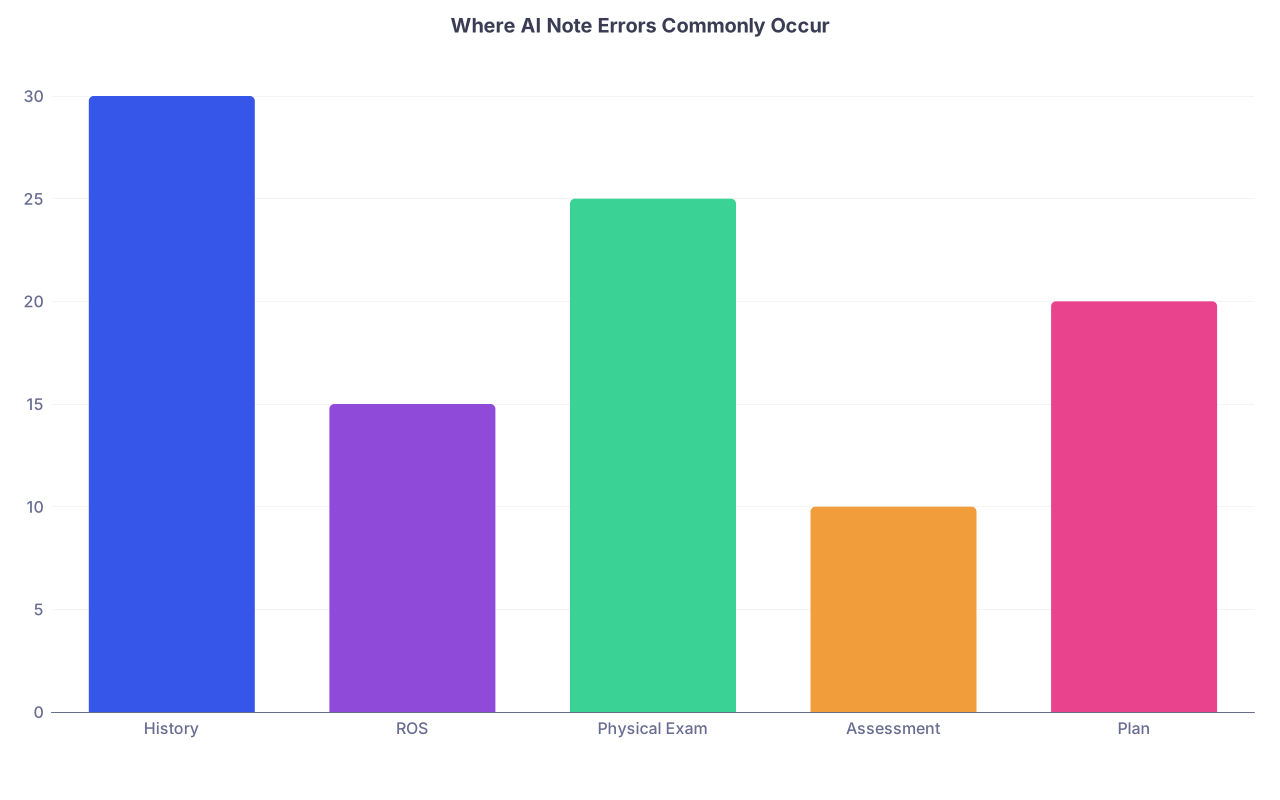
| Category | Value |
|---|---|
| History | 30 |
| ROS | 15 |
| Physical Exam | 25 |
| Assessment | 10 |
| Plan | 20 |
(That distribution is roughly what early audits from AI documentation pilots have shown: most errors live in history and exam, but plan contamination is particularly lethal.)
3. Copy-Forward Contamination on Steroids
Copy-forward has already burned many clinicians:
- Old, invalid problems still listed as active
- Medications the patient stopped months ago still in “current meds”
- ROS showing “no pain” when the visit was for pain
AI tools amplify this because they often:
- Pull “context” from prior notes
- Assume chronic problems are ongoing unless explicitly canceled
- Repeat templated ROS/exam sections that contradict the actual visit
Suddenly your note says:
- “Patient reports no suicidal ideation”
on the very visit where they told you they sometimes think of “not wanting to be here.” - “No history of DVT/PE”
when they had a submassive PE two years ago at another hospital that never made it into your problem list.
That is how plaintiffs argue failure to diagnose. Negligent history. Inadequate review of prior records.
You do not want to be pinned to an AI’s lazy assumptions.
4. Overconfident, Under-Nuanced Assessment Language
AI is spectacularly bad at hedging the way a cautious clinician hedges.
You might say out loud:
- “This is probably musculoskeletal, but I cannot fully exclude cardiac.”
The AI turns it into:
- “Assessment: musculoskeletal chest pain. No evidence of cardiac etiology.”
And because you are tired and behind, you sign.
Down the line, the troponin comes back elevated or the patient returns with an NSTEMI. Your note shows:
- An overconfident, undocumented diagnostic closure
- No clear record that cardiac was considered and safety-net instructions were given
When the plaintiff’s cardiology expert reads that, they will have a field day.
Why Reading AI Notes “Lightly” Is Not Enough
The partial-read trap is another big problem.
I have seen people adopt this pattern:
- Skim the HPI opening sentence
- Glance at medications
- Scroll to assessment/plan, maybe tweak one line
- Sign
They believe this counts as “reviewing” the note.
It does not. Not legally. Not clinically.
Here is what gets you in trouble:
- You miss a subtle misphrasing of the patient’s chief complaint
- You miss a fabricated negative review of systems
- You miss an exam section listing systems you never assessed
- You miss the AI quietly reusing last visit’s plan language, which no longer applies
When reviewed later, the medical record is treated as an integrated whole. No one in court says, “Well, the doctor only skimmed this part.” It is all adopted as your statement.
If you cannot defend every section of that note as “I accept this as an accurate reflection of what I did and what the patient reported,” then you should not sign it.
The Medico-Legal Reality: You Own the Note
Let me be direct. There are several hard truths you cannot outsource.
Regulators and courts do not care how the note was generated.
Voice, template, AI—irrelevant. What matters is the content and whether it reflects reasonable care.“Standard of care” does not yet include trusting AI.
In 2026, no serious expert will testify that a reasonable physician can safely rely on an AI-generated note without human verification.EHR metadata can betray you.
Many systems log:- How long the note was open
- Which sections you expanded or edited
- Whether you imported an AI draft and signed it in seconds
An astute attorney can subpoena that metadata. They will say:
- “Doctor, is it true you signed this four-page note 12 seconds after it was generated?”
- “Can you explain how you thoroughly reviewed it in that time?”
Institutional policies will shift liability toward you.
Watch the fine print. Most hospital/clinic AI policies say some version of:- “The clinician is responsible for validating and editing AI-generated content.”
- “AI tools are adjuncts; final responsibility resides with the provider.”
So yes: use AI. But do not lie to yourself about who owns the result.
The Red Flags You Cannot Ignore When Using AI Note Tools
If any of these sound familiar, you are already in the danger zone.
- You routinely sign AI notes without reading every section.
- You could not, under oath, describe your standard process for validating AI-generated documentation.
- Your exam sections are identical visit to visit, regardless of the presenting problem.
- The AI routinely documents full ROS and exams that you did not perform.
- You rarely delete sections. You just let them stand “because they’re not wrong enough to bother.”
- You have no idea what your institution’s AI documentation policy actually says.
Let me spell out the mistake: treating AI notes as a “mostly fine default” rather than a raw draft.
Once you see that, you will start catching egregious nonsense your tired brain was previously glossing over.

| Step | Description |
|---|---|
| Step 1 | AI Generates Draft |
| Step 2 | Clinician Reviews HPI Carefully |
| Step 3 | Clinician Reviews Exam and ROS |
| Step 4 | Delete or Correct Inaccurate Content |
| Step 5 | Review Assessment and Plan |
| Step 6 | Edit Language and Add Nuance |
| Step 7 | Sign Note |
| Step 8 | All Findings Performed and Accurate |
| Step 9 | Note Reflects Actual Encounter |
Practical Guardrails: How to Use AI Without Hanging Yourself
You do not need to reject AI. You need to cage it.
Here is a practical, defensible way to use AI documentation tools while staying out of malpractice trouble.
1. Explicitly Limit What AI Is Allowed to Touch
Do not let it freestyle your entire visit. Set clear personal rules.
Safer zones for AI help:
- Structure: headings, formatting, paragraphing
- Summarization of your own typed bullets (not raw audio)
- Simple expansions: turning shorthand into full sentences
- Non-clinical phrases: patient education language you then verify
High-risk zones where you must be ruthless:
- Physical exam details
- ROS negatives
- “Patient denies…” statements
- Assessment certainty levels (“no evidence of,” “ruled out,” etc.)
- Documenting procedures you performed
My rule: If I did not personally say it, type it, or clearly confirm it, it does not stay in the note.
2. Build a Short, Non-Negotiable Review Ritual
You need a simple, repeatable checklist that you follow on every AI-assisted note. It should be quick but real.
At minimum, before signing:
Chief complaint / HPI opening sentence
- Does it precisely match what brought them in?
- Is there any subtle reframing that downplays severity or chronicity?
ROS and exam
- Delete any system you did not specifically ask about or examine.
- Delete any negatives you do not remember clearly confirming.
- Make the exam proportionate to the visit. Short visit, focused exam. Not a full textbook neuro exam documented for every URI.
Assessment language
- Remove phrases that imply certainty you do not have.
- Add brief lines documenting your differential, even if short.
- Make sure your risk framing matches reality (e.g., “low but not zero suspicion for PE; patient advised to go to ED if…”).
Plan and safety net
- Check that follow-up and warning signs are clearly documented.
- Verify that meds and tests recommended match what you actually ordered.
This is not about perfection. It is about being able to look anyone in the eye and say, “Yes, I reviewed and edited this note meaningfully.”
| Task Type | Risk Level |
|---|---|
| Auto-generating full physical exam | High |
| Summarizing clinician-typed HPI | Lower |
| Transcribing and structuring ROS | High |
| Formatting headings and sections | Lower |
| Drafting assessment language | High |
| Turning clinician bullets into prose | Lower |
Institutional Policies: The Trap You Have Not Read
Many physicians are blindly trusting their institutions to “vet” these AI tools. That is not how this works.
You need to protect yourself by understanding:
- What exactly your hospital or group has approved
- Is the tool technically “in pilot”?
- Are there documented limitations on what it should be used for?
- What training they claim to have given you
- Did you attend that 45-minute webinar?
- Do they have your name on a list marked “trained in AI usage”?
- What their policy says about responsibility
- Almost all will say “clinician is responsible for final content.”
Because later, if there is a problem, the institution may argue:
- “We provided an AI tool as an adjunct, not a replacement.”
- “We trained clinicians to review all AI-generated content.”
- “If Dr. X chose to sign notes without review, that is an individual practice issue.”
If you have not even skimmed the policy, you are giving them an easy out.
Take one lunch break. Pull it up. Read it. Adjust your workflow to match.
The Psychological Trap: Trust by Familiarity
The longer you use an AI note tool, the more familiar its voice becomes. That is dangerous.
You start thinking:
- “This is how my notes sound.”
- “The AI knows my style.”
- “I have not seen big errors recently.”
So your brain relaxes. That is when subtle inaccuracies sneak through:
- Wrong laterality
- Wrong duration of symptoms
- Mislabeling acute vs chronic
- Generic exam findings that contradict the actual case
Remember: AI is not “learning you” the way you think. It is predicting text. It will confidently output plausible nonsense if the input is ambiguous or incomplete.
Never equate “looks like something I would say” with “is definitely accurate.”

What a Plaintiff Attorney Will Actually Do With Your AI Notes
If you want motivation to tighten up your process, picture this.
You are being sued for delayed diagnosis of appendicitis, PE, meningitis—pick your poison. The opposing counsel obtains:
- All your notes for that patient
- Several months of other notes from your clinic for pattern analysis
- EHR metadata on how you use AI drafting tools (import events, timestamps)
- Your institution’s AI usage policy
They will look for:
- Repeated documentation of full exams in <1–2 minutes
- Identical ROS templates used for wildly different complaints
- Obvious internal contradictions (e.g., “no SOB” with documented “speaking in 2–3 word sentences”)
- AI-style phrasing copied across dozens of patients
Then they will build a narrative:
- You adopted AI documentation to save time.
- You stopped meaningfully reviewing notes.
- The chart overstates how thorough you were.
- The record cannot be trusted as an accurate reflection of care.
- Given this pattern, it is more likely you missed key complaints or exam findings in this specific patient.
You do not beat that narrative by saying, “But everybody uses AI.” You beat it by having a documented, consistent, defensible pattern of actual review and correction.
How to Protect Yourself Starting Tomorrow
You do not need a monthlong quality project. You need to change a few core behaviors.
Do this, starting with your next clinic day:
Turn off full auto-exam if possible.
If your tool allows, disable auto-generation of exam/ROS. Or set it to “minimal” and add only what you actually did.Adopt a one-sentence rule.
Before signing, force yourself to ask:
“If I had to testify tomorrow, would I stand by this note as an accurate reflection of this visit?”
If the answer is anything but yes, fix it.Audit five recent AI-assisted notes.
Alone, no distractions. Compare:- What you remember doing vs what is documented
- How detailed the ROS/exam are relative to reality
- Any phrases that imply certainty you did not have
You will learn quickly where your worst sloppiness lives.
Tell your team your new standard.
Say it out loud in clinic or group chat:
“I am tightening up how I use the AI note generator. No more full auto-exam, and I am deleting anything I did not do.”
That social commitment makes it much harder to slip back.Document your workflow once.
Write a short paragraph in your personal files:- “When using AI notes, my standard practice is to review HPI, ROS, exam, and plan on every encounter; delete any unperformed exam elements; and correct any misstatements before signing.”
If you are ever asked, you can truthfully say you had a defined, careful process.
- “When using AI notes, my standard practice is to review HPI, ROS, exam, and plan on every encounter; delete any unperformed exam elements; and correct any misstatements before signing.”
The Bottom Line
Three things you need to remember:
AI can draft your notes. It cannot own your liability. Every word under your signature is yours, no matter who—or what—typed it.
The most dangerous errors are the quiet, plausible ones. Over-documented exams, softened complaints, and overconfident assessments are exactly what plaintiffs’ experts use to tear apart your care.
A simple, ruthless review ritual is non-negotiable. Delete what you did not do. Fix what you did not say. Refuse to sign anything you would not defend under oath.
Use AI to save time. But never at the cost of your license. Or your credibility. Or your patient’s safety.