
It’s 6:45 pm. Clinic “ended” at 4:30. You’re still in your office hammering out notes, clicking boxes, and re-reading a consult that you barely remember. Somebody mentioned AI scribes in the lounge today. You rolled your eyes… but then you realized you’ve spent two extra unpaid hours here. Again.
Here’s the real question you’re asking:
If I’m a practicing physician (or running a group), is paying for an AI scribe actually worth it—financially and legally—or is this just another shiny tech bill that doesn’t move the needle?
Let’s walk through that directly.
1. What an AI Scribe Actually Does (and Doesn’t)
Strip away the buzzwords. An AI scribe does basically this:
- Listens to the visit (usually via phone app / browser / room mic)
- Transforms that audio into:
- HPI
- ROS
- Exam (sometimes inferred, sometimes prompted)
- Assessment & Plan (structured by problem)
- Pushes a draft into your EHR to review, edit, and sign
Some of the well-known players (as of late 2024/early 2025): Nuance DAX, Suki, Abridge, Notable, DeepScribe, Augmedix Go, and a bunch of smaller startups plugging into Epic, Cerner, Athena, eClinicalWorks, etc.
What it does NOT do (reliably or safely):
- Independently bill, code, or sign notes
- Replace your medical decision-making
- Guarantee compliance without your review
- Take legal responsibility for documentation errors
You’re still on the hook. The AI just drafts faster than your fingers.
2. Hard Numbers: Is It Financially Worth It?
Let’s talk money, not vibes.
Typical pricing
Most serious AI scribe products land around:
| Model Type | Price Range | Unit |
|---|---|---|
| Per provider/month | $400–$800 | Unlimited or capped |
| Per encounter | $5–$15 | Per completed note |
| Enterprise contracts | Highly variable | Custom, volume-based |
Reality in many ambulatory settings right now: you’re looking at roughly $500–$700 per provider per month for a solid, integrated, clinic-appropriate tool.
Now, is that worth it? You evaluate on three axes:
- More revenue
- Recovered time
- Reduced burnout / retention (soft dollars, but real)
Quick revenue math
Use simple numbers. Let’s say:
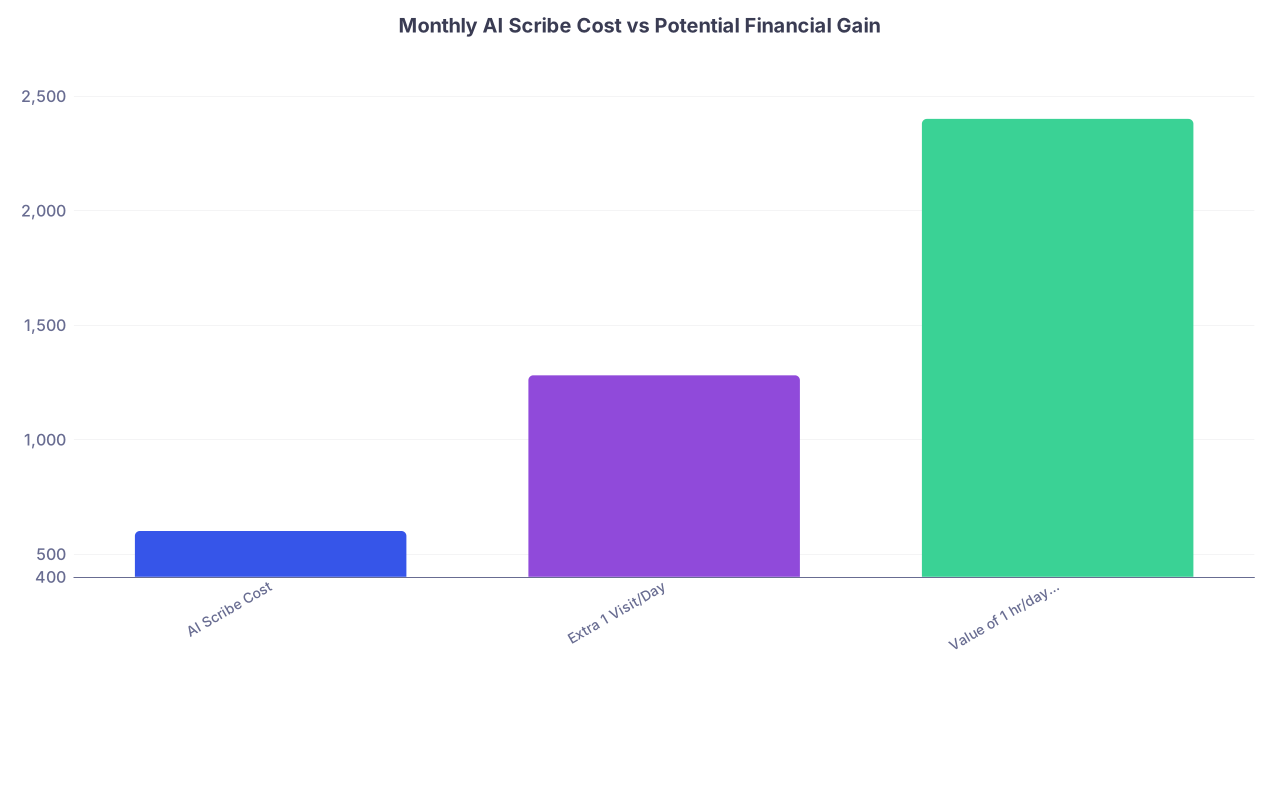
- AI scribe cost: $600/month
- You work 4 clinic days/week, ~16 days/month
- So, cost per clinic day ≈ $600 / 16 = $37.50
- Cost per clinic hour (8‑hour day) ≈ $4.70/hour
Now what might it gain you?
Scenario 1: You can see just ONE more established patient per clinic day because your charting time per visit drops by 3–5 minutes.
Say:
- Average net revenue to the practice per follow-up: $80 (after payer mix / write-offs)
- One extra patient/day x 16 days = $1,280/month
You’re paying $600, getting $1,280. Financially that’s a win.
Even if you’re in a capitation or salary model and don’t personally see that margin, your group or system does. That’s your angle when you ask them to pay for it.
Scenario 2: You don’t want to see more patients. You want your life back.
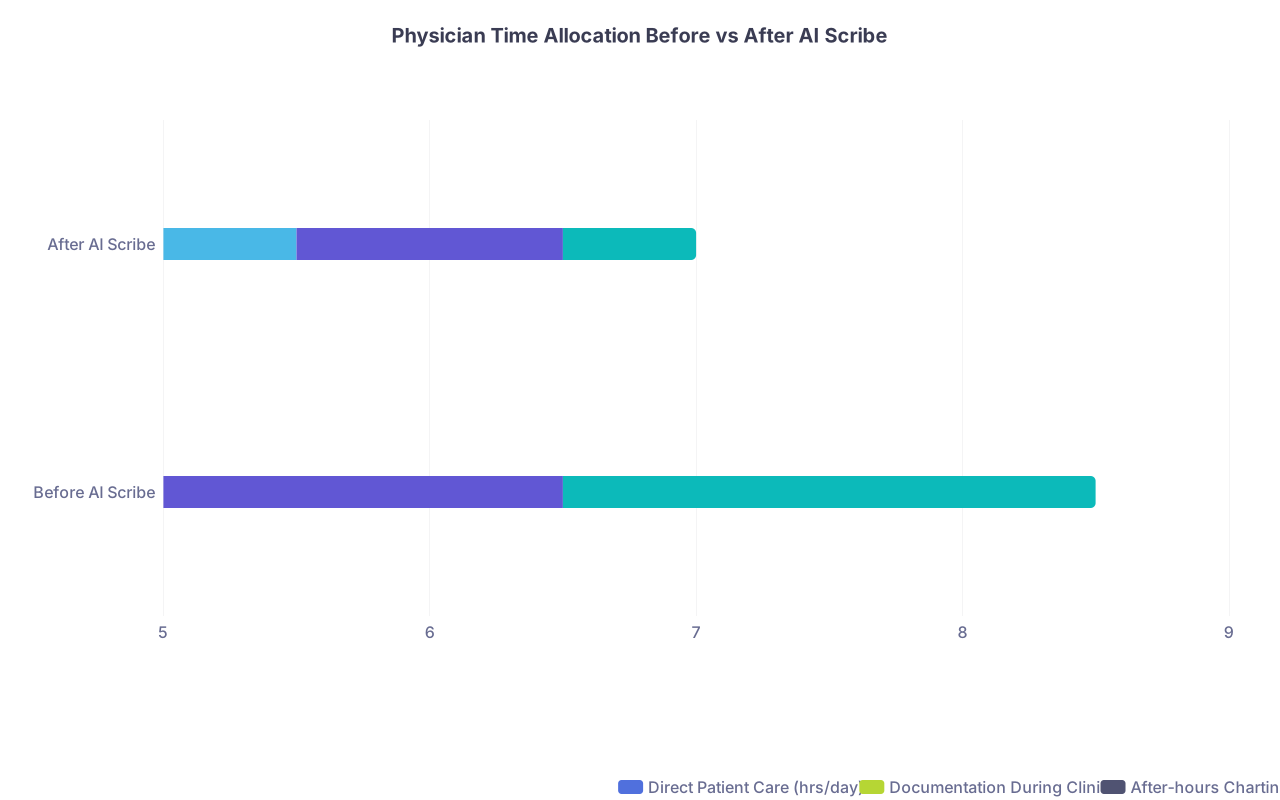
You save, say, 1–1.5 hours/day of after-hours documentation. No extra visits. Pure time.
What’s your time worth?
- Let’s pretend your fully loaded hourly value is $150–$250 (which is conservative for most specialists)
- Saving 1 hour/day x 16 days = 16 hours/month
- 16 hours x $150 = $2,400 “value” in recovered time
Even if you only half-believe that number, it dwarfs $600.
The key question: will you actually save that much time? If your notes are already 3 lines and you click fast, maybe not. If you’re in family med, cards, ortho, pain, oncology, etc., and you’re writing long problem-based notes, the time saved is real.
| Category | Value |
|---|---|
| AI Scribe Cost | 600 |
| Extra 1 Visit/Day | 1280 |
| Value of 1 hr/day Saved | 2400 |
When the math doesn’t work
AI scribes are NOT worth it, or at least marginal, if:
- Your clinic volume is low (e.g., boutique concierge with 4–6 patients/day and you already spend a lot of time with each)
- You’re in a tightly capped system with no incentive for throughput and no real burnout relief (e.g., protected admin time, decent templates)
- You’re mostly procedural with minimal documentation per encounter (e.g., quick injections, very template-able ortho follow-ups)
In those settings a good template + smartphrases + occasional dictation might be enough.
3. Legal, Compliance, and Risk: Where AI Scribes Get Hairy
Here’s where people get nervous—and rightly so. You’re putting PHI into a black box that’s drafting legal documents (your notes). Let’s break the risk down.
HIPAA and BAAs
If you take nothing else from this section, take this:
You need a Business Associate Agreement (BAA). Full stop.
If a vendor:
- Handles PHI
- Stores audio or transcripts
- Integrates with your EHR
They must be HIPAA-compliant and sign a BAA with whoever is the covered entity (your practice, hospital, health system). No BAA = huge red flag.
Data storage and use
Questions you should directly ask every vendor:
- Where is data stored?
- Is audio stored long-term, or only transiently processed?
- Is data used to train models? If so, is it de-identified? Can I opt out?
- How long do you retain PHI?
- What’s your breach protocol?
If they can’t clearly answer within 2–3 minutes, they’re not mature enough for clinical use.
Who “owns” the note?
Legally, you do. The AI is a drafting tool, like a dictation buddy. That means:
- You must review and edit every note
- You’re responsible if the note says “patient denies chest pain” when they very much did have chest pain
- You can’t blame the AI in court; it’ll play badly
That also means your workflow needs to reinforce: read the damn note. Don’t autopilot sign.
4. Documentation Quality, Liability, and Malpractice Risk
Everybody asks this: “Will an AI scribe increase my malpractice risk?”
The honest answer: used correctly, it probably reduces certain risks and introduces new, but manageable, ones.
Where AI scribes help legally
- Completeness: They’re weirdly good at capturing all the little context phrases you actually said but never had time to type: discussions of risks/benefits, patient refusals, shared decision-making.
- Consistency: Fewer half-finished notes, fewer “see prior note” disasters.
- Timeliness: More notes done same-day, which looks a lot better in audits and litigation.
I’ve seen physicians go from “I’ll try to document that conversation later” to having exact language show up in the note, like: “We discussed that not obtaining the CT scan could miss a small bleed; patient declined after understanding this risk.” That’s gold in court.
Where AI scribes can hurt you
Hallucinations
The AI may “infer” an exam or ROS element that never happened. Example: It defaults to “No calf tenderness” when you never mentioned calves. That’s a problem.Mitigation: Turn off auto-exam inference unless you’re absolutely sure you’ll edit. Use templates that say “Exam as performed and documented above” and make sure they match.
Over-documentation
The note can look like you performed a 45-minute cognitive evaluation when you spent 8 minutes on it. That can be used both ways in court—“You must have had time to catch this.”Copy-forward errors on steroids
If you don’t review, the same incorrect problem list or plan can propagate across weeks of visits.
Your policy should be: AI drafts, physician curates. If you’re signing notes you haven’t read, you’re gambling.
5. Practical Implementation: Solo vs Group vs Employed
This is where the “Is it worth it?” question really depends on your setup.
1) Solo / small independent practice
Pros:
- You control everything: purchase, implementation, workflow.
- You capture all upside from extra visits or productivity.
- You can pivot fast if a tool sucks.
Cons:
- You eat the full cost.
- You have to handle IT/security vetting and BAAs (or pay someone to).
Rule of thumb: If you’re seeing 15+ patients/day and documenting yourself, an AI scribe is very likely worth it financially and personally. Trial 1–2 vendors, negotiate down the price (they will negotiate, especially if you’re willing to be a reference site), and give it 60–90 days.
2) Medium to large group practice
This is where the math loves AI scribes:
- You spread implementation and IT overhead.
- You can negotiate much lower per-provider pricing on volume.
- You can standardize templates and workflows so notes are more uniform.
You should absolutely be modeling:
- Incremental RVUs from:
- Added visits
- Better closed care gaps
- Improved documentation supporting higher codes (when justified)
- Physician retention and recruitment:
- “We provide AI scribes for all full-time clinicians” is a recruiting perk now, like scribes were 10 years ago.
| Category | Direct Patient Care (hrs/day) | Documentation During Clinic | After-hours Charting |
|---|---|---|---|
| Before AI Scribe | 5 | 1.5 | 2 |
| After AI Scribe | 5.5 | 1 | 0.5 |
3) Employed physician in a health system
Here the key is leverage and framing.
Your direct cost: $0 (if they pay for it).
Your leverage: burnout, recruitment, throughput, patient access.
How to frame it when you talk to leadership:
- “Here’s my average after-hours charting per day: X hours.”
- “If that drops, I can either:
- Add 2–3 visits/day, or
- Maintain volume and lower burnout / risk of turnover.”
- “Our specialty recruitment is already painful and expensive. This is cheaper than replacing me.”
If you’re in a RVU-heavy contract, you should also push for clarity on:
- Who pays?
- Will they expect more RVUs?
- Are they willing to build AI scribes into everyone’s workflow, not just top producers?
6. Choosing a Vendor: What Actually Matters
Skip the hype, ask pointed questions. Here’s the short checklist.
Integration
- Does it plug directly into your EHR (Epic, Cerner, Athena, etc.)?
- Can it place notes, problem lists, orders, or just text blobs?
Latency and reliability
- How long from end-of-visit to usable draft? (Target: <5 minutes, ideally near real-time)
- What’s your uptime? (You want >99%)
Note style control
- Can you control template structure (SOAP vs problem-oriented vs specialty-specific)?
- Can you tune length? (Nobody wants 3 pages of fluff.)
Security & compliance
- Signed BAA?
- US-based data centers?
- Clear policy on PHI retention and model training?
Specialty support
- Do they have real examples in your specialty?
- Can they handle your vocab (onc regimens, rheum drugs, interventional terminology, etc.)?
Pilot structure
- Do they offer a time-limited pilot with defined success metrics?
- Can you exit cleanly if it’s not working?

| Step | Description |
|---|---|
| Step 1 | Identify Pain Point |
| Step 2 | Estimate Extra Visits |
| Step 3 | Estimate Hours Saved |
| Step 4 | Shortlist Vendors |
| Step 5 | Check Integration and Security |
| Step 6 | Pilot with 3-5 Clinicians |
| Step 7 | Expand to Group |
| Step 8 | Switch or Drop Vendor |
| Step 9 | Need Revenue or Time? |
| Step 10 | ROI and Satisfaction Positive? |
7. Red Flags and Common Mistakes
Let me be blunt. If you do these, you’re asking for trouble.
Using a consumer AI note app with NO BAA for real PHI.
This is how you end up on the wrong side of a HIPAA investigation.Autopilot signing without reading the note.
Plaintiff attorneys will eat that alive in deposition.Assuming “AI will fix our documentation problems.”
It won’t. Garbage conversation in → slightly cleaner garbage out.Buying enterprise-wide because a C-suite exec saw a demo.
You pilot first. On real clinicians with real volume and measure:- After-hours charting time
- Visit throughput
- Clinician satisfaction

8. Bottom Line: Is an AI Scribe Worth It?
If you’re a typical post-residency physician in clinic-heavy practice—primary care, IM subspecialty, many surgical subspecialties—yes, an AI scribe is very likely worth the cost, with three big caveats:
- You pick a serious, compliant vendor with a BAA and real EHR integration.
- You actually change your workflow and stop doing double-documentation.
- You keep clinical ownership of the note and don’t sign what you haven’t read.
If you’re low-volume, documentation-light, or already have excellent human scribe support that you like and can afford, the ROI is less obvious. In those cases, a hybrid model (AI for some, humans for others) may be smarter.

FAQs

1. Is an AI scribe HIPAA-compliant?
It can be, but not automatically. HIPAA compliance depends on the vendor’s infrastructure and whether they sign a BAA with your organization. Any AI scribe you use with real patient data must:
- Encrypt PHI in transit and at rest
- Limit access to authorized staff
- Have clear breach protocols
- Provide a BAA to your practice or health system
If there’s no BAA, you shouldn’t use them with PHI. Period.
2. Can I use ChatGPT or a generic AI tool to write notes?
Not for real PHI in production practice. Generic consumer tools aren’t configured as HIPAA-compliant services for covered entities. If you want to experiment, you’d have to fully de-identify (properly, not “I removed the name”) and still keep any generated note fully under your review. For day-to-day clinical notes tied to patients, stick to vendors with BAAs and healthcare-specific products.
3. Who is legally responsible if an AI scribe makes a documentation error?
You are. The physician of record remains responsible for the content of the note. AI is treated as a drafting tool, not an independent actor. If the note says the patient denied a symptom they actually had, or that an exam was done when it wasn’t, you own that in court. That’s why reviewing and editing every note is non-negotiable.
4. Will an AI scribe help me bill higher levels (e.g., more 99214/99215)?
It can support proper higher-level coding by capturing more complete history, exam, and decision-making details that you truly performed. But it doesn’t magically justify upcoding. If you didn’t actually review multiple external notes, manage high risk, or do complex decision-making, you shouldn’t code like you did just because the note looks impressive. Auditors care about reality, not prose.
5. Are AI scribes better than human scribes?
They’re different tools. AI scribes are:
- Cheaper at scale
- Available consistently (no sick days, no turnover)
- Easier to deploy across locations
Human scribes:
- Handle ambiguity better in real time
- Can manage orders, phone calls, and in-basket work in some models
- May understand nuanced local workflows deeply
For many practices, AI scribes either replace remote scribes or create a hybrid model (e.g., AI for standard visits, humans for complex or procedural days). Financially, AI usually wins on cost; operationally, humans can still be superior in very complex clinics.
6. How do I know if an AI scribe is actually saving me time?
Track it. For 2–4 weeks before the pilot:
- Note average time leaving clinic after last patient
- Note approximate after-hours charting time/night
Then during the pilot:
- Track the same numbers weekly
- Ask: Are most notes done by the end of each session?
- Check your in-basket and unfinished notes queues
If you’re not seeing at least 30–60 minutes/day of reduction after 2–3 weeks of use, either the tool isn’t good enough, or your workflow hasn’t changed enough. That’s your signal to tweak or switch.
7. Should I pay for an AI scribe personally if my employer won’t?
It depends how miserable you are and how your comp is structured.
You might consider paying personally if:
- You’re on heavy RVU incentive and can easily add more visits
- Your burnout from documentation is very high
- $500–$700/month feels acceptable to protect your sanity and family time
I’d push hard first to get your group or system to fund it, framing it as both an access and retention solution. But if they refuse and you’re drowning in charts, yes, some physicians are paying out of pocket and still feel it’s worth every dollar.
Key takeaways:
- Financially, AI scribes usually pay for themselves if you’re seeing moderate-to-high clinic volume and actually adjust your workflow.
- Legally, they’re tools, not shields—you stay responsible for the note, so you must review and choose a HIPAA-compliant, BAA-backed vendor.
- The real value is reclaimed time and reduced burnout; if you don’t feel that within a couple of months, don’t be sentimental—switch or walk away.