
The way you move your mouse in Epic or Cerner is already on the negotiation table. You just do not realize it yet.
Everyone obsesses over RVU rates, comp models, and “fair market value.” Almost nobody talks about the one lever that quietly determines whether any RVU rate will work in your favor: how efficiently you convert EHR clicks into billable work.
Program directors never teach this. Admins will not say it out loud. But behind closed doors, when they talk about whether you’re “worth” improving the RVU rate, they’re not just looking at your total wRVUs. They’re looking at how many resources you consume per RVU. And your EHR efficiency is a massive, hidden part of that.
Let me walk you through how it actually plays out.
The RVU Story You’re Told vs. The One They Use
The public story is simple: RVUs measure your work; compensation is some multiplier of your wRVUs; negotiate the multiplier and you win.
That’s the brochure version.
In real life, leadership looks at you as a production system. Inputs and outputs. And your EHR behavior is the single biggest digital footprint of how “expensive” it is to get RVUs out of you.
They pay attention to three quiet questions:
- How much support do you need per RVU?
- How much non-billable time do you burn in the EHR?
- How much risk do your documentation habits create?
Those three answers are often more important than the RVU rate you’re arguing about.
Here’s the part you’re rarely told: every modern system has analytics dashboards on provider usage. They know:
- Average chart closure time
- Inbasket message volume and response time
- Clicks per note / time per note
- % of visits closed same-day vs. days later
- How often coders have to “fix” or downgrade your charges
- How many IT tickets you submit; how often you ask for EHR “exceptions”
Not because they’re bored. Because they’re modeling cost and risk per RVU.
How Admins Quietly Score Your “RVU Efficiency”
I’ve sat in meetings where a physician asks for a bump from, say, $48 to $55 per wRVU. Admin leaves the room, pulls up a dashboard, and the conversation sounds like this:
“Dr. A wants a higher rate.” “Current?” “$48/wRVU.” “Production?” “5,500 wRVUs this year.” “Support?” “Two MAs, 0.5 FTE scribe, constant complaints about inbox volume. Charts open for days. Coders say documentation is sloppy. Denial rate higher than peers.” Pause. “Hard no. We’ll lose money increasing their rate.”
Did that physician’s RVU volume matter? Sure. But their EHR-driven “cost per RVU” killed their bargaining power.
Contrast that with someone else:
“Dr. B is asking to renegotiate.” “Numbers?” “6,200 wRVUs, same clinic template as peers. No scribe, one MA, closes 95% of notes same day. Lowest denial rate in the group. Inbasket metrics solid. Minimal IT noise.” Response? “Okay, we can talk. Show me the comp survey ranges.”
Let’s be clear: both are “productive” doctors. Only one is EHR-efficient. And only one gets serious consideration when they ask for better RVU terms.
The Hidden Math: EHR Time vs. Paid RVUs
You think about your time like this: clinic session, patient volume, RVUs generated. Leadership layers another dimension on top: non-compensated EHR time required to produce that volume.
Here’s the quiet calculation they’re running:
Net revenue per RVU – (direct comp per RVU + overhead per RVU + EHR friction per RVU).
That last term—EHR friction—is where you live or die.
EHR friction per RVU includes:
- Extra FTEs needed (MA, scribe, coder, RN) to compensate for your inefficiency
- After-hours EHR time that increases burnout risk (and turnover costs)
- Delay in billing when notes stay open
- Higher denial rates from weak documentation
- Litigation exposure from copy-paste trash and poorly updated problem lists
They can’t put a clean dollar number on all of it, but they can see its footprint. And they adjust their appetite for raising your RVU rate accordingly.
To make it even more concrete, here’s how this commonly looks in internal comparisons.
| Metric | Dr. Efficient | Dr. Inefficient |
|---|---|---|
| Annual wRVUs | 6,000 | 6,000 |
| Notes closed same day | 92% | 45% |
| Average after-hours EHR (hrs/wk) | 2 | 10 |
| Denial rate | 3% | 9% |
| Support staff per clinic day | 1 MA | 1 MA + scribe |
On paper they produce the same RVUs. In reality, one is cheap and low-risk to operate. The other is expensive and fragile. Guess which one gets leverage when negotiations start.
How EHR Efficiency Shows Up in Negotiation Rooms
No one walks into your RVU negotiation and says, “We pulled your Epic usage stats and decided you’re inefficient.”
That would cause a political mess.
They do it indirectly. Here’s what it looks like from the inside.
1. “Template inflexibility” excuses
If you’re chronically behind on charts and your templates are a known problem, leadership will use that against you.
“We understand you’re working hard, but the documentation remains incomplete. Before we talk about a higher per-RVU rate, we’d really like to see improved documentation metrics and fewer coding downgrades.”
That’s admin-speak for: you’re sloppy or slow in the EHR, and we’re already paying for it.
2. “You already need more support”
I’ve seen this line used verbatim:
“Your current FTE support per clinic session is already above group norms. Increasing your rate would put you well above market when we factor total cost.”
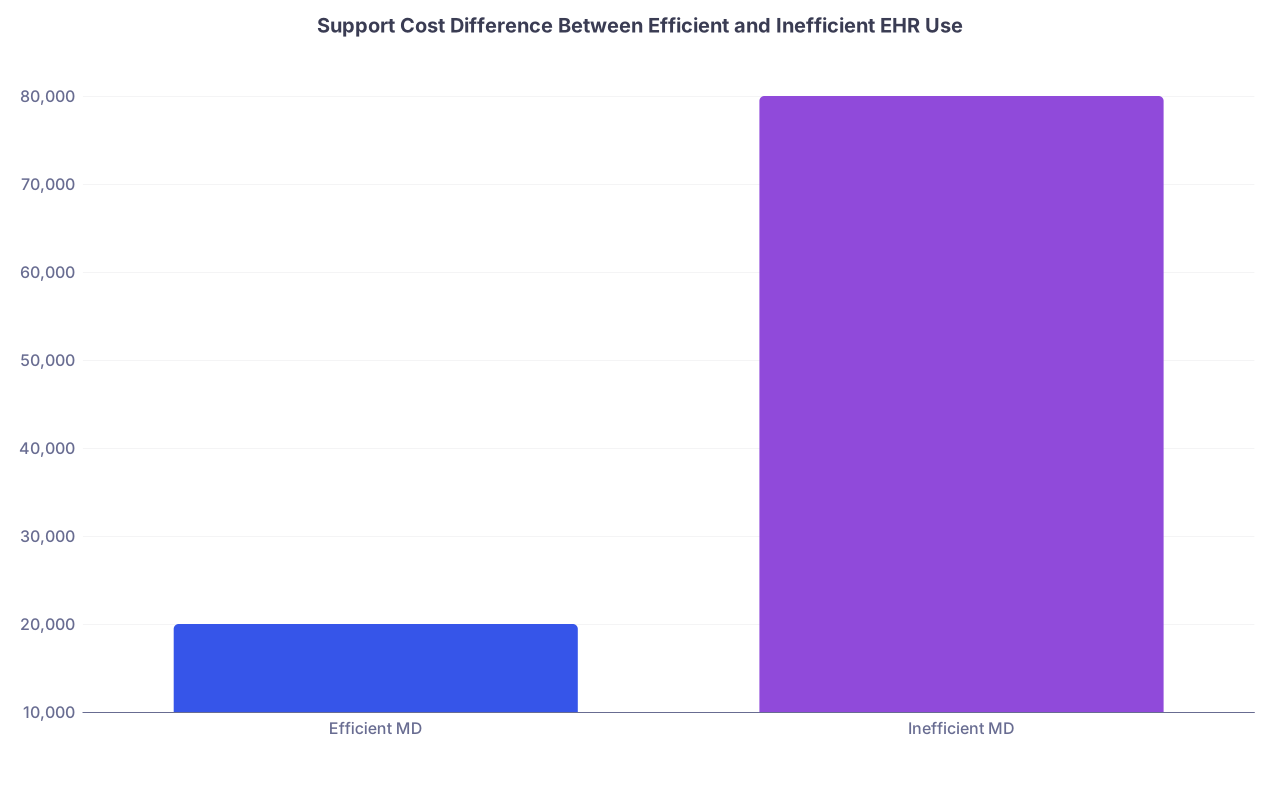
Translation: your EHR strain is costing us an extra MA/scribe/nurse. You’re expensive before we even touch the RVU number.
| Category | Value |
|---|---|
| Efficient MD | 20000 |
| Inefficient MD | 80000 |
Those numbers aren’t fantasy. A half FTE scribe plus fractional RN work to clean up your mess can easily run tens of thousands of dollars annually. They bake that into how much they’re willing to pay you per RVU.
3. “We’re worried about sustainability”
Admin knows EHR misery is a burnout accelerant. If all your RVUs come at the cost of 12 hours a week of pajama time, they don’t trust your longevity.
I’ve seen CMOs say:
“Look, the production is good, but the way they get there isn’t sustainable. I’m not improving the rate on someone who might flame out in 18 months.”
They’re reading your burnout risk directly off your after-hours EHR report. If you’re not efficient, your own misery becomes a financial liability in their eyes.
The Quiet Metrics They Watch That You Don’t
You probably think you’re judged on:
- RVUs
- Patient satisfaction
- Quality metrics
Fair. But those are only the visible layer. The hidden layer is almost all EHR driven. Let me spell out the ones I’ve literally seen on admin dashboards.
Time to close encounter
They track average hours from visit end to note sign-off. If you consistently sit at 24–72 hours, they see lag in billing and higher error risk.
If you routinely close before leaving clinic? They see a machine. Even if your raw volume isn’t the absolute highest, your “low friction” rating helps you.
Seconds/minutes per note and template use
EHR usage logs show:
- Average time in note-writing per encounter
- How often you use smart phrases, dot phrases, order sets
- How much free-text vs. structured data you enter
People who:
- Build solid templates
- Use shortcuts
- Don’t reinvent the wheel each time
… consume fewer IT, scribe, and coder resources. And admin knows it.
EHR + coding synergy
Coding audits reveal who’s doing clean, billable documentation versus who constantly leaves money on the table or forces coders to chase clarification.
Coders will absolutely complain about you to leadership. I’ve heard:
“Dr. X’s notes are vague and unstructured. We downgrade constantly. We have to query them on basic stuff. It takes extra time to code their charts.”
When that happens, your ask for a better RVU rate lands on a table where people already think: “You’re wasting revenue we should have captured with better documentation. Why would we pay you more per RVU?”
Why EHR Efficiency Is a Negotiation Weapon (If You Use It Right)
Now the part no one tells you: EHR efficiency isn’t just a pass/fail metric. You can weaponize it in negotiations if you bring data instead of complaining.
Most physicians walk into RVU talks with:
- MGMA benchmark printouts
- “This is what my friend makes at [competing system]”
- A vague sense of “I’m working harder than ever”
The admin side walks in with dashboards on your throughput, your EHR behavior, and your cost footprint.
If you’re actually efficient, but you don’t articulate it, you’re leaving leverage on the table.
Here’s how an efficient physician should come to the table:
- “My wRVUs are at the 75th percentile.”
- “My same-day closure rate is over 90%.”
- “My denial rate is below group average.”
- “I run without a scribe and minimal MA support.”
- “My after-hours EHR time is consistently low.”
Those are not just bragging points. They’re cost arguments. You’re telling them: “You’re getting these RVUs at a discount. I want some of that discount back in my rate.”

| Step | Description |
|---|---|
| Step 1 | EHR Efficiency |
| Step 2 | Lower Support Cost |
| Step 3 | Lower Denials Risk |
| Step 4 | Faster Billing |
| Step 5 | Lower Cost per RVU |
| Step 6 | Higher Admin Willingness to Improve Rate |
If you’re inefficient, you still need to understand the game. Because right now, you’re likely negotiating blind with a handicap you don’t even realize you have.
Concrete EHR Behaviors That Change Your RVU Story
Let’s get out of theory. These are the exact patterns that program directors and chairs quietly talk about when they say someone is “high value” versus “high maintenance.”
1. Note closure habits
Doctors who:
- Finish >80–90% of notes before leaving clinic
- Have minimal “open encounter” lists
- Rarely need coders to chase them
Get labeled as low-friction producers. They’re safe bets to invest in.
Doctors who:
- Carry 30, 50, 100+ open notes
- Require repeated reminders
- Blow up coders’ inbaskets with vague notes
Are seen as chronic problems. Even if they’re “busy.”
2. Template and smart tool usage
I’ve watched IT quietly pull reports on:
- Smartphrase coverage
- Order set adoption
- Time per encounter
One hospital I know literally used this to justify which physicians got access to scribes first. Highest documented EHR efficiency? Priority. The rest? “We’ll re-evaluate next budget cycle.”
You don’t need to be a tech wizard. But if you refuse to learn tools that cut your click load, you’re choosing to be expensive.

3. Inbasket and messaging
This one’s sneaky. Messaging volume is exploding, and many systems are starting to track:
- Average response time
- Number of touches per patient issue
- How many messages get escalated to staff
Physicians who:
- Use messaging templates
- Route appropriately to RN/MA
- Don’t let inbasket overflow explode
… again are low-friction producers.
Physicians who send disorganized replies, trigger more follow-ups, or let messages sit? They need more support per RVU, even if nobody says it that way to their face.
4. Copy-paste and compliance risk
Compliance officers and risk management watch two things that intersect directly with EHR usage:
- Copy-forward contamination (old problems dragged forever)
- Unrealistic exam documentation (full ROS + 12-point exam on every telehealth follow-up)
That stuff triggers audits. Audits cost time, reputation, and sometimes money.
If risk management sees your name a lot, no one in leadership is eager to boost your production incentives. They’re busy worrying about paying for a lawsuit triggered by your “template.”
How to Turn EHR Efficiency Into Negotiation Ammo
Let’s talk strategy. You’re post-residency, staring down your first or second contract. Or you’re a few years in and trying to renegotiate after proving yourself.
Here’s how to set this up so your EHR habits support your RVU ask instead of undermining it.
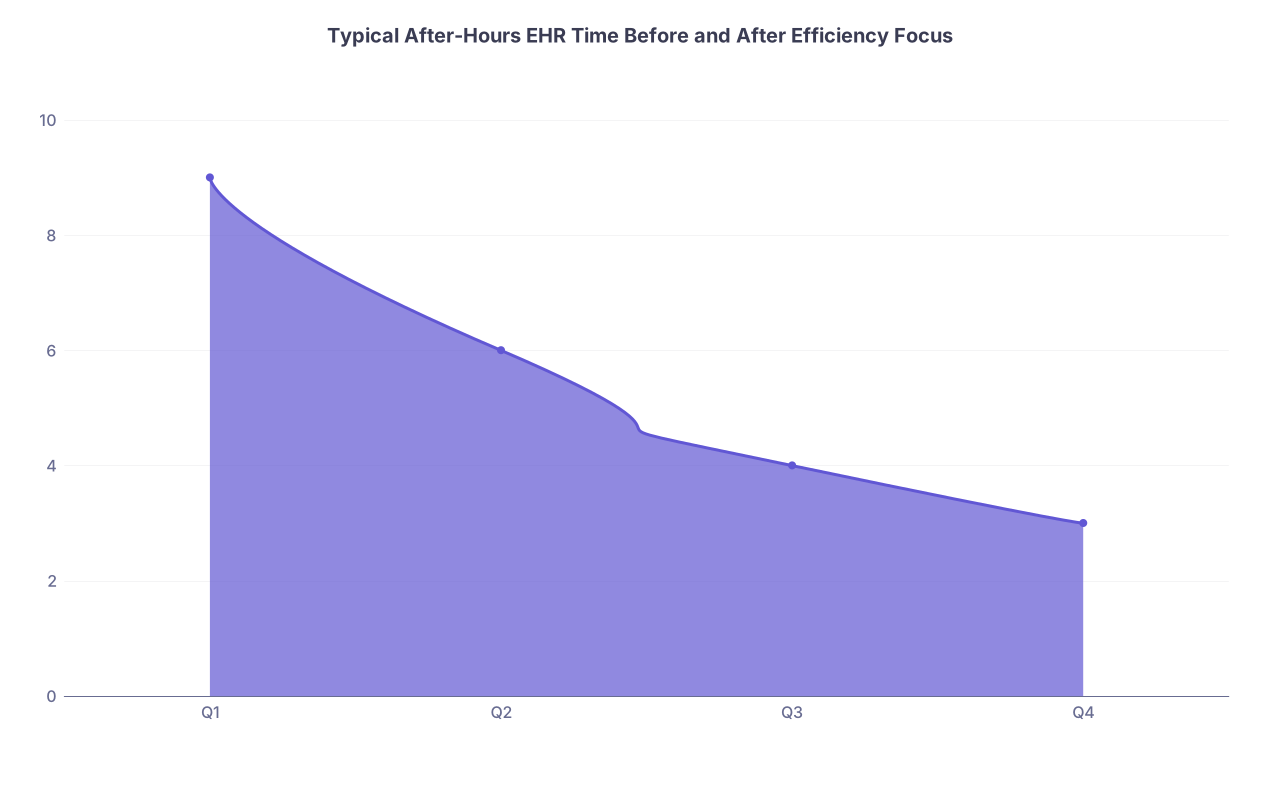
Step 1: Quietly get your own numbers
Before you even mention compensation, find:
- Your average wRVUs per year (and percentile vs. benchmarks)
- Your same-day closure rate (ask informally if you can’t see it yourself)
- Your average after-hours EHR time (Epic’s “Signal” or similar tools show this)
- Any data on denial rates or coder feedback
You don’t need a perfect spreadsheet. You need enough to say, confidently: “I am not the problem child.”
| Category | Value |
|---|---|
| Q1 | 9 |
| Q2 | 6 |
| Q3 | 4 |
| Q4 | 3 |
Then improve what you can for 3–6 months before formal talks. Close more notes same-day. Use better templates. Clean up your inbasket habit.
Step 2: Build the narrative explicitly
You go into that meeting and you do not just say “I work hard.” You say:
“I’ve maintained X wRVUs annually, which is around the [50/75/90]th percentile. I close over 90% of my notes same-day. My after-hours EHR usage is low for my volume. I run with minimal extra support. So when we talk about my RVU rate, we’re talking about RVUs that come with low overhead and timely billing.”
You frame yourself as cheap to operate. Easier to justify better rates.

Step 3: Anticipate the “support cost” pushback
If they say, “We can’t raise your rate; everyone is at X,” you counter carefully:
“I understand the group rate. But I’d like to highlight that my production requires less support than many peers: fewer open encounters, minimal coder rework, low denial rate, and sustainable EHR time. That lowers the cost per RVU on your side. I’m asking to share some of that efficiency upside.”
You are not whining. You are pointing out a financial truth they already know but won’t volunteer.
Step 4: If you’re inefficient right now, change the conversation
Suppose you’re the one with 80 open charts and 12 hours a week of pajama time. Fine. Don’t pretend otherwise. Instead:
- Spend 3–6 months aggressively fixing it: templates, training, shadowing the efficient doc down the hall.
- Then, when you negotiate: “I know my chart closure and EHR time were pain points before. I’ve improved X, Y, Z, and the metrics now reflect that. My current performance is much closer to group leaders. I’d like my RVU structure to reflect that improvement going forward.”
You acknowledge the past without letting them anchor your future to it.
One More Uncomfortable Truth: EHR Misery Is Used Against You
Burnout language gets thrown around a lot, but behind closed doors, the thinking often sounds different.
Administrators see two attendings:
- Both at 6,000 wRVUs.
- One closes notes in clinic, minimal pajama time, no drama.
- One documents until midnight, constantly complains about the EHR, threatens to leave every quarter.
If there’s money to sweeten someone’s deal, it almost never goes to the second one first. Why? Because leadership assumes no amount of money will fix that person’s misery if the underlying EHR behavior doesn’t change. They view it as throwing cash into a fire.
Your EHR efficiency isn’t just a productivity metric. It’s your credibility when you say, “This workload is sustainable, and I’m worth investing in.”

If you’re drowning in clicks because no one ever trained you properly? That’s fixable. But if you don’t fix it, it will quietly cap your compensation ceiling, no matter how many flashy RVU numbers you throw on a PowerPoint.
The Bottom Line
Three things to remember.
First, RVU negotiations are never just about the RVU rate. They’re about the total cost of getting those RVUs out of you. EHR efficiency—how fast, clean, and low-drama your documentation and messaging are—is a huge, hidden part of that cost.
Second, your EHR data is already being watched. Time to close notes, after-hours use, denial rates, coder complaints, support needs—those patterns shape whether leadership sees you as high value or high maintenance long before you walk into any negotiation.
Third, if you can produce RVUs with clean documentation, low friction, and sustainable EHR habits, you have a powerful argument: “You’re getting these RVUs at a discount. I deserve a better share.” If you ignore that reality, you’ll keep fighting over pennies on the RVU rate while leaving thousands on the table every year.