
The partners are not asking about your EHR habits to be polite. They’re trying to figure out if you’re going to quietly generate revenue… or quietly destroy their margins, staff morale, and malpractice risk.
I’ve sat in on those hiring meetings. The formal interview ends, the candidate leaves, the door closes—and the conversation immediately turns to: “Is this person going to be a charting black hole?”
Not your research. Not your chief year. Your documentation.
The Real Question Behind Every EHR Conversation
Nobody phrases it this bluntly in the interview, but this is the subtext:
“Will this doc chart fast, code correctly, not piss off the MAs, and stay out of legal trouble without needing us to babysit?”
When a group of partners is deciding whether to hire you, they care about three EHR-related risks:
- You’re slow – you stay late charting, clog the schedule, and need scribes or extra support.
- You’re sloppy – poor documentation, copy-paste garbage, missing critical elements, risk for audits and malpractice.
- You’re high-maintenance – constantly complaining about the system, demanding custom workflows, draining IT and admin energy.
That’s it. Everything they ask about EHR use is a proxy for one of those.
And no, they don’t believe what you say. They believe what your behavior reveals.
What Partners Actually Ask (And What They’re Really Listening For)
Let me walk you through the common questions you’ll hear—and the real scorecard running in the partners’ heads when you answer.
1. “What EHRs have you used? How comfortable are you with them?”
Surface-level question. Hidden evaluation.
They’re not trying to quiz you on Epic vs Cerner. They’re trying to answer: “How long is this person’s onboarding going to be, and will they constantly say ‘but my last place did it this way’?”
When you say:
- “We used Epic in residency, and I’m very comfortable with it. I used mostly the outpatient flows, inbasket, and created my own templates.”
That sounds like: low training burden, probably competent in workflows, can adapt.
When you say:
- “Honestly I hate EHRs. We used [EHR X] and it was awful. I’m more of a paper person.”
The room hears: high-risk hire, will resist workflows, probably poor documentation habits, may be slow.
I’ve watched two candidates with identical CVs get completely different feedback based on this question alone. One said:
“I got fast with Epic because finishing notes by the end of clinic was the only way I survived.”
The other:
“I don’t really pay attention to which system. They all suck.”
First one got an offer. Second one did not. Same program, same specialty.
Partners don’t expect you to love EHRs. They expect you not to be the problem.
2. “Do you typically finish your notes during clinic or after hours?”
This is the million-dollar question.
They’re not curious. They’re calculating: “Are we inheriting someone whose RVUs look great on paper but who will bleed out in burnout and overtime while dragging others down?”
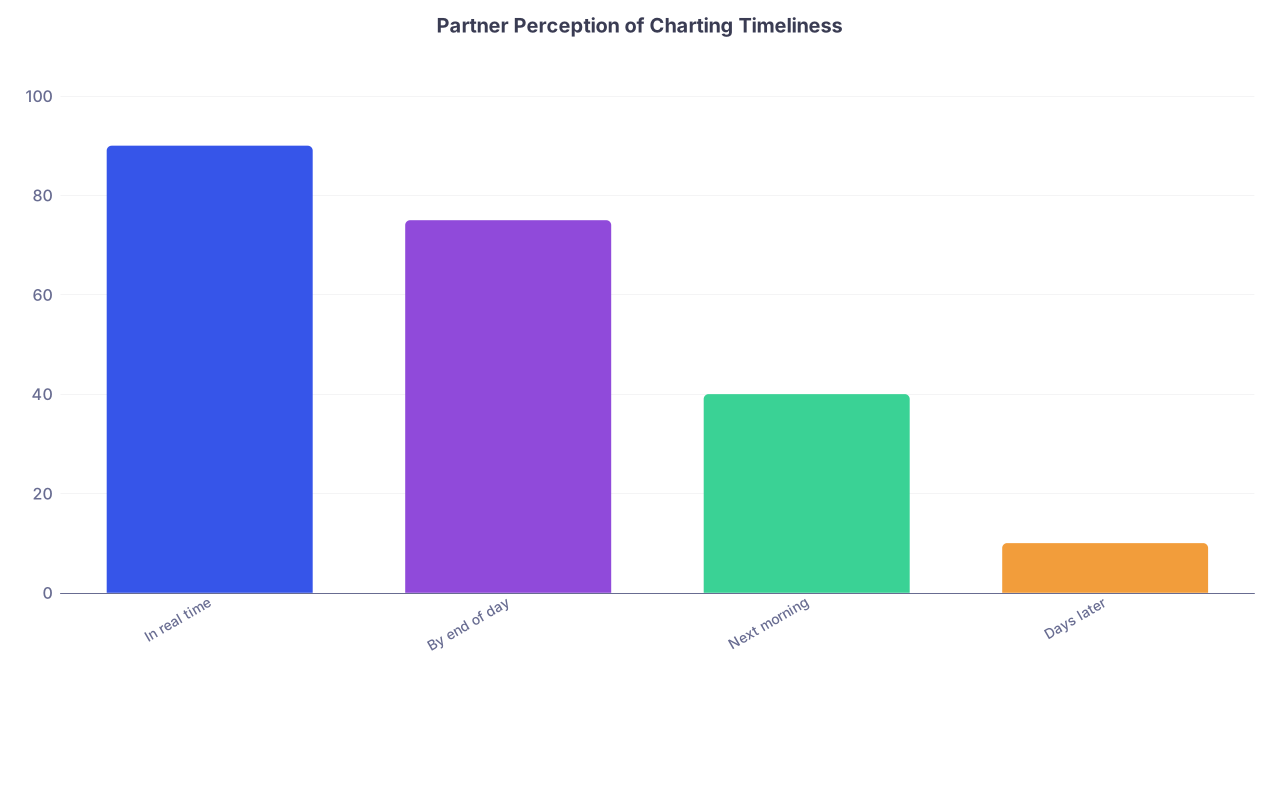
Here’s the internal scoring system people use, whether they admit it or not:
| Category | Value |
|---|---|
| In real time | 90 |
| By end of day | 75 |
| Next morning | 40 |
| Days later | 10 |
Those numbers are not productivity; they’re likelihood of being viewed as a low-drama, safe hire.
“In real time” doesn’t have to mean literally every note finished during the visit, but they want to hear some version of:
“I aim to finish the vast majority of my notes before I leave for the day. I usually close encounters either during small gaps in clinic or immediately after the last patient. I don’t like carrying charts over.”
What raises red flags is the casual attitude:
“Oh, I prefer to really think through my notes at home. I’ll usually finish later in the evening.”
Partners have heard that story. It usually comes with:
- Delayed billing
- Angry coders
- Staff chasing you for signatures, scripts, letters
- A growing inbasket because you’re already behind
The worst answer I’ve heard (from a smart, otherwise strong candidate):
“I don’t rush my documentation. If that means I finish some charts over the weekend, I’m okay with that.”
The practice administrator’s face said everything.
3. “How do you manage inbasket messages and patient portal volume?”
This one is about behavior under stress and respect for the team.
They’re trying to figure out:
- Are you the doc who responds promptly and efficiently?
- Or the doc whose inbasket looks like a hoarder’s living room?
You don’t need a perfect system. But you need a system. The partners care more about having a method than about which method.
When you answer, they want to hear things like:
- You check the inbasket at defined times, not constantly between every patient.
- You use your staff appropriately (RNs, MAs) via protocols and routing.
- You set expectations with patients about what belongs in portal messages versus visits.
The quiet truth you won’t see on any job ad:
Some groups have a known problem-child partner whose inbasket is always overflowing. They are terrified of hiring a younger version of that person.
If you say you’re “very responsive” but then describe manually handling every refill, triage message, and prior auth yourself, it sounds impressive—but it makes experienced partners nervous. You look like someone who will burn out or start demanding a scribe, extra MA, or half days “for admin catch-up.”
4. “Do you use templates, dot phrases, or macros? How much do you rely on them?”
This is about efficiency vs laziness.
Partners are trying to separate two types of template users:
- The efficient doc – uses smart phrases, builds structured templates, updates them, customizes per patient.
- The dangerous doc – blanket copy-paste, template bloat, cloned nonsense, same 14-point ROS for every visit.
They are not against templates. In private conversations, many partners basically admit templates are what keep them functional. But they’ve also seen:
- Audit nightmares: cloned notes that don’t match the billed visit
- Legal issues: notes saying “normal exam” on a limb that was amputated years earlier
- Patient complaints: documentation completely disconnected from reality
A strong answer will sound something like:
“I do build and use templates heavily, especially for common visit types, but I’m careful to keep the subjective and plan sections very patient-specific. I’ll start with my template, then edit aggressively based on the encounter. I also try not to let templates get bloated with unnecessary text because that slows me down more than it helps.”
What they don’t want to hear:
“I have a template that pretty much covers everything, so I just use that for most visits.”
That’s how malpractice attorneys eat.
5. “Have you ever had issues with chart completion deadlines or coding audits?”
This is where you’re being tested for honesty and insight.
Yes, they can sometimes call your program or employer and sniff this out indirectly. But more often, they’re listening for your self-awareness.
If you say, “Never, I’ve always been perfect with documentation,” you sound naive at best, dishonest at worst. Everyone struggles early on.
The better route is selective vulnerability with a clear trajectory:
“In my first year, I struggled with keeping up with notes on heavy days and fell behind a few times. My PD pulled my data, and I worked with one of our senior residents to build better templates and block short ‘admin pauses’ during clinic. Since then I’ve been consistently on time with chart completion.”
That kind of answer tells them:
- You’ve been monitored.
- You improved.
- You didn’t blame the system, the staff, or the patients.
You know what makes them very nervous? This sentence:
“I’ve never really paid attention to coding levels—I just document and let billing figure it out.”
That’s not “humble.” That’s “liability.”
The Unspoken Metrics They’re Judging You On
Partners rarely say this out loud in interviews, but behind closed doors they’re rating you on four EHR metrics, whether they have the data or not.
| Dimension | What They Want To See |
|---|---|
| Speed | Finish most notes same day |
| Accuracy | Clean, specific documentation |
| Independence | Minimal IT hand-holding |
| Team Fit | Respects staff workflows |
After you leave, the conversation sounds like this:
- “Do you think she’s going to be slow? She talked a lot about thinking carefully about each chart…”
- “He gave me ‘I hate EHRs’ vibes. We have enough of that here already.”
- “She seemed very organized. Talked about inbasket routines. I like that.”
Nobody, and I mean nobody, says:
“What did you think of his Step score?”
How To Answer EHR Questions Like Someone Who’s Already Been in Practice
You’re coming out of residency or fellowship. You want to sound like someone who understands that EHR behavior is part of your professional identity, not just a headache.
Here’s how to present yourself like that.
Show you think in workflows, not complaints
Partners want physicians who can function inside the existing system, not redesign it from scratch.
So instead of ranting about “clicks,” talk in terms of:
- “Here’s how I batch my inbox work during the day.”
- “I try to keep my documentation as real-time as possible so I don’t rely on memory.”
- “For high-risk or complex patients, I slow down and document more thoroughly, but I adjust my schedule accordingly.”
You’re signaling: I don’t need hand-holding. I know how to operate in a system.
Signal that you respect billing and risk
You don’t need to be a coder. But you must show that you’re not blind to the economics.
When they ask about documentation, it’s fair to say something like:
“I try to document in a way that accurately reflects the complexity of the visit and supports appropriate coding. I’m not trying to game the system, but I also know under-documenting is just leaving money on the table for the practice and can look odd in audits.”
That phrase—“supports appropriate coding”—tells them you’re at least aware there’s a connection.
Most partners have lived through:
- Downcoded charts that tank revenue
- Upcoded charts that trigger audit fear
- Random levels with no documentation logic
They want a colleague who understands there’s a game being played, and at least knows they’re on the field.
Talk about specific tricks you actually use
Specifics are what separate the “interview answer” from the “this person actually does this” answer.
Examples that land well:
- “I built chief complaint–specific templates for my top ten visit types, and I keep the rest pretty free-form.”
- “I use smart phrases for patient instructions and follow-ups so I’m not reinventing common recommendations for every visit.”
- “I try to keep my macros lean; once a template gets too long, it’s actually slower.”
That last line? I’ve heard it from attendings who run 30+ patients a day and still leave by 5:30. When a candidate says it, partners recognize their own battle scars.
What They Ask the Staff About You (That You’ll Never Hear)
You think the partners are the only ones evaluating your EHR habits? No.
The quietest but most lethal feedback comes from:
- Clinic managers
- Lead MAs
- The nurse who’s been there 18 years and has outlasted 12 physicians
After you do a site visit or shadow day, partners will ask:
- “Did they seem comfortable in the system?”
- “Did they slow you down?”
- “Did they seem respectful of how you work?”
If you insisted on doing everything manually, refused to let the MA pend orders, or hovered and re-did their work, that’ll all get reported.
On the flip side, if you ask a lead MA:
“How do the docs here usually handle refills and messages? What’s the smoothest workflow you’ve seen?”
You earn massive points. You’ve shown that you’re willing to adapt to their best practices, not enforce yours.
I’ve seen a lead MA kill a candidacy with one sentence:
“Honestly, I think they’d be really high-maintenance with their charting.”
You won’t see that in any official email. You’ll just stop hearing back.
What You Should Ask Them About EHR (To Sound Like a Future Partner)
The biggest mistake candidates make? They act like EHR is a nuisance topic. So they say the bare minimum and change the subject.
Smart candidates use EHR questions to show they think like owners.
Ask questions like:
- “How does your group handle inbox coverage when someone is out or on vacation?”
- “Do you have shared templates or standardized documentation expectations for common visit types?”
- “Are there any EHR habits that have caused friction here in the past that I should avoid if I join?”
That third one is surgical. It does two jobs at once:
- Shows maturity: you know interpersonal friction and workflow problems are real.
- Gives you a roadmap of landmines. If they say, “We had someone who always left 30 unsigned charts,” you now know what behavior is radioactive.
You’re not just a job seeker anymore. You’re talking like someone who’s thinking, “If I join, how do I not become that partner?”
Red Flags You Raise Without Realizing It
Let me be blunt about a few “innocent” comments that partners hate.
“I’m not really a computer person.”
Translation in partner-speak:
“I will forever be behind, blame the system, and make everyone adapt to my discomfort.”
“I like to dictate long, detailed notes for every visit.”
Sometimes fine in certain subspecialties. But if you’re applying to a high-volume outpatient practice, what they actually hear is:
“You’ll either kill your own productivity or insist on expensive dictation/scribe resources.”
“I feel strongly that my MA should do X, Y, Z in the chart for me.”
Careful. If you’re walking into a system where MAs are already stretched, you’ve just told the partners you’ll clash with staff and demand more support than your peers.
“Honestly, I don’t think about metrics—I just focus on patient care.”
That might sound noble. Practices hear:
“I will be shocked and offended the first time anyone brings me data on my visit numbers, inbasket response times, or chart completion rates.”
Good groups want you to care about patient care and understand that the machine has to run.
A Quick Reality Check: How Much EHR Use Actually Matters in Hiring
To put it bluntly: for most mid-sized practices, your EHR habits matter more than your fellowship poster, your Step 1 score, or your med school name.
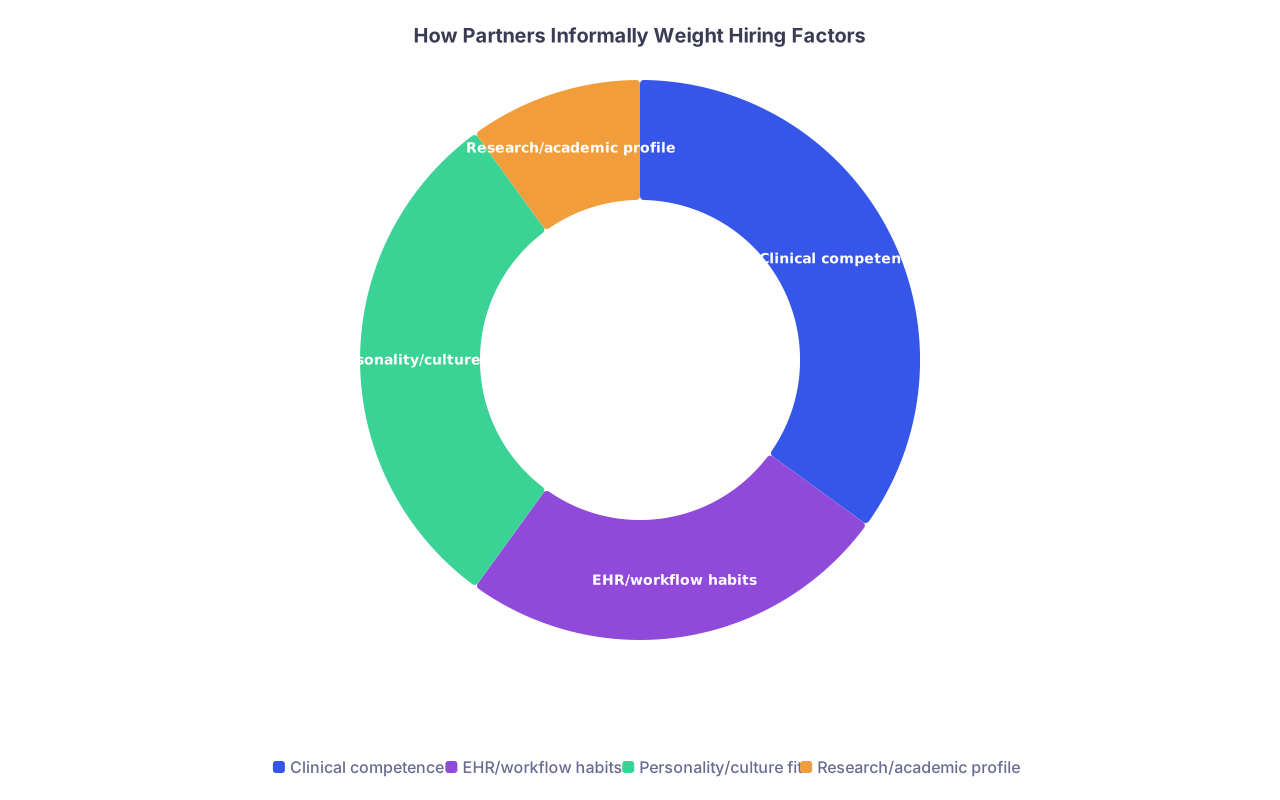
Here’s roughly how partners mentally weight things when they’re hiring a young attending (no one writes this down, but they think like this):
| Category | Value |
|---|---|
| Clinical competence | 35 |
| EHR/workflow habits | 25 |
| Personality/culture fit | 30 |
| Research/academic profile | 10 |
You can be slightly green clinically. They’ll teach you.
You can be less academic. Nobody cares in a community practice.
But if you’re a documentation disaster?
That pain shows up every single day—in staff complaints, admin frustrations, billing problems, and call coverage headaches.
A Simple Way to Prepare Before Interviews
If you want to sound like someone who’s already thought about this, sit down for 30 minutes before interview season and outline honest answers to these five questions:
- When do I usually finish my charts—and what have I done to improve that?
- How do I manage my inbox today—and how would that scale if my volume doubled?
- What tools in my current EHR actually make me faster—and how would I recreate them in a new system?
- When have I gotten feedback about my documentation—and what changed after?
- How do I use other team members (MAs, nurses) to streamline EHR work without dumping on them?
You’re not trying to craft perfect lines. You’re trying to be clear with yourself so that in the interview, your answers sound like your actual practice, not something you invented in the lobby.
The Bottom Line
Partners don’t care if you can recite every feature of Epic. They care if, at 4:45 p.m. with three patients left and 12 unfinished charts, you’re the kind of physician who rolls up their sleeves, uses the tools at hand, leans on their team appropriately, and gets it done—without drama.
Your EHR habits are not a side detail. They’re one of the most concrete predictors of whether you’ll be a high-functioning partner or a chronic problem to be “managed.”
Years from now, you won’t remember the exact phrasing of your EHR answers in those interviews. But you’ll be living, every day, with the documentation habits you bring into your first job. Make sure the story you tell partners matches the physician you actually are at 5 p.m. on a busy Tuesday.