
You are three months into your first attending job. It is 6:45 p.m., you are finishing notes so you can get out of the hospital, and a pop‑up reminder just blocked your cursor because you skipped three mandatory structured fields.
You stare at the screen and think: “Why do they care so much if I click a box or write a sentence? The note says the same thing.”
No. It does not say the same thing.
This is where the gap lives between “I documented it” and “the system can use it.” And that gap is exactly what decides whether your hospital can generate real analytics, justify staffing, negotiate payer contracts, and prove your outcomes—or just keep exporting garbage spreadsheets no one trusts.
Let me break this down specifically.
Discrete data vs free text: what we are actually talking about
At the most basic level:
- Discrete data = structured, codified, machine‑readable fields.
- Free text = narrative, unstructured prose that only a human (or a very sophisticated NLP pipeline) can reliably interpret.
What counts as discrete data?
You know these when you see them:
- Checkboxes (e.g., “Smoker: current / former / never”)
- Drop‑downs (e.g., “Disposition: home, SNF, rehab, expired”)
- Radio buttons and switches (e.g., “Sepsis present on admission: yes / no”)
- Numeric fields (e.g., “Pain score: 0–10”, “Glucose: 186 mg/dL”)
- Coded diagnoses and procedures (ICD‑10, SNOMED, CPT, LOINC)
- Time stamps and locations (e.g., arrival time, ICU transfer time)
These fields are often stored with underlying codes. You see “CHF with reduced EF”; the database sees I50.22. Your pulse ox 88% at 03:12 is actually a row in a vitals table with a patient ID, timestamp, and a LOINC code.
What counts as free text?
Everything else:
- HPI, assessment, and plan narrative
- Consult notes and discharge summaries
- Pathology and radiology reports (the prose part)
- Secure messages, chat, “sign‑out” text blobs
- “Other” text boxes used as a dumping ground
Clinically, free text is gold. It is how you express nuance, uncertainty, context, and reasoning. It is also where crucial details hide—social barriers, family dynamics, subtle exam findings.
From an analytics standpoint? Free text is a black box unless you throw serious NLP at it. And even then, you will never get to 100% fidelity.
Why your documentation format matters more once you are an attending
You are past residency; the game changed. Your documentation is no longer just “did I cover myself medicolegally.” It now feeds:
- Quality metrics tied to your compensation
- Service line budgets and FTE requests
- Negotiated payer contracts and risk adjustment
- Public reporting and rankings
- Internal research and QI projects
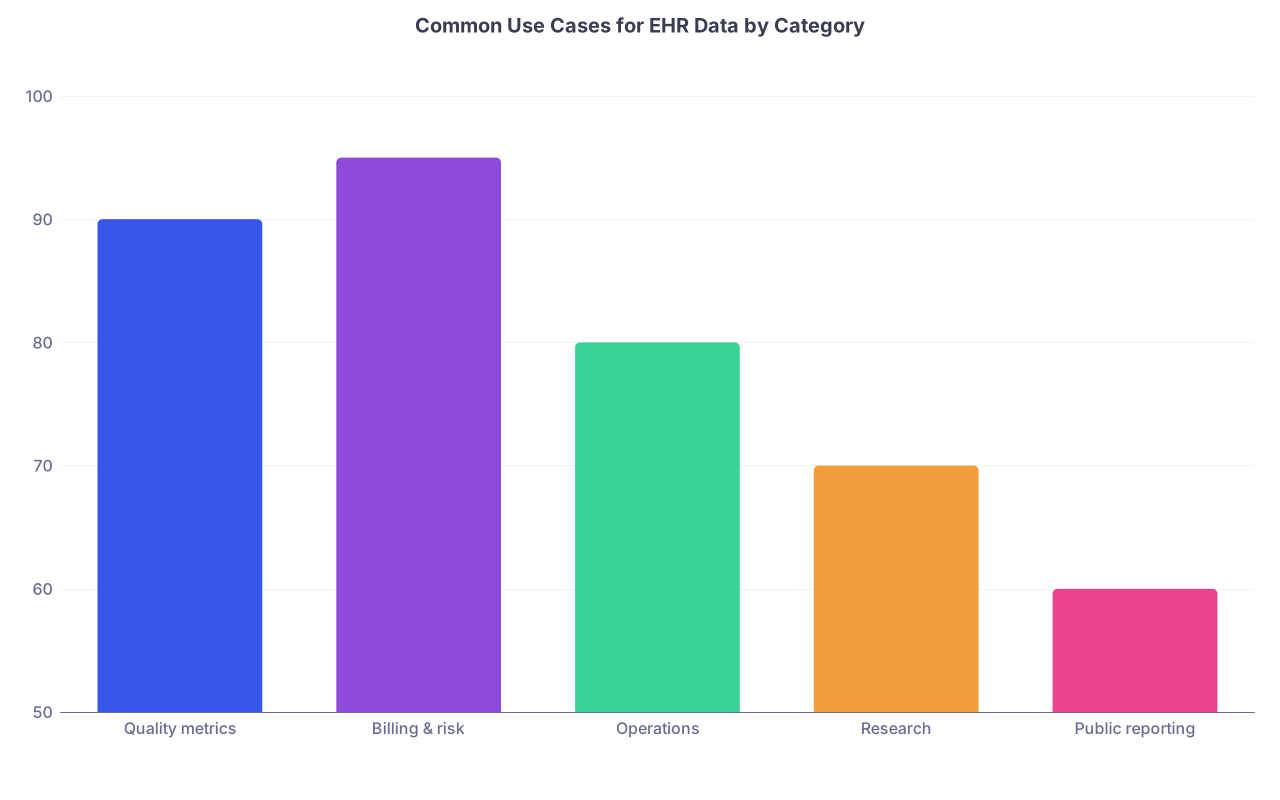
| Category | Value |
|---|---|
| Quality metrics | 90 |
| Billing & risk | 95 |
| Operations | 80 |
| Research | 70 |
| Public reporting | 60 |
If the only place a fact exists is in your prose paragraph, analytics cannot reliably use it. Full stop.
Let me give you concrete situations.
Example 1: Sepsis metrics
You write in your H&P:
“Concern for early sepsis, likely urinary source, started ceftriaxone, 30 cc/kg bolus.”
Clinically terrific. Operationally:
- If “sepsis” is not coded in the problem list or diagnosis field, the case may not get captured as a sepsis encounter.
- If your fluid bolus volume is only in narrative and not in a medication/admin record, compliance with “30 cc/kg within 3 hours” will fail.
- If “time sepsis suspected” is only implied in your prose, no one can precisely measure door‑to‑antibiotic time.
Your leadership will sit in a quality meeting staring at a dashboard that says you are not meeting sepsis bundles—while you are, every day, in your notes.
Example 2: Social determinants that never count
You document:
“Lives alone on third floor walk‑up, minimal family support, struggles affording meds.”
If “lives alone,” “limited caregiver support,” or “financial barrier to meds” are not captured discretely—either as Z codes or structured SDOH fields—that complexity never propagates to:
- Risk adjustment models
- Length‑of‑stay predictions
- Readmission risk scores
- Payer negotiations about your population complexity
So your patients look “simple” in the data compared to what you actually manage. Guess what that does to staffing and resources on your unit.
How analytics actually consume your documentation
Think like a data architect for a second. The EHR is not one giant spreadsheet; it is dozens of tables: encounters, problems, diagnoses, meds, orders, vitals, procedures, flowsheets, notes. Analytics pulls from the ones it can trust.

What gets reliably used in analytics
Four big workhorses:
- Diagnoses and problem list (ICD‑10, SNOMED)
- Orders and results (CPT, LOINC, internal procedure codes)
- Flowsheets and vitals (nursing documentation, structured fields)
- Med administration and MAR records
These are structured and standardized. That makes them trustworthy. If you tick the right boxes or trigger the right order sets, your care becomes visible in the data.
What usually gets ignored or under‑used
Unstructured notes are a mess:
- Variable phrasing: “severe LV dysfunction” vs “EF 20%” vs “dilated cardiomyopathy”
- Negation issues: “No evidence of pneumonia” vs “Concern for early pneumonia”
- Copy‑paste noise: a wall of text that repeats “possible PE” three days after it has been ruled out
NLP vendors will promise that they can extract diagnoses, findings, and context out of this mud. Sometimes they can, for specific use cases, after months of tuning. But no one is running risk‑bearing contracts on unvalidated NLP output alone. They use it as a supplement, not the backbone.
Concrete differences: discrete vs free text for common clinical facts
Let me show you what this looks like in practice.
| Clinical Fact | Discrete Representation | Free Text Only Example |
|---|---|---|
| New diagnosis of HFrEF | ICD-10 I50.22 on problem list | "Echo shows EF 30%, consistent with systolic HF" |
| Smoking status | Drop-down: Former smoker, quit 2018 | "Smoked half pack for years, stopped a while ago" |
| Fall in last 6 months | Checkbox: Fall within 6 months: Yes | "Patient reports slipping in bathroom a few months ago" |
| Palliative care discussion | Order or visit type: Palliative consult | "Had a long goals of care conversation with family" |
| Chronic opioid use | Structured med list: Oxycodone 10 mg BID | "Takes oxy regularly for back pain, unclear dosing" |
In the left column, I can build a query in 30 seconds: “Show me all patients with I50.22 who are current or former smokers and had a fall.” On the right, I am into the world of fuzzy NLP and manual chart review.
How this affects your paycheck and your job market
You are post‑residency now. Quality and productivity data follow you.
Compensation tied to metrics
Most employed physicians now have some portion of compensation tied to:
- Sepsis bundle compliance
- Diabetes control (A1c thresholds)
- Readmission rates
- Appropriate screening (colon, breast, cervical, depression)
- “Documentation completeness” scores
If you are doing the work but not supplying discrete signal, the system records you as underperforming. It is that blunt.
Network reputation and “physician scorecards”
Health systems are increasingly building internal scorecards that are shared with division chiefs and sometimes across the group:
- Average length of stay by DRG
- Risk‑adjusted mortality
- Procedure complication rates
- Outpatient panel quality measures
If your documentation does not support accurate risk adjustment—because you bury severity and comorbidities in prose—you will look like a worse doctor than you are.
Payers, large employers, and in some markets, patients are also starting to see some of this, at least in aggregated form. That does not help you when you move jobs.
Research and leadership opportunities
Who gets tapped for “Clinical Director of Heart Failure Quality” or “Lead for Sepsis Initiative”? Often the person whose data looks clean and impressive.
If your patient outcomes are good but your cases are under‑coded and your documentation is scattered in narrative, your contribution is invisible when leadership reviews service line dashboards.
The trap: “Just make it all discrete” (and why that fails)
Here is the reflexive, wrong answer some IT departments reach: “If discrete is good, let us just force more fields.”
You know this pattern:
- Ten new checkboxes added to your discharge summary
- Three mandatory “core measures” screens blocking order sign‑off
- Bloated admission templates that scroll for three pages before you can type the story
This is lazy design. It burns physician time, lowers note quality, and paradoxically worsens data quality. Why? Because when you cram structured fields everywhere:
- Clinicians click the first option to get through the alert.
- You get “No” for every risk factor because that is the path of least resistance.
- Critical fields get drowned among irrelevant ones, so they are often skipped or defaulted.
The trick is not “more discrete data.” It is the right discrete data, in the right place, at the right time, with minimal friction.
Smart hybrid: where to use discrete, where to keep narrative
You do not want an EHR that turns you into a drop‑down robot. But you also do not want one where none of your hard work is visible in analytics.
So here is the division that actually works.
Absolutely must be discrete (non‑negotiable)
These are the backbone of analytics and reimbursement:
- Principal and secondary diagnoses (ICD‑10/SNOMED)
- Procedures (CPT/HCPCS and internal procedure codes)
- Core clinical status elements that drive risk and quality measures, such as:
- Smoking status
- Frailty / functional status (basic ADLs)
- Key comorbidities (CKD stage, CHF, COPD severity, dementia)
- Presence of devices (LVAD, ICD, dialysis access)
- Timed events:
- Time of arrival, first provider contact
- Time of antibiotic for sepsis, stroke thrombolysis, PCI
- Time of intubation/extubation, OR in/out
These absolutely cannot live only in prose.
Better discrete, but can be hybrid
- Code status / Goals of care
- Social determinants of health
- Pain scores and response to therapy
- High‑risk med use (benzodiazepines, opioids in elderly)
- Falls and pressure ulcer risk factors
Ideal design: a small number of tightly focused discrete fields (e.g., “Code status,” “Fall in last 3 months: yes/no”) plus your narrative elaboration.
Narrative should rule
- Your diagnostic reasoning
- Differential diagnosis
- Nuance of patient preference and values
- Complex prognostication
- Uncertainty, “watch and wait” plans
- Teaching points in academic notes
Do not try to cram clinical judgment into checkboxes. Let the prose carry it. Analytics is terrible at “Was this a good clinical decision in a messy scenario?” and that is fine.
How modern NLP, AI scribes, and voice tools fit into this
Post‑residency, you are going to see a parade of “AI documentation helpers” and “ambient scribe” tools.
They do three different jobs, and you should be clear on which is which.
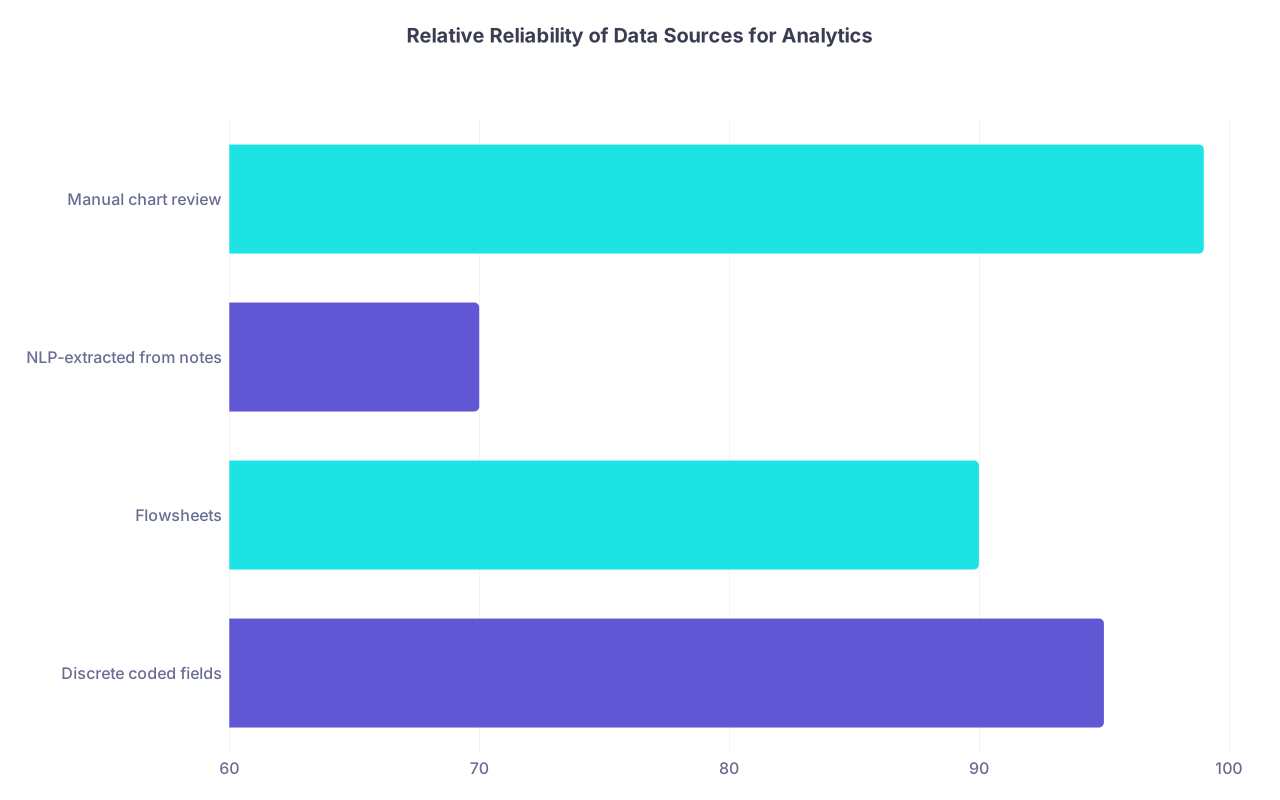
| Category | Value |
|---|---|
| Discrete coded fields | 95 |
| Flowsheets | 90 |
| NLP-extracted from notes | 70 |
| Manual chart review | 99 |
1. Ambient scribes / voice‑to‑text
These sit in the room, transcribe your conversation, and draft the HPI/assessment. They mainly generate free text.
Upside: less typing, more patient time.
Downside: if the vendor or your EHR does not also map some of that content into structured fields, they just moved the black box from your keyboard to the microphone.
2. NLP extraction engines
These run in the background, reading your notes and pulling out key concepts to create structured tags: e.g., “tobacco use: former,” “palliative discussion: yes,” “diagnosis: HFrEF.”
When they are tightly scoped and validated, they are actually useful, especially for:
- Quality abstraction (e.g., trauma registries, oncology registries)
- Safety surveillance (e.g., suspected adverse drug events)
- Research cohort building
But they are probabilistic. A good system might hit 90–95% accuracy on a narrow task after tuning. That is still not as clean as you picking “Former smoker” once in a discrete field.
3. Mixed systems: assist with discrete capture
Best‑in‑class tools now use AI to suggest discrete entries while you dictate:
- You say: “She quit smoking five years ago after 20 pack‑years.”
- The system proposes in a side panel: Smoking status: Former, Quit date: 2019, Pack‑years: 20.
- You approve with one click.
That is the sweet spot. You use narrative naturally; the system converts what it can into discrete data with your verification.
If your organization is choosing tools and they are not asking “How does this improve discrete data capture without adding clicks?”, that is a red flag.
As an attending, what you can actually do differently tomorrow
You do not control the EHR build. You do control how you use it and how you push your organization.
1. Stop fighting every discrete field blindly
Some fields are garbage and should be killed. But others are pulling more weight than you think.
Before you rage‑click “No” on a prompt, ask (or email) your local CMIO or informatics lead:
“Which of these fields actually drives quality metrics or risk adjustment?”
Prioritize those. Ignore the ones that everyone agrees are noise. Good informatics teams will tell you, and they will use the physician feedback as ammunition to trim the nonsense.
2. Build your own precision macros and templates
You probably already have dot phrases. Tighten them:
- Embed key structured data entry points in the right places.
- Example: In a heart failure A&P smart phrase, include a quick CHF problem list update link and EF field.
- Use smart links that pull in discrete data instead of re‑typing lab values and vitals in narrative. That way your note references the same structured data analytics uses.
You want to type prose where nuance matters, not where the system already knows the number.
3. Fix the problem list and diagnoses as if they actually matter (they do)
The problem list is not a trash heap. It is the backbone of nearly every analytic pipeline.
Practical habits:
- Promote major active issues from the note to the problem list when they appear (HFrEF, advanced CKD, chronic lung disease).
- Inactivate or resolve problems that are no longer active, so your patients do not look sicker than they are.
- Make sure your principal diagnosis actually reflects the main reason for the encounter, not the first thing in your template.
You want your panel to “look like” what you really manage when someone pulls data for service line planning or research.
How this plays into jobs, promotions, and negotiations
Let me connect this straight to your career.
Multi‑hospital employers and your “data trail”
If you move from one job to another within a big system, your new chiefs may see:
- Your historical length‑of‑stay patterns by DRG
- Your throughput times in the ED or OR turnover times
- Quality measure performance vs peers
If your documentation is sloppy from a data standpoint, the numbers will show that. It will not matter that you are clinically sharp if they only see a dashboard.
Academic advancement
Promotion packets increasingly include:
- Contributions to quality improvement and patient safety
- Leadership in documentation optimization or registry building
- Participation in informatics projects
If you are the attending whose service line has the cleanest, richest discrete data, you are suddenly indispensable to:
- Outcomes publications
- Registry‑based research
- Institutional quality reporting
You become the person they keep around the table when decisions are made.
Private practice and contracting
Even in private groups, payers will look at:
- Risk scores (HCC coding) for your panel
- Cost of care per risk‑adjusted member
- Quality bonus attainment
Groups that document loosely get underpaid for sick panels and over‑penalized on quality. When they renegotiate contracts or merge with larger entities, this history matters. A partner who understands discrete vs text and can improve the numbers becomes valuable in leadership.
A realistic mental model going forward
Do not think of documentation as “note writing.” Think of it as two parallel products:
- The human story of the encounter
- The machine‑readable ledger of what factually happened
You create both every time you click and type.

| Step | Description |
|---|---|
| Step 1 | Clinician encounter |
| Step 2 | Discrete entries |
| Step 3 | Free text note |
| Step 4 | Analytics engines |
| Step 5 | NLP extraction |
| Step 6 | Quality metrics |
| Step 7 | Operations planning |
| Step 8 | Research and reporting |
If you only care about #1, you will feel “good” about your charting while your institution quietly under‑represents your work. If you only care about #2, you will produce soulless checklists that do not support clinical reasoning and are medicolegally weak.
The right balance is not abstract. It is concrete:
- Make sure critical, countable facts exist at least once in discrete form.
- Use narrative for why you did what you did, what you are worried about, and how the patient fits into their life context.
- Push your institution to use automation and AI to bridge the two without adding stupid clicks.
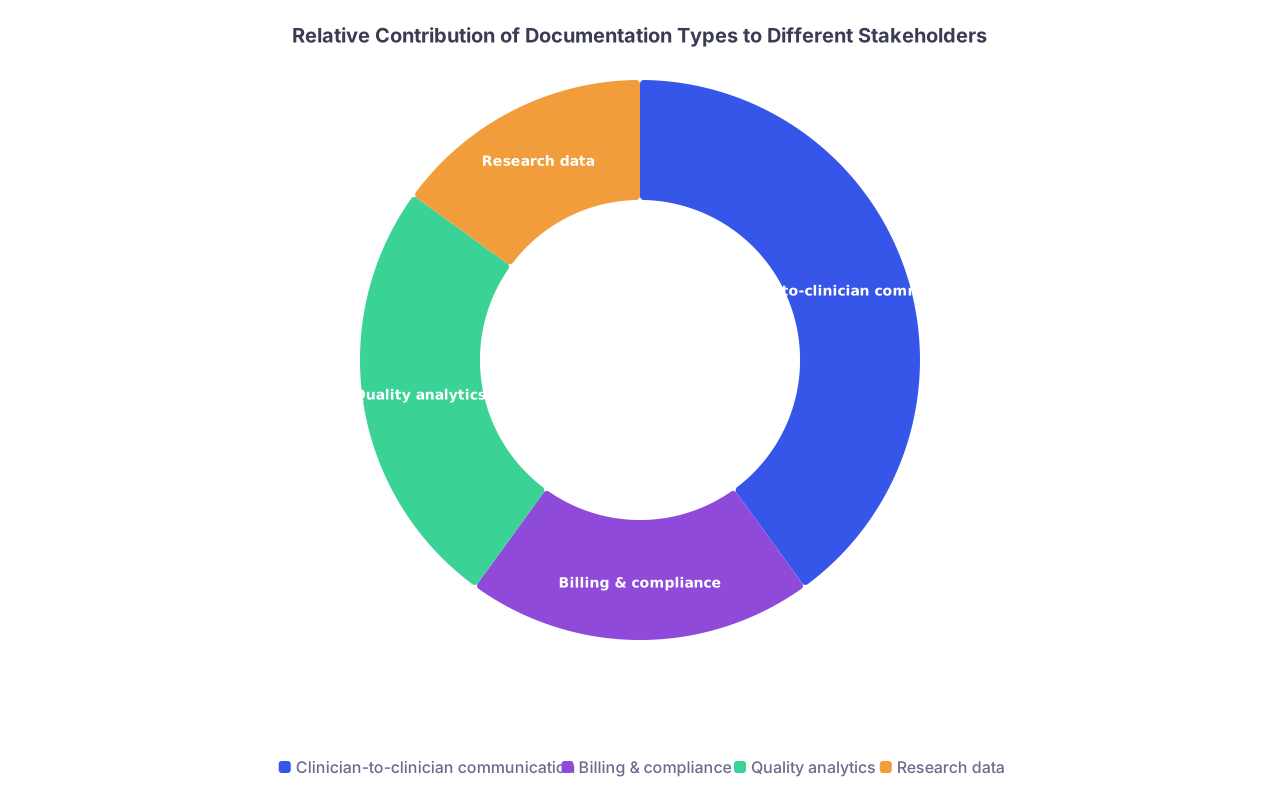
| Category | Value |
|---|---|
| Clinician-to-clinician communication | 40 |
| Billing & compliance | 20 |
| Quality analytics | 25 |
| Research data | 15 |
FAQ (exactly 5 questions)
1. If NLP and AI are getting better, why should I bother with discrete fields at all?
Because payment, risk adjustment, and regulatory reporting require deterministic, auditable data. NLP is probabilistic. Payers and regulators are not going to accept “90% accurate model output” as the basis for billions of dollars in risk payments. AI is excellent for assisting and backfilling, but it will not replace the need for core discrete fields any time soon. Think of NLP as a helpful resident, not as the primary source of truth.
2. How do I tell which structured fields are actually important in my EHR?
Ask directly. Your CMIO, quality officer, or service line informatician will know which fields feed your major dashboards and payer reports. Focus on: problem list diagnoses, core quality measure components (e.g., LVEF for CHF, A1c for DM), code status, smoking status, and key comorbidities. If no one can tell you what a field is used for, that field is a candidate for removal.
3. Does overly aggressive copy‑paste in notes hurt analytics?
Indirectly, yes. Most analytic engines avoid free text entirely or down‑weight it because of noise. When NLP is used, heavy copy‑paste creates “zombie problems” that appear active long after they are resolved—like “rule out PE” showing up daily even after the negative CT. That contaminates any model trying to use text and erodes trust in chart accuracy. Clean, concise notes with accurate problem lists produce much better data.
4. I am already overwhelmed with clicks. How can I improve discrete capture without adding time?
Three real tactics: 1) Use smart phrases and templates that bundle necessary discrete fields into your normal workflow instead of separate screens. 2) Update problem lists and key statuses (smoking, code status) during natural touchpoints—admission, big plan change, discharge—rather than piecemeal. 3) If you have access to voice tools or AI scribes, push your org to enable “suggested discrete fields” so you can accept structured entries from your own speech with one click.
5. As a job seeker, can I leverage my understanding of documentation and data in interviews?
Absolutely. For hospital or large group positions, ask how they use EHR data for quality and operations, and describe specific ways you have improved documentation quality—cleaning problem lists, working with informatics, helping build templates. For leadership‑track roles, demonstrate that you understand how discrete data underpins contracts, staffing models, and public reporting. That signals you are not just clinically competent but system literate, which is rare and valuable.
Key points, stripped down:
- If a fact only lives in your prose, it is mostly invisible to analytics, payment, and operations.
- Get the crucial, countable elements into discrete fields; let narrative carry judgment and nuance.
- Use tools and your own influence to reduce junk fields and make the necessary discrete data almost automatic, not an extra chore.