
The way most electronic medical record risk scores are used today is backwards: they’re designed around data availability and vendor convenience, not around clinical reality.
Let me break down how sepsis and readmission scores in EMRs are actually built, what they’re doing under the hood, and why some are genuinely useful while others are glorified noise generators.
1. What EMR Risk Scores Are Really Trying To Do
Forget the marketing language. At its core, every EMR risk model is doing one of two things:
Predicting an event
– “Will this patient develop sepsis in the next 6–24 hours?”
– “Will this patient be readmitted within 30 days of discharge?”Predicting a state
– “Does this patient currently have sepsis that is not yet recognized?”
– “Is this patient currently high risk for decompensation?”
Everything else—colors, alerts, dashboards—is window dressing.
Underneath, you have:
- A target outcome (label): sepsis, readmission, mortality, deterioration.
- A time horizon: next 6 hours, this hospitalization, 30 days post-discharge.
- A feature set: vitals, labs, meds, history, utilization data.
- A model: logistic regression, gradient boosting, random forest, or increasingly, deep learning.
The critical mistake many clinicians make is assuming all of this was designed thoughtfully around your workflow. It was not. It was designed around whatever structured data the EMR can reliably pull at scale.
2. Sepsis Scores: From SIRS to “Black Box in the Sidebar”
Let us start with sepsis. You have probably seen at least three flavors of sepsis-associated numbers in your EMR:
- SIRS-based rule (“Sepsis Alert”, “Sepsis Screen Positive”)
- qSOFA/SOFA components
- A vendor-proprietary “sepsis risk” score (0–100, low/moderate/high)
They are not the same thing.
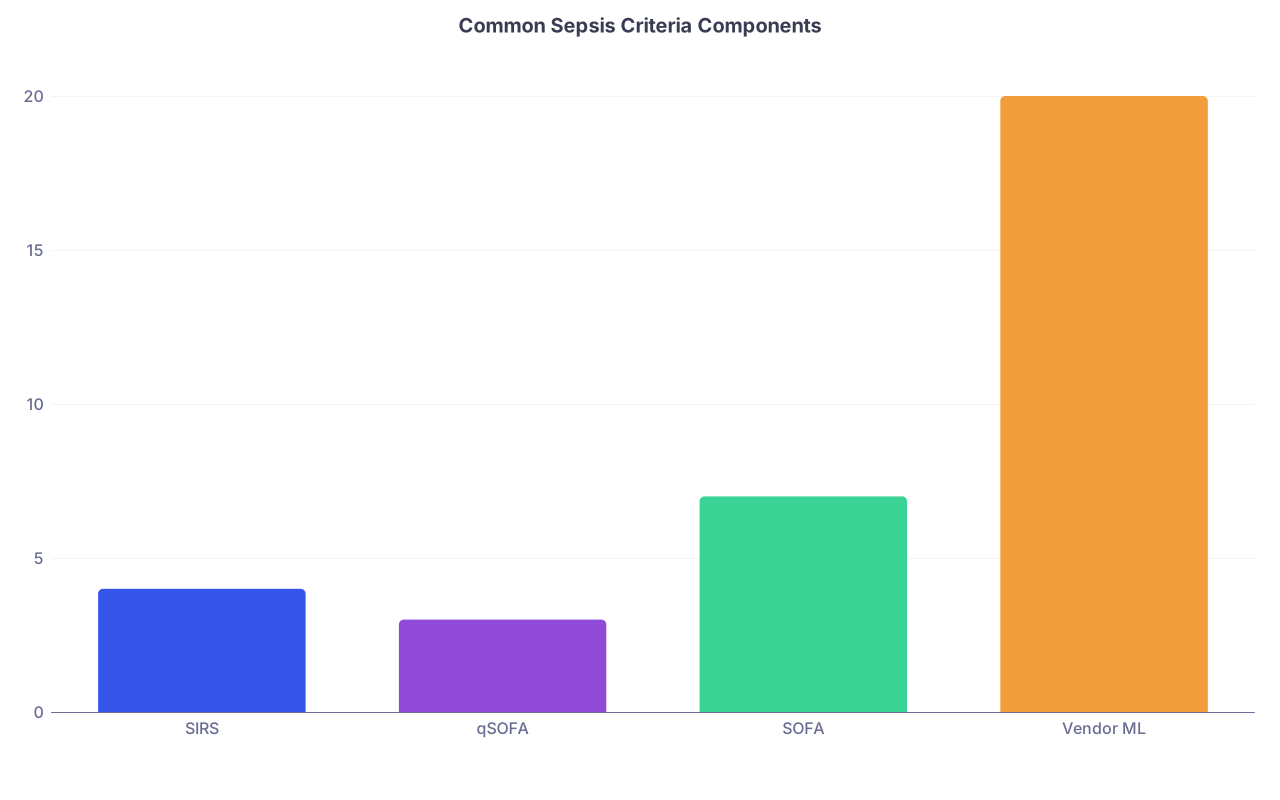
| Category | Value |
|---|---|
| SIRS | 4 |
| qSOFA | 3 |
| SOFA | 7 |
| Vendor ML | 20 |
That bar chart is not about importance; it is about feature complexity (approximate number of core variables used). Vendor ML models easily use 20+ structured features.
2.1 Classical rule-based sepsis scoring
The old-school stuff is simple, transparent, and crude.
SIRS criteria:
- Temp > 38°C or < 36°C
- HR > 90
- RR > 20 or PaCO₂ < 32 mm Hg
- WBC > 12K or < 4K or >10% bands
Typically, an EMR rule fires if ≥ 2 SIRS criteria + suspected infection (e.g., cultures ordered, antibiotics started). Implementation is literally:
- If conditions met → flag = 1, show the alert.
- Otherwise → flag = 0, no alert.
No complex model. Just Boolean logic and thresholds. The EMR queries the flowsheet, labs, and med orders every few minutes or on each new data point.
Pros:
- Transparent. You know why it fired.
- Easy to tune (e.g., require lactate, require hypotension).
- Works even with limited data.
Cons:
- Horrible specificity in many settings.
- High false positive rate → alert fatigue.
- Treats a postop day 1 tachycardic patient like a neutropenic septic shock patient if the numbers line up just right.
qSOFA, SOFA, and NEWS-based rules are the same idea: rule sets with fixed thresholds, implemented as configurable “best practice alerts”.
2.2 Machine-learning based sepsis risk models
Now the fun (and sometimes dangerous) stuff.
In many large systems (Epic, Cerner, custom academic builds), there is a proprietary “sepsis risk score” that updates hourly or even continuously. The ingredients are almost always:
- Demographics
- Vitals (absolute values and trajectories)
- Labs (absolute, trends, and missingness)
- Medications and orders (antibiotics, vasopressors, fluids, lactate, cultures)
- Comorbidities / prior utilization (from problem list, ICD codes, prior admits)
Workflow-wise, here’s roughly what happens behind that score you see on the screen:
Define the label (ground truth “sepsis”)
This sounds trivial. It is not. You need to tag past encounters as “sepsis yes/no”. Since nobody documents “sepsis onset: 14:23 on day 2” consistently, developers approximate:- Use SEP-1 or Sepsis-3 definitions retrospectively based on vitals, labs, vasopressors, lactate, and suspected infection.
- Define an “onset time” by the first time criteria are met.
- Use charts reviewed by clinicians to refine rules.
This labeling is noisy. Garbage labels → garbage model.
Decide the prediction window
Common patterns:- At any given hour, “Will this patient meet sepsis criteria in the next 6 hours?”
- Or a sliding window: “Will they meet criteria in the next 6–24 hours?”
Each hourly time point in the training data becomes a row with features at that time and a label “future sepsis yes/no”.
Extract structured features
This is where EMRs either shine or fail.
- Latest vitals: HR, RR, BP, temp, SpO₂.
- Derived vitals: trend over last 4–6 hours (slope), variability.
- Labs: WBC, creatinine, bilirubin, lactate, platelets, bicarb.
- Derived labs: percentage change from baseline, delta in last 24 hours.
- Orders: time since antibiotic order, fluid bolus, lactate order, blood cultures.
- Diagnoses/comorbidities: CHF, COPD, CKD, cancer, diabetes, immunosuppression.
EMR data pipelines aggregate this from multiple tables: flowsheets, lab results, med orders, ADT events.
Train a model
Typically:
- Logistic regression with regularization
- Gradient boosting (XGBoost, LightGBM)
- Random forests
- Occasionally deep learning (LSTM, temporal convolution) at big academic centers
The target: P(sepsis in next X hours | current features).
You split data into training, validation, and test cohorts. You handle extreme imbalance (sepsis is relatively rare compared to all time points) with class weighting or sampling.
Choose thresholds and scores
The raw model outputs a probability (e.g., 0.08 = 8% risk). The EMR then:
- Converts this into a 0–100 “score” (e.g., simply 100 × probability, or some quantile-based scaling).
- Defines alert thresholds:
– “≥ 0.85 probability” or
– “score ≥ 80” triggers an interruptive alert. - Often uses two thresholds: one to color the score (e.g., >50 = yellow, >80 = red), another for hard alerts.
Integrate into workflow
Usually:
- Display the score in a sidebar or banner.
- Trigger BPA alerts when thresholds are crossed.
- Add links to sepsis order sets when risk is high.

| Step | Description |
|---|---|
| Step 1 | Raw EMR Data |
| Step 2 | Feature Extraction |
| Step 3 | Model Inference |
| Step 4 | Risk Probability |
| Step 5 | Score Scaling 0-100 |
| Step 6 | Display Only |
| Step 7 | Alert + Order Set |
| Step 8 | Thresholds |
You, as the clinician, see the last 10% of this process. Your frustration often comes from the 90% you never see: how labels were defined, what features are included, what thresholds and trade-offs were chosen.
3. Readmission Scores: Different Data, Same Game
Readmission prediction is less emotionally charged than sepsis, but more abused in QI dashboards and admin reporting.
There are three main flavors you will encounter:
- Classical scores implemented in EMR (e.g., LACE, HOSPITAL score)
- Vendor-built proprietary risk models (e.g., Epic’s readmission model)
- Locally developed models embedded into the EMR at large systems
3.1 Classical readmission scores
LACE score is a standard example:
- L = Length of stay
- A = Acuity of admission
- C = Comorbidities (Charlson index)
- E = ED visits in previous 6 months
The math is trivial: each component contributes a fixed number of points, and the sum gives a risk category.
In EMR terms:
- Map LOS, admission type, comorbidity codes, and ED utilization into those point buckets.
- Sum them.
- Display a “Low / Medium / High readmission risk” on the discharge planning screen.
No real machine learning here. It is a paper score ported into software.
Predictive performance? Mediocre. AUROC around 0.68–0.72 in many studies. But at least you know what is driving the score.
3.2 Vendor proprietary readmission models
This is where most post-residency clinicians start seeing mysterious “Readmission Risk: 23 (High)” scores that do not correspond to any published formula.
Conceptual design:
- Outcome (label): unplanned readmission within 30 days of index discharge.
- Population: all adult discharges except hospice, AMA, etc.
- Time horizon for prediction:
– At admission (“risk at admit”)
– Daily during stay
– At discharge (“final risk”)
Features are usually more diverse than sepsis models, because readmission is a broader signal:
- Demographics: age, sex, sometimes insurance as a proxy for SES.
- Utilization: admissions and ED visits in last 6–12 months, prior readmissions.
- Clinical complexity: comorbidities, Charlson index, diagnosis-related groups.
- In-hospital course: length of stay, number of consults, ICU stay, number of procedures.
- Labs/vitals: acute severity, renal function, Hb, etc.
- Social and discharge factors (if captured): discharge disposition, home support, DME needs, language.
The training pipeline mirrors sepsis, but with one prediction per encounter rather than per hour:
- Each historical discharge = one training example.
- Features drawn from the stay + prior history.
- Label: readmitted within 30 days (1) or not (0).
- Train logistic regression / gradient boosting.
- Tune thresholds to meet operational goals (e.g., “flag enough high-risk patients to give the care managers a meaningful but manageable queue”).
What most people underestimate is how much these models depend on:
- Data quality: incompletely documented comorbidities → underestimated risk.
- Clinical coding culture: aggressive coding vs minimal coding drastically affects comorbidity features.
- System behavior: a system with intensive home health use will have different patterns than one that dumps to SNF.
| Category | Sepsis Model Features | Readmission Model Features |
|---|---|---|
| Demographics | Age, sex | Age, sex, insurance |
| Vitals | HR, RR, BP, temp, SpO₂, trends | Baseline vitals, extremes during stay |
| Labs | WBC, lactate, creatinine, platelets | Creatinine, Hb, Na, BUN, prior lab values |
| Orders/Medications | Antibiotics, cultures, vasopressors | Number of meds, high-risk meds |
| Comorbidities | CKD, CHF, COPD, immunosuppression | Charlson index, specific chronic diseases |
| Utilization history | Prior ICU, prior admissions | Prior admissions, ED visits, readmissions |
| Discharge-related | Rarely used directly | Disposition, length of stay, consults |
4. How These Models Actually Get Into Your EMR
If you are post-residency and working in a health system, you need to understand the pipeline from idea to “thing that interrupts my charting with a BPA”.
This is the path, in plain language.
4.1 Model training environment vs production environment
Models are typically trained in a data warehouse or analytics environment:
- Cloned or near-real-time copy of EMR data.
- SQL, Python/R, ML frameworks used by data scientists.
- Static datasets derived from past years.
Production scoring is in the EMR runtime:
- Real-time or near real-time data.
- Vendor APIs or on-prem inference servers.
- Tight latency constraints (scores must compute in seconds, not minutes).
So you have two worlds:
- Offline world (data science) – messy, flexible, lots of experimentation.
- Online world (clinical EMR) – brittle, heavily controlled, versioned, audited.
Bridging these worlds is 80% of the work.
4.2 Data pipelines and feature computation
In production:
- Event triggers fire when new data arrives (new vital, lab result, order, or at fixed intervals).
- The EMR or a middleware layer composes the feature vector from current data:
– Fetch last N hours of vitals.
– Pull last lab values and timestamps.
– Compute simple aggregates or deltas. - That vector (e.g., 50–200 numeric/categorical features) is passed to the model scoring engine.
There are three main strategies for where the model “lives”:
Native EMR model (e.g., Epic’s Cognitive Computing models)
– Model is implemented or hosted within vendor ecosystem.
– Health system just configures thresholds, displays, and BPA hooks.On-prem custom model service
– Hospital IT maintains a microservice that hosts models.
– EMR calls the service via web API.
– Output returned and stored in custom flowsheet fields or result tables.Batch scoring
– For readmissions, sometimes daily batch jobs score all inpatients overnight.
– Scores stored in a “risk” table and surfaced during the day, not real time.

| Step | Description |
|---|---|
| Step 1 | EMR Events |
| Step 2 | Feature Builder |
| Step 3 | Model Service |
| Step 4 | Risk Score |
| Step 5 | EMR Storage |
| Step 6 | Clinician View |
| Step 7 | BPA Engine |
| Step 8 | Alerts and Order Sets |
You are seeing F and H. Most institutions barely monitor A–D after go-live, which is how models silently degrade over time.
5. Evaluation: AUROC Is Not Enough
Admins love to quote “Our readmission model has an AUROC of 0.82”. As if that solves anything.
For a model living in an EMR and touching clinician workflow, several questions matter much more:
Positive Predictive Value (PPV) at the chosen threshold
If your “high risk” sepsis alert has a PPV of 10%, 9 out of 10 alerts are noise. That will die quickly in practice.Number-needed-to-screen / alert rate
- How many alerts per 100 patient-days?
- Can nurses and residents realistically respond to that volume?
- Is anyone measuring it?
Clinical impact
- Does early sepsis detection via the model lead to faster antibiotics, fluids, or ICU escalation?
- Does readmission risk targeting actually change discharge planning or follow-up?
Calibration
A model with AUROC 0.82 may still be poorly calibrated, meaning the raw probability does not correspond well to observed risk. You want: “score 0.30 ≈ 30% risk in practice”.
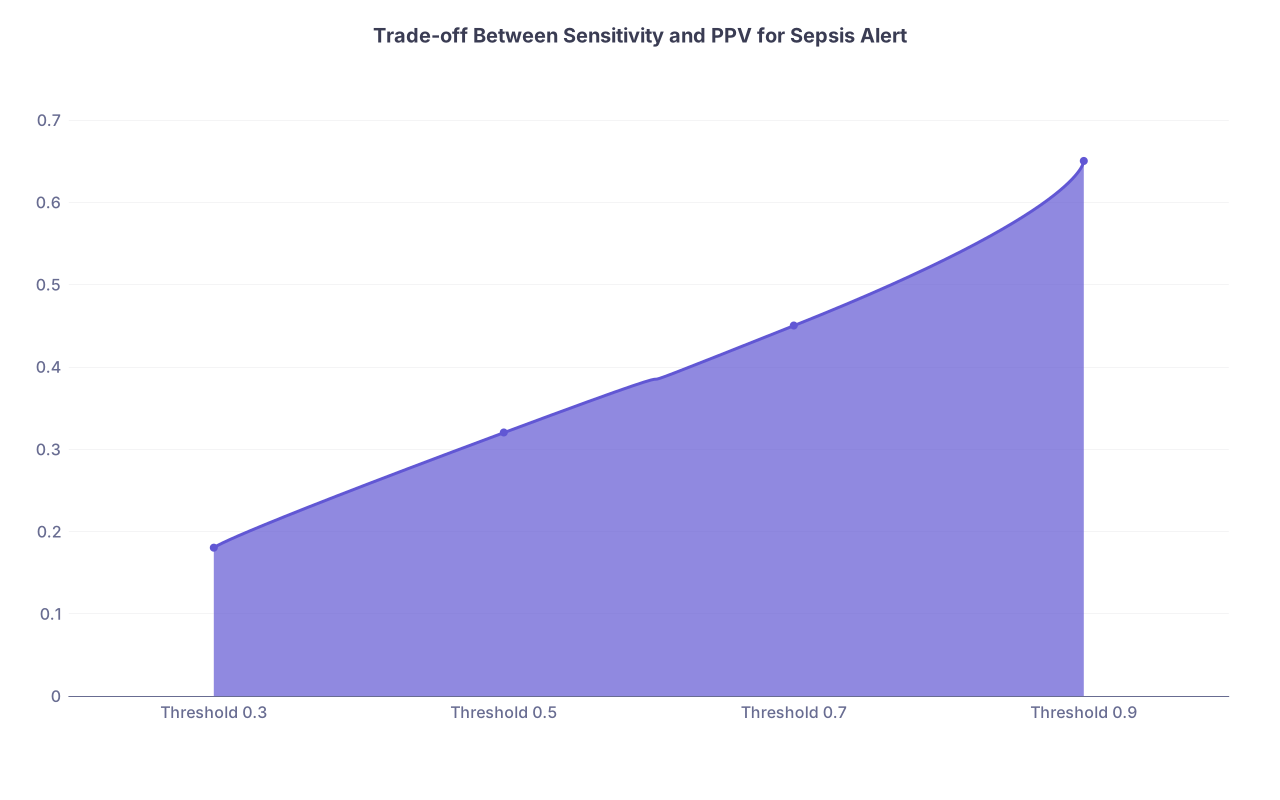
| Category | Value |
|---|---|
| Threshold 0.3 | 0.18 |
| Threshold 0.5 | 0.32 |
| Threshold 0.7 | 0.45 |
| Threshold 0.9 | 0.65 |
Interpret that line as “PPV at various thresholds” (illustrative). As you crank up the threshold, PPV improves but sensitivity drops. The right choice depends on your institution’s tolerance for missed cases vs false alarms.
6. Real-World Failure Modes You Will See
If you work long enough with EMR risk scores, you start seeing the same pathologies over and over.
6.1 Mis-specified or drifting labels
Definition of “sepsis” changes (SEP-1 updates, institutional protocols shift). Model trained on version A, used in world B. Performance drops silently.
Readmission rates change (COVID, new observation unit, home hospital programs). Model is now calibrated on a different baseline risk.
Nobody retrains or recalibrates for years. You have a zombie model.
6.2 Data quality and missingness
The model assumes:
- Vitals documented every 4 hours.
- Certain labs drawn in most sick patients.
- Comorbidities coded reliably.
Reality:
- Vitals entered late or charted in bulk.
- Labs drawn selectively.
- Comorbidities under-coded in certain services.
The model then learns that “missing lactate” or “no comorbidity codes” is low risk. Which is often just low documentation, not low disease.
A classic failure: sepsis model underestimates risk in understaffed wards with poor documentation, and overestimates in well-staffed ICUs with meticulous charting.
6.3 Alert design divorced from clinical workflow
I have seen:
- Sepsis alerts firing every 2 hours on the same patient with no suppression logic.
- Readmission scores displayed in a hidden tab that only case managers open.
- BPA that fires when the resident already placed appropriate orders, because the alert checks criteria before order placement is recognized.
This is not a model problem. It is an EMR integration and design problem. But clinicians blame “the algorithm” anyway.
6.4 Feedback loops and gaming
Once a model is in play:
- Clinicians may change documentation to avoid inappropriate alerts.
- QI may pressure services to “improve their risk numbers”, which can distort behavior.
- Coders and billing practices shift, which indirectly affects model inputs.
The model is not static. It interacts with human behavior. Ignoring this turns any “AI” into a blunt instrument.
7. Interpreting and Using These Scores as a Practicing Clinician
You are not going to rebuild the model yourself. But you should know how to use (and not use) the output.
7.1 Know the basic properties of your institution’s models
You should be able to answer:
For this sepsis score:
– Is it rule-based or ML-based?
– What is the target horizon (now vs next 6 hours)?
– What is the approximate PPV at the alert threshold?
– Who owns it (IT, quality, a clinical champion)?For this readmission score:
– Is it logistic regression, a published score, or a vendor black box?
– What is “high risk” defined as (top 10%, top 20%)?
– What actions are tied to “high risk”? Follow-up calls, pharmacy review, case management?
If you cannot get straight answers, that is a governance red flag. Someone needs to own these tools.
7.2 Use scores as triage, not oracles
The right mental model:
- Sepsis score: “This is a triage nudge to look again at this patient.”
- Readmission score: “This is a prioritization tool for resource-limited transitional care.”
What it is not:
- Sepsis: “The score is low, so this cannot be sepsis.” (Dangerous.)
- Readmission: “Score is high, so we will absolutely see this patient again.”
Treat the model as a canary, not a judge.
7.3 Watch for edge cases
Based on experience, models often stumble on:
- Immunosuppressed patients (transplant, chemo) – atypical vitals.
- Underweight / frail elderly – lower baselines, weird trajectories.
- Hospice-bound or comfort-care patients – high acuity but different goals of care.
- Frequent flyers with psychosocial drivers – readmission drivers are not in the EMR (housing instability, addiction, etc.).
If you rely heavily on model output in these populations, you are asking for trouble.

8. For Those Interested in Building or Influencing These Models
As a post-residency clinician, you are in a position to influence how your institution implements risk scores. If you want to do more than complain, here is the playbook.
8.1 Get involved at the design stage
Ask to be involved when:
- New sepsis alerts are proposed.
- QI wants to “improve readmission metrics with predictive analytics.”
- Vendors pitch “AI-powered risk scoring”.
Your leverage is in defining:
Use case:
– For sepsis: early recognition in med-surg vs ICU vs ED.
– For readmission: are we trying to drive more post-discharge calls, more clinic follow-ups, better SNF placement?Actionability:
– For every “high risk” classification, what exactly happens?
– Who will do it? When? How many per day can they handle?
If there is no answer beyond “we will monitor,” you already know the project will flop.
8.2 Demand clear metrics and ongoing monitoring
For each deployed model:
- Baseline outcome rates before launch (sepsis mortality, readmission rate, etc.).
- Prospective evaluation after go-live:
– Alert volume per 100 patient-days.
– PPV and sensitivity in real use.
– Time to antibiotic, time to escalation, or post-discharge contact rates.
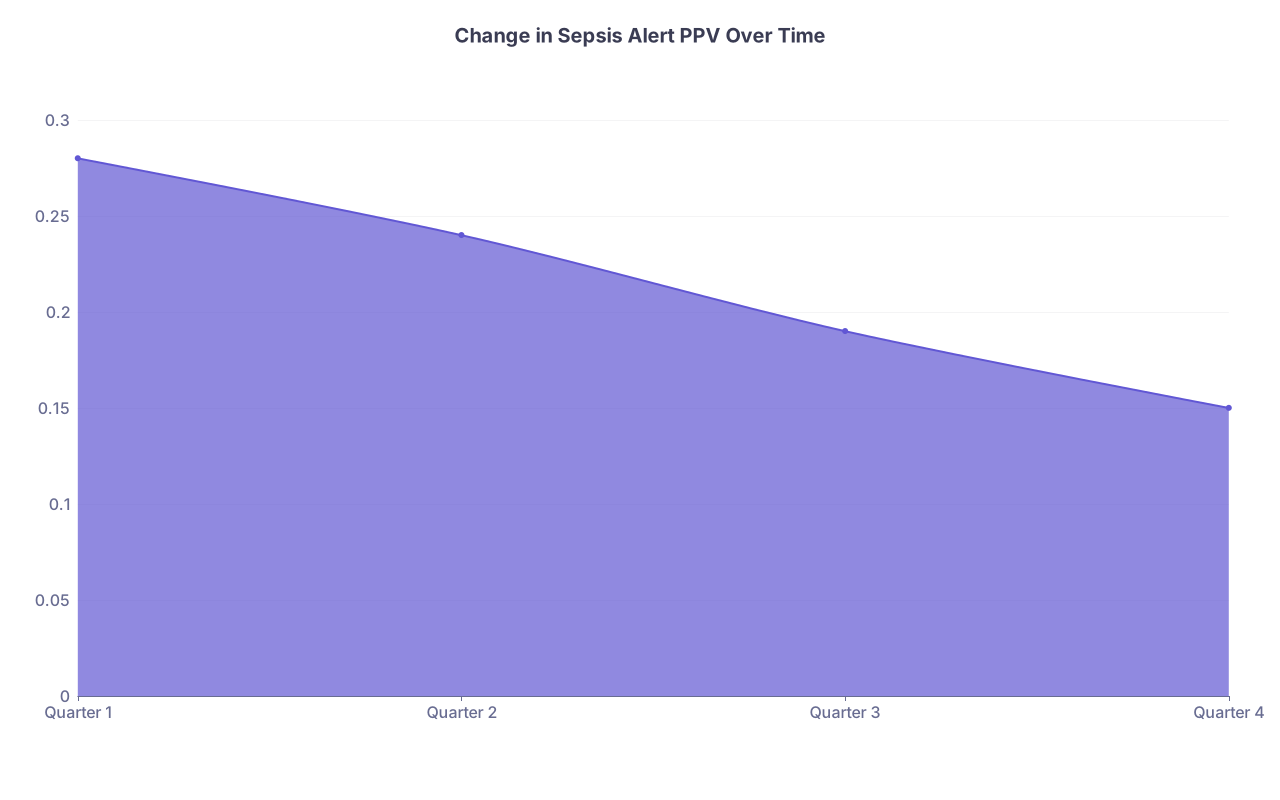
| Category | Value |
|---|---|
| Quarter 1 | 0.28 |
| Quarter 2 | 0.24 |
| Quarter 3 | 0.19 |
| Quarter 4 | 0.15 |
If you see a drift like that—PPV quietly dropping from 28% to 15% over a year—something is off. Data drift, label drift, or operational misuse.
8.3 Push for transparency, even with vendor models
Vendors often hide behind “trade secrets”. You are not asking for the full model weights. You need:
- List of input feature categories (labs, vitals, diagnoses, utilization).
- Performance metrics in your population, not just generic marketing numbers.
- Basic explanation of calibration and cut-points.
If your leadership cannot get even that, they are buying a black box with no accountability.

9. Where This Is Going Next (And What To Watch For)
The next generation of EMR risk models will not just look at snapshots of vitals and labs. They are already starting to:
- Use time-series models (RNNs, transformers) that ingest full trajectories of vitals and labs.
- Incorporate clinical notes via NLP (mentions of “concern for infection”, “poor social support”).
- Combine in-hospital risk with post-discharge environment (pharmacy fill data, social determinants, claims).
That sounds impressive. It also makes interpretability worse. You will hear “we use deep learning on multimodal data” and see an even more opaque 0–100 score.
The key risks:
- Overfitting to local quirks – models that perform brilliantly in one academic center but fail even at a sister hospital.
- Algorithmic bias – systematic under- or over-prediction in racial, socioeconomic, or language groups based on biased training data.
- Overreach – using these scores in credentialing, insurance denials, or punitive benchmarking, far beyond their intended clinical-support role.
If you are going to trust these tools at the bedside, you need a seat at the governance table.

10. The Bottom Line
Three points you should not forget:
The score you see in the EMR is the end product of a long chain of assumptions – label definitions, feature choices, model selection, threshold setting, and alert design. If any link is sloppy, the whole thing degrades.
Sepsis and readmission models are triage tools, not adjudicators of truth – they should prompt you to look harder, not override your clinical judgment. When in doubt, trust the patient and your exam, not a number in the sidebar.
As a practicing clinician, you are entitled to transparency and performance data – you do not need the source code, but you should demand clear information on inputs, accuracy, PPV, alert volume, and real-world impact. If your institution cannot provide that, the problem is governance, not “AI”.
Use these scores. But use them with your eyes open.