
You’re three months into your first attending job. Your badge still feels new, but the honeymoon is over. You’ve figured out the EMR, you know where to find the good coffee, and you’ve stopped introducing yourself as “one of the residents.”
Then your department chair says, in that smooth, scripted tone, “We’ve been reviewing your metrics. Overall you’re doing fine, but there are a few areas we need to monitor.”
You walk out of that meeting thinking:
What metrics?
According to whom?
And what the hell does “fine” mean?
Let me tell you what’s actually going on behind that door.
The Quiet Shift: You vs The Algorithm
Hospitals and large private groups have quietly moved from “gut feel + reputation” to “data-driven physician performance.” And they’re not just running simple dashboards. They’re increasingly using machine learning systems—often buried inside “clinical decision support,” “productivity analytics,” or “quality platforms”—to rank you.
Not publicly. Not in your face.
But in the background, those scores are being used to decide:
- Who gets the prime block time
- Who gets renewed vs “non-renewed”
- Who gets the leadership titles
- Who is “low hanging fruit” in the next cost-cut wave
And the uncomfortable truth: most attendings have no idea which AI-driven metrics actually matter. They obsess over the wrong ones. And get blindsided.
Let’s walk through the metrics that actually drive your “quality” score as an attending, as seen by the machines and the people hiding behind them.
1. The Hidden Productivity Equation: RVUs Are Just the Surface
You think they’re looking at your wRVUs. That’s the kindergarten level.
The real systems—Epic Cogito, Cerner analytics layers, proprietary group dashboards—build composite “efficiency” profiles on each physician.
Here’s how it actually looks under the hood.
| Component | Approx Weight |
|---|---|
| RVUs per clinical hour | 30% |
| Median visit length | 15% |
| Template utilization rate | 15% |
| After-hours charting time | 20% |
| Same-day close rate | 20% |
No vendor will show you that table. But those are the levers.
RVUs per clinical hour
Not per FTE. Not per month. Per hour of scheduled patient contact.
The AI flags outliers. If you’re 1 standard deviation below your department’s mean, your name shows up red on some VP’s dashboard. They won’t fire you for that alone. But the label sticks: “Low producer.”
And then when they’re “restructuring,” the low producers are suddenly “not aligned with strategic goals.”
Visit length & template utilization
If your average visit length is 30 minutes in a clinic where the median is 18, the system notices. It flags you as “low access / low capacity.” Doesn’t care that your notes are thoughtful and your patients love you.
Template utilization is another quiet killer. If you constantly leave open slots or block off time for “admin,” those blank cells are revenue opportunities the AI thinks you’re wasting.
After-hours charting & same-day close
Here’s where it gets interesting. Developers started mining after-hours EMR use as a burnout signal. Administration twisted it into an efficiency metric.
If you’re consistently charting from 8–11pm:
- The system labels you as inefficient (too slow during clinic)
- Or potentially at-risk for errors (fatigue, rushed documentation)
Same-day close rate—percentage of encounters closed before midnight—is hugely tracked. High performers close >90% the same day. Many systems now display this as a leaderboard. That leaderboard? Often feeding an AI model that predicts “operational reliability.”
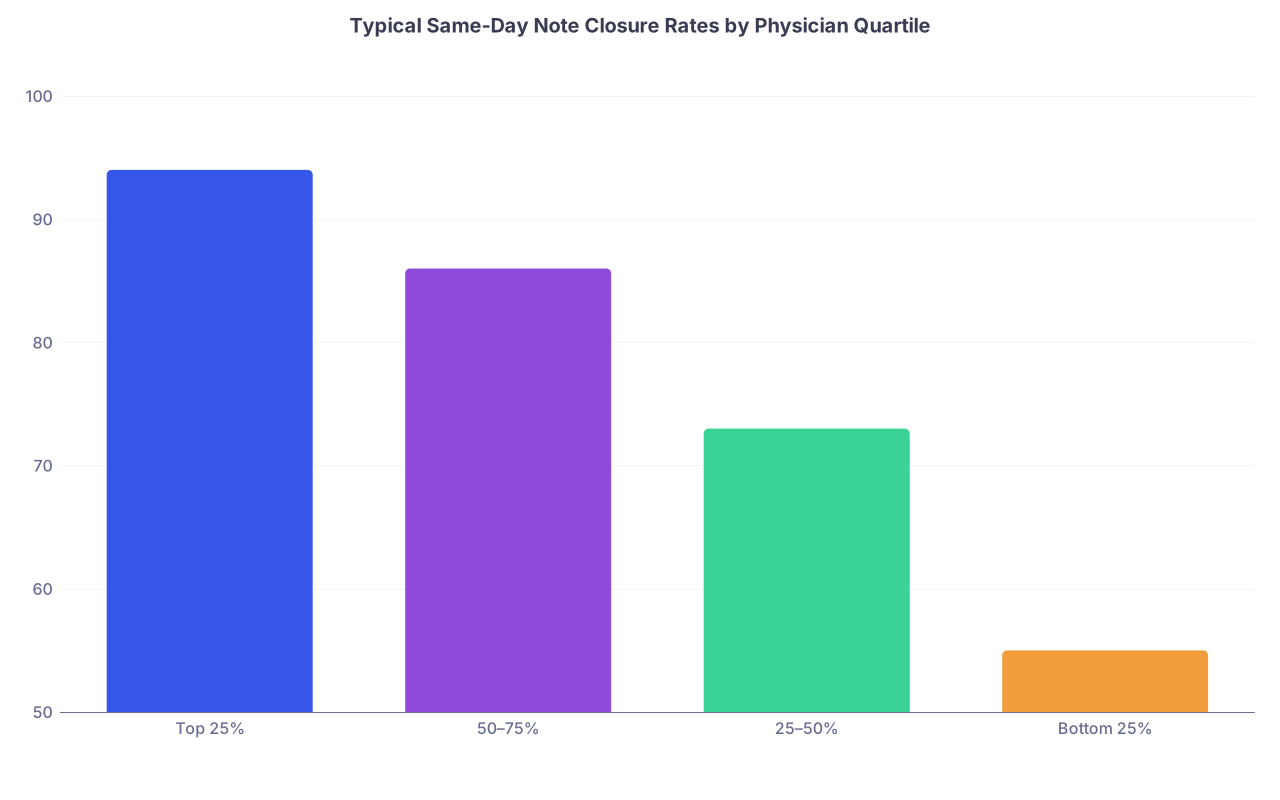
| Category | Value |
|---|---|
| Top 25% | 94 |
| 50–75% | 86 |
| 25–50% | 73 |
| Bottom 25% | 55 |
The takeaway: the AI doesn’t just care how much you produce. It cares how predictably and cleanly you produce.
2. The Quiet Judge: Risk-Adjusted Outcomes You Never Really See
You know “quality” is about outcomes. But here’s the part clinicians underestimate: these systems risk-adjust the hell out of everything, and then compare you to your peers as if you’re running a controlled trial every month.
They’re looking at things like:
- 7-day and 30-day readmissions
- ED bounce-backs to the same complaint
- Post-op complication rates
- Mortality indices
- “Observation to inpatient” upgrade rates
- Length-of-stay vs expected LOS
And every one of those is adjusted for case mix using the coded diagnoses and comorbidities in your notes and orders.
The coding/AI trap you’re walking into
If your problem lists and diagnoses are lazy, the risk-adjustment model punishes you.
Example:
Two hospitalists admit similar sick COPD patients.
- Attending A documents and codes: COPD exacerbation, acute on chronic respiratory failure, sepsis, AKI, malnutrition
- Attending B writes: COPD exacerbation
If they both end up with a 5-day LOS, the system “expected LOS” for A might be 5.2 days (complex case), but for B it might be 3.1 days (simple COPD).
Result on paper:
- A looks right on target
- B looks like they keep patients too long
Same clinical care. Completely different “quality” labels.
That’s where the AI quietly labels some attendings as “high variance” or “underperforming” while they’re actually just under-coding.

The advanced platforms are now building predictive quality scores—essentially: “Given the patients you see and how you document, what’s the probability your outcomes will look bad next quarter?”
Those predictions steer where leadership focuses their “coaching,” who they assign “mentors” to (code word for monitoring), and in some systems, who they want to offload.
3. The Financial AI: How ‘Expensive’ You Are to the System
This part almost never gets said out loud in clinician meetings. It’s all over the finance meetings.
You aren’t just measured on revenue. You’re scored on cost per unit of care delivered, and how much downstream revenue you generate.
The financial AI models track:
- Imaging orders per RVU or per diagnosis
- Lab intensity per admission
- Use of high-cost drugs or devices
- Rate of “preferred network” referrals vs outside referrals
- Procedure vs conservative management patterns
The system doesn’t care about “clinical nuance” as much as you think. It’s sliding you into one of a few buckets:
- High revenue, high cost
- High revenue, moderate cost
- Moderate revenue, low cost
- Low revenue, high cost (this is the kiss of death category)
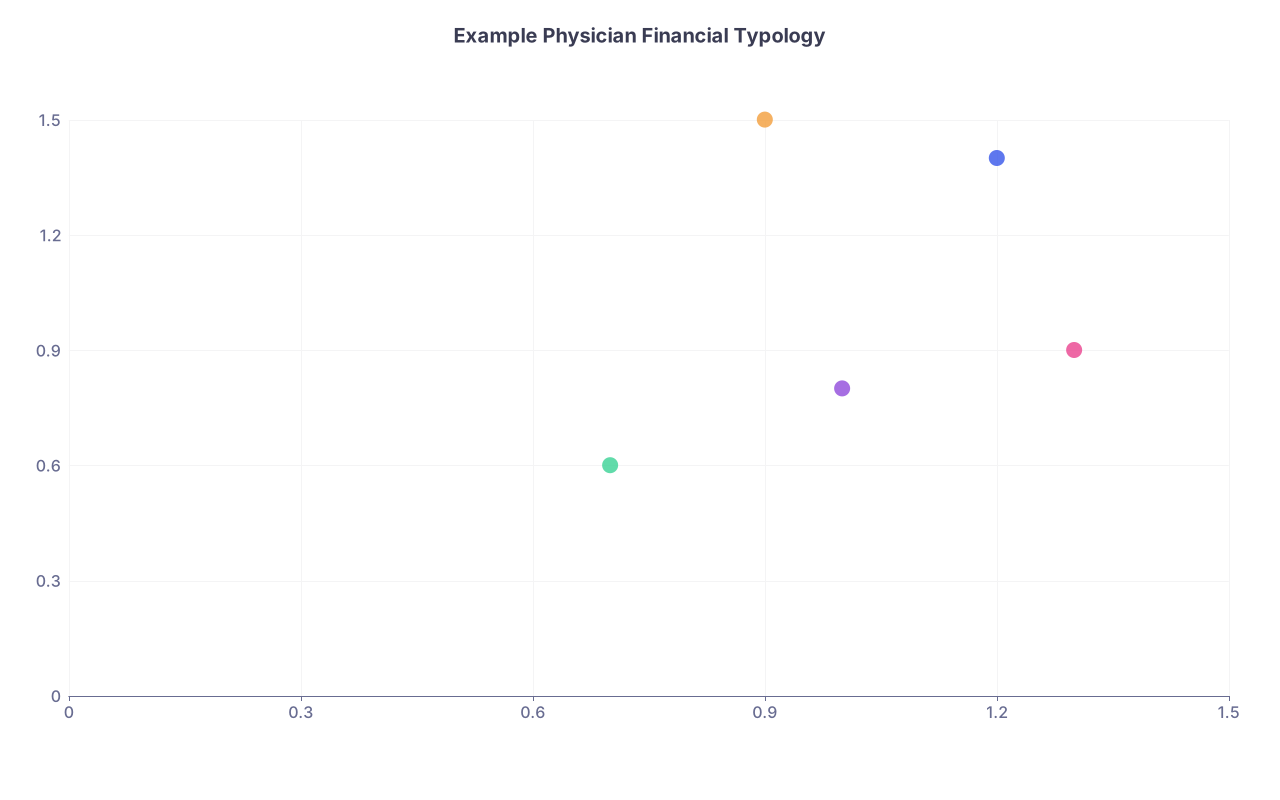
| Category | Value |
|---|---|
| Dr A | 1.2,1.4 |
| Dr B | 1,0.8 |
| Dr C | 0.7,0.6 |
| Dr D | 0.9,1.5 |
| Dr E | 1.3,0.9 |
(x-axis: relative revenue index, y-axis: relative cost index; 1.0 = department average)
Dr D—high cost, below-average revenue—is the one who gets constant “utilization review” emails, pre-authorization grief, and “friendly chats” about guideline adherence.
Referral patterns: the invisible funnel
If you’re in a system that owns specialty clinics, surgery centers, imaging suites—your referral pattern is absolutely in the models.
- Do you send your joints to the health system ortho or to your buddy’s private group?
- Do you send advanced imaging to the hospital MRI or let patients go to the cheaper independent center?
Neutral from your lens. Very non-neutral from theirs.
You will never see a dashboard tile that says “loyalty to owned service lines,” but I’ve seen exactly that metric in VP decks—with physician names attached.
4. Patient Experience: The AI That Doesn’t Believe Your Personality
Here’s the part most attendings underestimate and then get crushed by: patient experience AI.
I’ve sat in meetings where service line leaders scroll through Press Ganey/CG-CAHPS comments linked to a physician’s name, then flip to a “sentiment analysis dashboard” that’s auto-classified words like:
- “Rushed”
- “Didn’t listen”
- “Seemed annoyed”
Those words get converted into scores—trend lines by month, even predicted future satisfaction scores.
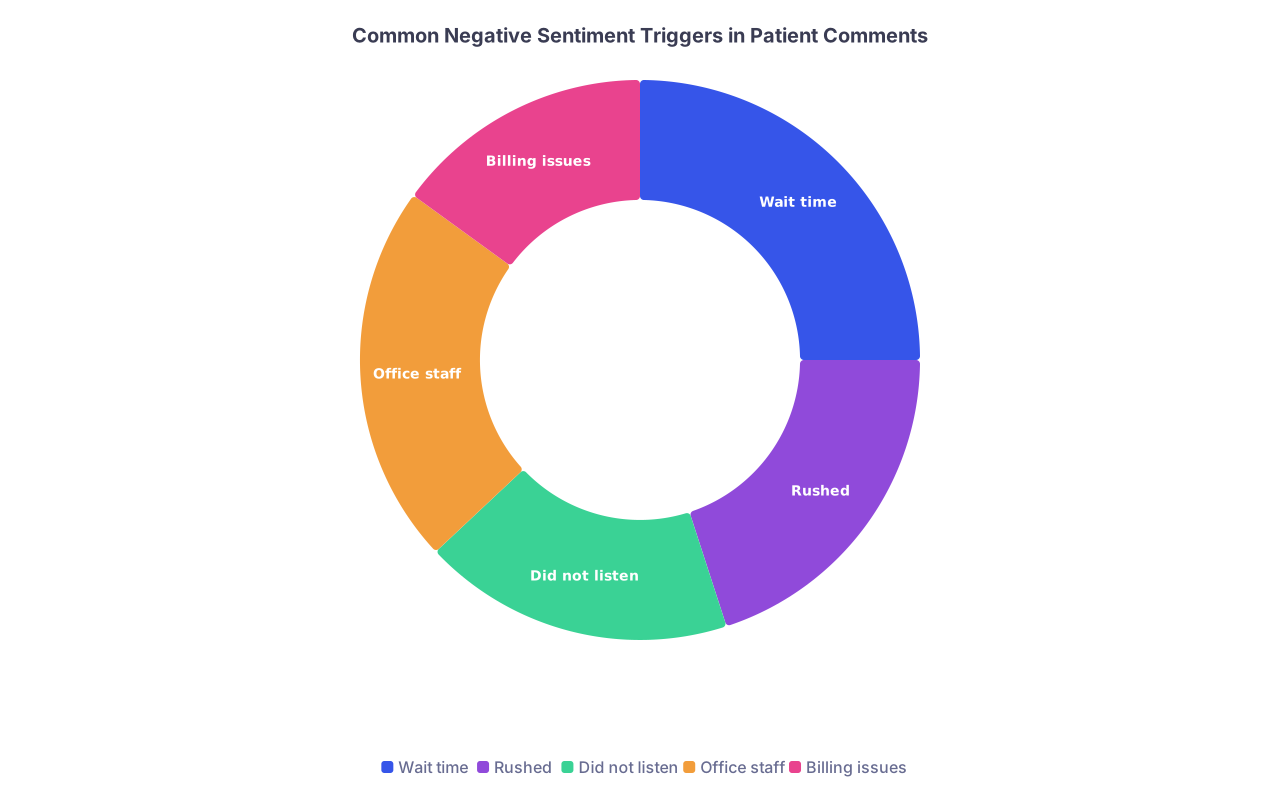
| Category | Value |
|---|---|
| Wait time | 25 |
| Rushed | 20 |
| Did not listen | 18 |
| Office staff | 22 |
| Billing issues | 15 |
Now here’s the catch: you think this is about being “nice.” It’s not.
The natural language models are tuned to specific phrases and structures that correlate with low ratings. That means if the MA is rude, or the front desk messes up scheduling, often you eat the negative sentiment because the physician’s name shows up on the survey.
There are attendings who are warm, kind, clinically excellent—and still consistently score as “problematic” on experience dashboards because:
- Their clinic is always running behind
- Their staff turnover is high
- Their patient population is tech-poor or survey-averse
The AI doesn’t fully correct for that. It quietly labels you as “low satisfaction risk.” And then your name shows up when they’re asking, “Who needs ‘coaching’ this year?”
You can be clinically outstanding and still be on the “watch list” because the hallway chairs are uncomfortable and parking is a nightmare.
5. Safety & Compliance: The Red-Flag Models You Never See
Every large system now runs “safety/event correlation” models. They take:
- Incident reports with physician names or MRNs attached
- Near misses from pharmacy, lab, nursing
- Trigger tools (unplanned return to OR, ICU transfers, reversal agents, naloxone use, INR >5 with bleeding, etc.)
Then they ask: which physicians have higher-than-expected rates of events when controlling for acuity?
Nobody tells you you’re in one of these models. You just notice:
- A spike in “just checking in about this case” emails from quality
- Being “invited” to chart reviews more often
- Getting nudged about certain order sets or protocols more than your peers
Often, the real story is simple: you see the sickest patients. Or you work the terrible night shifts. Or you’re the surgeon they give the train wrecks to.
Does the model fully adjust for that? Not as well as it pretends.

Here’s the part I’ve only ever heard in closed-door meetings: there’s almost always a “safety risk tier” list for physicians. Red, yellow, green. Not formal discipline. Just “situational awareness.”
You do not want your name in the red band. Even if you’re a brilliant clinician. Once they think you’re “risky,” every bad outcome sticks to your reputation twice as hard.
6. The EMR Shadow Profile: How You Actually Use the System
The AI isn’t just reading what you type. It’s watching how you work.
- How long you spend on each screen
- How much you copy-paste vs free text
- How often you override warnings
- Whether you use approved order sets vs ad-hoc orders
- Whether your documentation patterns trip audit rules
Then the analytics layer starts clustering physicians:
- “Order set adherent vs non-adherent”
- “High alert override rate”
- “Copy-heavy vs original text”
- “Coder friction” (encounters frequently returned for correction)
The compliance and audit folks are particularly interested in outliers.
Example: if you bill high-level visits 30% more often than your peers with weaker documentation patterns, you’ll light up the fraud/waste/abuse radar. That doesn’t automatically mean trouble. But it means you’re much more likely to have auditors crawling through your charts.
One large system I know scores each physician on a “documentation risk index” from 0–100. Anything above a threshold automatically triggers:
- Focused education
- Retrospective chart reviews
- Sometimes prepayment audits by insurers
You never see that number. But it absolutely exists.
7. The Composite “Quality” Score: How They Really Stack-Rank You
In internal presentations, they almost never show a single “physician quality score.” Looks bad. Provokes lawsuits.
But make no mistake: the systems are building them. And they look something like this, even if the exact math varies.
| Domain | Example Inputs |
|---|---|
| Clinical outcomes | Mortality, readmissions, complications |
| Utilization/cost | Imaging, labs, LOS, drug/device costs |
| Productivity | RVUs/hr, note closure, template use |
| Patient experience | Surveys, sentiment, complaint rates |
| Safety/compliance | Incident correlation, audit risk, alerts |
Then they normalize it across your specialty, build percentiles, and quietly start using percentiles in high-level decisions:
- Who’s “ready” for section chief
- Who’s “not meeting targets” at contract renewal
- Who gets pulled into the “remediation” orbit
The executives will say, “We take a holistic view.” And sometimes they do. But when money’s tight, the red/yellow/green model rules:
- Green: leave them alone
- Yellow: coach them
- Red: consider replacing them

| Step | Description |
|---|---|
| Step 1 | Raw Metrics |
| Step 2 | Normalize by Specialty |
| Step 3 | Composite Quality Score |
| Step 4 | Standard Oversight |
| Step 5 | Coaching and Review |
| Step 6 | Contract Scrutiny |
| Step 7 | Risk Tier |
You will rarely, if ever, see your true composite score. You’ll just feel its consequences.
8. How to Survive (and Quietly Game) These Metrics Without Selling Your Soul
You’re not going to dismantle this system. It’s baked in now. The trick is to understand the game well enough that it doesn’t crush you.
Here’s the pragmatic playbook used by attendings who actually thrive in this environment.
1. Make friends with one person: the local data/quality analyst
Not your chair. Not the CMO. The nerdy analyst who builds the dashboards.
You want a 30-minute meeting where you say, “Show me exactly how my data looks and how you slice it.” Then you shut up and listen. Bring genuine curiosity, not defensiveness.
You’ll learn:
- Which 3–5 metrics leadership actually obsesses over
- Where you look bad because of documentation, not care
- How far from the median you are in the things they care most about
That’s worth more than any leadership course.
2. Fix what’s easy, ignore what’s noise
You don’t need to become a cartoonishly efficient RVU machine. You do need to get out of the danger zones.
Usually that means:
- Get your same-day close rate up. Even moving from 60% to 85% changes your profile.
- Tighten documentation for risk adjustment. Use complete problem lists and accurate diagnoses.
- Stop being an outlier on avoidable costs. If you’re the only one ordering daily MRIs, stop.
You can do that without becoming a robot. It’s not selling out. It’s keeping the algorithm off your back so you can focus on real medicine.
3. Own your narrative with leadership
If your numbers are going to look “bad” for good reasons—heavier case mix, night coverage, safety net clinic—do not wait for them to “discover” that.
You walk in first and say:
“I want you to know: I disproportionately take the complex X, Y, Z cases. That’s going to make some of my metrics look worse on paper. Here’s why that’s still valuable to the system.”
People forget this: most non-clinical leaders don’t understand the front-line nuance. If you don’t explain it, the composite score speaks for you. And it lies.
4. Watch for the early warning signs
Before anyone gets pushed out, there are tells:
- Suddenly more “check-in” meetings about your metrics
- Getting added to “coaching” or “professional development” plans
- Emails that start referencing “alignment” and “system expectations”
That means your composite profile is drifting into yellow or red. That’s when you:
- Demand specific data, not vague comments
- Push back on inaccurate risk adjustments
- Get allies—senior physicians who can vouch for your case mix and value
Silence is what kills people. The ones who end up blindsided? They nod politely and hope it goes away.
FAQ (5 Questions)
1. Can I actually see my own composite “quality” score?
Usually not in its full form. You’ll see fragments: quality dashboards, Press Ganey reports, RVU reports, safety summaries. The true composite—where they normalize and weight those—is typically internal. Your best move is to sit down with whoever manages physician analytics and ask them directly, “If leadership had to summarize my performance in three numbers, what would they be?”
2. Am I allowed to challenge or correct bad data in these systems?
Yes. And you should. Misattributed encounters, wrong patient panels, inaccurate attribution of readmissions—these errors are common. They quietly poison your metrics if you do not speak up. Be specific: “This readmission should be attributed to Dr X; I was not the attending of record.” Get it in writing.
3. Does being heavily involved in teaching or research help my AI metrics?
Not directly. The models care about billable activity, outcomes, costs, and patient experience. Teaching and research are “nice” but often invisible to the algorithms. They may protect you politically, though, if leadership values academic output or resident education; humans still make the final call on contracts, even if they’re reading from AI-informed dashboards.
4. Is it safer to be “average” across all metrics or excellent in some and weak in others?
Being a wild outlier in anything expensive or “risky” (utilization, safety flags, low satisfaction) is dangerous. It’s generally safer to be solidly average in cost/safety/experience and let your excellence show up in productivity or outcomes. Outliers always draw algorithmic attention. Once they’re looking closely, they often find problems that would’ve been ignored in an average performer.
5. How much should I change my practice because of these metrics?
You should adjust your documentation, workflows, and a few easily tweakable habits. You should not let a dashboard dictate clinical decisions that you know are right for a specific patient. The sweet spot is: practice good medicine, but make it legible to the system. Translate your nuance into documentation and patterns that don’t trigger the AI as “wasteful” or “unsafe.” If you let the metrics fully drive your care, you’ll burn out or become someone you don’t recognize.
Years from now you will not remember the exact percentile of your note closure rate or your risk-adjusted LOS. You will remember whether, when the metrics came for you, you understood the game you were in—or whether you let invisible algorithms define your worth as a physician without ever fighting for your own story.