
The biggest lie in academic medicine right now is that “we’re just looking for a good clinician and solid researcher.” That used to be true. It is not true anymore. Whether they say it out loud or not, your hiring committee is already judging you on how you understand, use, and talk about AI.
They often do not even have the language for it. But they know what they want when they see it.
Let me walk you through what actually happens in those closed-door meetings when your name comes up, your CV is on the screen, and everyone around the table is pretending they’re not terrified of missing the “AI wave” or hiring someone who will be obsolete in five years.
What AI Really Means to Hiring Committees (Not the PR Version)
Publicly, the department will say things like “we’re exploring AI initiatives” or “we’re open to digital innovation.” Inside the hiring committee room, the subtext is much simpler:
“Is this person going to help us survive the next decade of AI-driven medicine, or are they dead weight?”
They rarely phrase it that bluntly, but I’ve heard versions of:
- “We can’t keep hiring people who can’t use the EMR beyond basic documentation.”
- “We need people who can lead AI projects, not complain about them.”
- “If we bring in another Luddite, we’ll be buried by the hospital down the street.”
AI, in their heads, means four things:
Revenue and grants.
Can you attract money through AI-related projects, collaborations, or industry partnerships?Reputation.
Will your name show up on AI-related publications, panels, or media quotes that make the department look forward-thinking?Operational efficiency.
Are you someone who can help integrate AI into workflows so that the department looks “innovative” and maybe actually runs better?Risk management.
Are you going to get the department sued with reckless AI use, or will you talk like someone who understands bias, validation, and regulation?
If you’re walking into an academic job search in 2026 still acting like AI is a fringe topic, you’re already behind. They won’t always say it. But they are absolutely judging you on where you fall on the AI literacy spectrum.
The Three Unspoken “AI Archetypes” Every Candidate Gets Sorted Into
Nobody in the room announces this, but when your application is reviewed, mentally you’re dropped into one of three buckets.
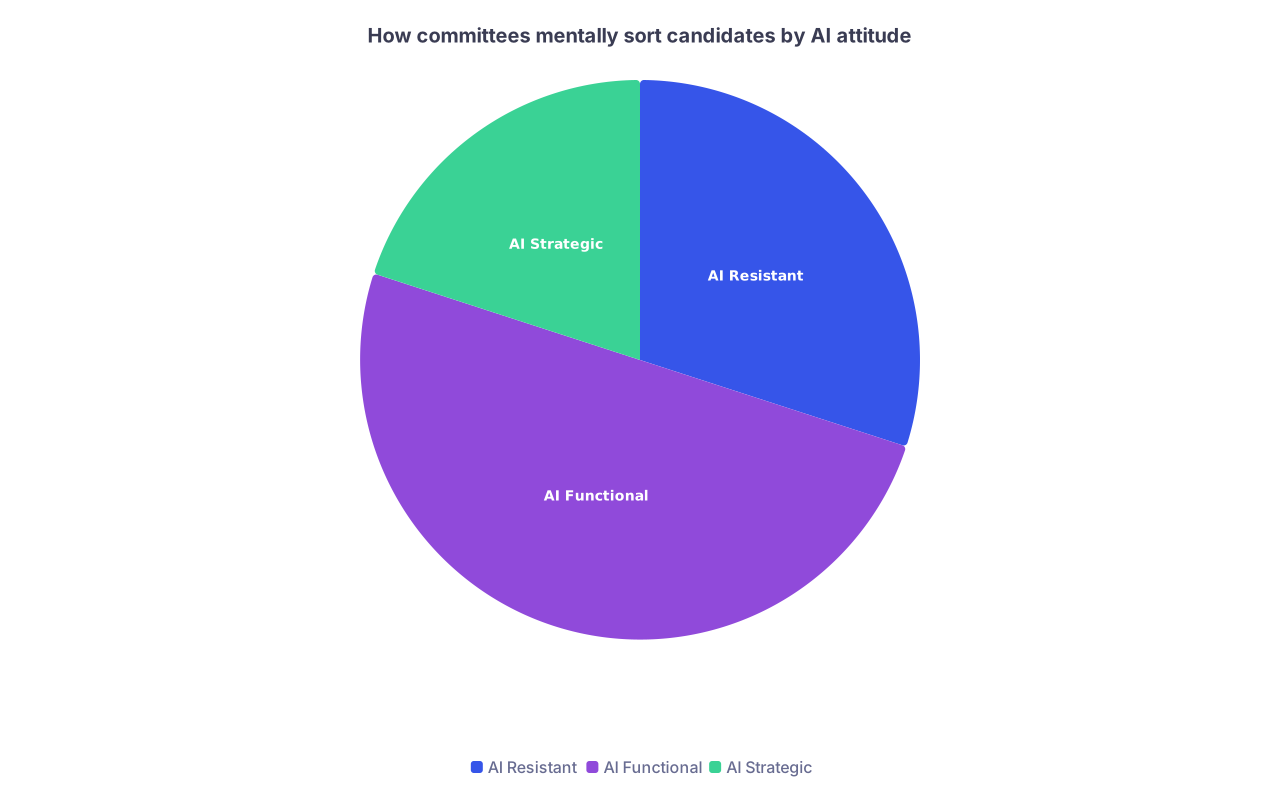
| Category | Value |
|---|---|
| AI Resistant | 30 |
| AI Functional | 50 |
| AI Strategic | 20 |
1. The AI Resistant (Red Flag Category)
This is the candidate who says variations of:
- “I think AI is probably overhyped.”
- “I still prefer to do things the traditional way.”
- “Our patients don’t want algorithms deciding their care.”
I’ve seen people kill themselves in 30 seconds with one offhand comment like:
“I don’t really use decision support pop-ups, they just get in the way.”
To you, that sounds like clinical judgment and independence.
To the hiring committee, it can sound like: “This person is going to fight every tech rollout and slow us down.”
If more than one faculty member already feels burned out by EMR changes and new tools, you just became the lightning rod they do not want to hire.
Nobody is expecting you to be an AI engineer. But obvious skepticism or disdain? That’s starting to look like a liability.
2. The AI Functional (The Safe Hire)
This is where most successful candidates land right now. They’re not leading AI labs, but they clearly live in 2026, not 2006.
They:
- Can discuss how they use clinical decision support, predictive tools, or AI scribes in their daily work.
- Mention understanding limitations: “We audited performance on our patient population and adjusted our workflow.”
- Know some basic vocabulary: large language models, drift, bias, validation, interpretability.
These candidates sound like clinicians and researchers who can adapt, not obstruct. Committees like them because they’re not risky. They won’t embarrass the department when a dean asks, “So how are you using AI on your service?” and points at you.
3. The AI Strategic (The Multiplier)
This is the small group whose file gets a second look, and whose interview moment changes the room.
They sound like:
- “We used a predictive model to identify high-risk patients and then redesigned our care pathway. We cut LOS by 0.8 days.”
- “We piloted an AI-based note-generation tool and saved residents around 3–4 hours per week.”
- “We’re working with our data science group to validate models for our specific population before deployment.”
They are not just users. They’re translators between tech and clinical reality.
These people get comments like:
- “They could anchor an AI initiative for our division.”
- “This is the kind of person industry wants to partner with.”
- “They’d make us look really good to the Dean’s office.”
If you want real academic leverage over the next decade, this is where you want to be headed, even if you’re not fully there yet.
What Committees Actually Look For on Your CV and Application
Let’s be blunt: most CVs still look like it’s 2015. A wall of publications, some QI, a little teaching, generic EPIC experience. So anything AI-adjacent jumps out immediately.
Here’s what gets noticed and talked about behind closed doors.
AI-Flag Words on Your CV
Your application gets scanned fast. They’re looking with half-attention for certain words:
- “Machine learning,” “deep learning,” “AI,” “predictive analytics”
- “Natural language processing,” “large language models”
- “Clinical decision support,” “algorithm validation,” “model performance”
- “Bias,” “fairness,” “model governance,” “implementation science”
If any of those show up in:
- Your research section
- QI projects
- Committee work
- Talks and invited presentations
You just got mentally labeled as at least “AI-aware.” That alone raises your stock compared to an identical candidate without it.
The Difference Between Real and Cosmetic AI Experience
Hiring committees are not fooled by buzzwords. They’ve seen a wave of “AI” projects that were basically glorified logistic regression with a shiny title.
They will be silently asking:
- Did you actually work with data scientists? Or just slap “AI” on a QI poster?
- Do you know what metrics matter? AUROC vs. “the model performed well.”
- Did anything make it into the real workflow, or was it a conference toy?
The candidate who says:
“In our ICU sepsis model, we achieved an AUROC of 0.82, but when we tested it prospectively on a different unit, performance dropped, so we paused deployment and re-calibrated.”
…sounds very different from:
“We used AI to improve sepsis detection.”
The first person clearly understands how AI behaves in the wild. That gets you instant credibility.
Non-Research AI Signals Committees Love
You do not need to have a Nature Medicine AI paper to look relevant. I’ve seen committees be impressed by:
- Serving on your hospital’s “AI oversight” or “clinical decision support” committee.
- Leading a departmental rollout of an AI scribe or triage tool.
- Teaching residents a basic AI-in-medicine session.
- Helping write guidelines for how to use, or not use, certain models in your unit.
Those usually end up as one bland line on a CV—“Member, clinical decision support committee”—but in the room, someone who knows the internal politics might say:
“That committee actually did the heavy lifting on validating our readmission model. That’s real work.”
And suddenly your candidacy shifts from “clinician-scholar” to “strategic asset.”
Interview Day: AI Landmines and Power Moves
The way you talk about AI in your interview reveals more about you than you think. I’ve watched candidates lose offers and I’ve watched average CVs get rescued entirely by how the candidate handled this topic.
The Silent Test: “Tell Me About Your Use of Technology”
This usually doesn’t include the word “AI.” It sounds like:
- “How do you see technology changing your field?”
- “What innovations are you most interested in?”
- “How do you use our EMR or data resources in your work?”
If you respond with a generic rant about EPIC or “I hope tech will reduce our documentation burden,” you sound like everyone else. Fine, not special.
If you talk like this:
“We’ve started experimenting with AI scribes in my clinic. The error rate is still frustrating in complex cases, but for routine follow-ups it’s already saving me time. The key has been setting clear guardrails and auditing a sample of notes each month.”
You’ve just shown:
- You’ve actually used real tools.
- You understand oversight.
- You think in terms of workflows and governance.
That is exactly the mindset committees want.
The Worst AI Answer You Can Give
I’ve heard this almost word for word:
“I’m a bit skeptical of AI. I’ve seen it make some really bad recommendations. I prefer to rely on my own judgment.”
On the surface, that sounds prudent. But here’s how two people in the room might hear it:
- The informatics person: “Great, they’re going to fight every CDS we roll out.”
- The chair: “We can’t keep hiring people who want to practice like it’s 1995.”
A much smarter version is:
“I’ve seen AI tools misfire when they were deployed without proper validation on our patient population. I’m interested in how we can rigorously test and monitor these systems so they actually support, rather than replace, clinical judgment.”
Suddenly you’re not anti-AI. You’re pro-responsible AI. Completely different signal.
The Power Move: Asking the Right AI Question
You want one question in your interview that quietly signals you’re thinking where leadership is thinking.
Ask something like:
“How is the department currently evaluating or governing AI tools being introduced into clinical workflows? Is there an opportunity for faculty to be involved in that process?”
or
“Does the institution have a strategy for AI in research and clinical care, and where do you see a new faculty member contributing to that?”
These questions do three things:
- Signal you understand there should be governance.
- Flag you as someone potentially useful in that governance.
- Expose whether they’re actually organized or just improvising.
I’ve seen a chair turn to the associate dean after a question like that and say, half-joking, “We should put them on the AI workgroup if we get them.” You want that.
AI Expectations by Academic Role: What They’re Really Hoping For
Not every hire is judged the same way. What committees silently expect from you around AI depends a lot on your intended role.
| Role Type | Minimum Expectation | What Impresses Them |
|---|---|---|
| Clinician-Educator | Functional user | Teaching AI literacy |
| Clinician-Researcher | Uses AI tools in research | Leads AI-enabled projects |
| Data/AI Researcher | Deep technical expertise | Clinical implementation impact |
| Division Leader | Strategic understanding | Drives institutional AI agenda |
Clinician-Educator
They do not need you to code. They do need you to not be technologically helpless.
Bare minimum in their minds:
- Comfort using AI-based tools: CDS alerts, triage support, scribes.
- Willingness to teach trainees critical thinking around AI outputs.
- Ability to give a talk like “AI in [your specialty]: what clinicians need to know.”
If you can say:
“I’ve added a session for residents on how to interpret and question AI-generated recommendations and documentation.”
You’re ahead of most.
Clinician-Researcher
Here they want to see that you can either:
- Partner effectively with data science teams, or
- Use AI/ML as one of your research tools (even if you’re not the coder).
What matters is:
- Have you co-authored with computer science, informatics, or biostats people?
- Can you talk about your datasets, outcome measures, and model performance intelligently?
- Did anything you built or studied actually get used in practice?
The clinical researcher who says:
“Our trial included an AI-derived risk score, but we did a sensitivity analysis to ensure it did not introduce bias toward any demographic subgroup.”
…gets instant respect.
Pure Data/AI Researcher
For these hires, the committee is brutal. If you’re being brought in as “the AI person,” they’re asking:
- Are you technically legitimate? (top journals, serious methods, not just riding the hype)
- Have you worked with real clinical data, messy EMR stuff, not just perfect datasets?
- Can you play nicely with clinicians, or will you sit in a silo?
They’ve been burned by “AI stars” who cannot get anything deployed because they do not understand clinical workflows or regulatory landmines.
If you can show:
- A track record of deployed tools, or at least pilot integrations.
- Familiarity with FDA, IRB, and institutional data governance.
- An ability to explain your work in normal English.
You’re gold.
Division/Section Leader
For leadership roles, they don’t care if you can build a model. They care if you:
- Have a coherent vision for how AI will affect your specialty.
- Can recruit the right mix of front-line clinicians and data talent.
- Will not let the department get blindsided by tech decisions made elsewhere in the system.
The leader who says:
“In the next 5 years, I expect AI tools to meaningfully change triage, documentation, and risk stratification in our field. I want our division to be the one shaping those tools with our own data and expertise, not having them handed down to us.”
…sounds like someone who can steer the ship, not ride it.
How to Quietly Upgrade Your AI Profile Before You Hit the Job Market
You do not need to take two years off for a data science degree. But if you’re 6–18 months from the market, there are fast, credible ways to look like you understand where medicine is going.
Quick Wins That Actually Matter
Attach yourself to one AI-ish project in your department.
Join the CDS committee. Volunteer to help evaluate a new tool. Write one methods-light but clinically serious AI paper with an informatics team.Learn the language at a minimum functional level.
Not coding. Vocabulary and concepts. Enough to ask smart questions and not sound naive. There are short, high-yield online courses tailored to clinicians; do one and apply it immediately.Build one teaching asset.
A noon conference on AI in your specialty. A resident journal club where you critically review an AI paper. Put that in your CV.Clean up your AI story.
In your research statement, personal statement, and interview answers, have 2–3 concrete sentences that show how you see AI fitting into your clinical, research, or educational work. Not grand theory. Specific use-cases.
The Hidden Fear Driving All of This
Let me be frank about why this matters so much more than people are saying out loud.
Chairs and division chiefs are scared of two things:
- Being left behind by peer institutions that embrace AI intelligently.
- Being flooded by unusable, unsafe, or poorly validated tools they don’t understand but are forced to implement.
You, as a new hire, are either part of the solution or another variable they have to manage.
They are not expecting everyone to be an AI scientist. But they are absolutely expecting that, five years from now, the people they hire today will be:
- Comfortable working with AI in the clinic.
- Thoughtful about ethics, bias, and safety.
- Able to help residents and fellows think clearly about AI.
- Open to collaborations that bring in money, data, and prestige.
If your file and your interview signal that you live in that future, you move up their list. If you sound like you want everything to stay the way it was, you quietly slide down, even if nobody tells you why.

| Step | Description |
|---|---|
| Step 1 | Applicant CV |
| Step 2 | Traditional evaluation only |
| Step 3 | Flag as AI functional |
| Step 4 | Flag as strategic asset |
| Step 5 | Standard ranking |
| Step 6 | Moderate boost in discussion |
| Step 7 | Priority for interviews and offers |
| Step 8 | AI Signals Present |
FAQs
1. Do I need formal AI or data science training to be competitive for an academic job now?
No. Formal training helps if you’re selling yourself as an AI or informatics researcher, but for most clinician-educator or clinician-researcher positions, committees just want to see functional literacy. That means you can talk about how AI is used in your area, you’ve engaged with at least one real project or governance process, and you’re not hostile to technology. A short, focused course plus a concrete project is more valuable than a long list of vague AI interests.
2. I’m late in training and have zero AI experience. Is it too late to fix this before applying?
You can change your profile meaningfully in 6–12 months. Attach yourself to one existing project—AI scribe pilot, risk prediction model rollout, CDS tuning—and do visible, documented work: draft guidelines, help design a workflow change, or co-author a small paper or abstract. Then be ready to talk concretely about what worked, what failed, and what you learned about AI limitations. That alone will separate you from many peers.
3. How technical do I need to be when discussing AI in interviews?
Not very, unless the job is explicitly for an AI researcher. What matters more is conceptual clarity. You should know the difference between “we used machine learning” and “we just ran a logistic regression,” be able to mention metrics like sensitivity, specificity, AUROC, and show awareness of bias, validation, and generalizability. If you can explain one AI-related project in plain language and answer basic follow-ups intelligently, you’re at the right level for most roles.
4. Can being too enthusiastic about AI backfire with hiring committees?
Yes, if you sound like a cheerleader detached from clinical reality. The fastest way to lose credibility is to imply AI will replace physicians soon or to gloss over safety, bias, and validation. The sweet spot is “cautiously ambitious”: you see real opportunities, you’ve worked on specific, grounded use-cases, and you emphasize governance and patient safety. Committees want AI optimists who are not fools. That combination is rare—and very hireable.
Key points: Academic hiring committees are already judging you on your AI literacy, even if they never mention the word. You do not need to be an AI engineer, but you must sound like someone who can live—and lead—in an AI-augmented healthcare system. Shape your CV, your projects, and your interview answers with that reality in mind, or you’ll be competing in the wrong decade.