
The physicians who get picked for AI pilots are not the “smartest” or the “most techy.” They’re the safest bets politically and operationally. And CMIOs are ruthless about that, even when they smile and say this is a “collaborative innovation opportunity.”
You want in on AI pilots? You want your name on early papers, internal presentations, and the slide decks that go to the board? Then you need to understand how CMIOs actually think when they build these teams. I’ve sat in those selection meetings. I’ve watched names get highlighted and others quietly crossed out with no explanation.
Let me walk you through what is really going on.
The CMIO’s Real Agenda (That Nobody Explains to You)
Forget the glossy “innovation” language from town halls. A CMIO choosing physicians for an AI pilot has four real priorities, in roughly this order:
- Don’t embarrass leadership
- Don’t blow up operations
- Don’t trigger a safety or compliance incident
- Maybe generate real value and data
Innovation is fourth. Survival is first.
The CMIO lives in the blast radius between the C-suite, legal/compliance, IT, front-line clinicians, and vendors. Every AI pilot is a career-limiting opportunity if it goes wrong. So when they pick physicians, they’re selecting for people who reduce risk in all those directions.
That’s why the criteria they use are not the same ones you think matter: Step scores, number of AI papers in med school, that “Machine Learning in Healthcare” Coursera certificate—all background noise unless they map onto the four priorities.
Criterion #1: Operational Credibility, Not Academic Stardom
CMIOs do not start with, “Who understands AI?” They start with, “Who runs a clean service?”
The very first filter is: can this physician integrate a new tool without wrecking throughput, safety, or morale?
Here’s the reality check:
When we were picking attendings for an AI-driven sepsis early warning pilot at a large Midwestern academic center, the CMIO had a list of “interested clinicians” from a town hall. That list went straight into the shredder. Instead, we pulled:
- Service chiefs’ informal ranking of “steady hands”
- Nursing managers’ list of attendings who “don’t make the floor chaos”
- Quality department data on order timing, response to critical alerts, and compliance with key pathways
If your name is associated with:
- Chronic delays in note signing
- Constant arguments with nursing about orders
- Wild variability in practice patterns
you’re not getting near an AI pilot. Because from a CMIO’s view, if you can’t reliably work inside the current system, adding AI will just multiply your chaos.
What “operationally credible” looks like from the CMIO seat
They look for physicians who:
- Close notes and orders on time (IT and quality can pull these numbers in seconds)
- Have low complaint rates from nurses and case managers
- Are known for “making the service run” rather than “being brilliant but a mess”
- Do not constantly escalate petty EHR complaints to leadership
You don’t hear this on innovation panels, but when the CMIO and COO talk about who to tap, they literally say things like: “I need someone who won’t create a dumpster fire in week two.”
If you want in on AI pilots, fix your operational reputation first. That’s the real gatekeeper.
Criterion #2: Politically Safe but Not Politically Toothless
AI pilots are political projects. They touch budgets, workflows, risk, and public messaging. CMIOs know this better than anyone.
So they pick physicians who are:
- Safe to showcase in front of the board or media
- Not actively at war with any major stakeholder group
- Yet have enough gravitas that people will follow their lead when workflows change
This is a delicate balance. And a lot of very smart, very capable physicians get excluded because they fail this filter.
You’re not chosen if:
- You’re known as “that doc who trashes admin at every staff meeting”
- You constantly undermine IT or Epic/Cerner in front of trainees
- You’ve publicly mocked prior innovation initiatives
I’ve watched a very talented ICU attending—MD/PhD, published in ML for physiology—get passed over at a major coastal AMC because the CMIO said one sentence: “If we put him as the face of this, Operations will push back. Hard pass.”
Conversely, you also won’t be chosen if you’re seen as a complete administrative pawn who nobody respects clinically. Staff won’t follow you into new workflows. Pilots die in quiet noncompliance.
The sweet spot? Someone the CMIO can stand next to on a slide and say:
“Dr. X is a respected front-line leader who’s helping us shape how AI actually works in clinical care.”
If you can’t picture your CMO saying that about you with a straight face, you’re not yet in the selection lane.
Criterion #3: Healthy Skepticism Without Being a Saboteur
Here’s a secret: CMIOs do not trust physicians who are blindly enthusiastic about AI. They’re dangerous.
When you say things like “AI will fix burnout” or “this model is better than humans,” data and compliance people start twitching. CMIOs remember every time an “innovative” tool overpromised and underdelivered. They’ve had to stand in front of incident review committees explaining why a black-box score popped up on the wrong patient.
So they quietly avoid the Kool-Aid drinkers.
What they want instead is a particular kind of skeptic:
- You question model performance and bias
- You insist on clear inclusion criteria and guardrails
- You ask, “What happens at 2 a.m. when this thing fires during surge and there’s no superuser around?”
- But you still agree to actually try the tool rather than slow-roll it into oblivion
During one inpatient readmission risk pilot, we had three kinds of physicians show up for the kickoff:
- The evangelist who essentially said, “I’ll click anything, this is the future.”
- The saboteur who brought a list of 20 reasons this would fail and asked about liability every third sentence.
- The grounded realist who said, “If this helps us prioritize discharges safely, I’m in—but I want to see the calibration plots and know how often it’s wrong.”
Guess which group the CMIO pulled into the governance council and later invited to the next pilot? The grounded realists.
If your persona in meetings is either pure hype or constant doom, you get filtered out fast.
Criterion #4: EHR Literacy and Change Resilience
You don’t need to code in Python. You do need to not break when someone moves a button.
Most AI in hospitals today is glued onto the EHR: inbasket messages, order sets, risk scores, workflow nudges. That means the physicians in the pilot need to:
- Understand how their current EHR flows actually work
- Tolerate short-term friction while new workflows stabilize
- Not scream bloody murder the first time they get three more clicks
The CMIO will quietly ask the EHR team:
“Who are the attendings that actually use the system as designed? Who doesn’t meltdown every time we upgrade?”
If your name shows up as:
- Constant ticket submitter for trivial issues
- Frequent bypasser of standardized order sets
- The one person who still dictates outside the templates
you’re a high-risk choice. Not because you’re wrong, but because you’re brittle.
Contrast that with the doc who:
- Reaches out with specific, actionable feedback
- Adapts to version upgrades after a few days of grumbling
- Has served as a superuser or pilot site once without burning the place down
That person gets tapped again and again for new tools—including AI.
Criterion #5: Volume, Data, and Measurability
AI vendors and internal data scientists care about numbers. CMIOs know that if the pilot can’t produce measurable impact, it dies. So they choose physicians and units where:
- Patient volume is high enough to generate signal
- Documentation is consistent enough to be analyzable
- Outcomes can be clearly tied to workflow changes
You see this pattern everywhere:
- ED pilots for triage tools
- ICU pilots for physiologic monitoring AI
- Hospitalist services for LOS / readmission / sepsis tools
- High-volume outpatient clinics for documentation and inbox AI
If you’re the solo subspecialist seeing four rare disease patients a day, you’re interesting scientifically but a bad pilot site for an enterprise AI deployment.
This is why CMIOs gravitate toward:
- Hospitalist group leads
- ED section heads
- ICU directors
- High-volume primary care champions
Not because they like them more, but because the math works. If the tool touches 40 patients per day instead of 4, you can actually show the CFO and CMO something meaningful on a slide.
That’s also why they often bypass junior attendings in tiny practices, even if those folks are most excited and most fluent in AI lingo.
Criterion #6: Communication Style Under Scrutiny
Here’s the part nobody warns you about: when you’re in an AI pilot, you are not just a doctor. You’re a communications liability.
CMIOs and PR are quietly asking:
- If a journalist calls this an “AI experiment on patients,” will this physician say something reckless?
- If the tool misfires, will this physician run to Twitter and post screenshots?
- Can this physician explain what the tool does in plain language without lying or overhyping?
I’ve seen candidates removed from the pilot list because:
- They spoke at a local meeting and called prior EHR changes “criminal”
- They posted heavily on social media about “stupid admin decisions” with enough identifiers that any insider knew the hospital
- They overpromised AI capabilities publicly, triggering legal’s anxiety
On the flip side, physicians who:
- Use grounded language like “decision support,” “another input,” “tool, not replacement”
- Talk thoughtfully about bias, safety, and uncertainty
- Take concerns seriously but do not incite panic
get invited into every next wave. They become the “trusted clinician voice” leadership trots out for town halls, board meetings, even payor conversations about AI.
If your instinct is to be performative or inflammatory whenever leadership is involved, you will quietly be excluded from this world.
Criterion #7: Alignment With Institutional Strategy (Not Your Personal Brand)
The AI project you care about and the AI project your hospital cares about are often not the same thing.
You might care about:
- Cutting-edge diagnosis models
- Radiology image segmentation
- Precision oncology
Your CMIO is probably under pressure for:
- Reducing length of stay
- Improving throughput
- Managing readmissions
- Cutting documentation time
- Reducing denials and improving coding integrity
Guess which agenda wins when they choose pilot clinicians.
This is why you see so many pilots around:
- Discharge planning prioritization
- Sepsis alerts
- Documentation and ambient scribing
- Imaging triage (not final read automation)
If your pet project doesn’t line up with metrics on the hospital’s dashboard, it will stay a pet project. Maybe research. Not an enterprise pilot.
That means, when the CMIO is picking physicians, they choose:
- People embedded in services that move those metrics
- Leaders who attend throughput, quality, and finance meetings
- Folks who understand that “sexy AI” is less interesting to leadership than “AI that drops denials by 5%”
If you want in, position yourself near the core institutional pain points, not just what’s cool at conferences.
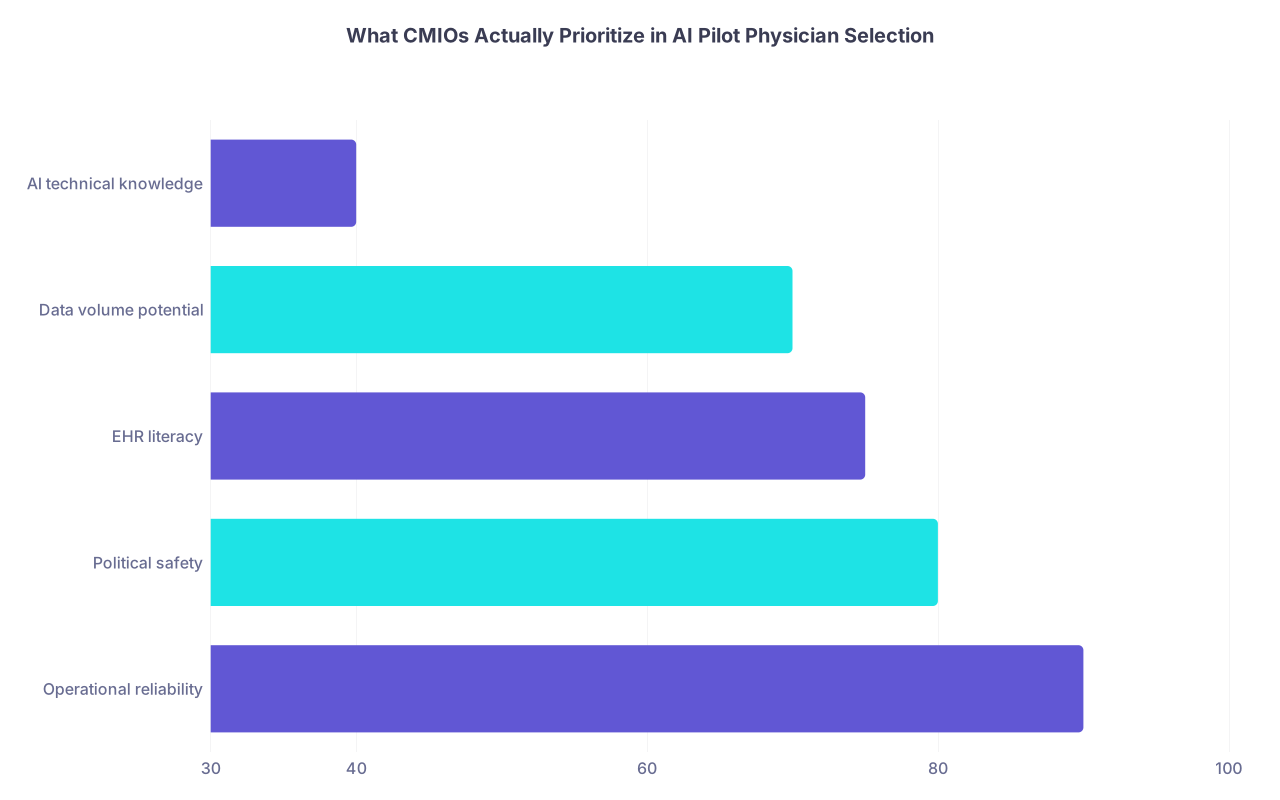
| Category | Value |
|---|---|
| Operational reliability | 90 |
| Political safety | 80 |
| EHR literacy | 75 |
| Data volume potential | 70 |
| AI technical knowledge | 40 |
How CMIOs Actually Build the Roster (Step-by-Step, Behind Closed Doors)
Let me show you how this works in real life. This is the typical pattern for a mid-size AI pilot.

| Step | Description |
|---|---|
| Step 1 | Executive asks for AI pilot |
| Step 2 | CMIO defines use case |
| Step 3 | Identify target service or unit |
| Step 4 | Ask service chief for 3-5 names |
| Step 5 | Ask nursing and ops who is reliable |
| Step 6 | Pull EHR and quality metrics |
| Step 7 | Crosscheck names from all sources |
| Step 8 | Remove politically risky candidates |
| Step 9 | Select 2-3 primary champions |
| Step 10 | Add a few neutral rank and file |
| Step 11 | Run pilot and adjust roster if needed |
At no point in that flow did anyone say, “Who took the AI elective?” or “Who wrote about transformers in radiology?” Those may help at the margins, but they’re not the core.
What matters:
- Your service chief thinks you’re solid
- Nursing doesn’t hate you
- Your metrics are not a disaster
- You’re not a political bomb
- You can speak like an adult in front of leadership
That’s the real funnel.

What You Can Do Now (Post-Residency and Early Career)
You’re out of residency or fellowship, on the job market or early in your attending role. You want in on AI. Here’s how you quietly reposition yourself.
1. Build the “steady hand” reputation first
For the first 6–12 months:
- Be boringly reliable with documentation
- Treat IT and nursing as partners, not punching bags
- Fix obvious workflow issues on your service, even small ones (discharge communication, handoffs)
CMIOs hear about the new attendings who make everyone’s life easier. They also hear about the ones who generate drama.
2. Signal interest the right way
Do not walk into the CMIO’s office saying, “I’m really into AI, can I be in your pilots?” That’s noise.
Instead:
- Tell your service chief: “If there are any workflow or EHR-related pilots coming, I’d be interested in helping test or refine them.”
- Volunteer to be a superuser or early adopter for non-AI EHR changes—small risk, high signal.
- When you meet the CMIO (you will eventually), say something like:
“I care a lot about efficient and safe workflows. I’d be interested in helping evaluate tools—AI or otherwise—that actually fit how we work at the bedside.”
That positions you as a grounded partner, not a tech fanboy/fangirl.
3. Learn just enough AI language to not sound naive
You do not need to be a data scientist, but you should be able to discuss:
- Sensitivity, specificity, PPV, calibration
- Bias and generalizability across populations
- Alert fatigue and human factors
- “Decision support” vs “automation”
That competence makes the CMIO’s life easier. You can be placed in front of committees, and you won’t embarrass anyone.
| Pilot Type | Common Physician Targets |
|---|---|
| Sepsis / deterioration alerts | Hospitalists, ICU attendings |
| ED triage / risk scores | ED section heads, senior ED docs |
| Documentation / ambient AI | High-volume primary care, hospitalists |
| Imaging worklist triage | Radiology section leads |
| Readmission / LOS tools | Hospitalist chiefs, case management-aligned attendings |
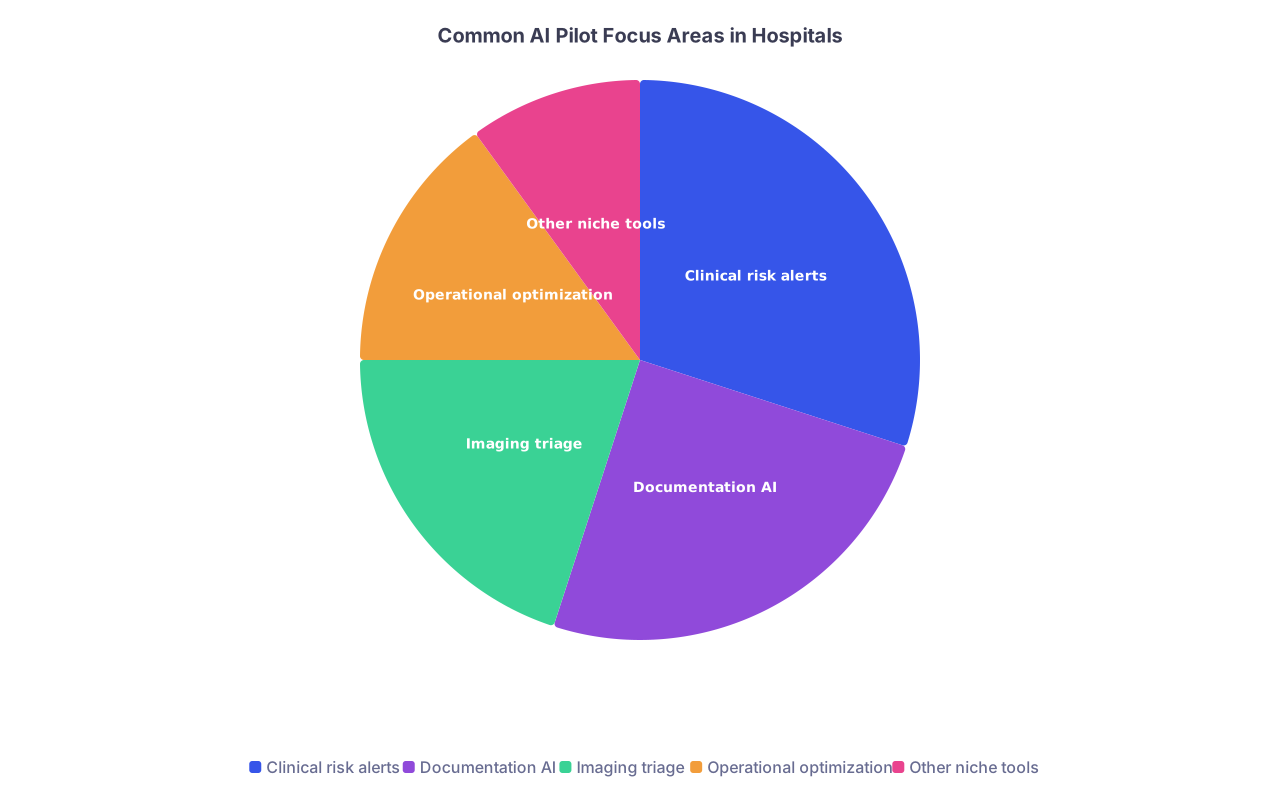
| Category | Value |
|---|---|
| Clinical risk alerts | 30 |
| Documentation AI | 25 |
| Imaging triage | 20 |
| Operational optimization | 15 |
| Other niche tools | 10 |

The Hidden Trap: Being Too Useful in the Wrong Way
One more thing insiders won’t say publicly: there’s a risk of getting pigeonholed.
If you become the “AI doc” who can smooth over bad tools with endless workarounds, leadership will keep feeding you half-baked products. You’ll be indispensable. And stuck.
The smart physicians do something different:
- They help pilots succeed when the tool is sound and aligned with strategy.
- They are vocal and data-driven when a tool is unsafe, unworkable, or misaligned.
- They push for decommissioning or redesign, not just propping up broken tech with heroic effort.
CMIOs respect that. And yes, they still pick those people. Because they need allies willing to say “no” with evidence, not just “yes” to every shiny thing.

The Bottom Line
CMIOs are not running a talent show. They are managing risk, politics, and outcomes under the banner of “innovation.” When they choose physicians for AI pilots, they are choosing:
- Operators, not just thinkers
- Politically stable, not loudest on Twitter
- Skeptical realists, not evangelists or saboteurs
- EHR-literate clinicians in high-impact services
- People who make their lives easier with leadership, not harder
If you want to be that person, stop chasing every AI headline and start cleaning up your own little corner of the system. Show you can make workflows safer and saner with the tools you already have. The CMIOs notice. They talk to each other. Your name gets mentioned in rooms you’re not in.
Years from now, you won’t remember which specific AI model version you piloted. You’ll remember that you were at the table when clinical AI stopped being a buzzword and started being real—and that you’d positioned yourself so the CMIO had no choice but to call your name.