
The way you use your EHR is quietly killing your RVUs and your career satisfaction.
Not the software alone. Your habits in it. The clicks, the shortcuts, the “I’ll just finish this at home later.” That’s what drains your time, buries your revenue, and pushes you toward burnout while the admin slide deck keeps praising “efficiency gains.”
Let me walk you through 7 EHR habits I keep watching attendings repeat year after year—habits that tank productivity, wreck documentation quality, and bleed RVUs you already earned.
If you fix these, you don’t just “chart better.” You get your evenings back. And you stop donating free work to the system.
1. Free-Text Everything Instead of Using Structured Tools
This is the most common silent RVU leak I see.
You think: “I’m fast at typing, I’ll just free-text the HPI, ROS, and plan. It’s more natural.”
Reality: You’re:
- Slower than you think
- Less complete than you think
- Leaving billable complexity undocumented
Most modern EHRs (Epic, Cerner, athena, etc.) have:
- Problem-based templates
- Smart phrases / quick-text
- Clickable structured ROS and exam elements
- Pre-built “complex visit” frameworks
If you ignore them and type everything manually, here’s what usually happens:
- You miss key elements that justify higher-level codes (e.g., no clear documentation of complexity, risk, or data review)
- Your notes get longer but not better—bloated narrative, missing billing-critical phrases
- You spend extra minutes per note you could’ve saved with well-built templates
Over a half-day clinic, being just 2 minutes slower per visit adds up brutally.
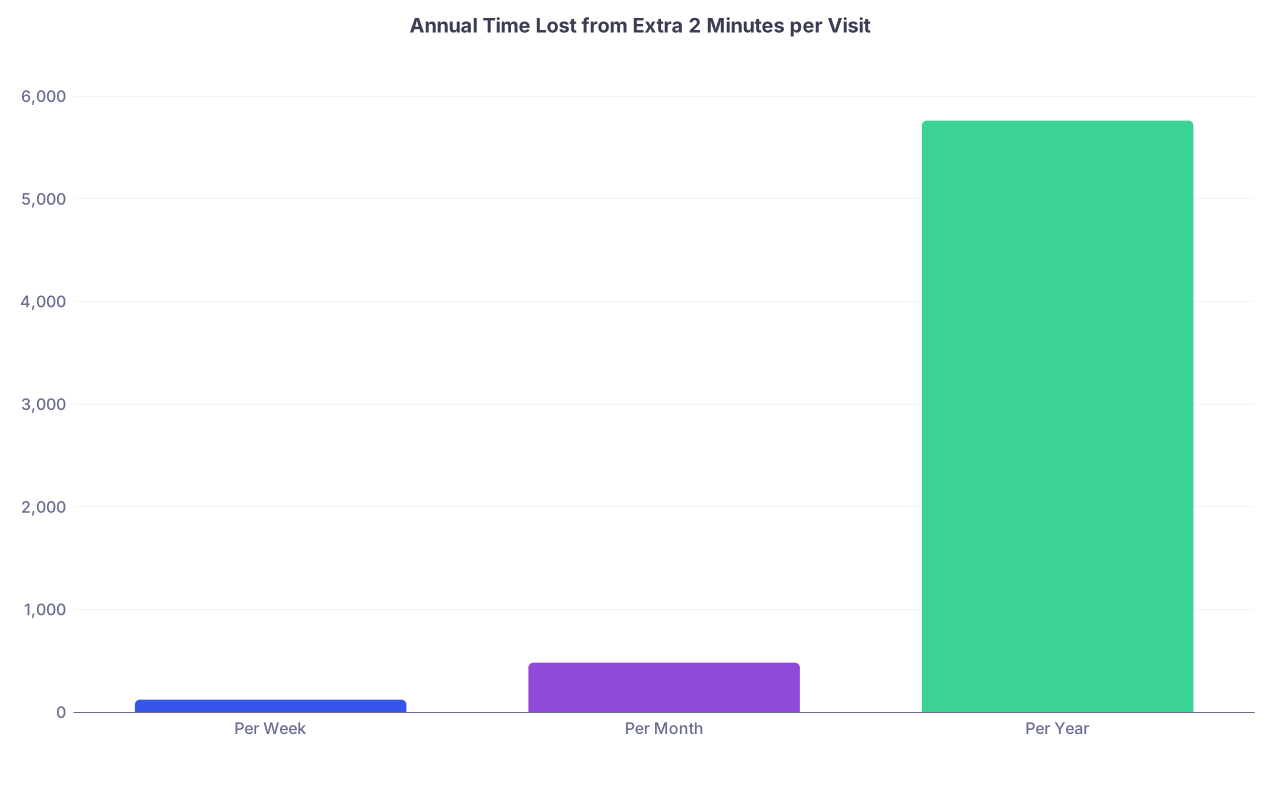
| Category | Value |
|---|---|
| Per Week | 120 |
| Per Month | 480 |
| Per Year | 5760 |
That “I like to just type it my way” attitude? It’s costing you:
- Hours per week in extra charting
- RVUs per month from under-documented complexity
Habit to avoid: Free-typing almost everything out of habit.
Better pattern: Build 5–10 high-yield templates and smart phrases that cover:
- New patient complex visit
- Established patient complex visit
- Follow-up for your top 3 diagnoses
- Post-op or post-discharge follow-up
- Telehealth visit
Then customize from there. Don’t start from zero every time.
2. Charting After Hours Instead of During the Visit
“I finish my notes after the kids go to bed.”
Translation: “I am doing hours of unpaid work and reinforcing terrible workflow habits.”
The delayed-documentation trap looks like this:
- You prioritize “seeing the next patient” over finishing the current chart
- Notes pile up by noon
- You’re finishing 10–20 notes at night, relying on memory
- You forget details that justify higher levels of service
- You feel constantly behind—and you are
This directly hits your RVUs and your sanity:
- Lower RVUs: When you chart from memory, you under-document complexity, data reviewed, time spent, risk discussion. Your note reads like a level 3 even though you did level 4 work.
- Higher burnout: Your brain never shuts off. Work is following you home via remote logins and half-finished notes.

Habit to avoid: Letting notes spill into the evening as a norm.
Better pattern: Aim to complete 80–90% of your documentation in the room or immediately after the patient leaves. That means:
- Use real-time typing during the visit (and tell the patient: “I’ll type as we talk so I don’t miss anything.” They usually appreciate it.)
- Close every encounter to at least a draft-complete state before seeing the next complex patient
- Use dragon/voice dictation for long, complex plans while the discussion is fresh
Is it socially comfortable at first? Not always. Is it worth it? Completely. The physicians who do this have fewer “charting at 11 PM” nights and better-justified RVUs.
3. Copy-Paste and Clone Abuse That Backfires on Billing
Copy-forward is a tool. A dangerous one if you’re lazy with it.
The habit goes like this:
- You clone yesterday’s or last visit’s note
- You tweak a few lines
- You leave a ton of old, inaccurate, or irrelevant content unchanged
On the surface, it looks efficient. In reality, it creates:
- Contradictions (normal exam documented with a note about worsening symptoms)
- Bloated, unreadable notes that hide the actual changes in the patient’s status
- Audit risk—payers hate obvious cloning, especially when complexity is high but nothing actually changed in the documentation
Auditors and compliance teams look for:
- Identical notes across multiple encounters with different dates
- Long ROS and exam with minimal decision-making changes
- Outdated problems listed as active
When they find it:
- They down-code your visits, slashing RVUs retroactively
- Or in the worst case: recoup money and flag you as a risky biller
| Pattern | Risk Level |
|---|---|
| Identical notes across 3+ visits | High |
| ROS copied with no changes | Medium |
| Old meds/problems left active | Medium |
| Same exam on telehealth and in-person | High |
Habit to avoid: Mindless note cloning for “speed.”
Better pattern:
- Copy forward structure, not content—use templates and problem-based documentation
- If you copy forward, actively prune: delete irrelevant problems, meds, and repeated fluff
- Highlight what changed: “Since last visit…” sections that show your thinking today
- Use short, focused assessments rather than paragraphs of repeated narrative
Shorter, accurate, non-cloned notes with clear complexity are easier to defend and often support higher RVUs than giant Frankenstein notes.
4. Ignoring Built-In Workflows That Save You Minutes per Patient
A lot of physicians use the EHR like it’s a glorified typewriter. Then they wonder why it feels so slow.
You’re making your life harder if you:
- Don’t use order sets for your common scenarios
- Manually enter the same 6 orders for every chest pain workup, every postop follow-up, every diabetes visit
- Don’t customize your favorites list (meds, labs, imaging, phrases)
- Don’t use inbox filters and quick actions to sort refills, results, and messages
Those “few extra clicks” add up. Fast.
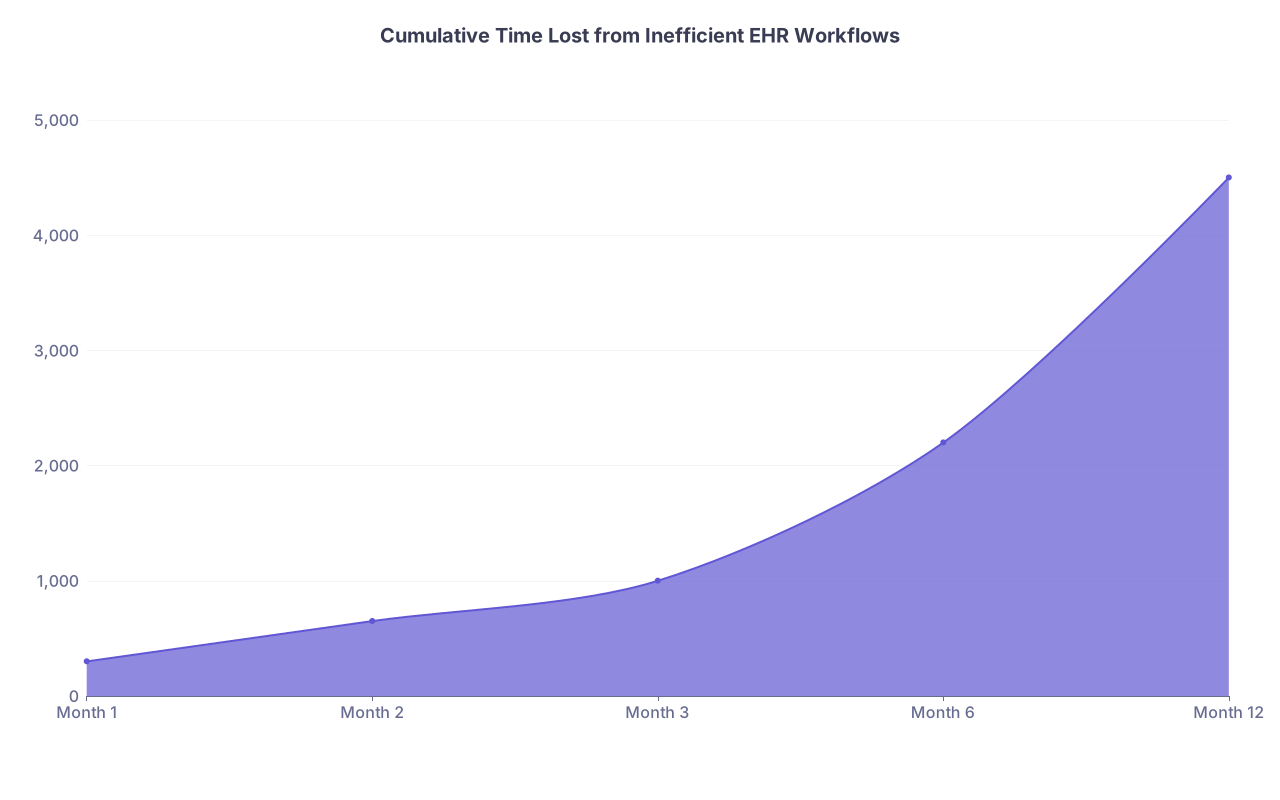
| Category | Value |
|---|---|
| Month 1 | 300 |
| Month 2 | 650 |
| Month 3 | 1000 |
| Month 6 | 2200 |
| Month 12 | 4500 |
I’ve watched attendings in the same clinic:
- One uses order sets and favorites → finishes clinic mostly on time
- The other searches for every order each time → chronically behind, more after-hours charting, more stress
Same patients. Same schedule template. Totally different experience.
Habit to avoid: Using “search everything every time” as your default.
Better pattern (take one afternoon and do this):
- Build 3–5 order sets: common admit, common discharge, common outpatient workup
- Add your top 20 medications and top 20 labs/imaging to favorites
- Learn 2–3 keyboard shortcuts for your EHR (yes, literally ask IT or a super user)
- Tidy your inbox filters so you’re not drowning in noise
These are one-time investments that pay back daily for the rest of your career.
5. Treating the EHR Inbox Like a 24/7 Emergency Room
The inbox is not your boss. But a lot of physicians act like it is.
Here’s the pattern:
- You keep your EHR inbox open all day
- You respond to messages between every patient
- You check it on your phone, at lunch, in bed
- You feel constantly interrupted and behind
This destroys both your focus and your RVUs.
Why?
- Every time you context-switch, you lose time ramping back up to patient care or documentation
- You respond reactively to low-value messages instead of finishing charts that actually generate billable work
- You handle clinically significant work (med titration, complex advice) but don’t bill for any of it

Habit to avoid: Treating every inbox message like a STAT consult.
Better pattern:
- Check your inbox in batched blocks (e.g., twice in the morning, twice in the afternoon) instead of continuously
- Use message pools and delegate appropriately to nurses/MAs when allowed
- Learn your system’s rules for billable e-visits / virtual check-ins and actually use them
That last point gets ignored constantly. Many systems allow billing for:
- Patient-initiated messages with documented clinical decision making
- Medication adjustments requiring review of data and chart
- Stable, established patients managed asynchronously
But if you don’t document properly (time, complexity, decision-making) inside the EHR, you’ve just done free clinic.
6. Letting Everyone Else Dictate Your EHR Workflow
Another quiet burnout bomb: you let the system push work onto you that doesn’t belong to you.
Examples I see all the time:
- Refill requests auto-routed to you without any protocol or MA/nurse triage
- Every incoming lab routed to you—even when another doc ordered it
- Administrative tasks (school forms, DMV forms, letters) shoved into your inbox with no time allocation or RVU structure
- Med reconciliation and data entry done entirely by the physician while MA/Nurse capacity is underused
You accept all of this as “part of the job” and then complain you’re behind. You should be. You’re doing extra jobs.
There’s a direct link between this and RVUs:
- Time spent doing low-value EHR tasks = time not spent seeing one more patient, adding one more procedure, or finishing notes that justify higher-level codes.
- When you’re rushed, you under-document, under-code, and lose RVUs you already earned clinically.
Habit to avoid: Silently absorbing everyone else’s EHR work as your own.
Better pattern:
- Sit down with your manager or medical director and review your routing rules
- Push for protocols:
- Which refills can nursing handle?
- Which labs go to ordering provider only?
- Which forms have pre-visit completion by staff?
- Train your MA or nurse to:
- Pre-populate histories
- Start documentation on vitals, ROS, meds, allergies
- Flag charts for you intelligently
You’re not being “difficult” by insisting on rational workflows. You’re protecting your time and your RVUs.
7. Never Learning the RVU and Documentation Rules for Your Specialty
This one stings a bit: a lot of attendings don’t actually know how their work turns into RVUs.
They guess.
They rely on coders to fix it.
They assume “if I just write a long note, it must support a high code.”
Wrong.
If you don’t understand:
- What makes a visit level 3 vs 4 vs 5 under current E/M guidelines
- Which procedures generate separate RVUs and require clear documentation
- How time-based billing vs complexity-based billing interacts with your note content
- Which services can be billed separately (care coordination, e-visits, prolonged services, transitional care)
…then you’re almost certainly undercoding yourself. Or occasionally overcoding in ways that get down-coded silently.
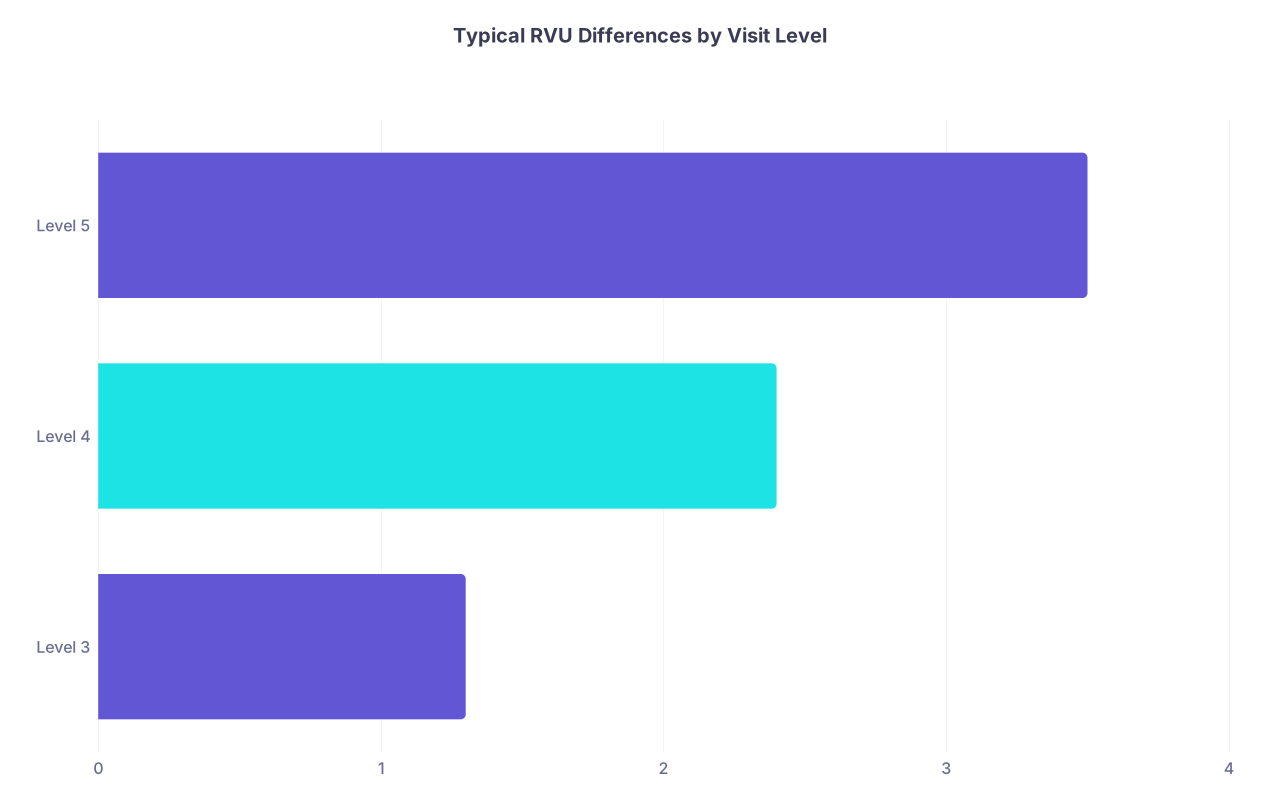
| Category | Value |
|---|---|
| Level 3 | 1.3 |
| Level 4 | 2.4 |
| Level 5 | 3.5 |
Think of it this way:
- If you always default to level 3 or 4 because it “feels safer,” you are donating income to the system
- If your note doesn’t clearly document complexity, risk, and decision-making, your coder either down-codes or takes the hit
I’ve watched colleagues see nothing but high-complexity visits and bill like they’re running a quick-care clinic. Their RVUs don’t reflect their effort. That’s not the EHR’s fault. That’s a knowledge gap.
Habit to avoid: Staying deliberately ignorant of documentation and RVU rules because “I’m a doctor, not a biller.”
Better pattern:
- Spend 2–3 focused hours with:
- Your coding department
- A specialty-specific documentation guide
- A colleague who consistently hits higher RVUs ethically
- Ask very specific questions:
- “Show me 3 of my notes where I left RVUs on the table and why.”
- “What phrases or elements are you always wishing I’d include?”
- “In my specialty, what’s the most common reason visits get down-coded?”
Then build smart phrases that include those key elements (risk discussion, data reviewed, time spent, shared decision-making) in your EHR.
You’re not “gaming the system.” You’re documenting reality in the way the system understands and pays for.
Pulling It Together: A Safer EHR Strategy That Doesn’t Own You
If you recognize yourself in several of these habits, that’s normal. You were trained to be a clinician, not a systems engineer.
But post-residency, on the job market, the rules change. You’re measured by:
- RVUs
- Throughput
- Patient satisfaction
- “Engagement” (which usually hides “how many unpaid tasks you absorb without complaining”)
Your EHR habits directly affect all of those.

| Step | Description |
|---|---|
| Step 1 | EHR Habits |
| Step 2 | Time Per Visit |
| Step 3 | Documentation Quality |
| Step 4 | After Hours Work |
| Step 5 | Visit Level and RVUs |
| Step 6 | Burnout |
| Step 7 | Compensation |
| Step 8 | Career Longevity |
If you want a practical path forward, focus on three levers:
Speed without sloppiness
- Use templates, smart phrases, order sets, and favorites
- Finish most documentation in or immediately after the visit
Quality that maps to RVUs
- Learn what actually differentiates visit levels and procedures
- Avoid clone abuse; highlight your decision-making and risk
Boundaries around unpaid EHR work
- Batch inbox time
- Offload what doesn’t require a physician
- Stop doing all your meaningful thinking after 9 PM on the couch
You don’t need to become a “tech person.” You just need to stop making the same EHR mistakes that quietly drain your RVUs and your energy.
Protect your time like it’s a limited resource—because it is.
FAQ (Exactly 3 Questions)
1. Is it really worth my time to learn templates and shortcuts if my EHR might change in a few years?
Yes. The concepts transfer even if the software changes. Knowing how to build templates, use favorites, and structure notes around problems and decision-making is portable. You’ll adapt faster to any new system and avoid restarting from zero every time your hospital updates vendors.
2. How do I know if I’m undercoding or losing RVUs because of my documentation?
Pull a small sample of your recent charts and sit with a coder or billing specialist. Ask them to walk you through how they coded each visit and whether your note would have supported a higher level if documented differently. One focused session like this usually reveals clear, repeatable patterns you can fix.
3. What’s the single biggest EHR habit to change if I’m overwhelmed and can’t tackle everything at once?
Stop finishing your notes at night. Commit to closing most charts before you leave clinic or the hospital, even if it means adjusting how you work in the room. Once you break the “I’ll just do it later” cycle, you free up mental space to improve everything else—templates, inbox management, documentation quality—without being constantly exhausted.