
27% of published “AI beats doctors” diagnostic studies actually compare algorithms to non‑specialists or use cherry‑picked test sets that specialists never see in real life.
So let’s kill the headline myth right away: no, AI diagnostic tools are not generally “better than specialists.” They’re sometimes better than some doctors on narrow, artificial tasks under ideal conditions. That’s not the same thing as outperforming real-world experts seeing messy, biased, incomplete data at 3 a.m. with a malpractice lawyer sitting on their shoulder.
You’re post‑residency, thinking about where you fit in the job market while AI startups keep shouting that they’ll “replace radiologists,” “outperform dermatologists,” or “do triage better than ED attendings.” You deserve the actual numbers, not the press‑release version.
Let’s walk through what the evidence really shows.
The Hype vs. The Study Design
A huge chunk of the “AI outperforms doctors” narrative comes from quietly rigged comparisons.
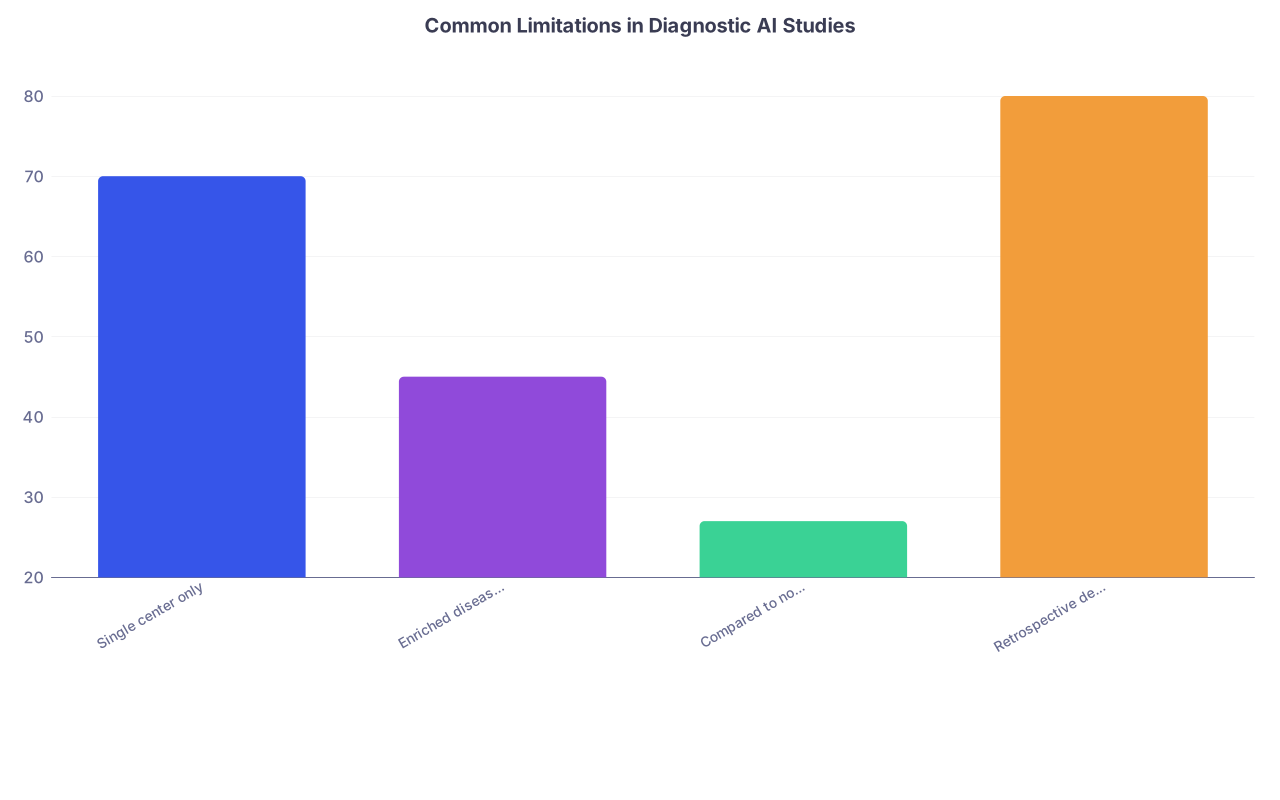
| Category | Value |
|---|---|
| Single center only | 70 |
| Enriched disease prevalence | 45 |
| Compared to non-specialists | 27 |
| Retrospective design | 80 |
All those sound bad. They are. Here’s what that actually means in clinical terms:
- Single-center: Model trained and tested on the same institution’s data. It learns that “this scanner + this population = this disease pattern.” Move it to another hospital? Performance often drops. Hard.
- Enriched prevalence: Instead of real-world 1–2% disease prevalence, they construct a test set with 30–50% positives. That makes sensitivity/specificity look amazing and hides how terrible PPV would be on a normal day.
- Weak comparators: “AI vs doctors” turns out to be “AI vs random internal medicine residents who never read chest CTs unassisted in real life.”
- Retrospective: Model sees clean, fully documented, nicely labeled data. The stuff you wish you had before the patient crashed. Not the partial, contradictory, “outside hospital, no radiology report available” reality.
I’ve sat in journal clubs where the abstract sounded like Skynet in a lab coat. Then you hit the methods section and realize the human comparator was a single fellow given 40 JPEGs with no clinical context and a five-minute time limit.
That’s not how specialists work. And it’s not how risk works when it is your license on the line.
Radiology: The Favorite AI Target
Radiology is always first on the chopping block in AI narratives, so let’s start there.
What the good studies actually show
Look at large, decently run studies and real deployments:
- Mammography AI: Several tools show radiologist‑level performance in detecting breast cancer on screening mammograms. But when used with radiologists instead of replacing them, the real value looks like:
- Slight increase in cancer detection
- Reduction in recall rate
- Sometimes decreased reading time
- Chest imaging AI (ED, ICU): FDA‑cleared tools for pneumothorax, PE, intracranial hemorrhage, etc.
- The best evidence: they improve time‑to‑report or time‑to‑intervention, not that they “outperform” radiologists in accuracy.
- A radiologist would have caught that bleed anyway. The AI just flags it earlier in the queue.
| Use Case | Primary Benefit | Replaces Radiologist? |
|---|---|---|
| Mammography CAD | Slight detection gain | No |
| Intracranial hemorrhage AI | Faster time‑to‑report | No |
| Chest x‑ray triage | Prioritization, workflow | No |
| Lung nodule detection | Second reader, QA | No |
The pattern is boringly consistent: when studied honestly, AI in radiology looks like a decent second pair of eyes and an aggressive queue‑manager, not a better subspecialist.
Where AI clearly loses
The moment you ask the model to deal with:
- Highly atypical presentations
- Incidental, unrelated but important findings
- Context (“Oh, this patient had chemo last month, that changes how I view this pattern”)
It falls on its face. Because those weren’t the problems it was trained to solve.
Radiologists don’t get paid to pixel‑match. They get paid to integrate signal with context, ambiguity, risk, and downstream consequences. The models are great at the first, bad at the rest.
Dermatology: The “AI beats dermatologists on photographs” Myth
You’ve seen the headline: “AI matches board‑certified dermatologists at skin cancer diagnosis using smartphone images.”
Reality check:
- The model sees cropped, high‑quality lesion photos.
- Compares to dermatologists staring at the same pictures, often stripped of:
- Palpation
- Dermoscopy
- Patient history
- Full‑body context (“how many lesions”, “pattern”, “phototype”)
In the real world, a dermatologist:
- Looks at the whole patient, not a 2D patch.
- Integrates history (“grew fast”, “bled last week”, “immunosuppressed”).
- Decides which lesions to biopsy, and how many, not just “looks malignant / benign.”
Where AI might help eventually:
- Patient‑side triage: “This needs a derm in 1 week vs 3 months.”
- Primary care support to reduce meaningless derm referrals.
- Monitoring changes over time in high‑risk patients.
But as of now, there’s no credible evidence that consumer‑grade or even most research AI tools can safely replace in‑clinic derm evaluation. And every time someone tries to deploy such an app at scale, real‑world performance is worse than the paper.
Pathology & Lab: Strong Algorithms, Fragile Reality
Digital pathology is fertile ground for AI: fixed slides, stained in consistent ways (ideally), high‑res images.
Some algorithms for:
- Mitotic figure counting
- Gleason grading assistance
- Lymph node micrometastasis detection
…are legitimately strong. On certain tasks, they equal or exceed individual pathologists in accuracy or speed.
Here’s the trap: “individual pathologist” is not the gold standard. In high‑stakes cases, real practice often uses consensus, repeat review, additional stains, and multidisciplinary discussion. When you compare AI against that, the “better than specialists” story largely evaporates.
Plus, pathology AI breaks down when you:
- Change scanners
- Use different stains
- Feed it suboptimally prepared slides from under‑resourced labs
In other words, the exact environments that most need help—low‑resource, variable‑quality settings—are where the models are least robust.
ED & Primary Care: Triage, Risk Scores, and CDS
Here’s where the myth gets more subtle. The question isn’t “Is AI better than an ED attending?” It’s “Is an AI‑augmented triage or risk tool better than a standard score or unaided clinician judgment?”
Look at sepsis prediction, AKI alerts, or ED triage support:
- Several high‑profile sepsis prediction tools (including commercial ones) had:
- High sensitivity on paper
- Massive alert fatigue and missed real sepsis cases in practice
- Early AKI prediction models often:
- Fire so many alerts that clinicians stop caring
- Are tested on retrospective datasets with perfect lab timing, not on messy EMR streams
Yet some tools do work—when they are basically just better calculators of risk scores embedded in sane workflows:
- Automated HEART score calculators in the ED that cut down on unnecessary admissions.
- Early warning systems that nudge nurses and residents when vitals drift in concerning patterns.
But again, that’s not “AI is better than an ED attending.” It’s “a well‑designed, sometimes ML‑powered tool, plus a human, is better than a human without that tool.”
Big difference.
Why “AI vs. Specialist” Is Usually the Wrong Question
There are three massive structural problems with the whole “who’s better?” question:
1. Ground truth is often messy, not binary
In cancer diagnosis, for example:
- Pathologists may disagree.
- Even “gold standard biopsy” can be mis‑sampled or read differently by experts.
- Guidelines evolve; what was “low risk” last decade is “treat aggressively” today.
So when a paper says “AI matched ground truth better than doctors,” always ask: who defined “truth”? A single pathologist? A consensus panel? Follow‑up over years? The answers matter a lot.
2. Real practice includes uncertainty and follow‑up
You don’t just stamp “disease” or “no disease” and walk away. You:
- Plan follow‑up imaging.
- Order additional tests.
- Safety‑net: “Come back in 48 hours if X, Y, Z.”
- Adjust your decisions based on dynamic data.
Almost no AI studies model the cascading decisions and safety nets that keep patients alive when the first call is wrong. They compare one‑shot predictions to one‑shot judgments.
3. The cost of error is not symmetric
A 95% sensitivity with 5% false negatives for cancer in a paper might look “non‑inferior.” In a real malpractice setting, missing 5 out of 100 cancers is unacceptable without robust safety nets and follow‑up.
Humans factor risk, reputation, liability, and patient preferences in. Models do not. Yet.
What Actually Happens When AI Is Deployed Clinically
Let me be blunt: the biggest “performance drop” for AI is not technical. It’s social and workflow.
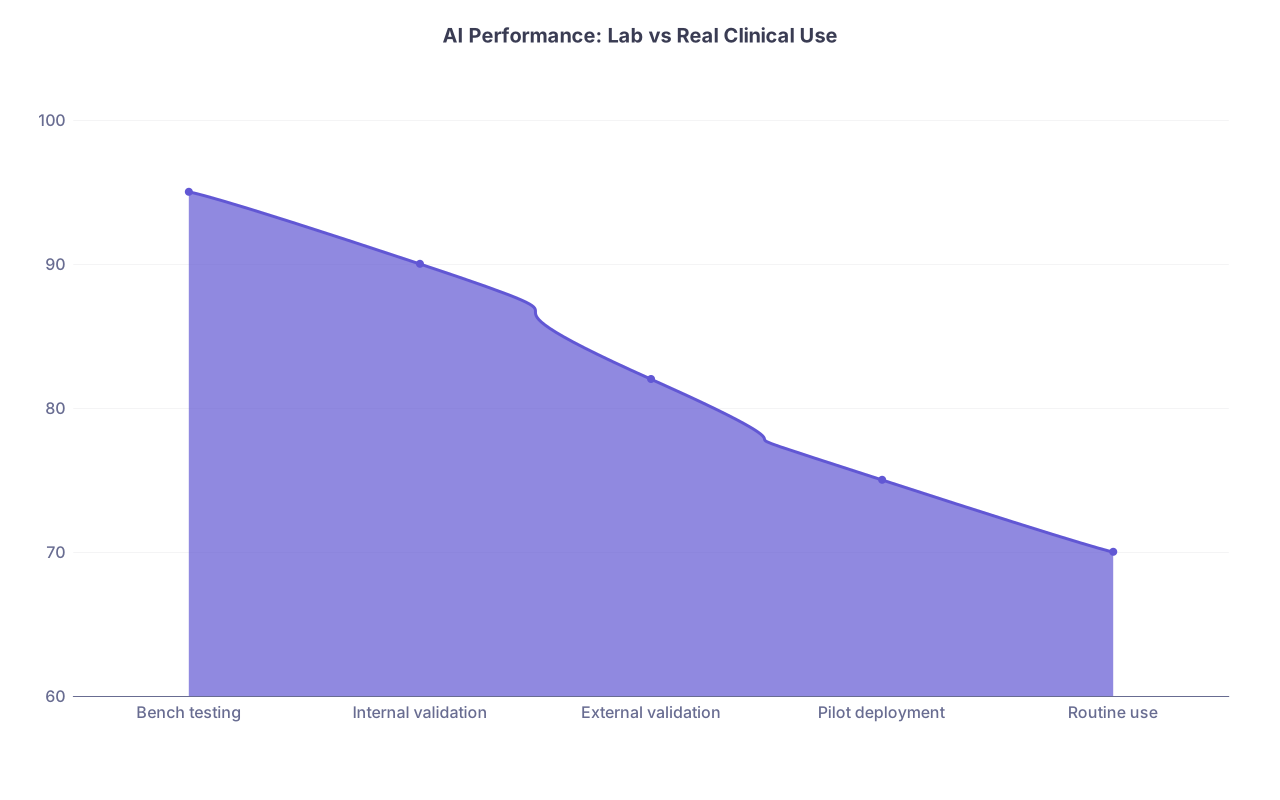
| Category | Value |
|---|---|
| Bench testing | 95 |
| Internal validation | 90 |
| External validation | 82 |
| Pilot deployment | 75 |
| Routine use | 70 |
That downward slope is exactly what clinicians feel and what investors pretend not to see.
Common failure modes I’ve seen or heard directly from colleagues:
- The tool is “available” in the EMR but buried three clicks deep. Nobody uses it.
- Alert fatigue. Sepsis or AKI tools that fire so often they get filtered out mentally with the background noise.
- Distrust. “The model says PE, but the clinical picture doesn’t fit, and there’s no explanation. I’m not risking an unnecessary CT on this.”
- Garbage input. Missing vitals, mismatched CPT codes, inconsistent note structure. Feed a model trash, get mathematically elegant trash back.
When AI is thoughtfully embedded:
- As a silent second reader that only flags discordant cases.
- As a queue‑prioritizer, not a final decider.
- As an automatic risk scorer that saves time instead of adding tasks.
…clinicians use it, trust it more, and patients probably do better. But that’s augmentation, not replacement.
For Post‑Residency Physicians: What This Means for Your Job Market
Let’s be brutally practical.
Your job is not to out‑pattern‑match an algorithm
If the only value you add is spotting a 5 mm lung nodule, yes, a machine will eventually beat you. That’s not a career; that’s a feature.
Where specialists maintain leverage:
- Integrating imaging / labs / history / social context / comorbidities into a management plan.
- Handling ambiguity and conflicting data.
- Communicating risk and uncertainty to patients and teams.
- Navigating tradeoffs: cost, access, quality of life, patient preferences.
AI is weak at all of that, and will remain weak for a while.
Smart specialists learn to operate the AI, not compete with it
You want to be the person who:
- Knows when to ignore the algorithm because the clinical picture is wrong.
- Understands the model’s training data and biases.
- Can explain to admin why a specific tool is garbage for your population.
- Helps tune thresholds and workflows so the tool actually helps rather than spams.
That makes you harder to replace, and ironically, more attractive to the same organizations flirting with AI.
Who Actually Gets Replaced?
Not radiologists. Not dermatologists. Not ED attendings.
The people most at risk are:
- Low‑autonomy, high‑volume, protocol‑driven work where:
- Clinical judgment is heavily constrained.
- Human workers are already treated as interchangeable.
- Environments where administrators believe the marketing slide more than the clinical literature.
In other words: if a job is already de‑skilled and checklist‑driven, AI may replace parts of it. But that’s a management problem long before it’s a technology problem.
The Evidence‑Based Bottom Line
Strip away the hype and the narrative is much less dramatic, but a lot more useful:
- AI diagnostic tools are usually not “better than specialists”; they’re better than unaided, time‑pressured humans on narrow, well‑defined subtasks.
- In real deployments, the wins are workflow and triage—faster prioritization, fewer misses in edge cases—when the tools are integrated sanely and used as augmentation, not replacement.
- For your career, the smart move is to own the integration of AI into your specialty, not to posture against it or blindly trust it. The specialists who understand both medicine and the limitations of these tools will be the ones writing the rules, not following them.