
It’s your second year out of residency. You’re in a “performance review” that was supposed to be quick. The CMO, a service line director, and some quality person you barely know are in the room. On the screen: dashboards with your name on them. EHR metrics. Portal messages. Order sets. “Clinical decision support adherence.”
You thought this was about RVUs.
They’re actually answering a different question:
Can we trust this doctor with the tech stack we’ve already paid millions for—
or are they going to be a problem?
Let me walk you through what’s really happening behind those closed doors, because none of this is written in your contract, your onboarding binder, or the hospital’s cheery “innovation” newsletter.
The Quiet Metric: Are You a Tech Multiplier or a Tech Drag?
Every modern health system has two parallel scorecards on you.
The public one: RVUs, patient satisfaction, length of stay, readmissions.
The private one: how you interact with the tools they’ve already sunk capital into.
They will never call it “tech adoption score” out loud. But it exists. I’ve sat in those meetings. I’ve watched them pull up the reports.
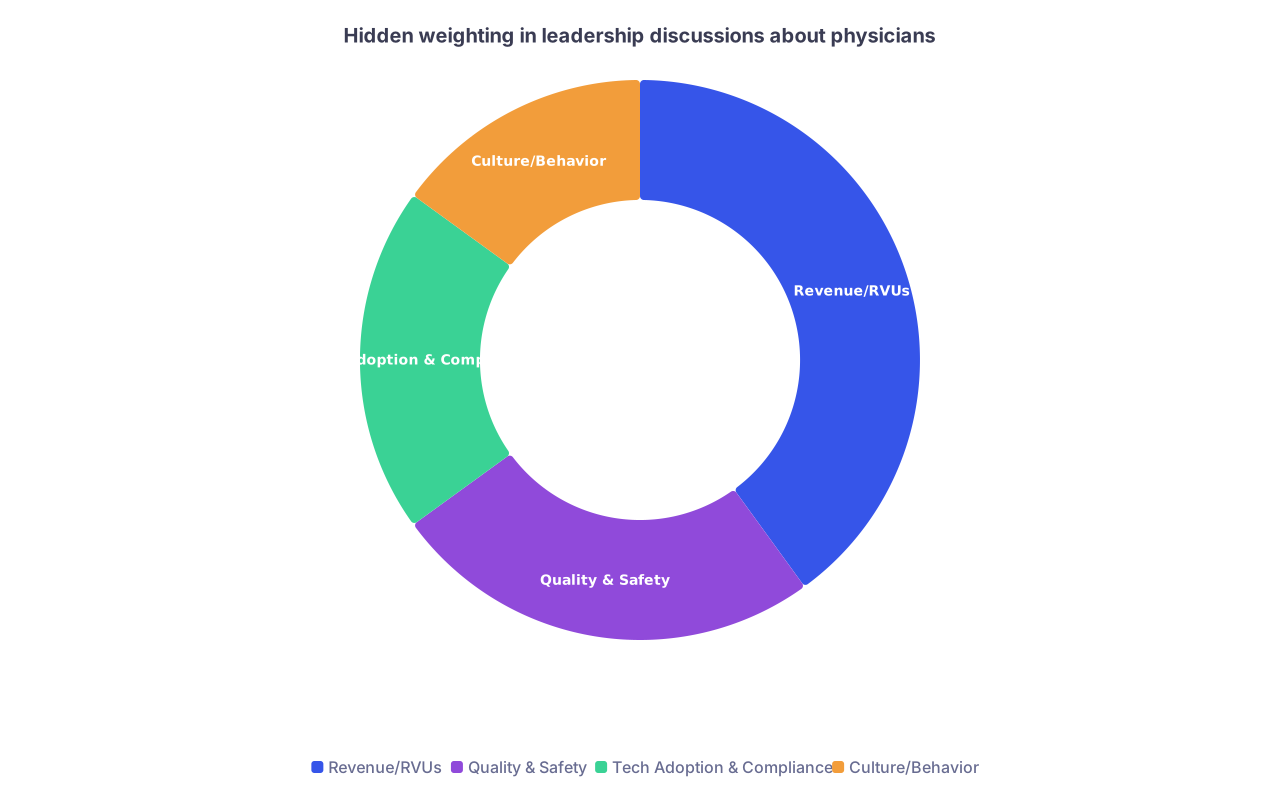
| Category | Value |
|---|---|
| Revenue/RVUs | 40 |
| Quality & Safety | 25 |
| Tech Adoption & Compliance | 20 |
| Culture/Behavior | 15 |
That 20% slice—tech adoption & compliance—decides who:
- Gets leadership titles
- Gets first shot at new clinics, programs, pilots
- Gets protected time, scribes, or extra staff
- Gets quietly sidelined, even if their numbers look “good”
They label physicians, tacitly, into three buckets:
- Multipliers – You make their expensive tech actually work in the real world.
- Neutral – You don’t help, but you don’t block.
- Drags – You slow down adoption, complain publicly, and train others to resist.
You want to be seen as a multiplier or at worst neutral. Becoming known as a drag? That follows you across systems. CIOs and CMOs talk.
The 7 Things They Actually Track (Even If They Pretend They Don’t)
Most of this is data-driven. A surprising amount is gossip-driven. I’ll give you both.
1. EHR “Citizenship” Score
First thing they pull up? EHR analytics. Every big EMR has a performance dashboard—Epic, Cerner, whatever. Admins love these.
They’re looking at:
- Chart completion time – How long after the visit do you finish your notes?
- In-basket response times – How fast do you handle messages, refill requests, result notifications?
- Use of templates, dot phrases, order sets – Are you using the standardized tools or “free-typing everything”?
Here’s the part they won’t say in the town hall:
They are less worried about your efficiency than about system predictability.
You finishing notes at 11 pm from home every night versus by 5 pm from clinic? That’s not about burnout for them. It’s about predictability of documentation, billing, and throughput.
Typical private conversation:
“She’s strong clinically, but she just won’t use the order sets. Every admission is custom. That’s killing our throughput and making standardization impossible.”
So they rank you mentally:
- Above-average EHR citizen → candidate for leadership, pilot projects, committee roles.
- Average → fine. You can stay where you are.
- Below-average / resistant → not who they want involved in strategic moves. You become “operational risk.”
2. Your Pattern With Clinical Decision Support (CDS)
You might think those interruptive alerts are just annoying. Admins see them as guardrails they can use in meetings with regulators, payers, and malpractice carriers.
Behind the scenes they track:
- How often you override alerts (and for which ones)
- How often you follow suggested pathways or protocols
- Whether your behavior diverges wildly from your peers
This is where language shifts from “innovation” to “risk.”
I’ve heard this exact sentence in a conference room:
“If we have a sepsis case end up in court, I want to be able to show the doc followed our sepsis pathway. If they’re always overriding it, that’s exposure.”
They don’t need you to obey every single prompt like a robot. But they absolutely notice if you are the outlier who dismisses everything.
Low-key secret: if you’re going to deviate often, you’d better be able to explain your pattern in a way that sounds systematic, not random. Otherwise you get tagged as “dangerous cowboy who ignores tools.”
3. Secure Messaging and Patient Portal Behavior
No one told you this in residency: your relationship with the patient portal is part of your tech adoption profile.
They pull data on:
- Response times to portal messages
- Rate of “message escalated to visit”
- Number of messages handled by your team vs you personally
- Complaints about “doctor doesn’t respond in portal”
CMO to CNO in a meeting:
“We rolled out asynchronous visits, but only 40% of physicians are using it as designed. The others are replying like it’s email and closing the encounter. That’s leaving money and efficiency on the table.”
Here’s the actual rubric they use in practice:
- If you refuse to use messaging, stall implementation, or bad-mouth it to patients → you’re labeled as a drag.
- If you use it but in a way that explodes your panel and generates chaos → admins see you as operationally unsophisticated.
- If you set boundaries, use templates, funnel messages into billed visits when appropriate, and train your MA/RN to triage → you become “a doc who gets it.”
They’re not grading you on kindness here. They’re grading you on whether your behavior aligns with the business model they’ve attached to the tech.
4. Telehealth: Your Post-2020 Reputation
Telehealth changed your file. Permanently.
During the early pandemic, some physicians:
- Took to telehealth fast
- Helped troubleshoot workflows
- Gave structured feedback (“this part works, this part breaks when volume spikes”)
Others:
- Fought it
- Gave vague complaints
- Refused visits or made staff convert them to in-person against policy
Guess which group is now considered:
- Future leaders
- “Safe bets” for new virtual care lines
- People you move into higher-leverage roles
Even now, in 2026, they still talk about “who stepped up during telehealth rollout” as shorthand for “who adapts to tech under pressure.”
If you ghosted telehealth or did the absolute minimum, the label stuck: “not great with change or tech.”
You can fix that, but it takes intentional work and visibility.
5. How You Handle New Tools (Pilots, Wearables, AI, Etc.)
This is the one that feels minor in the moment and kills careers quietly over 5–10 years.
New pilot: remote patient monitoring, AI scribes, wearables, digital check-in, whatever.
Here’s what leadership looks for:
- Who raises their hand to pilot (and actually engages)?
- Who participates but undermines the project with sarcasm and eye-rolling?
- Who gives concrete, actionable feedback versus “this sucks”?
Behind the scenes, they keep a short list:
- “Pilot-friendly” physicians – They call you when they need real-world clinical input. You get first access to whatever actually helps. You get face time with the CIO, CMO, and COO.
- “Pilot-hostile” physicians – They route around you. You find out about changes after decisions are made.
I’ve seen two physicians in the same department, same seniority, diverge hard over 3 years purely because of this. One said:
“I’ll try it, but I want a direct line to the project manager so I can give feedback fast.”
The other said:
“Another shiny object from admin. I’m not your guinea pig.”
Guess which one now sits on the system digital health council. Same clinical skills. Massively different internal value.
6. Influence on Peers: Are You a Force Multiplier or a Saboteur?
Admins know some attendings are highly influential. The older surgeon whose offhand comments torpedo an entire initiative. The charismatic hospitalist everyone imitates.
For those people, tech adoption behavior counts double.
If they see that:
- When you adopt something, a chunk of your colleagues follow
- When you trash something in the lounge, adoption plummets
You become a strategic priority. They either court you or they isolate you.
I’ve literally seen this play out:
- Influential doc who hates the new EHR → They remove them from certain committees and avoid them in early planning, then roll out around them.
- Influential doc who’s skeptical but willing → They get invited to “pre-launch demo,” their input gets baked in, and the tool is modified just enough to win them over.
Behind closed doors, you get described as:
- “Super user and champion”
or - “Vocal resistor we need to contain”
That description then leaks subtly into promotion conversations, leadership nominations, even reference calls when you apply somewhere else.
7. Are You “Trainable” on Tech?
Sounds demeaning, but I’ve heard the word used in exactly that way:
“She’s not a tech native, but she’s very trainable.”
What does “trainable” look like in their eyes?
- You show up to training sessions on time and stay engaged.
- You ask specific questions about your workflow, not philosophical monologues.
- You try the new workflow before deciding it’s useless.
- When something breaks, you report it through the right channels instead of venting only at the nurse’s station.
There’s a secret mental quadrant they keep you in:
| Quadrant | Description | Career Impact |
|---|---|---|
| High Skill / High Willingness | Tech-savvy and cooperative | Fast track for leadership |
| High Skill / Low Willingness | Capable but resistant | Viewed as risky, often sidelined |
| Low Skill / High Willingness | Learns with support | Protected, invested in |
| Low Skill / Low Willingness | Struggles and refuses help | First to be bypassed or pushed out |
You want to be either top-right or bottom-right. Top-left can work short-term but eventually irritates leadership. Bottom-left is how careers end early.
How Tech Adoption Quietly Affects Your Money, Power, and Options
No one sends a memo saying:
“We’re reducing your support because your EHR metrics are bad.”
But decisions shift, slowly, and they’re not random.
Compensation and Support
Three clear patterns I’ve seen in multiple systems:
Who gets scribes and MAs:
Physicians who play ball with tech, give usable feedback, and help smooth implementation mysteriously end up “high priority” for support resources. They get the pilot scribes. They get the extra MA “to help the digital workflows.”Who gets panel growth and new locations:
If they’re betting on digital front doors, remote monitoring, telehealth, online scheduling—they will grow panels of physicians who align with that model. Tech drags see panel “protection” that’s really stagnation.Incentive pay tied to “engagement”:
Some systems are already doing this explicitly—tying bonuses to portal adoption, telehealth utilization, order set use. Others bury it in “quality” and “citizenship” domains. Either way, your bonus is not just about outcomes anymore; it’s about using the tools that generate those outcomes in trackable ways.
Leadership and Committee Roles
This one is blunt.
When they choose:
- Medical directors
- Chiefs
- Section heads
- Quality leads
- Service line champions
They ask: “Will this person help us execute on our tech strategy, or slow it down?”
They’ll never make that the headline reason, but I’ve watched it be the tiebreaker.
Two equally qualified cardiologists. One is the informal “Epic guru” who helps others create smartphrases. The other is clinically brilliant and proud of never using templates.
Guess who becomes cardiology section chief.
Mobility Between Systems
If you think switching jobs resets your reputation, you’re half right.
Locally, yes. But the network of CMOs, CMIOs, and service line execs is smaller than you think. They talk, often off the record.
When a recruiter or CMO calls a contact at your old place, they don’t ask only, “Is she clinically strong?” They ask, “How is he with the EHR and new initiatives?”
I’ve heard:
“Smart doc, very good with patients, but he fought us on every tech rollout. I wouldn’t put him in a high-change environment.”
That one sentence will cost you certain jobs. Especially at places branding themselves as “digital-forward” or “innovation-driven.”
How to Look Good on Tech Adoption Without Selling Your Soul
Let’s get practical. You do not need to love every piece of software shoved in your face. You do need to be smart about how your behavior looks from 20,000 feet.
Step 1: Decide On Your Persona
You can’t be everything. But you can pick who you’re going to be:
- The “pragmatic adopter” – You try things, keep what works, critique what doesn’t, but always in terms of workflow and patient impact.
- The “translator” – You help bridge between frontline clinicians and IT. You understand enough tech language to be dangerous and enough clinical reality to keep things grounded.
- The “late but loyal adopter” – You’re not first, but when something becomes standard, you support it publicly and stop fighting.
You do not want the persona of “the talented complainer.” Those get tolerated, then quietly removed from real power.
Step 2: Learn Enough of the System to Speak Their Language
You don’t need to become a CMIO. But you do need to understand:
- What metrics your system is tracking on physicians in the EHR
- Which initiatives are tied to real money (bundles, payer contracts, value-based deals)
- The top 2–3 tech projects your hospital is prioritizing this year
Then, when you give feedback, you can say things like:
“If we tweak this order set, I think we can cut two clicks and reduce average admission time by a minute. That will help your throughput goal and make residents less miserable.”
That’s how you sound like a multiplier, not just another person with complaints.
Step 3: Be Strategic About Your Resistance
Sometimes a tool is genuinely unsafe or unworkable. Fine. Fight it. But fight it in a way that raises your stock, not tanks it.
That means:
- Document specific failure points (“This alert misses X scenario,” “This workflow creates Y delay”)
- Propose alternatives (“If we adjust criteria to Z, we catch most but don’t overwhelm with noise”)
- Route concerns through the right committees or channels instead of grandstanding only in public
People remember how you resist more than that you resisted.
Step 4: Make One Tech Area “Your Thing”
You do not have to be good at everything. But you should be visibly strong in at least one domain:
- Telehealth efficiency
- Order set optimization
- Smart use of AI scribes
- Patient portal communication design
- Remote monitoring workflows
Become known as “the person who really figured out X.” That gives you leverage and insulation when you’re less enthusiastic about Y and Z.
Step 5: Protect Yourself From Being Over-Voluntold
Here’s the trap: once they see you’re good with tech, they will try to use you as free labor.
Learn to say:
“I’m glad to help shape this, but I need protected time if you want consistent input.”
Or:
“I can be deeply involved in one major initiative this year. If you want me on this, I’ll need to step back from that other committee.”
Being tech-sophisticated without boundaries leads straight to burnout. Admins rarely protect you proactively; you have to set the terms.
One More Uncomfortable Truth: They’re Scoring You Even When You Don’t Know There’s a Test
You may think:
“I’m just doing my job. I’m not in leadership. This stuff doesn’t apply to me.”
It does.
Because every time you:
- Trash an initiative in front of residents
- Publicly blow off portal messages
- Refuse to use a standardized workflow
- Make your MA work around the system rather than within it
Someone is watching. Usually your nurse manager, clinic manager, or service chief. They report “soft data” up the chain.

| Step | Description |
|---|---|
| Step 1 | Your daily tech behavior |
| Step 2 | Local impressions |
| Step 3 | Manager and chief narratives |
| Step 4 | Leadership discussions |
| Step 5 | Opportunities and resources |
You’re building a tech reputation, whether you want one or not.
You can either let it form by accident, based on your worst days and hottest frustrations.
Or you can engineer it on purpose.