
The belief that clinical decision support will “keep you out of trouble” is dangerously naïve.
Used well, CDS is a powerful ally. Used as a crutch, it quietly erodes your judgment, exposes you medicolegally, and puts your patients at real risk. I have seen attending physicians walk into peer-review meetings stunned: “But the system did not flag it.” That sentence never saves them.
You are post‑residency now. No attending buffer. No “the EMR didn’t warn me” excuse. Here is how over‑reliance on clinical decision support (CDS) backfires—and how to protect yourself before it is your name on the chart, the complaint, and the lawsuit.
1. You Outsource Your Clinical Judgment And Forget It Is Still Your License
The first and biggest mistake: treating CDS as a safety net instead of a tool.
Clinical decision support systems—drug‑drug interaction alerts, sepsis bundles, anticoagulation dosing suggestions, radiology appropriateness scores—are built on:
- Outdated guidelines (often lagging by years)
- Population-level assumptions that do not fit the patient in front of you
- Conservative algorithms designed more for risk avoidance than nuanced care
They are not built on your specific patient’s nuance, frailty, or goals of care.
I have watched new attendings click “Accept order set” for chest pain in a 92‑year‑old with advanced dementia and DNR‑comfort status because “that’s the pathway.” Troponins, heparin drip, serial ECGs. Why? The pathway recommended it. Nobody stopped and asked, “Is this appropriate?”
The trap looks like this:
- You assume: “If it were dangerous, the system would flag it.”
- You interpret absence of an alert as positive confirmation.
- You gradually stop actively checking doses, contraindications, and indications.
- Your mental “red flag” muscles atrophy.
That is how dosing mistakes, missed contraindications, and wildly inappropriate order sets sneak into your practice.
The harsh truth:
Courts, boards, and peer‑review committees do not care what the CDS suggested. They care what a reasonably prudent clinician should have done. You are judged against current standards of care, not the default settings of your EHR.
To avoid this mistake:
- Treat CDS as one input, never the final answer.
- Ask yourself out loud (yes, literally): “If the CDS was turned off right now, would I still order this?”
- Document when you consciously deviate from a CDS suggestion—and why. A one‑line note: “CDS suggested full-dose anticoagulation; withheld due to active GI bleed and hypotension” can save you in peer review.
2. Alert Fatigue Turns You Into A Click‑Through Machine
At first, you read every alert. Six months later, you are on autopilot. Two years in, you are clicking “Override” reflexively.
You think you are immune. You are not.
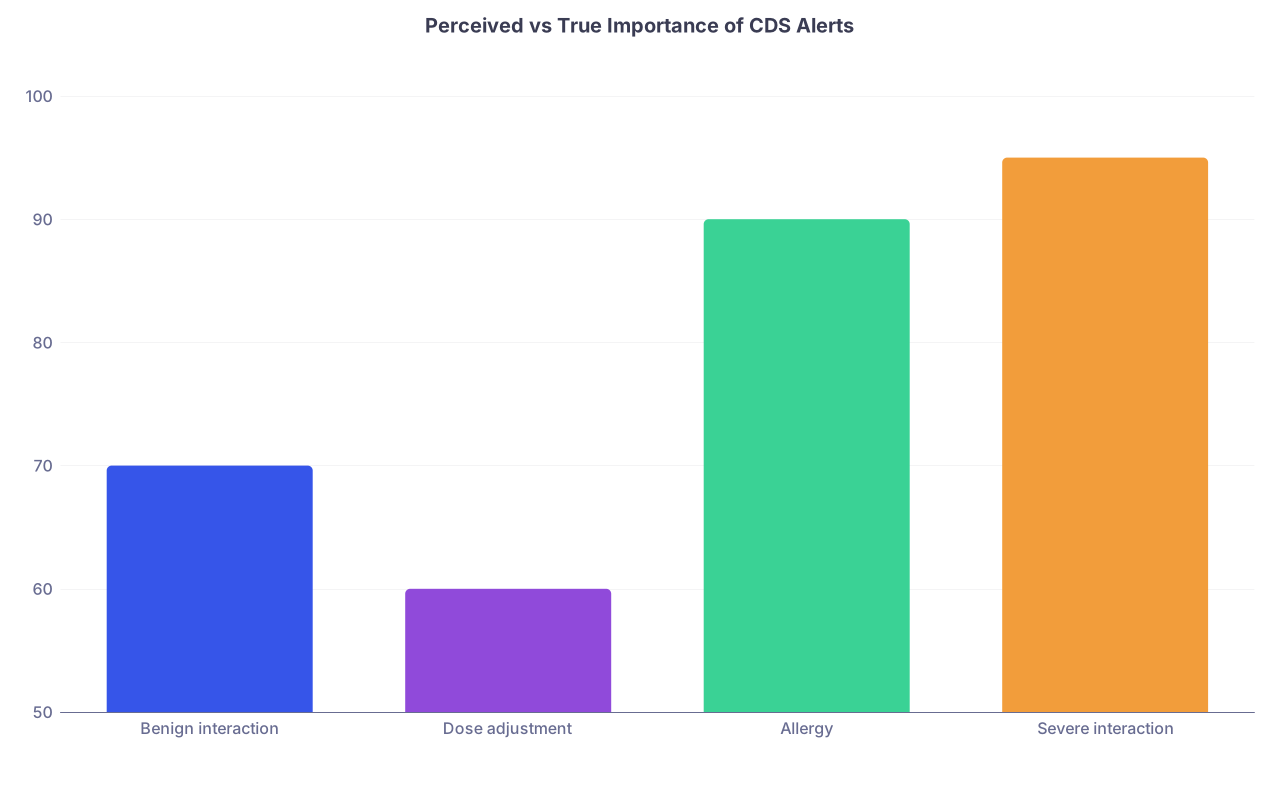
| Category | Value |
|---|---|
| Benign interaction | 70 |
| Dose adjustment | 60 |
| Allergy | 90 |
| Severe interaction | 95 |
In one large health system, I watched override rates climb into the 90–95% range for some alert categories. When nearly every pop‑up is noise, your brain treats all pop‑ups as noise—including the one that actually matters.
Here is the pattern:
You get hammered with irrelevant alerts:
- Creatinine 1.2 “renal dosing” alerts in young healthy patients
- Duplicate therapy warnings for combination drugs you intentionally prescribed
- Low‑value drug interaction warnings for combinations with trivial clinical impact
You speed up:
- Auto‑click “Override” to get through your day
- Stop reading the reason text
- Mentally classify alerts as administrative obstacles, not clinical warnings
Then the rare, critical alert fires:
- “Potential fatal QT interaction: droperidol + sotalol”
- “Heparin order in patient with platelet count 20K and history of HIT”
- “Massive acetaminophen dose in low‑weight child”
And you clear it like all the others.
This is how good clinicians make catastrophic, career‑changing mistakes.
Do not tell yourself, “I will slow down when it is important.” That is not how cognition under time pressure works. Once you are conditioned to dismiss, you dismiss.
How to protect yourself from alert fatigue:
Identify 2–3 categories of alerts you always read fully:
- Severe drug‑drug interactions
- Allergy alerts
- Renal/hepatic dosing in critically ill or frail patients
Ask your informatics or IT team to:
- Turn down or remove low‑value alerts. If you keep seeing the same useless ones, report them—repeatedly.
- Customize severity tiers. Not every minor interaction needs a red stop sign.
Build a simple habit:
When an alert is red, pause. Count to two. Read the bolded text. Then decide.
If you click through everything, you are not using CDS. You are defeating it—and setting yourself up to take the full blame when something goes wrong.
3. You Miss Rare But Critical Diagnoses That CDS Is Bad At Catching
There is a quiet, dangerous expectation among some new attendings: “If this were something serious, the sepsis tool / chest pain algorithm / stroke pathway would pick it up.”
This is fantasy.
CDS does well with pattern recognition for common, clear‑cut situations: classic sepsis labs, textbook pulmonary embolism risk stratification, simple antibiotic choices. It performs poorly when:
- Data are incomplete or not yet documented
- The presentation is atypical
- The diagnosis is rare, nuanced, or primarily clinical
Think about:
- Spinal epidural abscess in a young IV drug user with “back pain and fever” triaged to musculoskeletal complaints
- Necrotizing fasciitis in an obese diabetic with “cellulitis” and minimal early skin findings
- Aortic dissection in a 40‑year‑old with chest pain and “normal” ECG
These cases are not caught by elegant pop‑ups. They are caught by your index of suspicion, your willingness to be the paranoid one in the room, and your memory of “that one case” that went bad.

The subtle CDS trap:
You subconsciously downgrade your concern when the system is quiet.
- No sepsis alert? Maybe it is just a viral syndrome.
- No PE risk prompt? Maybe the pleuritic pain is musculoskeletal.
- No acute coronary syndrome pathway suggestion? Maybe this is GI.
That is backwards. The system should never set the upper bound of your concern. Your clinical suspicion should.
Protective habits:
On every potentially serious presentation, ask yourself:
- “What is the worst thing this could be?”
- “What would I regret missing on this visit?”
Write that differential into your note even if CDS is silent.
Decide on one high‑risk rule you will follow religiously without waiting for CDS:
- Any fever + neuro deficit → consider CNS infection
- Any chest pain + neuro symptom → consider dissection
- Any immunosuppressed patient with vague complaints → consider sepsis, opportunistic infections
When something terrible gets missed, it will not matter that the CDS did not fire. The question will be: “Why did you, as the physician, not consider it?”
4. You Blindly Follow Order Sets That Are Wrong For This Patient
Order sets and pathways are sold as standardization tools that “improve quality and efficiency.” Sometimes they do. Other times, they are Trojan horses for over‑testing, over‑treating, and ignoring patient individuality.
The mistake is subtle: you start using order sets as default decisions rather than default starting points.
I have seen:
- Full sepsis bundles used in DNR‑comfort patients who clearly did not want vasopressors or ICU care, but someone clicked the “sepsis order set” anyway.
- Massive cardiac enzyme and imaging panels ordered on clearly non‑cardiac chest pain because “it is in the chest pain set.”
- Broad‑spectrum antibiotics ordered inappropriately from an ED pneumonia set for a patient with simple viral bronchitis.
The system is nudging you. Hard.

| Step | Description |
|---|---|
| Step 1 | Patient arrives |
| Step 2 | Pick common order set |
| Step 3 | Auto add all default orders |
| Step 4 | Unnecessary tests and meds |
| Step 5 | Remove irrelevant items |
| Step 6 | Customized care |
| Step 7 | Stop and review? |
Order sets are built for:
- “Average” patients
- Billing convenience
- Throughput
- Compliance metrics
They are not built for:
- The patient who has explicitly refused aggressive interventions
- The frail person with multiple comorbidities where “standard” therapy is dangerous
- The nuanced scenario not covered by a neat guideline
Red flags you are over‑relying on order sets:
- You routinely use the phrase “That is just what the order set does” when questioned.
- You feel mildly uncomfortable removing items from an order set, as if you are breaking a rule.
- Nurses or pharmacists point out that you ordered something odd, and your first thought is “But it was in the set,” not “Does this actually make sense?”
To avoid this trap:
Before signing an order set, skim the entire list and deliberately:
- Remove at least one item that is not clearly necessary. This forces you to think.
- Check for any conflicts with patient goals (DNR, hospice, palliative focus).
For high‑stakes order sets (sepsis, ACS, stroke), build a mental checklist:
- “Is this patient truly a candidate for the full bundle?”
- “Are there any strong reasons to individualize care here?”
Document intentional deviations:
- “Standard sepsis bundle modified due to patient DNR and preference for no ICU care; limited to fluids and antibiotics only.”
When something goes wrong, the defense “I used the standard order set” will not impress anyone. The question becomes: “Did you critically apply it to this patient?”
5. You Underestimate The Legal, Regulatory, And Job Market Fallout
The final backfire is the one people rarely think about until it is too late: how over‑reliance on CDS can wreck your career prospects, not just your clinical day.
Hospitals, insurers, and plaintiff attorneys are increasingly sophisticated about informatics footprints. They can see:
- Which alerts fired
- Whether you overrode them
- How often you deviate from pathways
- Whether your practice pattern matches or deviates from peers
| Area | How It Backfires When You Over-Rely on CDS |
|---|---|
| Malpractice | Overrides and ignored warnings used as evidence of negligence |
| Peer Review | “Outlier” behavior vs pathways flagged for remediation |
| Credentialing | Pattern of poor documentation around CDS decisions scrutinized |
| Job Market | Reputation as “high‑risk” physician spreads within systems |
| Quality Metrics | Blind adherence to metrics over clinical sense hurts outcomes |
Think about two situations:
You ignore a critical drug interaction alert and harm occurs.
That override click is time‑stamped and pulled into discovery. A plaintiff attorney will put the screenshot on a huge screen in front of a jury. “Doctor, why did you proceed despite this clear warning?”You follow a pathway that is clearly inappropriate for this patient.
Maybe the sepsis bundle pushes harmful fluids in a patient with florid heart failure. The defense “the system told me to” sounds weak when every expert witness says, “No reasonable physician would have done that here.”
You get hit from both sides:
- Ignore CDS → “You were reckless and ignored safety systems.”
- Follow CDS blindly → “You failed to exercise independent clinical judgment.”
Over‑reliance means you live in the worst of both worlds.
Post‑residency, this has real economic consequences:
- Credentialing committees will flag frequent safety events tied to your decisions—even if “the system” was part of it.
- Employed positions in large health systems will quietly pass on applicants with a reputation for poor judgment or repeated CDS‑related incidents.
- Quality bonus structures and RVU incentives can be withheld when your care is either out of bounds or blindly guideline‑driven to the point of bad outcomes.
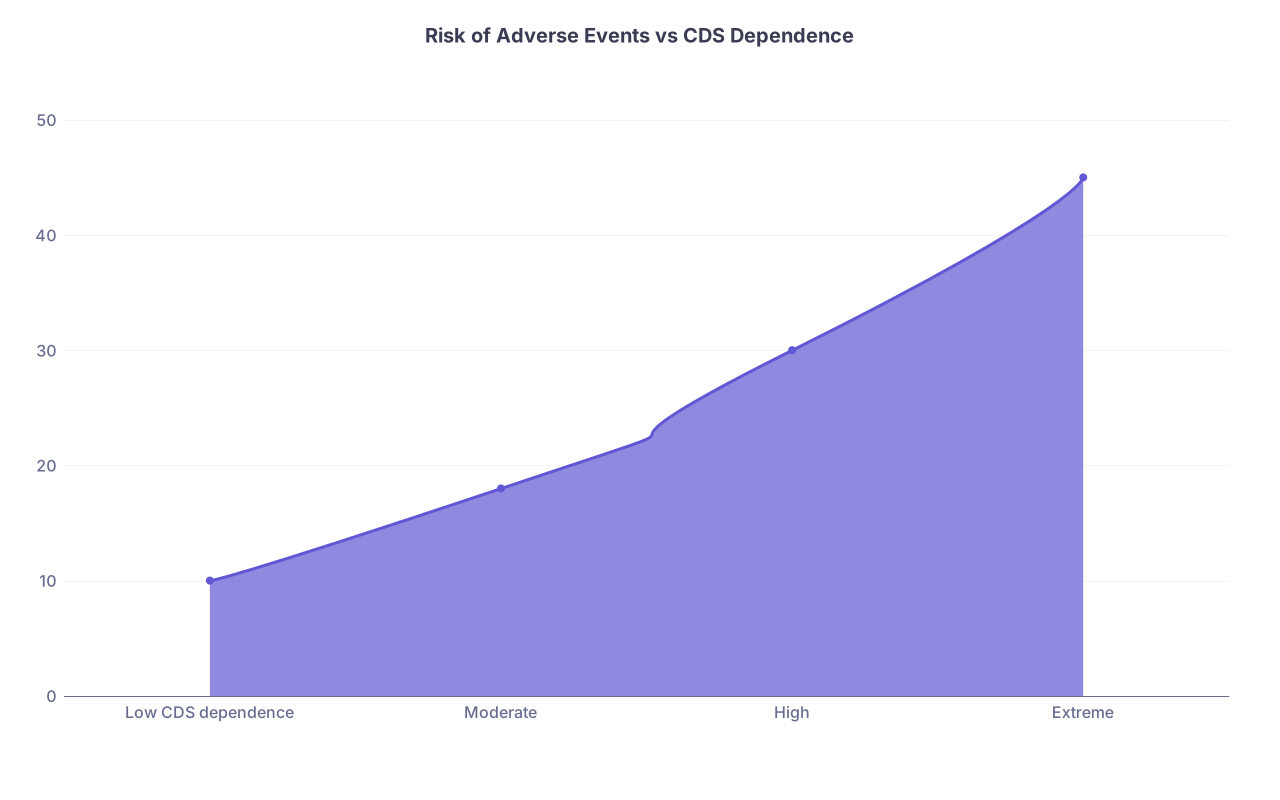
| Category | Value |
|---|---|
| Low CDS dependence | 10 |
| Moderate | 18 |
| High | 30 |
| Extreme | 45 |
The more you depend on CDS to think for you, the more fragile you become. One system upgrade, one algorithm change, one flawed alert configuration—and suddenly your practice is generating nonsense orders and dangerous omissions. Under your name.
Practical protections for your career:
Ask about CDS governance when you interview for jobs:
- Who tunes alerts?
- How often are order sets updated?
- Is there a mechanism for clinicians to request changes?
Keep a short log (even personal, de‑identified) of cases where CDS was wrong and you overrode it with good outcome. This:
- Keeps your critical thinking sharp.
- Gives you concrete examples for peer review or job interviews of exercising independent judgment.
When CDS contributes to an error in your group, volunteer (once the dust settles) to be involved in the fix. It shows you are proactive, safety‑minded, and not blindly trusting the system.
How To Use CDS Without Letting It Use You
You do not need to become a Luddite or go full paper‑chart nostalgia to protect yourself. You just need disciplined boundaries.
Here is a simple three‑rule framework I give to new attendings:
CDS can prompt, but it cannot decide.
If the system suggests something outside your gut sense, pause and make the decision consciously—do not just submit.Silence from CDS is not reassurance.
If you are worried, you are worried. Lack of an alert does not mean “safe.”Your note must show your brain, not the system.
Do not let your documentation read like a regurgitated pathway. Show that you weighed options, considered exceptions, and tailored care.
And one more, blunt rule:
If you would be embarrassed to say, “I just followed what the computer said” in front of a morbidity and mortality conference, then do not let that be your actual defense in real life.

FAQ (Exactly 4 Questions)
1. Is it ever defensible to follow CDS recommendations even if I feel mildly unsure?
Yes, but only if you can articulate a reasonable clinical basis beyond “the system suggested it.” Mild uncertainty is normal. The key is that you consciously evaluate the recommendation: does it fit the presentation, comorbidities, and goals of care? If your justification is clinically sound and aligns with accepted guidelines, following CDS is defensible. Blind acceptance without your own reasoning is what gets you in trouble—both clinically and legally.
2. How do I balance productivity pressures with taking time to read alerts carefully?
You will not survive if you try to analyze every trivial alert. The fix is triage, not martyrdom. Identify which alerts are truly high‑risk (allergies, severe drug interactions, dangerous doses, key lab abnormalities) and commit to reading those every time. Work with your IT/informatics team to reduce or eliminate low‑value alerts. You are not being “difficult” by demanding smarter alerts; you are protecting both patient safety and your workflow.
3. What should I document when I override CDS suggestions?
You do not need an essay. One concise sentence explaining your rationale is usually enough. For example: “CDS suggested renally dose‑reduced antibiotic; maintained standard dose due to life‑threatening infection and close monitoring planned.” Or “Sepsis bundle not fully applied due to patient DNR and preference to avoid ICU care.” The goal is to show that your override was thoughtful, not impulsive or careless.
4. How can I evaluate a new job or hospital for dangerous CDS culture before I sign?
Ask pointed questions during interviews and site visits. Request to see sample order sets in your specialty. Watch how attendings and nurses interact with alerts—do they complain about constant nonsense pop‑ups? Is there a clear process to request changes to CDS, and does leadership actually listen? If everyone says, “We just click through those; it is the only way to get work done,” treat that as a warning sign. A place that tolerates broken CDS will happily let you take the fall when the inevitable error occurs.
Open your last 10 notes and pick 3 patients where you followed CDS or an order set. For each, write a one‑sentence justification—in your own words—of why that decision made sense for that patient. If you struggle, that is your signal: you are leaning too hard on the system and not enough on your own clinical judgment.