
Last week a brand‑new attending told me, “I’m more scared of looking stupid with the hospital’s AI tools than I was of my first solo code.”
She’d just finished residency, survived nights on call, terrifying airways… and now her biggest fear? Clicking the wrong button in the new “clinical decision support AI” and exposing that she has no idea what it’s actually doing.
If that sounds even a little like you, you’re not alone. And you’re definitely not the only one quietly pretending to understand these tools while your stomach knots up.
The fear under the surface: “Everyone else gets this but me”
Let me say the thing you probably won’t say out loud: AI in medicine? Most people are faking how much they understand.
You’re worried that if you admit confusion about an AI tool:
- Your partners will think you’re behind or “not tech savvy”
- Your department chair will mentally dock you as “not future‑ready”
- Admin will label you as resistant, difficult, or “not adaptable”
- You’ll get quietly passed over for some tech‑related leadership role you might want later
And under all of that, the real horror story:
You miss something in the AI output because you were too scared to ask how it works, and now it’s tied to a bad outcome. Malpractice, M&M, all of it.
That fear is rational. You’ve seen people get shredded at M&M for not knowing “basic” stuff. You’ve watched pompous tech people throw around terms like “transformer models” and “ROC curves” like everyone else is supposed to keep up.
So you sit in the EMR training, half‑listening, half‑panicking, nodding along while thinking:
“I don’t actually know what this thing is doing.”
“Can it see all of my notes?”
“Is it safe to use for this decision?”
“Am I supposed to document that I used it?”
And the worst:
“I should know this already. If I ask now, I look incompetent.”
Let me be blunt: pretending you understand an AI tool is more dangerous than admitting you don’t.
Reality check: almost nobody really understands these tools
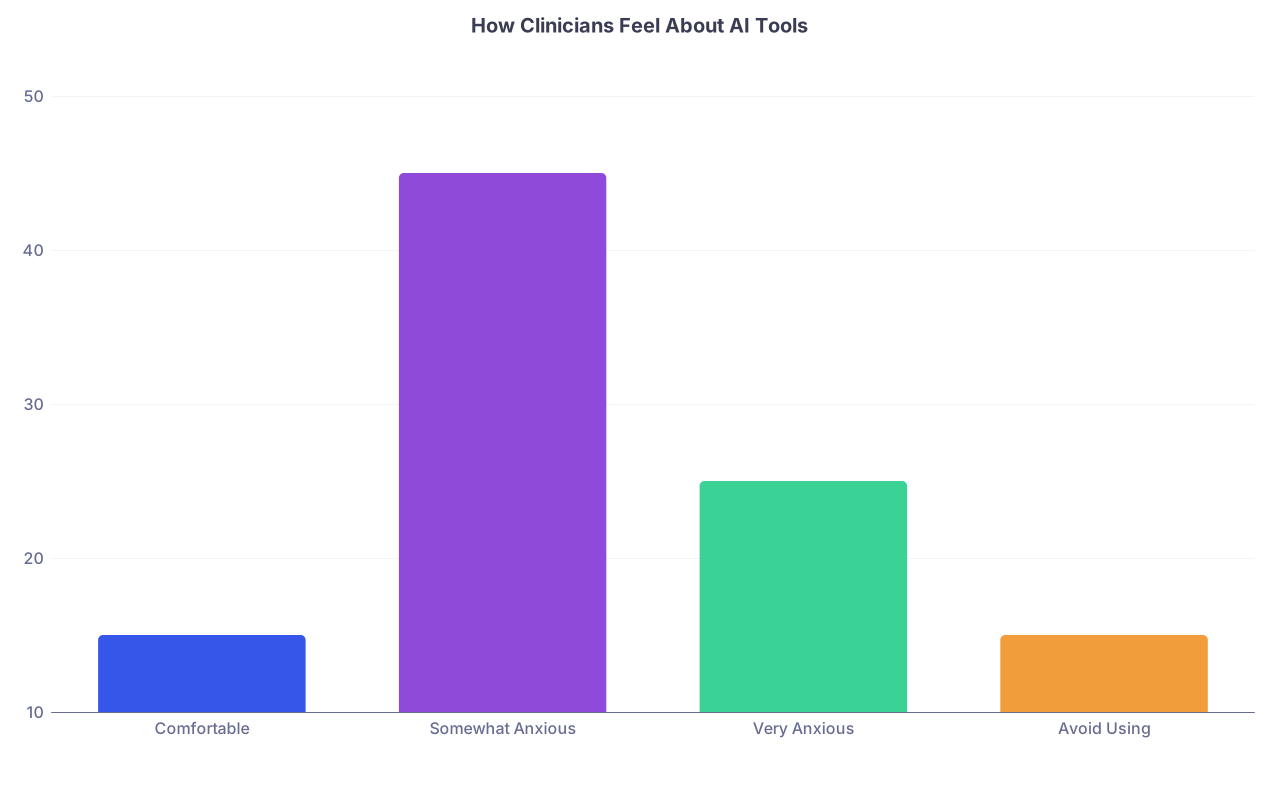
| Category | Value |
|---|---|
| Comfortable | 15 |
| Somewhat Anxious | 45 |
| Very Anxious | 25 |
| Avoid Using | 15 |
I’ve watched attendings, fellows, even seasoned department heads:
- Stare blankly at an “AI risk score” box in the EMR
- Ask, privately, what “black box model” actually means
- Whisper, “So… is this thing actually FDA‑approved or just slapped onto the chart?”
There are maybe three groups of people in your hospital:
- The AI vendor or IT folks, who understand the system technically but don’t practice clinical medicine
- The rare tech‑nerd clinician who actually read the white paper and plays with model outputs for fun
- Everyone else, which is… basically all of us. Trying to pretend we’re in group 2.
You’re in group 3. That’s not a moral failing. That’s normal.
The dangerous move isn’t being in group 3. The dangerous move is acting like you’re in group 2 when you’re not.
Why it feels so risky to admit “I don’t understand this”
There’s a special flavor of shame that comes after residency. You’re “the doctor” now. You’re supposed to know.
So the script in your head goes like this:
- “If I say I’m confused about an AI tool, they’ll think my clinical judgment is weak.”
- “I just finished training in 2024—aren’t we supposed to be the ‘AI‑generation’?”
- “Younger residents probably get this; I’ll look old and out of touch even if I’m 31.”
- “I made it through EMR transitions, I should be able to handle this too, right?”
Here’s the twist: leadership and risk management are more worried about quiet confusion than open questions. Silent compliance is where legal and safety nightmares come from.
So the safest thing—for patients and for your career—is actually asking. The trick is asking in a way that:
- Protects your reputation
- Signals that you care about safety and standards
- Frames you as thoughtful, not clueless
That’s what I’ll walk you through.
Safe scripts: how to ask about an AI tool without sounding “dumb”
Think of this as a set of pre‑written lines you can steal. You’re not going to say, “I don’t understand this at all, please help.”
You’re going to sound like a careful attending doing due diligence.
1. When you’re in a group training or meeting
You’re worried: “If I ask here, everyone will remember that I didn’t know.”
Use safety and governance language. Nobody argues with that.
You can say:
- “Can you walk through a concrete example of when the AI is not reliable, so we’re clear on its limitations?”
- “How should we document in the chart when the AI recommendation differs from our clinical decision?”
- “Who’s reviewing performance metrics on this tool, and how often? Are those reports shared with clinicians?”
- “For medico‑legal purposes, is there a policy on how heavily this tool should weigh into decisions?”
Notice what these do. They don’t say: “I don’t get it.”
They say: “I care about safety, accountability, documentation.”
That’s not perceived as ignorance. That’s leadership.
2. When you’re one‑on‑one with IT, the AI vendor, or a “super user”
Here’s where you can be more direct, but still look sharp.
Lines to use:
- “Clinically, here’s my concern: in [your specialty], nuance matters. What does the model actually see and what does it ignore?”
- “If I disagree with the AI output, is that captured anywhere? Or is there a way to flag questionable suggestions?”
- “On a practical level, if I have 90 seconds in a busy clinic, what’s the minimal safe way to use this tool?”
- “Can you show me, click‑by‑click, how you’d use this on a complex patient, not just the canned demo case?”
You’re still not yelling, “I’m confused.” But you are getting actual, usable understanding.
What you must understand before you trust any medical AI
There are a few non‑negotiables. If you don’t know these, you shouldn’t be blindly using the tool. Period.
| Question Area | Example Question You Can Ask |
|---|---|
| Purpose | What specific decision is this AI meant to support? |
| Data Sources | What data from the chart does it actually use? |
| Validation | Has this been validated in our patient population? |
| Limitations | In what scenarios is this tool likely to be wrong? |
| Oversight | Who monitors performance and handles issues? |
You can literally bring this mental checklist into any meeting:
What is this tool actually for?
Not the marketing phrase. The real answer. Triage? Risk prediction? Drafting notes? Prior‑auth letters?What data does it see and depend on?
Is it using structured fields only? Free text? Radiology notes? Past encounters from other institutions?How was it validated?
You don’t need statistics prowess. Just ask:
“Was this tested on patients like ours—in this hospital, with similar demographics?”When is it wrong or not meant to be used?
“What are the top two situations where you’d tell a clinician not to rely on this?”Who’s responsible if it misfires?
Asking this can feel confrontational. But you can soften it:
“From a risk perspective, how are we expected to integrate this with our own judgment?”
Those questions aren’t naive. They’re exactly what a cautious, competent attending should be asking.
How to push back without sounding “anti‑technology”
Your nightmare scenario: you raise concerns and get labeled “the difficult one” or “anti‑AI,” and that spreads.
You don’t need to be anti‑AI. You just need to be pro‑patient and pro‑safety.
Here’s how to phrase pushback safely:
Instead of:
“I don’t trust this AI thing.”
Say:
“I’m comfortable using this as one input, but I’m not comfortable with it being treated as a directive without clearer guardrails.”
Instead of:
“This seems dangerous.”
Say:
“From a safety standpoint, I’m worried about over‑reliance in edge cases. Can we define what appropriate use looks like in policy?”
Instead of:
“No way, I’m not using this.”
Say:
“I’ll start using it once I’ve seen some local performance data and had the chance to review a few misclassified cases.”
This frames you as a rational skeptic, not a Luddite.
Private learning: how to catch up without public humiliation
You might be thinking, “Fine, I’ll ask ‘smart’ questions. But I still feel behind.”
Okay. Here’s how to learn without making yourself a spectacle.
1. Treat it like a new procedure
You didn’t learn central lines by reading the entire Seldinger technique literature before touching a kit. You watched someone, then tried, then debriefed.
Do the same here:
- Ask a trusted colleague: “Can I sit with you for 10 minutes and watch how you actually use this on your patients?”
- Then flip it: “Watch me use it once and tell me if I’m missing anything.”
That’s not stupid. That’s normal professional behavior.
2. Do a low‑stakes sandbox run
If the tool allows it, practice on test patients or old charts where you already know the outcome.
Ask IT or the vendor:
“Is there a demo environment where I can see what it would’ve done on past cases?”
That gives you a feel for its blind spots without risking anyone’s life—or your license.
3. Look for short, clinician‑focused resources
You don’t need a machine learning course. You need just‑enough context.
You’re looking for things titled like:
- “AI in Radiology: What Attending Physicians Need to Know”
- “Using GPT‑based Tools Safely in Clinical Documentation”
Anything aimed at sysadmins or data scientists? Ignore. It’s not your job.
The career angle: will asking questions hurt you in the job market?
You’re post‑residency, trying to not screw up your first attending job, maybe thinking about leadership later. So the paranoia kicks in:
“If I’m the person asking all the ‘but how does it work’ questions, will they see me as high‑maintenance?”
Here’s how this actually plays out in real hospitals:
- Admin notices who can speak coherently about both clinical reality and tech limitations
- Those people end up on AI governance committees, documentation standards groups, task forces
- That looks like “leadership potential” on your CV, not incompetence
You can even flip the script explicitly:
“AI is being rolled out so fast that I’d rather we slow down and do this right. If there’s any group working on policies or clinician education around this, I’d like to help.”
You’ve just reframed yourself from “lost and confused” to “thoughtful physician leader concerned about implementation quality.”
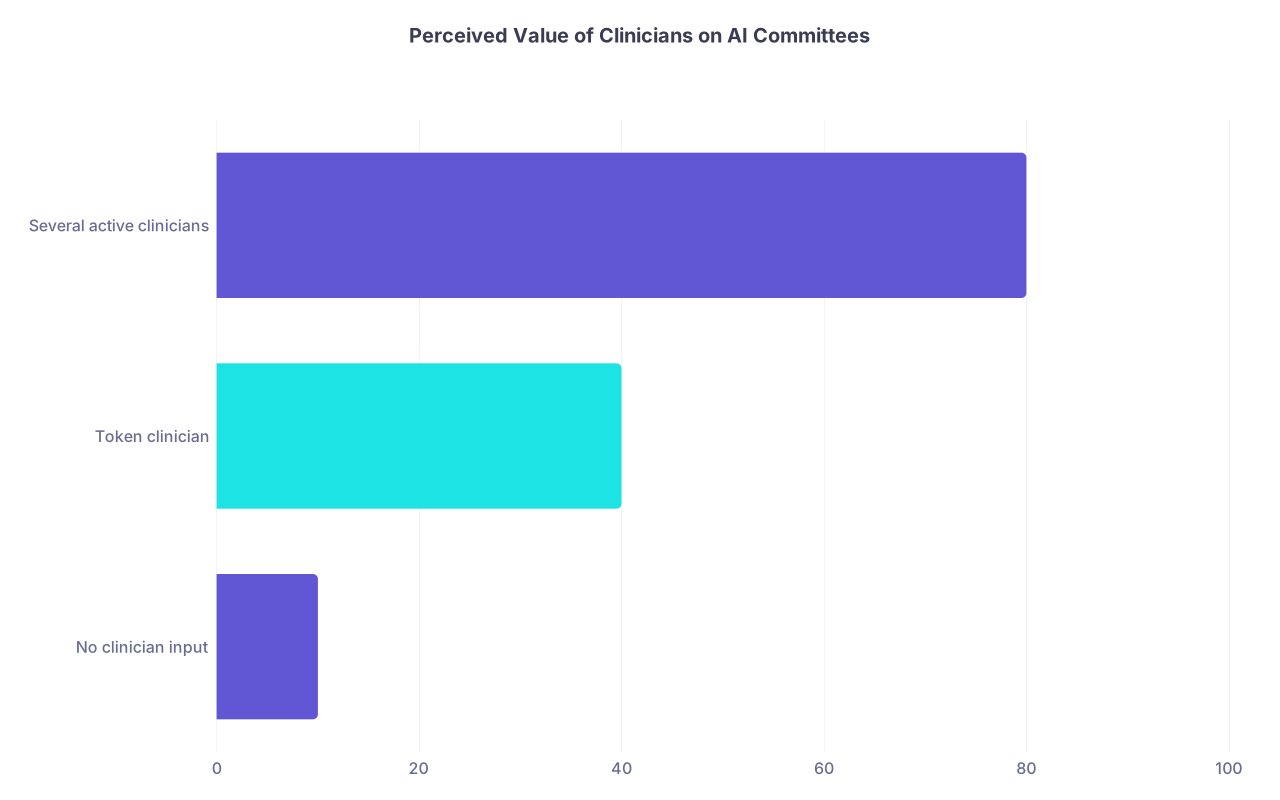
| Category | Value |
|---|---|
| No clinician input | 10 |
| Token clinician | 40 |
| Several active clinicians | 80 |
What to do when everyone else is nodding and you’re panicking inside
You know that conference room moment. Admin or the vendor finishes their polished demo. They ask, “Any questions?”
Silence. Everyone stares at their phone. You feel your heart pounding because you do have questions.
Here’s a script you can literally reuse:
“Two quick clarifications from a day‑to‑day clinical standpoint:
- Can you summarize in one sentence how we’re expected to use this during a busy clinic or night shift?
- And can you give one example where we should not rely on it, so we don’t overstep?”
Those questions are so reasonable that someone else will exhale in relief because they were wondering too.
If you’re totally frozen, send a follow‑up email afterward:
“Thanks for today’s session. I’m planning to start using [tool name] in my [clinic/ED/ward] work and want to make sure I do it safely. Could you point me toward any brief documentation or examples of best practices for our specialty?”
That’s not stupid. It’s the opposite.
A quick mental model to keep you sane
When you’re about to use—or be judged on—an AI tool, ask yourself three things:
- Do I know what problem this is trying to solve?
- Do I know at least one situation where I wouldn’t trust it?
- Can I explain, in one sentence, how I used (or didn’t use) it for this patient?
If you can answer those three, you’re already safer and more thoughtful than most people just clicking through.
And if you can’t? That’s your internal alarm to ask questions. Out loud.

| Step | Description |
|---|---|
| Step 1 | See AI output |
| Step 2 | Ask for clarification |
| Step 3 | Decide how much to rely |
| Step 4 | Document how AI was used |
| Step 5 | Know tool purpose |
| Step 6 | Know limitations |
FAQ: The stuff you’re probably still worrying about
1. Will my colleagues secretly judge me if I admit I don’t really understand our AI tools?
Some might. Briefly. But here’s what usually happens: you ask one thoughtful question, three people come up afterward and whisper, “I was wondering the same thing.” The loudest “early adopters” often know buzzwords, not details. People respect clinicians who prioritize safety and clarity over pretending.
2. Could asking too many questions make leadership think I’m “not adaptable” or “anti‑tech”?
It depends how you ask. If your questions are framed around patient safety, documentation, medico‑legal risk, and practical workflow, that reads as responsible, not resistant. If you just say, “I don’t trust this” with no specifics, that’s when you get the “difficult” label. Anchor everything to patient outcomes and you’re fine.
3. Is it safer for my career to just quietly avoid using the AI tools?
Honestly? No. Avoiding them entirely can backfire. These tools are being woven into workflows, quality metrics, and sometimes even billing. If something goes wrong and you’re the only one not using the standard tools, that can look equally bad. The safest path is selective, informed use—plus documenting your reasoning when you disagree with the AI.
4. What if I use the AI tool, it’s wrong, and I get blamed?
You’re still the clinician. Courts and hospitals will look at your judgment, not the AI’s. That’s why you should treat AI outputs like consult opinions: to be weighed, not obeyed. Document things like, “AI sepsis risk score: high; clinical assessment: low due to X, Y, Z—will monitor and repeat labs.” That shows you’re thinking, not deferring blindly.
5. I’m terrible with technology in general. Is it realistic to expect I’ll ever feel confident with AI tools?
You don’t need to be a tech person. You need the same skills you already use: pattern recognition, skepticism, and asking the right questions. You learned to use the EMR, PACS, and all the other hospital software you hated at first. AI tools are just one more thing. Start with one use‑case, on your own terms, and build from there.
6. What’s one safe sentence I can use tomorrow when someone asks if I’m using the new AI system?
Use this:
“I’m starting to incorporate it selectively—I treat it like a second opinion and make sure I understand its limitations before I lean on it.”
If you want to sound even more pulled‑together:
“I’ve been asking about how it was validated in our patient population so I know when it’s most trustworthy.”
Open the last email you got about an AI tool at your hospital—training invite, rollout announcement, whatever it is. Hit reply and write one concrete question from this article, something like: “Can you share a brief summary of the tool’s recommended use and its main limitations in our setting?”
Send it. Just that. That single question is you choosing safety—and your own sanity—over silent panic.