
It’s your first month as an attending. You finally have your own patients, your own orders, your own decisions. And instead of feeling powerful, you’re sitting in front of Epic/Cerner/Whatever with that horrible tight feeling in your chest because everyone else types like they’re playing a piano concerto and you’re… still trying to remember where the “sign orders” button is.
You’re staying late, clicking around blindly, praying you don’t accidentally discontinue someone’s anticoagulation while trying to reorder Tylenol. The residents are waiting on you. The nurses are paging you. And you’re staring at this EHR thinking:
“What if I literally can’t keep up? What if this is what breaks me?”
Let’s talk about that. The tech anxiety. The fear you’re going to be exposed as “the slow one” in front of your team. The dread that you’ll be charting until midnight forever.
Because you’re not the only one spiraling about this. Not even close.
The Ugly Fear: “I’m Too Slow for Modern Medicine”
Here’s the core nightmare, right?
You’re imagining this future where:
- Everyone else finishes notes by 5. You’re still on admission #2.
- You sign out and then stay 2 hours late just to finish documentation.
- You get labeled as “inefficient,” “disorganized,” or worse, “unsafe.”
- Admin starts tracking your RVUs and notes and silently puts a star next to your name: problem child.
And there’s that extra shame-layer: you’re supposed to be the attending now. The person who knows how to do things. You used to be the resident making jokes about “old attendings who can’t use the EHR” and now you’re like… oh. That’s me. Except you’re not old. You’re just new. And exhausted.
And you start wondering: Is it possible to be clinically good and still fail at this because I can’t click fast enough?
I’ve seen that exact fear melt people down. Residents in their last month, almost in tears: “What if I can’t keep up with the EHR as an attending?” Not because they’re lazy. Because they know as an attending, nobody is buffering for you anymore.
Let me be blunt: EHR speed feels like life or death when you start. But it’s skill, not destiny. And right now, your brain is confusing “new” with “defective.”
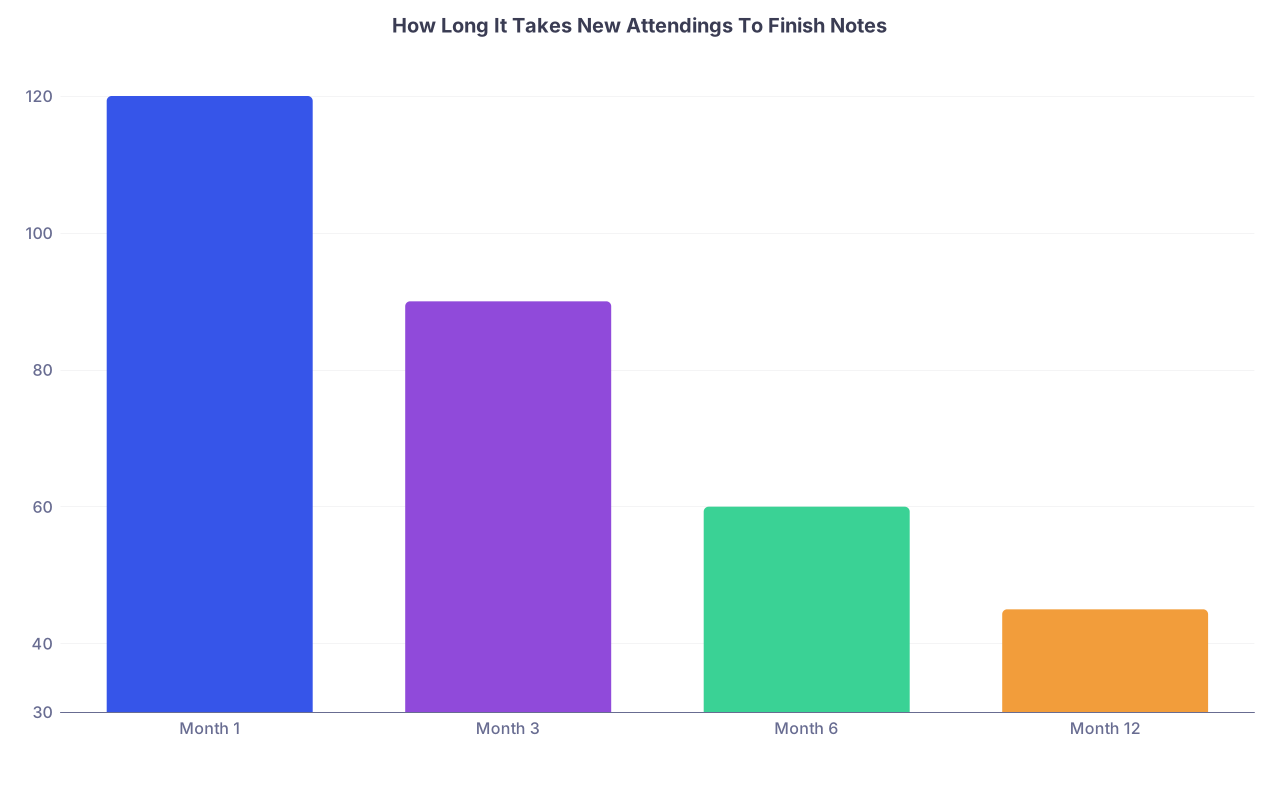
| Category | Value |
|---|---|
| Month 1 | 120 |
| Month 3 | 90 |
| Month 6 | 60 |
| Month 12 | 45 |
The Reality Behind EHR Competence (That Nobody Admits Out Loud)
Here’s what you’re not seeing when you compare yourself to that attending who seems to fly through notes in seconds.
They didn’t magically “get good with computers.” They did three things:
They suffered through a painful learning curve early. They asked questions. And they built a ridiculous number of shortcuts.
Most “fast” attendings have:
- Saved phrases for EVERYTHING: H&P skeletons, ROS, physical exam, discharge instructions, standard counseling, post-op checks, chronic disease follow-ups.
- Shortcut tricks burned into muscle memory: dot phrases, quick orders, preference lists, recent orders, templated macros.
- Years of repetition. Same clinic, same order sets, same conditions. It’s not genius. It’s repetition.
You? You’re still at “Where the hell is that button?” of the curve. And that makes your brain tell you a story: “Everyone is built for this except me.”
No. You’re just early.
I’ve watched brand new attendings in July look like they’re drowning. By October, same person is finishing most documentation by end of day. Not because their “tech IQ” improved. Because they finally made the EHR work for them instead of clicking like a lost intern every single time.
The part that’s messing with you is that nobody narrates this out loud. People flex how fast they finish notes, but nobody tells you about the three miserable months it took to figure it out.
Worst-Case Scenarios You’re Imagining (And What Actually Happens)
Your brain is probably running a horror show. Let’s drag some of those out into the light.
“What if I get called out by admin for being too slow?”
Could happen. Not usually in month 1–3. Early on, most systems expect you to be slower. They know attendings ramp up over months.
What’s more common?
You feel it before they do. You feel behind. You feel ashamed about being the last car in the parking lot. You create this story that “someone is tracking this and judging me.”
Sometimes admin does start to notice if:
- Your billing is repeatedly incomplete.
- Your notes aren’t closed for days.
- Your inbox backs up and labs aren’t acknowledged.
But that’s not “you’re hopeless with tech.” That’s a workflow problem. Fixable with structure and help, not some magical personality transplant.
Actual conversation I’ve heard from a department chair about a slow new attending: “Yeah, she’s behind on her notes. We’re pairing her with Carol for a few weeks to go over templates and workflow.” Nobody was saying, “We need to fire her, she can’t handle the EHR.”
Is there pressure? Yes. Catastrophic punishment because you’re slower at month 2? Not how it usually plays out.
“What if I miss something dangerous because I’m fumbling around the chart?”
This fear is very real. You’re clicking, trying to reconcile meds, and you’re terrified you’ll overlook a critical detail buried in a different tab.
Here’s the truth: everyone misses things sometimes. Even the “fast” ones. The EHR is designed in a way that practically guarantees that.
But being slow is not the risk factor you think it is. Rushing is. Being overloaded is. Multitasking while juggling five pages at once is.
You being extra deliberate while you’re new? That’s safer than you think.
You can build guardrails:
- Standard routines: Always check home meds in the same place. Always scroll labs down to X date. Same pattern every time.
- Ask nurses/pharmacists to double-check high‑risk stuff (anticoagulation, insulin, chemo, complex med histories).
- Use alerts and flags — even if they’re annoying — as a safety net, not an insult.
You’re not unsafe because you’re slow. You’d be unsafe if you were fast and sloppy. And you’re clearly not that person or you wouldn’t be reading this.

“What if the residents lose respect for me?”
They might be faster. They’ve been the power-users of the EHR for years. They’re used to doing everything by computer.
They will absolutely notice if you’re slower.
What they care about more:
- Do you teach them?
- Do you back them with nurses and consultants?
- Do you know medicine and own clinical decisions?
- Do you protect them when things get chaotic?
You don’t have to be the fastest typer in the room to be respected. You have to be the person they’d want on their side when a patient is crumping or a family is losing it in the hallway.
Also, every resident has worked with attendings who literally cannot log into the system without help… and somehow still have fan clubs. Because they’re good doctors and decent humans.
If you’re worried? Be transparent in a calm way: “Hey, I’m still getting my EHR workflow up to speed, so I may be a bit slow on clicks. I’m all ears if you have any favorite shortcuts.” That actually earns respect, not loses it.
Very Practical Ways to Stop Drowning in the EHR
I’m not going to say “it’ll all be fine” and leave you with vibes. You need concrete things you can do so you’re not crying into your keyboard at 8 pm.
1. Ruthlessly build templates before everything explodes
The worst time to build EHR tools is mid‑clinic or on call. Do it when you’re off, even if you hate it.
You want dot phrases / smart phrases for:
- New patient H&P
- Established follow‑up
- Common diagnoses in your specialty (COPD, CHF, DM2, HTN, post‑op day notes, prenatal visit, etc.)
- Normal exam templates you can modify
- Discharge instructions for your top 10 conditions
Yes, it’s annoying front‑loaded work. But this is the difference between, “I stayed 3 hours late dictating every word manually” and “I’m just editing.”
If your system supports it, steal phrases from a colleague. Most people are surprisingly willing to share.
| Shortcut Type | Impact on Your Day |
|---|---|
| Smart phrases | Cut charting time per patient |
| Preference lists | Faster ordering of common meds |
| Order sets | Reduce missed labs/meds |
| Inbox filters | Prioritize urgent results |
| Macro for exams | Consistent, editable documentation |
2. Find one EHR super‑user and shamelessly beg for help
Every department has that person. The PA who flies through charts. The senior attending who actually likes building templates. The informatics‑leaning fellow.
Ask your chief, director, or a colleague: “Who’s really good with our EHR?” Then do this:
“Can I shadow you for 30–60 minutes while you chart and place orders, just to watch your workflow? I’m specifically trying to speed up my X (inbox, notes, orders).”
You will learn more from that one hour than from ten generic IT trainings.
The key is watching their clicks, not their content. Where do they keep their shortcuts? How do they move between notes, orders, labs without backtracking ten times? What do they never type manually?
Take notes like a med student again. You’re a learner here. That’s fine.
3. Decide when you’ll definitely be done each day
Here’s where your anxiety loves to sabotage you. You tell yourself, “I’ll just stay until it’s all done,” and shocker: it’s never all done.
You will burn out in months if you let EHR work bleed endlessly into your night.
Pick a hard cutoff. For example: “On regular days, I leave by 6:30 pm no matter what.”
That means:
- You prioritize finishing the most important notes before you leave (billing‑critical, complex or high‑risk patients, discharges).
- You accept that something might wait till tomorrow but isn’t unsafe (simple follow‑up note, low‑risk lab that’s already scheduled for repeat).
- If you hit your cutoff and you’re wildly behind consistently, that’s data that your current system doesn’t work — and you need help, not more martyrdom.
You’re allowed to have a line. Admin might not draw it for you. You have to.
4. Learn to tolerate being “good enough” in your notes
A huge hidden cause of EHR slowness? Perfectionism disguised as “being thorough.”
You write notes like you’re turning in a graded assignment. Full sentences. Beautiful paragraphs. Every lab explained. You’re doing a literature review for a SOAP note.
That’s noble. And unsustainable.
The chart is not your magnum opus. It’s a legal document and a communication tool. Not your personal showcase.
Fast attendings do this:
- Template the normal stuff.
- Write precise, focused impressions and plans.
- Skip long narratives that nobody will read.
Ask yourself: “If another physician had to take over, would they know what’s going on and what I’m thinking?” If yes, stop editing.
You’re not going to get a gold star for the prettiest note. You will get your life back if you accept “clear and adequate” instead of “perfect.”
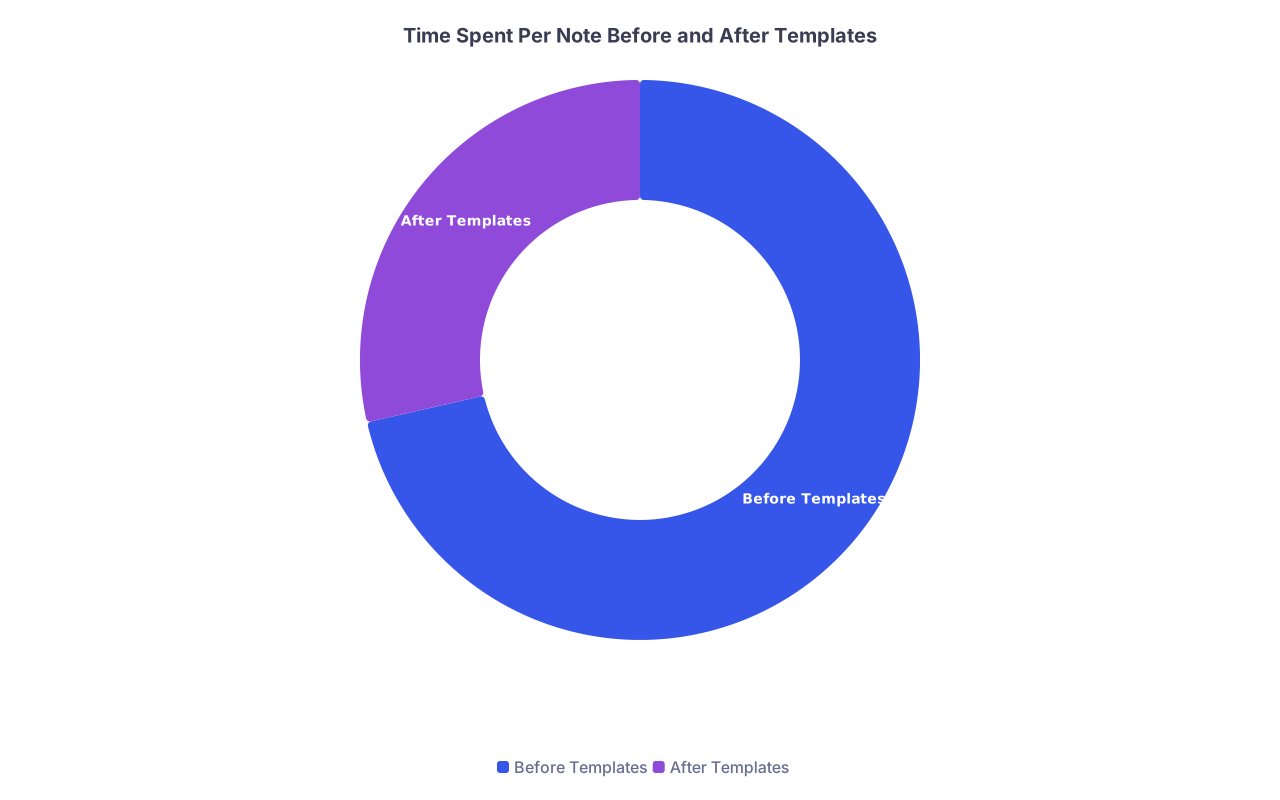
| Category | Value |
|---|---|
| Before Templates | 20 |
| After Templates | 8 |
5. Use non-clinical time strategically, not reactively
If your job gives you admin/“non‑clinical” time, it will disappear instantly into chaos unless you deliberately wall some of it off for two things:
- EHR cleanup (inbox, documentation odds and ends)
- EHR improvement (building templates, learning one new trick, meeting with a super‑user or IT educator)
Most people only use admin time to put out fires. You’ll be permanently barely coping if you do that. You need at least a sliver of time invested in making tomorrow easier, not just surviving today.
Even one hour a week improving your own system is huge. That’s how you quietly go from “I’m drowning” to “I’m… okay, actually” over a few months.
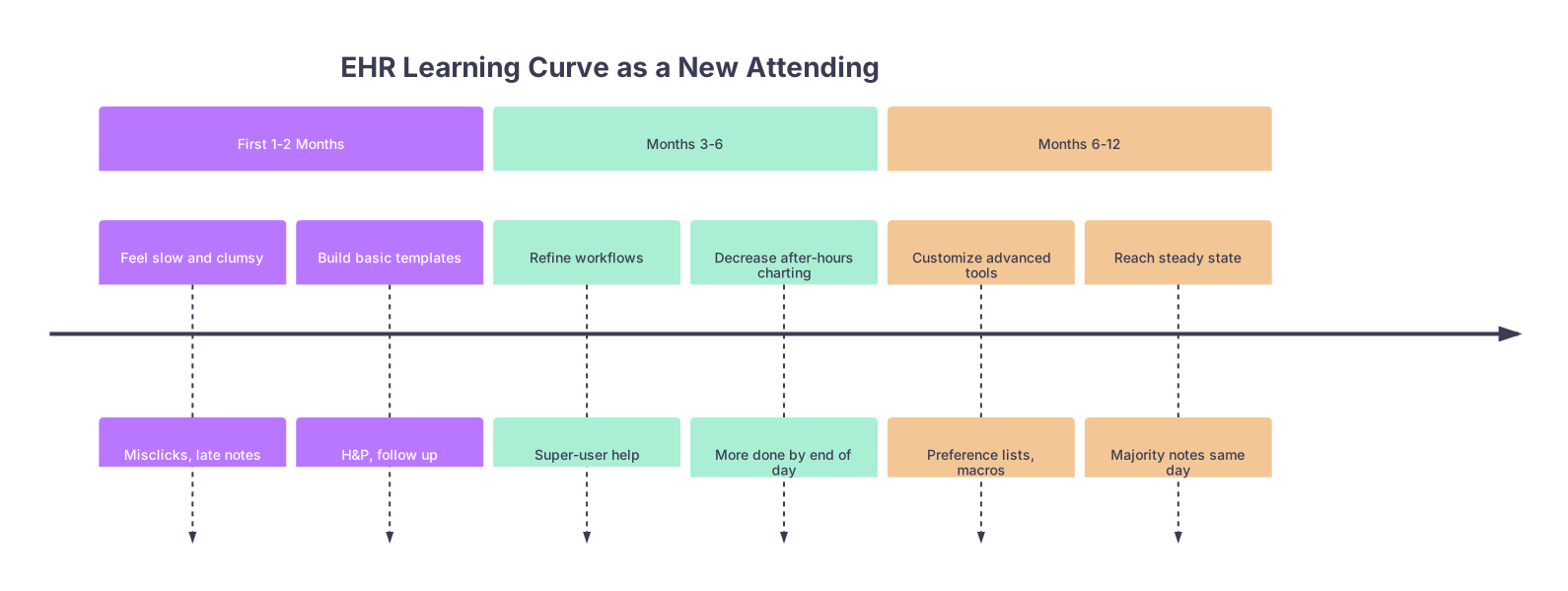
| Period | Event |
|---|---|
| First 1-2 Months - Feel slow and clumsy | Misclicks, late notes |
| First 1-2 Months - Build basic templates | H&P, follow up |
| Months 3-6 - Refine workflows | Super-user help |
| Months 3-6 - Decrease after-hours charting | More done by end of day |
| Months 6-12 - Customize advanced tools | Preference lists, macros |
| Months 6-12 - Reach steady state | Majority notes same day |
And If You Really, Truly Can’t Keep Up?
Let’s entertain your worst fear for a second. You try. You build templates. You get help. And you still feel like you’re not catching up.
That’s not failure. That is a signal.
You might be:
- In a practice model that’s fundamentally hostile to sane documentation (15-min visits, 20+ inbox messages a day, constant overbooking).
- In a system with a terrible EHR build and zero informatics support.
- Doing way too much non‑physician work because nobody protected your role.
That’s not a “you” problem. That’s an environment problem.
And yes, the nuclear option exists: you can change jobs, change settings, pick a practice where the EHR burden is more humane, or where scribes/voice recognition/support staff lighten the load.
I’ve watched multiple early‑career attendings switch from a high‑volume, EHR‑heavy clinic model to a smaller practice, hospitalist gig, or subspecialty role, and suddenly they’re not behind every night. Same person, different system. So no, your current experience isn’t a final verdict on your abilities.
You’re allowed to say, “This setup doesn’t work with my brain” and adjust. That’s not weakness. That’s survival.

FAQ (Exactly the Stuff You’re Afraid to Ask Out Loud)
1. How long does it usually take new attendings to feel semi-competent with the EHR?
Most people are miserable for the first 1–2 months. Around month 3, if they’ve invested in templates and asked for help, they usually stop staying hours late. By 6–12 months, they’re at their personal steady state. You’re not supposed to feel “good” at this in week 3. Feeling clumsy right now doesn’t predict where you’ll be in a year.
2. Is it dangerous if I’m slower at charting? Should I be worried about patient safety?
Being slow is annoying and exhausting, but it’s not inherently unsafe. What’s unsafe is rushed, distracted, fragmented care. Your slowness actually means you’re double‑checking and thinking carefully. Pair that with consistent routines and asking team members (nurses, pharmacists, residents) to verify high‑risk parts, and you’re far safer than the overconfident speed‑clicker.
3. What do I tell my boss if I’m struggling with EHR workload?
Skip the vague “I’m bad at the EHR.” Go specific: “I’m consistently staying X hours late because my documentation and inbox overflow into the evenings. I’d like help streamlining my workflow — maybe time with a super‑user or informatics person, and guidance on documentation expectations.” You’re framing it as a solvable workflow issue, not a character flaw.
4. Should I feel guilty using scribes or voice recognition if others can do it all themselves?
No. Stop romanticizing suffering. If your practice offers scribes, dictation, or extra support and you use it to be more present with patients and less destroyed at home, that’s not cheating. That’s adapting. Plenty of “efficient” attendings are efficient precisely because they offload something. You’re allowed to do the same without apologizing.
5. How do I know if my problem is me vs. a toxic practice environment?
Look at your peers. If everyone is drowning — late notes, weekend charting, constant complaints — that’s the system. If most people are coping and you’re the only one consistently in crisis even after building templates, getting help, and adjusting perfectionism, then your style and that job might be a bad fit. Neither scenario means you’re broken. But the solution is different: in one, you push for systemic change or leave. In the other, you might benefit from coaching, more training, or a different clinical mix.
If you remember nothing else:
- Feeling slow and stupid in the EHR as a new attending is common, not diagnostic of your worth.
- Templates, super‑users, and boundaries around work hours are not optional luxuries; they’re survival tools.
- If you truly can’t keep up even after trying, that’s a sign you may need a different system or practice — not that you’re a failure.